Sri Lanka Carbon Fibre Market Size, Share & Growth Rate
The Sri Lanka Carbon Fibre Market was estimated at USD 466 Million in 2025 and is projected to reach USD 637 Million by 2032, growing at a CAGR of 4.6% from 2026 to 2032. This growth trajectory is underpinned by a rising demand for lightweight and high-strength materials across various sectors, particularly aerospace and automotive. Furthermore, increasing investments in innovative manufacturing processes and sustainable practices will catalyze this expansion, making carbon fibre an essential material in Sri Lankas industrial landscape.
Sri Lanka Carbon Fibre Market Year-wise Growth Rate and Key Drivers
This graph highlights how the Sri Lanka Carbon Fibre Market has steadily grown over the years, supported by major growth factors.
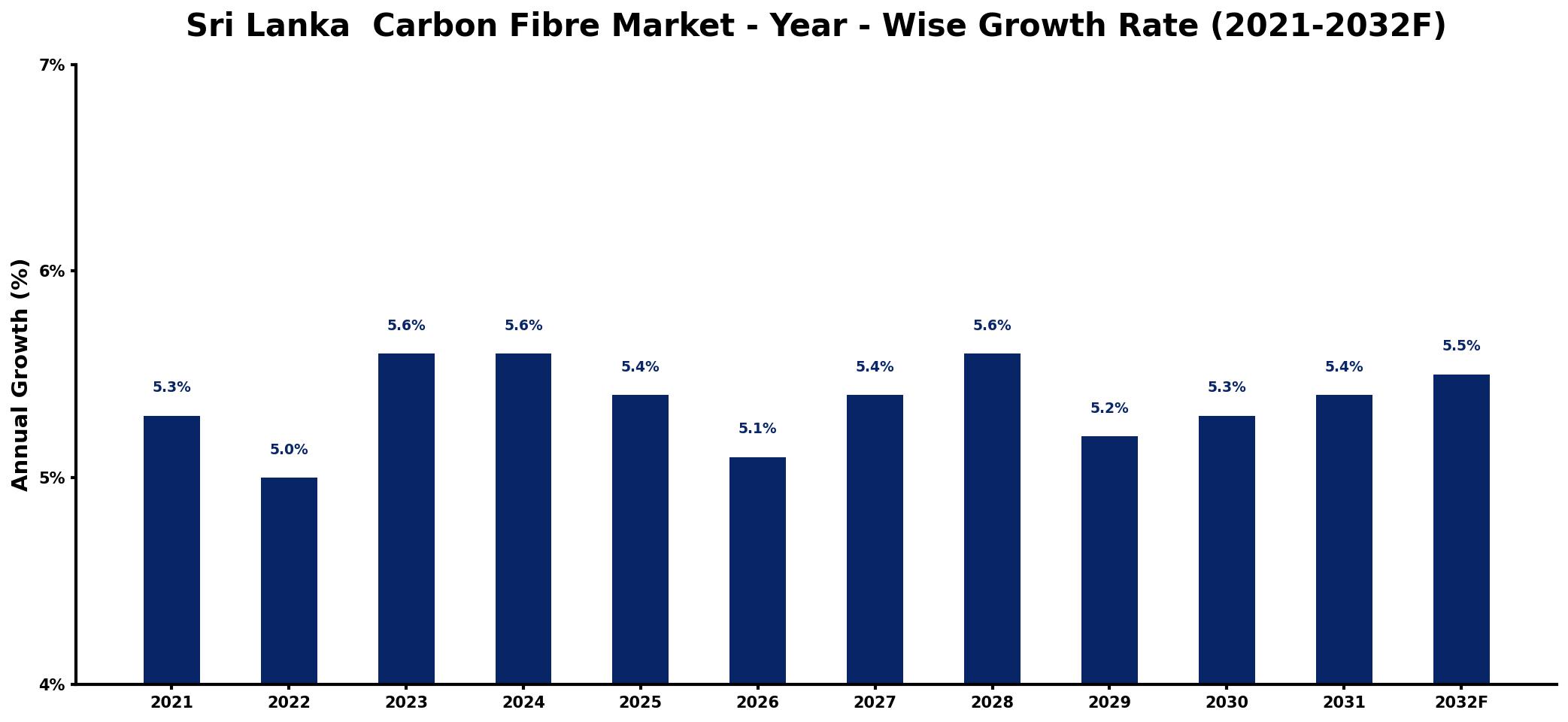
The table below presents the year‑wise growth rates along with the key drivers influencing the market
| Year | Growth Rate | Major Drivers |
| 2021 | 5.3% | Rising demand in automotive sector |
| 2022 | 5.0% | Increased investment in infrastructure projects |
| 2023 | 5.6% | Growth in renewable energy applications |
| 2024 | 5.6% | Expansion of aerospace manufacturing capabilities |
| 2025 | 5.4% | Surge in sporting goods production |
| 2026 | 5.1% | Technological advancements in composites |
| 2027 | 5.4% | Growing interest in lightweight materials |
| 2028 | 5.6% | Increased focus on sustainable solutions |
| 2029 | 5.2% | Emergence of new industrial applications |
| 2030 | 5.3% | Demand from consumer electronics industry |
| 2031 | 5.4% | Strengthening collaborations with manufacturers |
| 2032 | 5.5% | Enhanced research and development initiatives |
Note: Market size estimations and growth projections presented in this report are based on 6Wresearch's proprietary forecasting methodology, utilizing the latest available industry data, government publications, and primary research inputs.
Sri Lanka Carbon Fibre Market Synopsis
The primary force shaping the Sri Lanka Carbon Fibre Market is the escalating demand from multiple industries, notably aerospace and automotive. This demand is fueled by the material's exceptional properties, including its lightweight and high-strength characteristics, which are essential for enhancing efficiency and performance.
Additionally, the sports equipment manufacturing sector is increasingly turning towards carbon fibre due to its advantageous attributes. Innovation and development are further amplified by government initiatives aimed at promoting sustainability, ensuring that carbon fibre remains a focal point for future manufacturing strategies in Sri Lanka.
Sri Lanka Carbon Fibre Market Key Takeaways
- Growing demand for lightweight materials in aerospace, automotive, and sports sectors is driving market growth.
- Government initiatives are fostering a conducive environment for innovation and sustainable manufacturing practices.
- Investments in research and development are essential to overcoming challenges related to production costs and skilled labor shortages.
- The rising awareness of carbon fibre's benefits is contributing to increased adoption across various industries.
- Partnerships with international firms are crucial for technology transfer and enhancing local production capabilities.
Evaluation of Restraints in Sri Lanka Carbon Fibre Market
Despite its promising outlook, the Sri Lanka Carbon Fibre Market faces significant challenges. A notable restraint is the high cost of production, primarily due to the importation of raw materials, which can deter potential manufacturers. Furthermore, there is a general lack of awareness among end-users about the advantages of carbon fibre technology. This, combined with limited domestic production capabilities and a shortage of skilled labor in carbon fibre manufacturing, creates barriers to market growth. Competition from traditional materials, such as steel and aluminum, which are more established, also presents a challenge that must be addressed to unlock the market's full potential.
Sri Lanka Carbon Fibre Market Trends
A significant trend in the Sri Lanka Carbon Fibre Market is the shift towards innovative product development focused on enhancing performance characteristics. Manufacturers are investing in advanced technologies to create composites that cater to diverse industry requirements. There is also a noticeable rise in sustainable manufacturing practices, as companies aim to reduce their carbon footprint and comply with regulatory standards. These trends not only position carbon fibre as a preferred material but also align with global sustainability goals.
Sri Lanka Carbon Fibre Market Opportunities
The Sri Lanka Carbon Fibre Market holds lucrative investment opportunities, primarily due to the increasing demand for high-performance materials. Industries such as aerospace and automotive are actively seeking to incorporate carbon fibre into their production processes, which creates potential for new manufacturing facilities. Additionally, research and development into new applications for carbon fibre, including in construction and renewable energy, presents avenues for growth. Collaborations with local businesses can also enhance market entry strategies, leveraging Sri Lanka's strategic location and skilled workforce.
Government Initiatives in the Sri Lanka Carbon Fibre Market
The Sri Lankan government is taking proactive steps to bolster the carbon fibre market through various supportive policies. These include tax incentives and duty concessions for companies involved in carbon fibre manufacturing. There is also a concerted effort to promote research and development in advanced materials and encourage partnerships between local and international companies to facilitate technology transfer. By focusing on sustainable practices, the government aims to enhance competitiveness, attract foreign investment, and drive innovation within the sector.
Future Insights of the Sri Lanka Carbon Fibre Market
The future of the Sri Lanka Carbon Fibre Market looks promising, with several factors poised to drive growth from 2026 to 2032. The continued demand for lightweight and high-strength materials across various industries will solidify carbon fibre's role in manufacturing. Innovations in production technologies and an increasing focus on sustainability are expected to further propel market expansion. However, addressing existing challenges, such as production costs and awareness, will be crucial in realizing the market's full potential.
Sri Lanka Carbon Fibre Market Latest Developments (2025 - 2026)
Recent industry movements indicate a heightened focus on research initiatives aimed at improving carbon fibre manufacturing techniques. Additionally, strategic collaborations between local firms and international technology providers are emerging, enhancing the competitive landscape. With an eye on sustainability, more companies are adopting eco-friendly practices in carbon fibre production, which aligns with global trends towards greener manufacturing solutions.
Sri Lanka Carbon Fibre Market - Key Attractiveness of the Report
- 10 Years of Market Numbers
- Historical Data Starting from 2022 to 2025
- Base Year: 2025
- Forecast Data until 2032
- Key Performance Indicators Impacting the Market
- Major Upcoming Developments and Projects
Key Highlights of the Report:
- Sri Lanka Carbon Fibre Market Outlook
- Market Size of Sri Lanka Carbon Fibre Market, 2025
- Forecast of Sri Lanka Carbon Fibre Market, 2032
- Historical Data and Forecast of Sri Lanka Carbon Fibre Revenues & Volume for the Period 2022-2032F
- Sri Lanka Carbon Fibre Market Trend Evolution
- Sri Lanka Carbon Fibre Market Drivers and Challenges
- Sri Lanka Carbon Fibre Price Trends
- Sri Lanka Carbon Fibre Porter's Five Forces
- Sri Lanka Carbon Fibre Industry Life Cycle
- Historical Data and Forecast of Sri Lanka Carbon Fibre Market Revenues & Volume By Raw Material for the Period 2022-2032F
- Historical Data and Forecast of Sri Lanka Carbon Fibre Market Revenues & Volume By Pan??based Carbon Fiber for the Period 2022-2032F
- Historical Data and Forecast of Sri Lanka Carbon Fibre Market Revenues & Volume By Pitch??based Carbon Fiber for the Period 2022-2032F
- Historical Data and Forecast of Sri Lanka Carbon Fibre Market Revenues & Volume By Product Type for the Period 2022-2032F
- Historical Data and Forecast of Sri Lanka Carbon Fibre Market Revenues & Volume By Continuous Carbon Fiber for the Period 2022-2032F
- Historical Data and Forecast of Sri Lanka Carbon Fibre Market Revenues & Volume By Long Carbon Fiber for the Period 2022-2032F
- Historical Data and Forecast of Sri Lanka Carbon Fibre Market Revenues & Volume By Short Carbon Fiber for the Period 2022-2032F
- Historical Data and Forecast of Sri Lanka Carbon Fibre Market Revenues & Volume By Fiber Type for the Period 2022-2032F
- Historical Data and Forecast of Sri Lanka Carbon Fibre Market Revenues & Volume By Virgin Carbon Fiber for the Period 2022-2032F
- Historical Data and Forecast of Sri Lanka Carbon Fibre Market Revenues & Volume By Recycled Carbon Fiber for the Period 2022-2032F
- Historical Data and Forecast of Sri Lanka Carbon Fibre Market Revenues & Volume By Modulus for the Period 2022-2032F
- Historical Data and Forecast of Sri Lanka Carbon Fibre Market Revenues & Volume By Standard Modulus for the Period 2022-2032F
- Historical Data and Forecast of Sri Lanka Carbon Fibre Market Revenues & Volume By Intermediate Modulus for the Period 2022-2032F
- Historical Data and Forecast of Sri Lanka Carbon Fibre Market Revenues & Volume By High Modulus for the Period 2022-2032F
- Historical Data and Forecast of Sri Lanka Carbon Fibre Market Revenues & Volume By Application for the Period 2022-2032F
- Historical Data and Forecast of Sri Lanka Carbon Fibre Market Revenues & Volume By Composite for the Period 2022-2032F
- Historical Data and Forecast of Sri Lanka Carbon Fibre Market Revenues & Volume By Non-composite for the Period 2022-2032F
- Historical Data and Forecast of Sri Lanka Carbon Fibre Market Revenues & Volume By End-use for the Period 2022-2032F
- Historical Data and Forecast of Sri Lanka Carbon Fibre Market Revenues & Volume By Aerospace & Defense for the Period 2022-2032F
- Historical Data and Forecast of Sri Lanka Carbon Fibre Market Revenues & Volume By Automotive for the Period 2022-2032F
- Historical Data and Forecast of Sri Lanka Carbon Fibre Market Revenues & Volume By Wind Energy for the Period 2022-2032F
- Historical Data and Forecast of Sri Lanka Carbon Fibre Market Revenues & Volume By Sporting Goods for the Period 2022-2032F
- Historical Data and Forecast of Sri Lanka Carbon Fibre Market Revenues & Volume By Electrical & Electronics for the Period 2022-2032F
- Historical Data and Forecast of Sri Lanka Carbon Fibre Market Revenues & Volume By Civil Engineering for the Period 2022-2032F
- Historical Data and Forecast of Sri Lanka Carbon Fibre Market Revenues & Volume By Pipe & Tank for the Period 2022-2032F
- Historical Data and Forecast of Sri Lanka Carbon Fibre Market Revenues & Volume By Marine for the Period 2022-2032F
- Sri Lanka Carbon Fibre Import Export Trade Statistics
- Market Opportunity Assessment By Raw Material
- Market Opportunity Assessment By Product Type
- Market Opportunity Assessment By Fiber Type
- Market Opportunity Assessment By Modulus
- Market Opportunity Assessment By Application
- Market Opportunity Assessment By End-use
- Sri Lanka Carbon Fibre Top Companies Market Share
- Sri Lanka Carbon Fibre Competitive Benchmarking By Technical and Operational Parameters
- Sri Lanka Carbon Fibre Company Profiles
- Sri Lanka Carbon Fibre Key Strategic Recommendations






































