Sri Lanka Ceiling Tiles Market Size, Share & Growth Rate
The Sri Lanka Ceiling Tiles Market was estimated at USD 232 Million in 2025 and is projected to reach USD 311 Million by 2032, growing at a CAGR of 4.3% from 2026 to 2032. This growth trajectory is primarily fueled by the surge in construction and renovation activities across various sectors, including residential and commercial. Additionally, the increasing focus on sustainable building practices and advancements in manufacturing technology are enhancing the markets potential, attracting investments and innovation.
Sri Lanka Ceiling Tiles Market Year-wise Growth Rate and Key Drivers
This graph highlights how the Sri Lanka Ceiling Tiles Market has steadily grown over the years, supported by major growth factors.
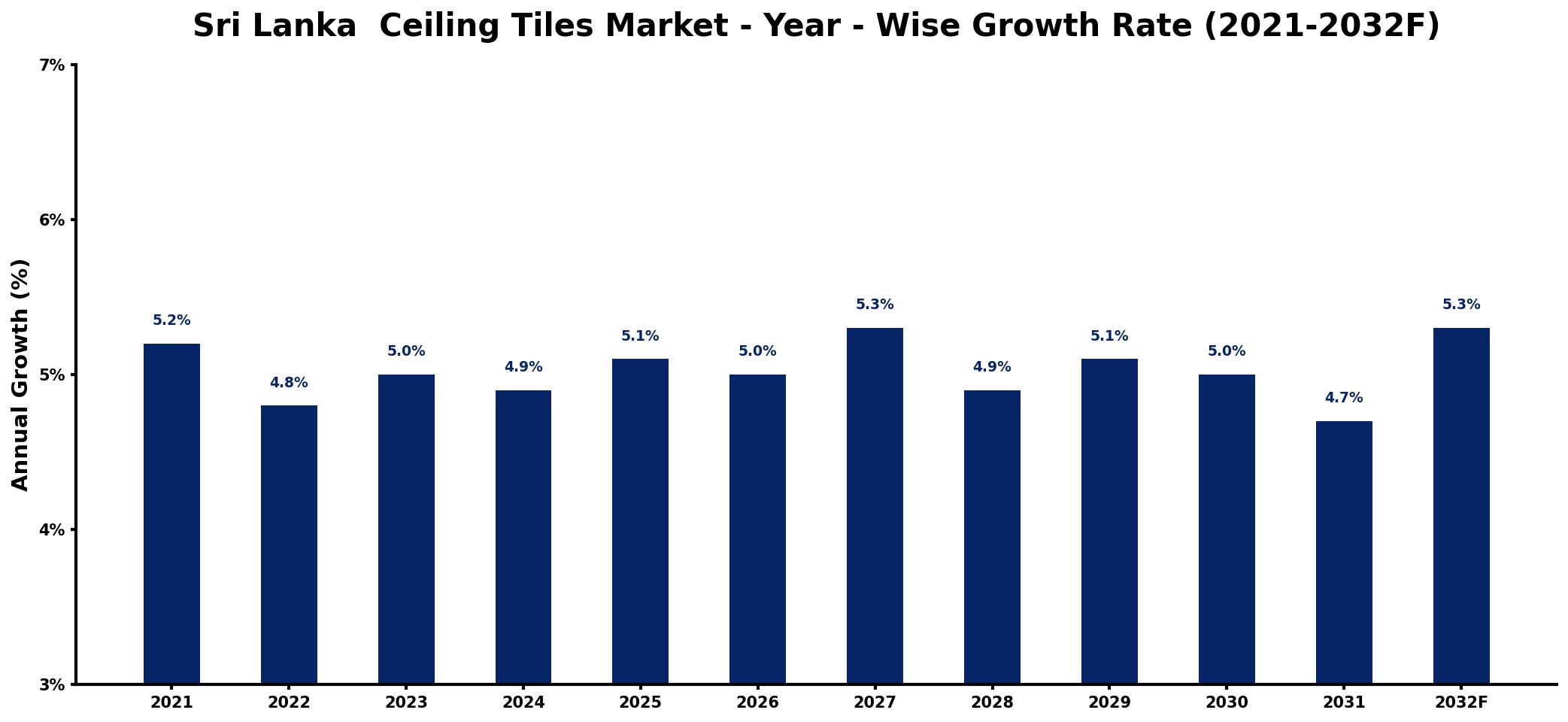
The table below presents the year‑wise growth rates along with the key drivers influencing the market
| Year | Growth Rate | Major Drivers |
| 2021 | 5.2% | Increased construction project investments |
| 2022 | 4.8% | Growing residential renovation activities |
| 2023 | 5.0% | Expansion of commercial infrastructure projects |
| 2024 | 4.9% | Rising demand for sustainable materials |
| 2025 | 5.1% | Boost in urban housing developments |
| 2026 | 5.0% | Surge in interior design trends |
| 2027 | 5.3% | Increase in government construction spending |
| 2028 | 4.9% | Growth in hospitality sector renovations |
| 2029 | 5.1% | Rising popularity of modular buildings |
| 2030 | 5.0% | rising procurement volume requirements |
| 2031 | 4.7% | growing commercial sector adoption |
| 2032 | 5.3% | Growing interest in eco-friendly designs |
Note: Market size estimations and growth projections presented in this report are based on 6Wresearch's proprietary forecasting methodology, utilizing the latest available industry data, government publications, and primary research inputs.
Sri Lanka Ceiling Tiles Market Synopsis
The strongest force shaping the Sri Lanka Ceiling Tiles Market currently is the robust growth in infrastructure development. Government initiatives and private sector investments are driving the demand for high-quality ceiling tiles that not only meet functional requirements but also contribute to modern aesthetic standards. This burgeoning construction landscape necessitates acoustic insulation, thermal comfort, and stylish design in interior spaces.
Furthermore, the growing hospitality and healthcare sectors are crucial contributors to market dynamics. As these industries evolve, they increasingly prioritize environment-friendly materials and technologies, thereby impacting purchasing decisions. Thus, the shift towards enhanced aesthetic appeal and functionality continues to reshape consumer preferences in ceiling tile selections.
Sri Lanka Ceiling Tiles Market Key Takeaways
- The ceiling tiles market is significantly supported by sustainable building practices and eco-friendly materials.
- Infrastructure and renovation projects are primary catalysts for growth in the construction sector.
- Advancements in manufacturing technologies are fostering the introduction of lightweight and durable ceiling solutions.
- Regulatory measures are influencing local production and ensuring quality compliance for imported products.
- Consumer preferences are shifting towards integrated aesthetic and functional ceiling tile solutions.
Evaluation of Restraints in Sri Lanka Ceiling Tiles Market
Despite a favorable growth outlook, the Sri Lanka Ceiling Tiles Market faces several constraints. Price sensitivity among consumers often limits the adoption of higher-quality products, leading to a potential compromise on performance and durability. Furthermore, the local market grapples with quality inconsistencies in domestically produced tiles, which can deter customers who prioritize reliability. The dependency on imports for specialized ceiling solutions introduces vulnerability to supply chain fluctuations, affecting overall market stability. Economic uncertainties and variable construction activities further complicate the landscape, making demand forecasts challenging.
Sri Lanka Ceiling Tiles Market Trends
Several trends are shaping the Sri Lanka Ceiling Tiles Market. Firstly, the integration of technology in production processes is enabling manufacturers to create innovative designs and enhance performance characteristics such as acoustic properties and fire resistance. Additionally, there is an increasing inclination towards modular and easy-to-install ceiling systems, driven by the need for faster construction timelines. Moreover, consumers are increasingly prioritizing products that align with environmental sustainability, prompting manufacturers to adopt greener materials and processes.
Sri Lanka Ceiling Tiles Market Opportunities
The potential for growth in the Sri Lanka Ceiling Tiles Market is vast. Opportunities exist in tapping into the renovation and refurbishment projects for existing buildings, which are on the rise due to increased urbanization and changing consumer preferences. Additionally, the surge in hospitality and healthcare facilities offers fertile ground for innovative ceiling solutions that cater specifically to these sectors. Investments in research and development for eco-friendly and technologically advanced products will not only meet regulatory standards but also attract a discerning clientele seeking modern solutions.
Government Initiatives in the Sri Lanka Ceiling Tiles Market
The Sri Lankan government is actively fostering the ceiling tiles market through various supportive measures. Policies aimed at encouraging local production, particularly those that focus on sustainable practices, are in place. Financial incentives are provided to manufacturers adopting eco-friendly technologies, which bolsters competitiveness and innovation in the market. Furthermore, stringent regulations ensure that imported products comply with environmental and quality standards, which helps maintain a balance between local producers and foreign imports.
Future Insights of the Sri Lanka Ceiling Tiles Market
Looking ahead to 2026-2032, the Sri Lanka Ceiling Tiles Market is poised for substantial growth driven by continued investments in infrastructure and a rising demand for sustainable building solutions. The anticipated urbanization trends and expansion of the construction sector suggest a persistent need for innovative ceiling products. As the market evolves, companies that adapt to changing consumer preferences and prioritize product quality will likely secure a competitive advantage. Furthermore, technological advancements will play a crucial role in shaping product offerings, with an emphasis on functionality and aesthetics.
Sri Lanka Ceiling Tiles Market Latest Developments (2025 - 2026)
In recent months, the ceiling tiles market in Sri Lanka has witnessed significant shifts towards innovation and sustainability. Manufacturers are increasingly embracing advanced technologies to enhance product performance and aesthetic appeal. Moreover, collaborative efforts between local producers and international firms have been seen, aimed at bolstering the quality and variety of offerings in the market. Regulatory updates have also been introduced to further support eco-friendly production practices, reflecting the governments commitment to sustainable development.
Sri Lanka Ceiling Tiles Market - Key Attractiveness of the Report
- 10 Years of Market Numbers
- Historical Data Starting from 2022 to 2025
- Base Year: 2025
- Forecast Data until 2032
- Key Performance Indicators Impacting the Market
- Major Upcoming Developments and Projects
Key Highlights of the Report:
- Sri Lanka Ceiling Tiles Market Outlook
- Market Size of Sri Lanka Ceiling Tiles Market, 2025
- Forecast of Sri Lanka Ceiling Tiles Market, 2032
- Historical Data and Forecast of Sri Lanka Ceiling Tiles Revenues & Volume for the Period 2022-2032F
- Sri Lanka Ceiling Tiles Market Trend Evolution
- Sri Lanka Ceiling Tiles Market Drivers and Challenges
- Sri Lanka Ceiling Tiles Price Trends
- Sri Lanka Ceiling Tiles Porter's Five Forces
- Sri Lanka Ceiling Tiles Industry Life Cycle
- Historical Data and Forecast of Sri Lanka Ceiling Tiles Market Revenues & Volume By Material Type for the Period 2022-2032F
- Historical Data and Forecast of Sri Lanka Ceiling Tiles Market Revenues & Volume By Mineral Wool for the Period 2022-2032F
- Historical Data and Forecast of Sri Lanka Ceiling Tiles Market Revenues & Volume By Metal for the Period 2022-2032F
- Historical Data and Forecast of Sri Lanka Ceiling Tiles Market Revenues & Volume By Gypsum for the Period 2022-2032F
- Historical Data and Forecast of Sri Lanka Ceiling Tiles Market Revenues & Volume By Others for the Period 2022-2032F
- Historical Data and Forecast of Sri Lanka Ceiling Tiles Market Revenues & Volume By Application for the Period 2022-2032F
- Historical Data and Forecast of Sri Lanka Ceiling Tiles Market Revenues & Volume By Residential for the Period 2022-2032F
- Historical Data and Forecast of Sri Lanka Ceiling Tiles Market Revenues & Volume By Non-residential for the Period 2022-2032F
- Sri Lanka Ceiling Tiles Import Export Trade Statistics
- Market Opportunity Assessment By Material Type
- Market Opportunity Assessment By Application
- Sri Lanka Ceiling Tiles Top Companies Market Share
- Sri Lanka Ceiling Tiles Competitive Benchmarking By Technical and Operational Parameters
- Sri Lanka Ceiling Tiles Company Profiles
- Sri Lanka Ceiling Tiles Key Strategic Recommendations






































