Sri Lanka Cloud CRM Market Size & Growth Rate (2026-2032)
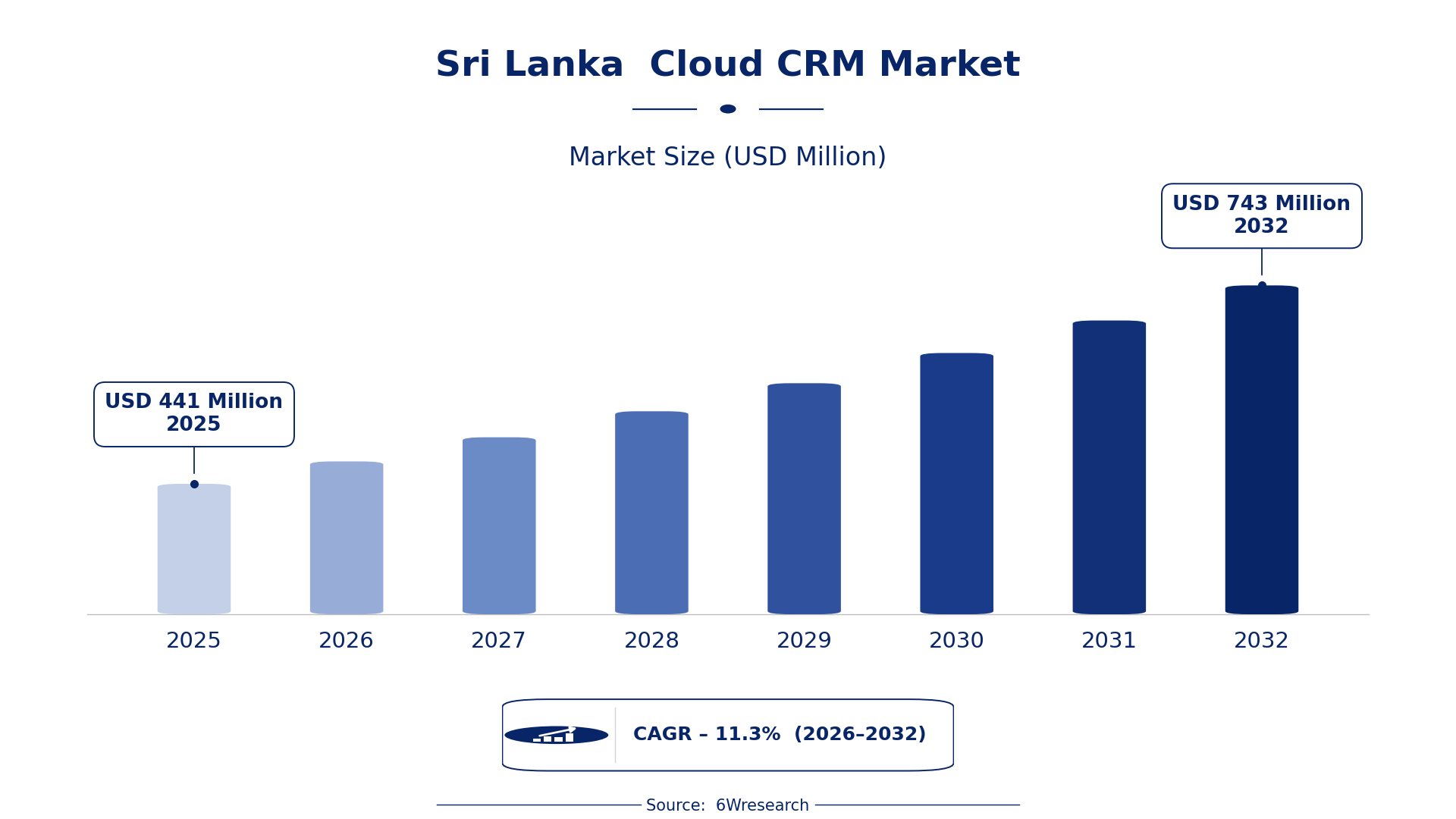
The Sri Lanka Cloud CRM Market was estimated at USD 441 Million in 2025 and is projected to reach USD 743 Million by 2032, growing at a CAGR of 11.3% from 2026 to 2032.
Sri Lanka Cloud CRM Market Synopsis
The demand for Cloud CRM solutions in Sri Lanka is rapidly escalating as businesses recognize the need to enhance customer engagement. The shift from traditional CRM systems to cloud-based platforms is not just about technology; it reflects a broader trend toward customer-centric business strategies.
Small and medium enterprises are at the forefront of this shift, attracted by the affordability and flexibility of cloud solutions. Local vendors are tailoring their offerings to meet the unique requirements of Sri Lankan businesses, further driving market growth.
Sri Lanka Cloud CRM Market Year-wise Growth Rate and Key Drivers
This graph illustrates the annual growth rates of the Sri Lanka Cloud CRM Market from 2021 to 2032, highlighting a steady upward trajectory and projected expansion over the forecast period.
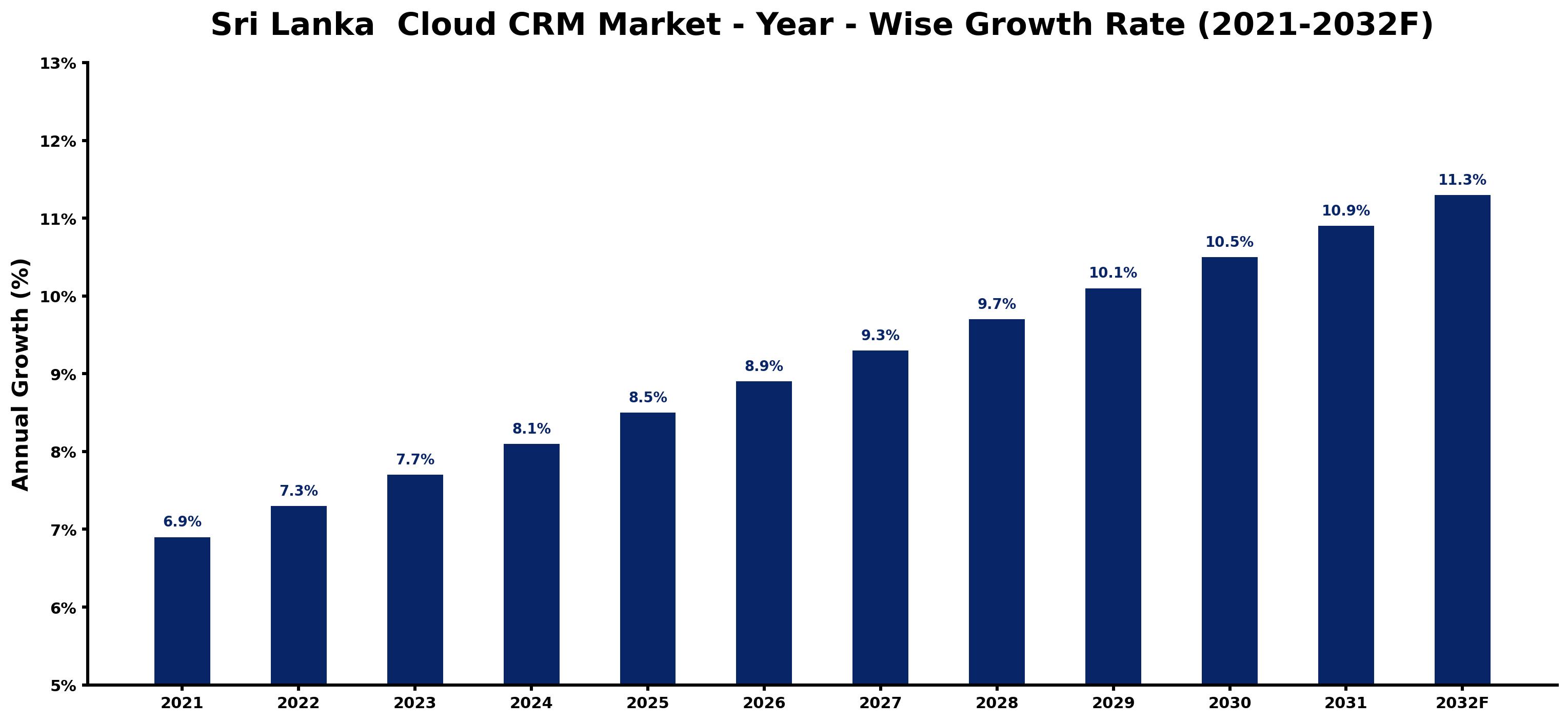
The table below presents the year‑wise growth rates along with the key drivers influencing the market
| Year | Growth Rate | Major Drivers |
| 2021 | 6.9% | Increased demand for remote customer engagement solutions. |
| 2022 | 7.3% | Rising adoption of digital transformation in SMEs. |
| 2023 | 7.7% | Government incentives for tech startups and innovation. |
| 2024 | 8.1% | Growing investment in customer analytics by enterprises. |
| 2025 | 8.5% | Local e-commerce boom driving CRM software adoption. |
| 2026 | 8.9% | Emergence of AI tools enhancing customer relationship strategies. |
| 2027 | 9.3% | Integration of cloud CRM in government service delivery. |
| 2028 | 9.7% | Young population embracing digital entrepreneurship models. |
| 2029 | 10.1% | Increased competition in retail driving customer experience initiatives. |
| 2030 | 10.5% | Partnerships between local firms and global CRM providers. |
| 2031 | 10.9% | Expanding internet penetration boosting cloud service usage. |
| 2032 | 11.3% | Focus on customer data protection regulations enhancing CRM trust. |
Note: Market size estimations and growth projections presented in this report are based on 6Wresearch's proprietary forecasting methodology, utilizing the latest available industry data, government publications, and primary research inputs.
Sri Lanka Cloud CRM Market Key Takeaways
Below are some of the specific key takeaways from the market, including:
- The market is witnessing a significant trend towards integrated CRM platforms that combine multiple functionalities.
- Mobile CRM solutions are gaining traction, allowing businesses to manage customer relationships remotely.
- Education on cloud technology remains crucial for overcoming initial resistance, especially among SMEs.
- Data security concerns are a primary consideration for businesses considering cloud CRM adoption.
- Government initiatives are enhancing the digital infrastructure, supporting Cloud CRM market growth.
Evaluation of Restraints in Sri Lanka Cloud CRM Market
Several factors are holding back the Sri Lanka Cloud CRM market. A lack of awareness about cloud technologies among small and medium enterprises leads to hesitance in adopting new systems. Concerns regarding data security and privacy further exacerbate this issue, creating barriers to entry. Additionally, the varying quality of internet connectivity across regions presents challenges for seamless CRM integration. These issues need addressing through targeted education and infrastructure improvements to unlock the full potential of the market.
Sri Lanka Cloud CRM Market Trends
A noticeable trend in the Sri Lanka Cloud CRM market is the growing emphasis on customization. Businesses are increasingly seeking tailored solutions that can cater to their specific needs. on top of that, the integration of artificial intelligence and analytics within CRM platforms is emerging, providing businesses with actionable insights to improve customer relationships.
Another trend is the rise in demand for cloud solutions that facilitate remote work, driven by recent global shifts. Companies are prioritizing features that allow real-time data access and collaboration, ensuring that customer engagement remains strong regardless of location.
Sri Lanka Cloud CRM Market Opportunities
The Sri Lanka Cloud CRM market is ripe with investment opportunities, particularly for those willing to adapt their offerings to local needs. Potential growth avenues include developing specialized CRM solutions that address industry-specific challenges. Companies can also consider partnerships with local businesses to enhance service delivery and create unique value propositions.
With the increasing push towards digital transformation, there is ample room for innovative technology providers to enter the market. Investors should focus on solutions that prioritize customer experience and operational efficiency, as these are becoming top priorities for Sri Lankan businesses.
Government Initiatives in the Sri Lanka Cloud CRM Market
The Sri Lankan government plays a crucial role in the advancement of the Cloud CRM market through various supportive initiatives. Recognizing the importance of digital transformation, the government has implemented policies aimed at enhancing cloud adoption across sectors. These initiatives not only foster a favorable business environment but also highlight the strategic importance of cloud solutions in boosting competitiveness.
- A recently completed initiative aimed at upgrading national digital infrastructure to support cloud services.
- Currently ongoing programs that provide tax incentives for companies adopting cloud technologies.
- Planned public-private partnerships expected to enhance internet connectivity in rural areas by 2028.
- Development of training programs to educate SMEs on cloud CRM benefits and implementation strategies.
- Proposals for regulatory frameworks that promote data security standards for cloud solutions.
Future Insights of the Sri Lanka Cloud CRM Market
Looking ahead to 2026-2032, the Sri Lanka Cloud CRM market is set to flourish. As more businesses prioritize customer relationship management, the demand for effective cloud solutions will intensify. The ongoing digital transformation initiatives and increasing awareness of cloud benefits will further drive this momentum. Companies that invest in understanding customer behavior and adapting their CRM strategies will likely see substantial growth and market share.
Sri Lanka Cloud CRM Market Latest Developments
In the past year, the Sri Lanka Cloud CRM market has witnessed several noteworthy developments. The push towards digitization continues to gain traction, with businesses increasingly embracing cloud solutions to enhance customer interactions and operational efficiency. As companies adapt to changing market dynamics, innovation within the CRM sector is accelerating.
- A major technology vendor launched a customizable cloud CRM platform in early 2025, catering specifically to local business needs.
- Ongoing collaborations between cloud service providers and local enterprises to integrate advanced analytics features into CRM systems.
- Upcoming initiatives focused on enhancing cybersecurity measures for cloud solutions, expected to begin in late 2025.
- Partnerships forming between technology firms and educational institutions to promote cloud CRM training programs throughout 2025.
- Recent investments in upgrading existing CRM infrastructures to include mobile access and real-time data capabilities.
Sri Lanka Cloud CRM Market - Key Attractiveness of the Report
- 10 Years of Market Numbers
- Historical Data Starting from 2022 to 2025
- Base Year: 2025
- Forecast Data until 2032
- Key Performance Indicators Impacting the Market
- Major Upcoming Developments and Projects
Key Highlights of the Report:
- Sri Lanka Cloud CRM Market Outlook
- Market Size of Sri Lanka Cloud CRM Market, 2025
- Forecast of Sri Lanka Cloud CRM Market, 2032
- Historical Data and Forecast of Sri Lanka Cloud CRM Revenues & Volume for the Period 2022-2032F
- Sri Lanka Cloud CRM Market Trend Evolution
- Sri Lanka Cloud CRM Market Drivers and Challenges
- Sri Lanka Cloud CRM Price Trends
- Sri Lanka Cloud CRM Porter's Five Forces
- Sri Lanka Cloud CRM Industry Life Cycle
- Historical Data and Forecast of Sri Lanka Cloud CRM Market Revenues & Volume By Vertical for the Period 2022-2032F
- Historical Data and Forecast of Sri Lanka Cloud CRM Market Revenues & Volume By Nonprofit for the Period 2022-2032F
- Historical Data and Forecast of Sri Lanka Cloud CRM Market Revenues & Volume By Higher Education for the Period 2022-2032F
- Historical Data and Forecast of Sri Lanka Cloud CRM Market Revenues & Volume By Nonprofit Sub Vertical for the Period 2022-2032F
- Historical Data and Forecast of Sri Lanka Cloud CRM Market Revenues & Volume By Education for the Period 2022-2032F
- Historical Data and Forecast of Sri Lanka Cloud CRM Market Revenues & Volume By Research and Innovation for the Period 2022-2032F
- Historical Data and Forecast of Sri Lanka Cloud CRM Market Revenues & Volume By Social Affairs for the Period 2022-2032F
- Historical Data and Forecast of Sri Lanka Cloud CRM Market Revenues & Volume By Children and Youth for the Period 2022-2032F
- Historical Data and Forecast of Sri Lanka Cloud CRM Market Revenues & Volume By Art and Culture for the Period 2022-2032F
- Historical Data and Forecast of Sri Lanka Cloud CRM Market Revenues & Volume By Others for the Period 2022-2032F
- Sri Lanka Cloud CRM Import Export Trade Statistics
- Market Opportunity Assessment By Vertical
- Market Opportunity Assessment By Nonprofit Sub Vertical
- Sri Lanka Cloud CRM Top Companies Market Share
- Sri Lanka Cloud CRM Competitive Benchmarking By Technical and Operational Parameters
- Sri Lanka Cloud CRM Company Profiles
- Sri Lanka Cloud CRM Key Strategic Recommendations






































