Sri Lanka Cloud Database and DBaaS Market Size & Growth Rate (2026-2032)
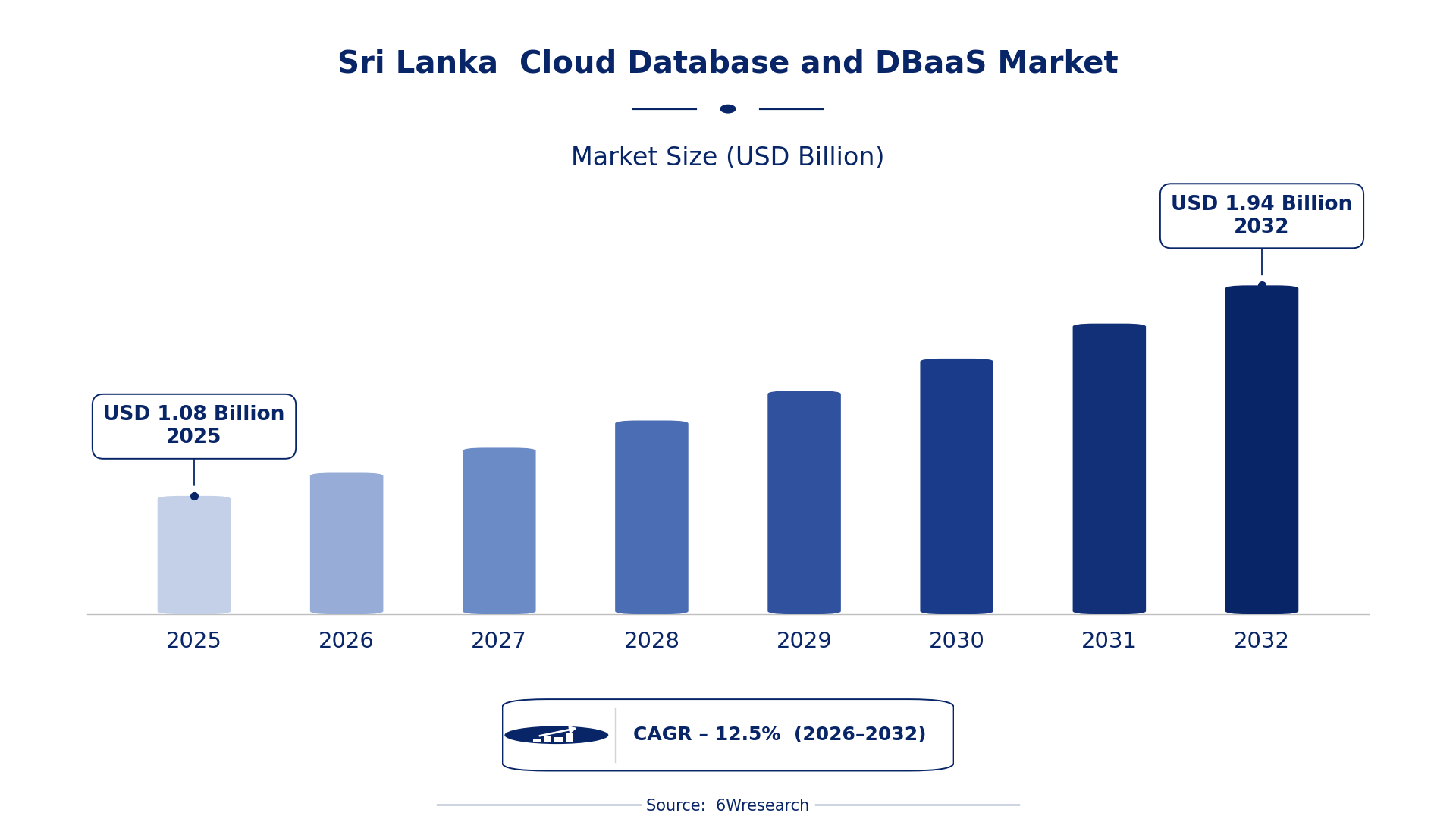
The Sri Lanka Cloud Database and DBaaS Market was estimated at USD 1080 Million in 2025 and is projected to reach USD 1944 Million by 2032, growing at a CAGR of 12.5% from 2026 to 2032.
Sri Lanka Cloud Database and DBaaS Market Synopsis
The most compelling force driving the Sri Lanka Cloud Database and DBaaS market is the rapid shift towards cloud-based solutions by businesses seeking efficiency and flexibility. Organizations are increasingly recognizing the tangible benefits of adopting cloud databases, including improved scalability and reduced operational costs.
As a result, the demand for services like database management, data warehousing, and analytics is on the rise. The proliferation of mobile devices and the growth of e-commerce are further catalyzing this market, as businesses strive for real-time data processing and enhanced decision-making capabilities.
Sri Lanka Cloud Database and DBaaS Market Year-wise Growth Rate and Key Drivers
This graph illustrates the annual growth rates of the Sri Lanka Cloud Database and DBaaS Market from 2021 to 2032, highlighting a steady upward trajectory and projected expansion over the forecast period.
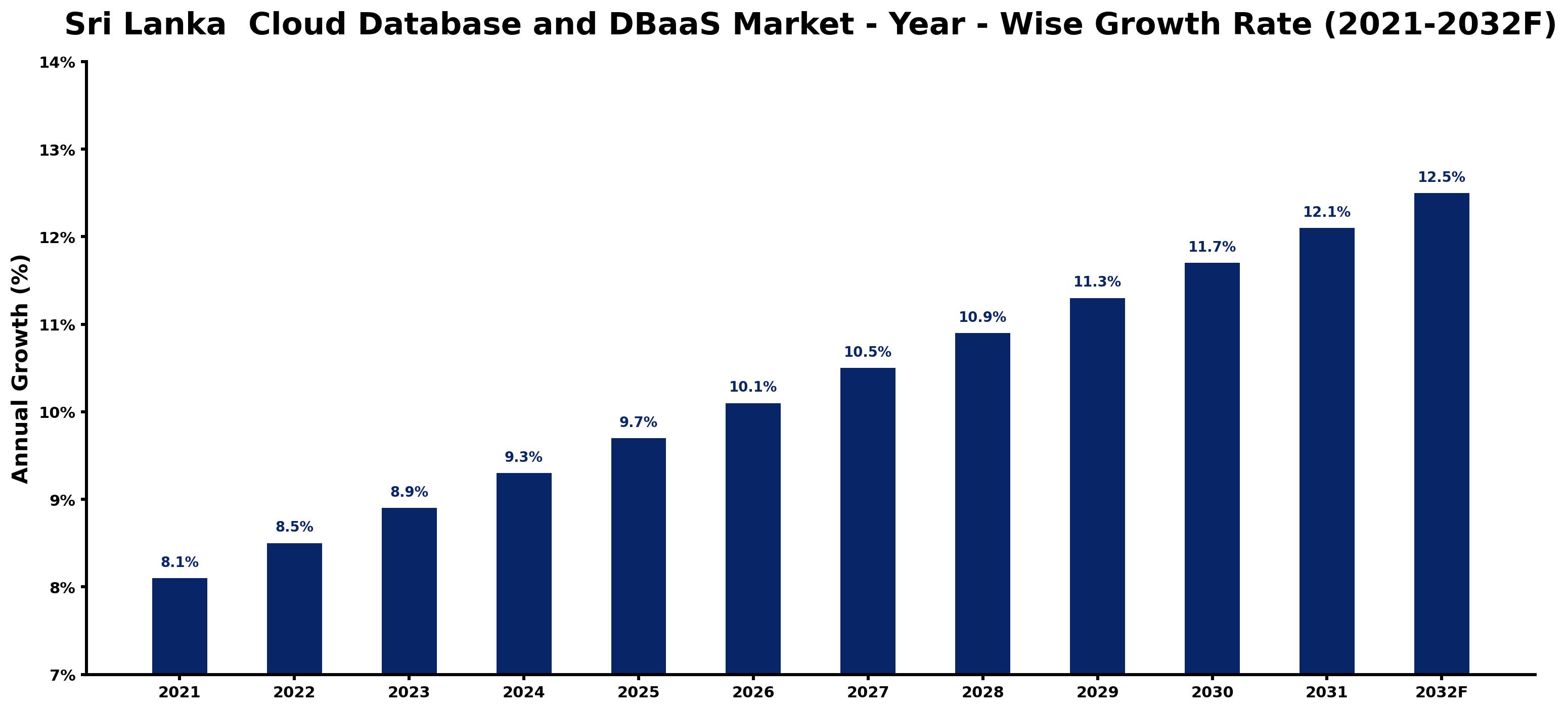
The table below presents the year‑wise growth rates along with the key drivers influencing the market
| Year | Growth Rate | Major Drivers |
| 2021 | 8.1% | Increased mobile internet penetration boosting cloud accessibility. |
| 2022 | 8.5% | New data protection laws driving database security investments. |
| 2023 | 8.9% | Growing fintech startups requiring scalable database solutions. |
| 2024 | 9.3% | Government funding for tech education enhancing cloud expertise. |
| 2025 | 9.7% | Emerging e-commerce platforms demand robust cloud database support. |
| 2026 | 10.1% | Adoption of IoT solutions amplifying data storage needs. |
| 2027 | 10.5% | Rising adoption of AI applications necessitating DBaaS services. |
| 2028 | 10.9% | Strategic partnerships with foreign tech companies advancing innovation. |
| 2029 | 11.3% | Local industries embracing data analytics for competitive advantage. |
| 2030 | 11.7% | Tax incentives for tech firms accelerating cloud service uptake. |
| 2031 | 12.1% | Increasing data generation from social media platforms boosting demand. |
| 2032 | 12.5% | Growing cybersecurity concerns enhancing focus on data management. |
Note: Market size estimations and growth projections presented in this report are based on 6Wresearch's proprietary forecasting methodology, utilizing the latest available industry data, government publications, and primary research inputs.
Sri Lanka Cloud Database and DBaaS Market Key Takeaways
Below are some of the specific key takeaways from the market, including:
- Adoption of cloud databases is accelerating, driven by the need for scalability and cost-effectiveness.
- Real-time data access and analytics are becoming essential for businesses to maintain competitive advantages.
- The market is witnessing increased integration of AI and machine learning into cloud database solutions.
- Government policies are fostering a supportive environment for cloud technology adoption.
- Challenges such as limited awareness and concerns over data security remain hurdles to overcome.
Evaluation of Restraints in Sri Lanka Cloud Database and DBaaS Market
Despite the promising growth trajectory, the Sri Lanka Cloud Database and DBaaS market faces notable constraints. A significant barrier is the limited understanding of cloud technologies among many businesses, leading to hesitation in adoption. on top of that, issues surrounding data security and compliance with privacy regulations contribute to uncertainty for organizations considering cloud migration. The shortage of skilled professionals adept in cloud database management also poses a challenge. Lastly, inconsistent internet infrastructure in certain regions can adversely affect performance and accessibility, complicating efforts to fully utilize cloud solutions.
Sri Lanka Cloud Database and DBaaS Market Trends
Several key trends are shaping the Sri Lanka Cloud Database and DBaaS market. The integration of artificial intelligence and machine learning capabilities is gaining traction, allowing for smarter data management and analytics. Additionally, the popularity of multi-cloud and hybrid cloud solutions is rising, as businesses seek greater flexibility and risk mitigation. The emphasis on data-driven decision-making is pushing organizations to invest in cloud databases to harness real-time insights. These trends collectively enhance the competitive landscape, as providers innovate to meet evolving business demands.
Sri Lanka Cloud Database and DBaaS Market Opportunities
Opportunities within the Sri Lanka Cloud Database and DBaaS market are abundant. The ongoing digital transformation initiatives across various sectors are propelling organizations to modernize their IT infrastructure. Cloud service providers can capitalize on this shift by offering tailored solutions that address specific business needs. on top of that, the rise of Internet of Things (IoT) devices presents a unique opportunity for cloud databases to manage the influx of data generated, fostering innovative applications and services. As awareness of cloud technology's benefits grows, the market is set for continued expansion.
Government Initiatives in the Sri Lanka Cloud Database and DBaaS Market
The Sri Lankan government is actively supporting the growth of the Cloud Database and DBaaS market through various initiatives aimed at enhancing digital transformation. With a focus on promoting cloud technology, the government is implementing policies that encourage businesses to invest in cloud infrastructure, while also prioritizing data security and privacy. These efforts create a favorable regulatory environment, essential for attracting investment and fostering innovation in the sector.
- A recently completed initiative introduced tax incentives for businesses that adopt cloud technologies, encouraging greater investment in cloud infrastructure.
- Currently underway is a national program aimed at improving digital literacy among businesses, focusing on the benefits of cloud solutions.
- Planned initiatives include the development of a regulatory framework to strengthen data protection and compliance standards for cloud services expected to launch in 2026.
- Ongoing collaborations with educational institutions aim to create a skilled workforce in cloud computing technologies to meet industry demands.
- The government is promoting data localization initiatives to enhance data security and privacy, which are critical for business confidence in cloud adoption.
Future Insights of the Sri Lanka Cloud Database and DBaaS Market
Looking ahead to 2026-2032, the Sri Lanka Cloud Database and DBaaS market is set for significant growth. The increasing shift towards cloud technologies, driven by a need for operational efficiency and cost-effectiveness, will continue to reshape business strategies. As more organizations acknowledge the advantages of cloud-based solutions, investments in innovative database services will surge. Additionally, the rise in data-driven decision-making and the proliferation of IoT devices will further fuel demand, positioning the market for robust expansion.
Sri Lanka Cloud Database and DBaaS Market Latest Developments
In the last 12-14 months, the Sri Lanka Cloud Database and DBaaS market has seen a wave of activity aimed at enhancing service offerings and infrastructure. As organizations adapt to new technological demands, providers are ramping up their efforts to stay competitive, launching new services and partnerships. This momentum indicates a clear trend toward embracing cloud solutions for improved data management.
- A major technology vendor announced a service upgrade in early 2025, enhancing their cloud database capabilities to include advanced analytics features.
- An initiative that began in late 2024 is currently underway, focusing on expanding cloud infrastructure to underserved regions to improve accessibility.
- A partnership was formed in Q1 2025 between a leading cloud service provider and a local enterprise to co-develop industry-specific database solutions, which is expected to enhance service delivery.
- Planned for mid-2026 is a rollout of a comprehensive training program designed to equip IT professionals with cloud database management skills.
- A recent expansion of cloud services was completed in late 2024, allowing for increased storage capacity and enhanced data security measures for existing clients.
Sri Lanka Cloud Database and DBaaS Market - Key Attractiveness of the Report
- 10 Years of Market Numbers
- Historical Data Starting from 2022 to 2025
- Base Year: 2025
- Forecast Data until 2032
- Key Performance Indicators Impacting the Market
- Major Upcoming Developments and Projects
Key Highlights of the Report:
- Sri Lanka Cloud Database and DBaaS Market Outlook
- Market Size of Sri Lanka Cloud Database and DBaaS Market, 2025
- Forecast of Sri Lanka Cloud Database and DBaaS Market, 2032
- Historical Data and Forecast of Sri Lanka Cloud Database and DBaaS Revenues & Volume for the Period 2022-2032F
- Sri Lanka Cloud Database and DBaaS Market Trend Evolution
- Sri Lanka Cloud Database and DBaaS Market Drivers and Challenges
- Sri Lanka Cloud Database and DBaaS Price Trends
- Sri Lanka Cloud Database and DBaaS Porter's Five Forces
- Sri Lanka Cloud Database and DBaaS Industry Life Cycle
- Historical Data and Forecast of Sri Lanka Cloud Database and DBaaS Market Revenues & Volume By Database Type for the Period 2022-2032F
- Historical Data and Forecast of Sri Lanka Cloud Database and DBaaS Market Revenues & Volume By SQL for the Period 2022-2032F
- Historical Data and Forecast of Sri Lanka Cloud Database and DBaaS Market Revenues & Volume By NoSQL for the Period 2022-2032F
- Historical Data and Forecast of Sri Lanka Cloud Database and DBaaS Market Revenues & Volume By Service for the Period 2022-2032F
- Historical Data and Forecast of Sri Lanka Cloud Database and DBaaS Market Revenues & Volume By Professional Services for the Period 2022-2032F
- Historical Data and Forecast of Sri Lanka Cloud Database and DBaaS Market Revenues & Volume By Consulting for the Period 2022-2032F
- Historical Data and Forecast of Sri Lanka Cloud Database and DBaaS Market Revenues & Volume By Implementation for the Period 2022-2032F
- Historical Data and Forecast of Sri Lanka Cloud Database and DBaaS Market Revenues & Volume By Support and Maintenance for the Period 2022-2032F
- Historical Data and Forecast of Sri Lanka Cloud Database and DBaaS Market Revenues & Volume By Managed Services for the Period 2022-2032F
- Historical Data and Forecast of Sri Lanka Cloud Database and DBaaS Market Revenues & Volume By Vertical for the Period 2022-2032F
- Historical Data and Forecast of Sri Lanka Cloud Database and DBaaS Market Revenues & Volume By Banking, Financial Services and Insurance (BFSI) for the Period 2022-2032F
- Historical Data and Forecast of Sri Lanka Cloud Database and DBaaS Market Revenues & Volume By Telecom and Information Technology (IT) for the Period 2022-2032F
- Historical Data and Forecast of Sri Lanka Cloud Database and DBaaS Market Revenues & Volume By Government for the Period 2022-2032F
- Historical Data and Forecast of Sri Lanka Cloud Database and DBaaS Market Revenues & Volume By Consumer Goods and Retail for the Period 2022-2032F
- Historical Data and Forecast of Sri Lanka Cloud Database and DBaaS Market Revenues & Volume By Manufacturing for the Period 2022-2032F
- Historical Data and Forecast of Sri Lanka Cloud Database and DBaaS Market Revenues & Volume By Energy and Utilities for the Period 2022-2032F
- Historical Data and Forecast of Sri Lanka Cloud Database and DBaaS Market Revenues & Volume By Media and Entertainment for the Period 2022-2032F
- Historical Data and Forecast of Sri Lanka Cloud Database and DBaaS Market Revenues & Volume By Healthcare and Life Sciences for the Period 2022-2032F
- Historical Data and Forecast of Sri Lanka Cloud Database and DBaaS Market Revenues & Volume By Component for the Period 2022-2032F
- Historical Data and Forecast of Sri Lanka Cloud Database and DBaaS Market Revenues & Volume By Solution for the Period 2022-2032F
- Historical Data and Forecast of Sri Lanka Cloud Database and DBaaS Market Revenues & Volume By Services for the Period 2022-2032F
- Historical Data and Forecast of Sri Lanka Cloud Database and DBaaS Market Revenues & Volume By Deployment Model for the Period 2022-2032F
- Historical Data and Forecast of Sri Lanka Cloud Database and DBaaS Market Revenues & Volume By Public Cloud for the Period 2022-2032F
- Historical Data and Forecast of Sri Lanka Cloud Database and DBaaS Market Revenues & Volume By Private Cloud for the Period 2022-2032F
- Historical Data and Forecast of Sri Lanka Cloud Database and DBaaS Market Revenues & Volume By Hybrid Cloud for the Period 2022-2032F
- Historical Data and Forecast of Sri Lanka Cloud Database and DBaaS Market Revenues & Volume By Organization Size for the Period 2022-2032F
- Historical Data and Forecast of Sri Lanka Cloud Database and DBaaS Market Revenues & Volume By Large Enterprises for the Period 2022-2032F
- Historical Data and Forecast of Sri Lanka Cloud Database and DBaaS Market Revenues & Volume By Small and Medium-sized Enterprises (SMEs) for the Period 2022-2032F
- Sri Lanka Cloud Database and DBaaS Import Export Trade Statistics
- Market Opportunity Assessment By Database Type
- Market Opportunity Assessment By Service
- Market Opportunity Assessment By Vertical
- Market Opportunity Assessment By Component
- Market Opportunity Assessment By Deployment Model
- Market Opportunity Assessment By Organization Size
- Sri Lanka Cloud Database and DBaaS Top Companies Market Share
- Sri Lanka Cloud Database and DBaaS Competitive Benchmarking By Technical and Operational Parameters
- Sri Lanka Cloud Database and DBaaS Company Profiles
- Sri Lanka Cloud Database and DBaaS Key Strategic Recommendations






































