Sri Lanka Coffee Maker Market: Import Trend Analysis
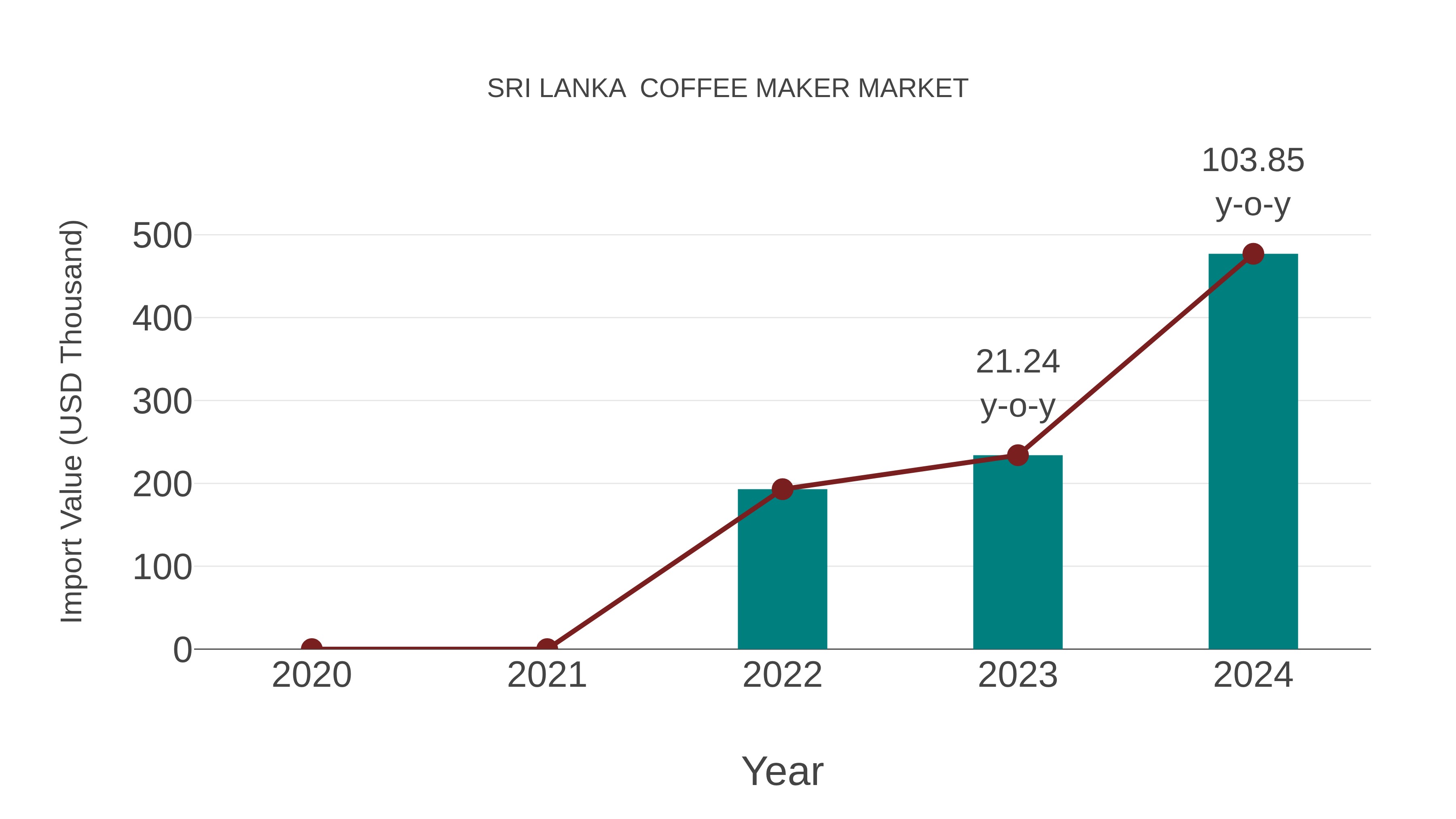
Sri Lanka import trend for the coffee maker market saw significant growth from 2023 to 2024, with a growth rate of 103.85%. The compound annual growth rate (CAGR) for the period 2020-2024 stood at 57.21%. This surge could be attributed to increasing consumer demand for convenient home appliances.
Coffee Maker Market: Sri Lanka vs Top 5 Major Economies in 2027 (Asia)
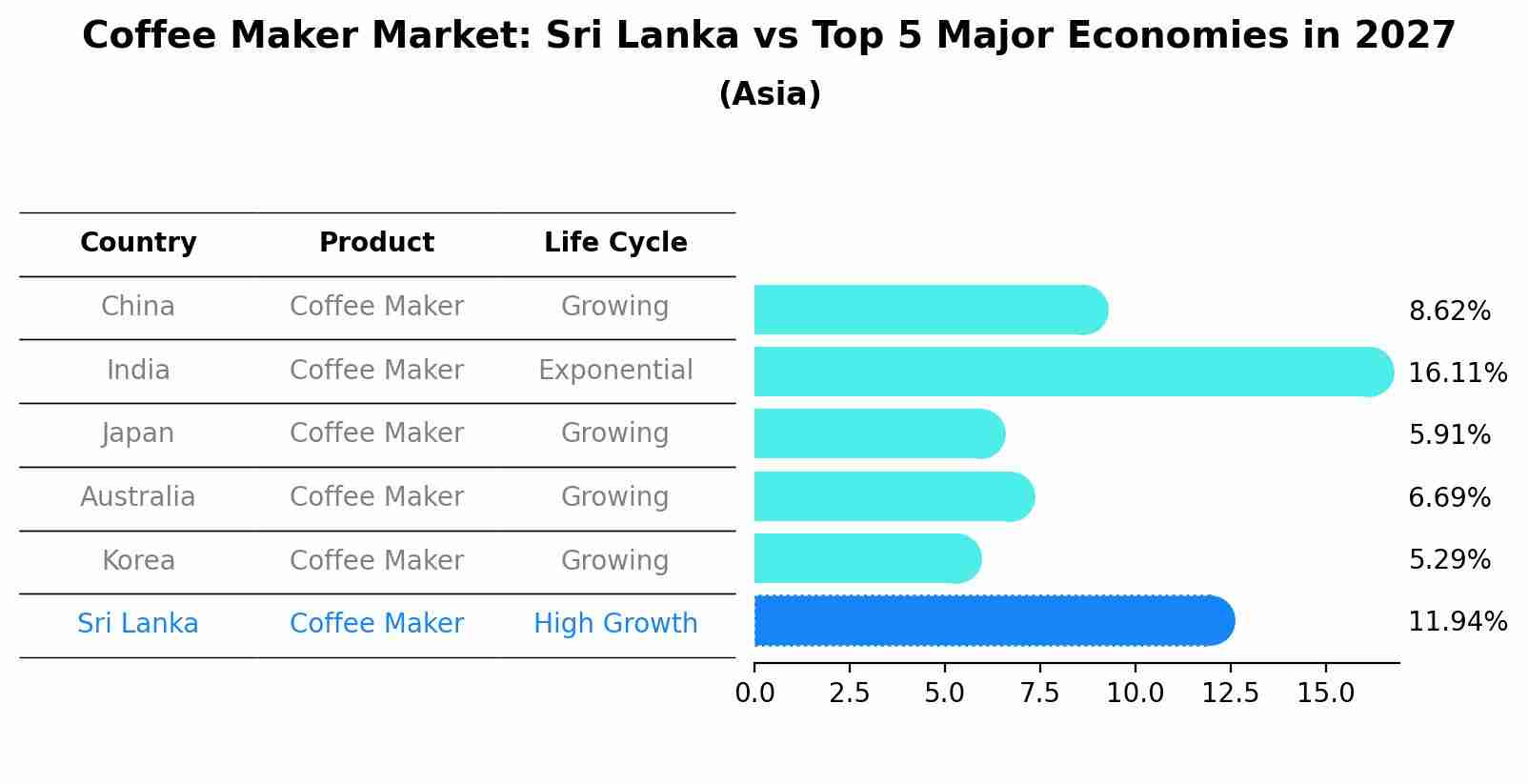
By 2027, Sri Lanka's Coffee Maker market is forecasted to achieve a high growth rate of 11.94%, with China leading the Asia region, followed by India, Japan, Australia and South Korea.
Sri Lanka Coffee Maker Market Overview
With a burgeoning café culture and increasing coffee consumption at home, the Sri Lankan coffee maker market is expanding. It includes a variety of coffee makers such as espresso machines, drip coffee makers, and capsule systems. The market is competitive with both local brands and international players vying for market share by offering affordable, user-friendly, and technologically advanced coffee-making solutions.
Drivers of the market
The coffee maker market in Sri Lanka is driven by the increasing consumer inclination towards convenient and premium coffee experiences. The proliferation of coffee shops and the growing home-brewing trend have significantly boosted the demand for coffee makers. Advancements in coffee maker technology, offering features such as programmability, multi-functionality, and ease of use, have further fueled market growth. Additionally, the rising disposable income and changing lifestyle preferences have led to an increased adoption of coffee makers, as consumers seek to replicate café-style coffee at home.
Challenges of the market
In Sri Lanka, the coffee maker market faces challenges including high import duties on coffee-making equipment, which increase product costs for consumers. Market penetration in rural areas and educating consumers about different coffee brewing methods are additional challenges impacting market growth.
Government Policy of the market
Government policies in the coffee maker market aim to stimulate local manufacturing and attract foreign investment. These policies include tax incentives for manufacturers, reduced import duties on essential components, and support for small and medium-sized enterprises (SMEs) involved in the production of coffee makers. Additionally, the government promotes quality standards to ensure that locally produced coffee makers meet international benchmarks.
Key Highlights of the Report:
- Sri Lanka Coffee Maker Market Outlook
- Market Size of Sri Lanka Coffee Maker Market, 2019
- Forecast of Sri Lanka Coffee Maker Market, 2026
- Historical Data and Forecast of Sri Lanka Coffee Maker Revenues & Volume for the Period 2016 - 2026
- Sri Lanka Coffee Maker Market Trend Evolution
- Sri Lanka Coffee Maker Market Drivers and Challenges
- Sri Lanka Coffee Maker Price Trends
- Sri Lanka Coffee Maker Porter's Five Forces
- Sri Lanka Coffee Maker Industry Life Cycle
- Historical Data and Forecast of Sri Lanka Coffee Maker Market Revenues & Volume By Types for the Period 2016 - 2026
- Historical Data and Forecast of Sri Lanka Coffee Maker Market Revenues & Volume By Drip Coffee Machine for the Period 2016 - 2026
- Historical Data and Forecast of Sri Lanka Coffee Maker Market Revenues & Volume By Steam Coffee Machine for the Period 2016 - 2026
- Historical Data and Forecast of Sri Lanka Coffee Maker Market Revenues & Volume By Capsule Coffee Machine for the Period 2016 - 2026
- Historical Data and Forecast of Sri Lanka Coffee Maker Market Revenues & Volume By Others for the Period 2016 - 2026
- Historical Data and Forecast of Sri Lanka Coffee Maker Market Revenues & Volume By End-users for the Period 2016 - 2026
- Historical Data and Forecast of Sri Lanka Coffee Maker Market Revenues & Volume By Commercial for the Period 2016 - 2026
- Historical Data and Forecast of Sri Lanka Coffee Maker Market Revenues & Volume By Industrial for the Period 2016 - 2026
- Historical Data and Forecast of Sri Lanka Coffee Maker Market Revenues & Volume By Distribution Channel for the Period 2016 - 2026
- Historical Data and Forecast of Sri Lanka Coffee Maker Market Revenues & Volume By Online for the Period 2016 - 2026
- Historical Data and Forecast of Sri Lanka Coffee Maker Market Revenues & Volume By Offline for the Period 2016 - 2026
- Sri Lanka Coffee Maker Import Export Trade Statistics
- Market Opportunity Assessment By Types
- Market Opportunity Assessment By End-users
- Market Opportunity Assessment By Distribution Channel
- Sri Lanka Coffee Maker Top Companies Market Share
- Sri Lanka Coffee Maker Competitive Benchmarking By Technical and Operational Parameters
- Sri Lanka Coffee Maker Company Profiles
- Sri Lanka Coffee Maker Key Strategic Recommendations






































