Sri Lanka Commercial Boiler Market Size, Share & Growth Rate
The Sri Lanka Commercial Boiler Market was estimated at USD 153 Million in 2025 and is projected to reach USD 213 Million by 2032, growing at a CAGR of 4.8% from 2026 to 2032. This growth trajectory is propelled by the increasing industrialization in the country, coupled with a burgeoning demand for reliable and efficient heating solutions across diverse commercial sectors, particularly hospitality and manufacturing. With a robust push towards sustainability and energy efficiency, stakeholders are increasingly favoring advanced boiler technologies that not only meet regulatory standards but also contribute to reduced operational costs.
Sri Lanka Commercial Boiler Market Year-wise Growth Rate and Key Drivers
This graph highlights how the Sri Lanka Commercial Boiler Market has steadily grown over the years, supported by major growth factors.
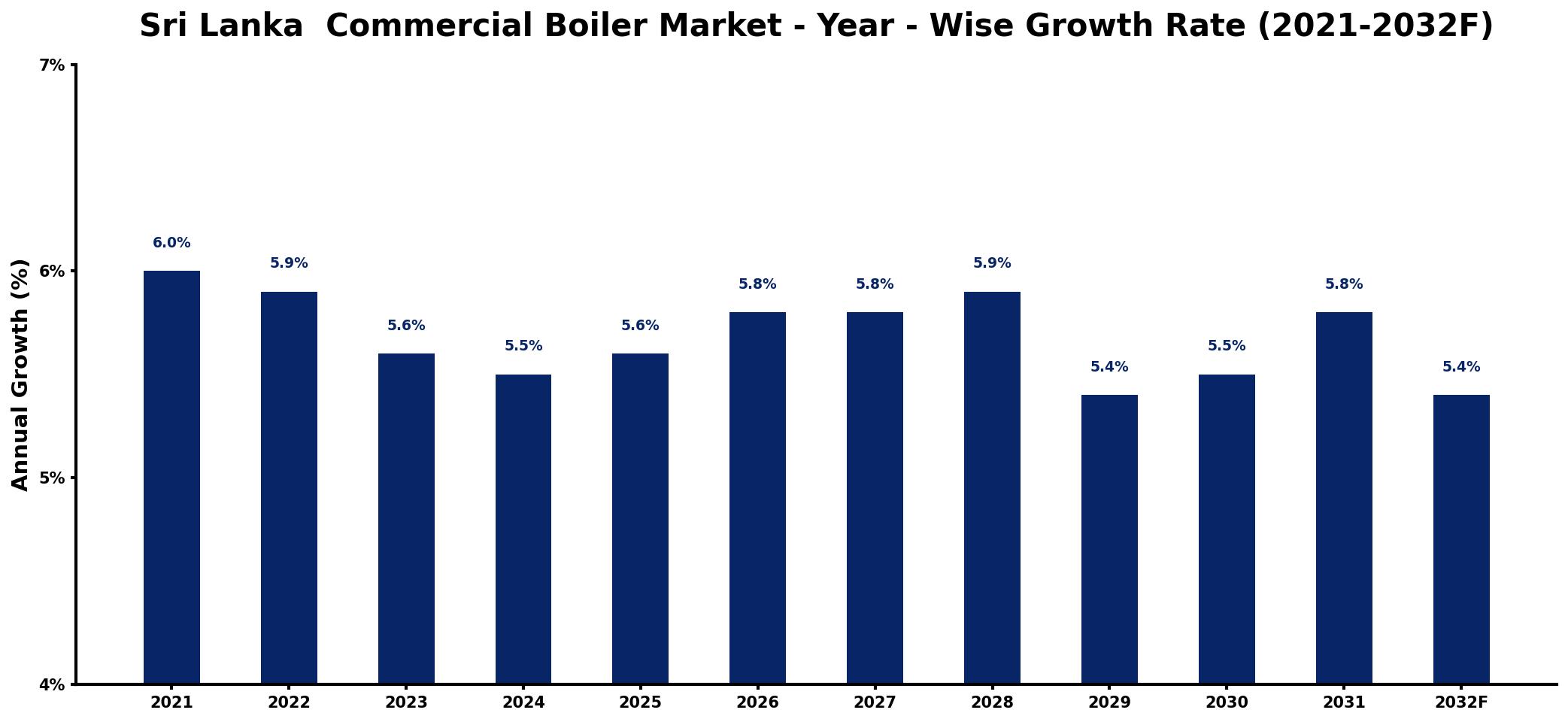
The table below presents the year‑wise growth rates along with the key drivers influencing the market
| Year | Growth Rate | Major Drivers |
| 2021 | 6.0% | Rising industrial energy requirements |
| 2022 | 5.9% | Increased focus on sustainability |
| 2023 | 5.6% | Growing hospitality sector demand |
| 2024 | 5.5% | Expansion of manufacturing facilities |
| 2025 | 5.6% | Higher investment in infrastructure |
| 2026 | 5.8% | Surge in food processing needs |
| 2027 | 5.8% | Boost in healthcare facility construction |
| 2028 | 5.9% | Development of tourism projects |
| 2029 | 5.4% | Emerging renewable energy initiatives |
| 2030 | 5.5% | Strengthened regulatory compliance standards |
| 2031 | 5.8% | Upsurge in textile production activities |
| 2032 | 5.4% | Increased urbanization and population growth |
Note: Market size estimations and growth projections presented in this report are based on 6Wresearch's proprietary forecasting methodology, utilizing the latest available industry data, government publications, and primary research inputs.
Sri Lanka Commercial Boiler Market Synopsis
As of 2025, the commercial boiler landscape in Sri Lanka is rapidly evolving, influenced by technological advancements and heightened awareness regarding energy efficiency. The emphasis on eco-friendly solutions is fostering innovation, leading to a marked shift towards modern boiler systems equipped with IoT capabilities.
This market is underscored by significant growth in the tourism sector, which continues to enhance the demand for reliable heating solutions in hotels and resorts. Furthermore, the industrial sector is adapting to stringent environmental regulations, fueling investments in high-efficiency boiler systems across various applications.
Sri Lanka Commercial Boiler Market Key Takeaways
- The market is on an upward trend, projected to grow from USD 153 Million in 2025 to USD 213 Million by 2032.
- Energy efficiency and sustainability are paramount, driving a shift towards advanced boiler technologies.
- The tourism sector is a key driver, with rising demand for heating solutions in hospitality.
- Government initiatives are fostering the adoption of eco-friendly and efficient boiler systems.
- Challenges include high initial investment costs and the slow uptake of new technologies.
Evaluation of Restraints in Sri Lanka Commercial Boiler Market
Despite the promising outlook for the Sri Lanka Commercial Boiler Market, several restraints are affecting its full potential. A significant barrier is the high initial investment required for the installation of advanced boiler systems, which can deter businesses from making necessary upgrades. Additionally, there is a slow adoption rate for newer technologies, stemming from both cost concerns and a lack of skilled labor to manage these systems effectively. The interplay of government regulations also adds complexity, as the market must continually adapt to meet evolving energy efficiency standards.
Sri Lanka Commercial Boiler Market Trends
Current trends in the Sri Lanka Commercial Boiler Market highlight the increasing integration of smart technology and IoT features in boiler systems. This evolution not only enhances operational efficiency but also enables real-time monitoring and predictive maintenance, thereby reducing downtime. Moreover, there is a discernible shift towards the use of renewable energy sources, such as biomass and solar thermal systems, as businesses seek sustainable alternatives to traditional fuel sources.
Sri Lanka Commercial Boiler Market Opportunities
Significant growth opportunities lie within the realm of renewable energy adoption, particularly as the government incentivizes businesses to transition to eco-friendly heating solutions. Furthermore, the growing tourism sector presents ample avenues for investment, as hotels and resorts increasingly seek high-efficiency boiler systems to meet guest expectations while minimizing energy costs. Innovations in boiler technology also create potential for product differentiation, appealing to a market that values sustainability and energy efficiency.
Government Initiatives in the Sri Lanka Commercial Boiler Market
Government policies in Sri Lanka are playing a pivotal role in shaping the commercial boiler market. Initiatives aimed at promoting energy efficiency and sustainability encourage businesses to invest in high-efficiency boiler systems. Various subsidies and incentives are available for companies that commit to adopting energy-efficient technologies. Regulatory mandates also ensure that new installations adhere to defined efficiency standards, which promotes the use of advanced technologies and aligns with national goals for reducing carbon emissions.
Future Insights of the Sri Lanka Commercial Boiler Market
Looking ahead to 2026-2032, the Sri Lanka Commercial Boiler Market is poised for robust growth. As industrialization continues to rise, and the demand for energy-efficient solutions intensifies, the market is expected to expand in tandem. The integration of smart technologies will likely become a standard expectation, driven by both operational requirements and consumer preferences. With government initiatives solidifying the commitment towards sustainability, investment in advanced heating systems will be essential for businesses striving to maintain competitive advantages.
Sri Lanka Commercial Boiler Market Latest Developments (2025 - 2026)
Recent developments in the Sri Lanka Commercial Boiler Market indicate a significant shift towards technological innovation, with many companies beginning to explore IoT-enabled boiler systems. Additionally, there's a growing interest in renewable energy sources for heating applications, aligning with global sustainability trends. Public sector initiatives are increasingly focused on facilitating the transition to cleaner technologies, thus fostering collaboration between the government and the private sector to enhance energy efficiency.
Sri Lanka Commercial Boiler Market - Key Attractiveness of the Report
- 10 Years of Market Numbers
- Historical Data Starting from 2022 to 2025
- Base Year: 2025
- Forecast Data until 2032
- Key Performance Indicators Impacting the Market
- Major Upcoming Developments and Projects
Key Highlights of the Report:
- Sri Lanka Commercial Boiler Market Outlook
- Market Size of Sri Lanka Commercial Boiler Market, 2025
- Forecast of Sri Lanka Commercial Boiler Market, 2032
- Historical Data and Forecast of Sri Lanka Commercial Boiler Revenues & Volume for the Period 2022-2032F
- Sri Lanka Commercial Boiler Market Trend Evolution
- Sri Lanka Commercial Boiler Market Drivers and Challenges
- Sri Lanka Commercial Boiler Price Trends
- Sri Lanka Commercial Boiler Porter's Five Forces
- Sri Lanka Commercial Boiler Industry Life Cycle
- Historical Data and Forecast of Sri Lanka Commercial Boiler Market Revenues & Volume By Fuel Type for the Period 2022-2032F
- Historical Data and Forecast of Sri Lanka Commercial Boiler Market Revenues & Volume By Natural Gas for the Period 2022-2032F
- Historical Data and Forecast of Sri Lanka Commercial Boiler Market Revenues & Volume By Oil for the Period 2022-2032F
- Historical Data and Forecast of Sri Lanka Commercial Boiler Market Revenues & Volume By Coal for the Period 2022-2032F
- Historical Data and Forecast of Sri Lanka Commercial Boiler Market Revenues & Volume By Others for the Period 2022-2032F
- Historical Data and Forecast of Sri Lanka Commercial Boiler Market Revenues & Volume By Technology for the Period 2022-2032F
- Historical Data and Forecast of Sri Lanka Commercial Boiler Market Revenues & Volume By Condensing for the Period 2022-2032F
- Historical Data and Forecast of Sri Lanka Commercial Boiler Market Revenues & Volume By Non-Condensing for the Period 2022-2032F
- Historical Data and Forecast of Sri Lanka Commercial Boiler Market Revenues & Volume By Capacity for the Period 2022-2032F
- Historical Data and Forecast of Sri Lanka Commercial Boiler Market Revenues & Volume By Less than 10 MMBtu/hr for the Period 2022-2032F
- Historical Data and Forecast of Sri Lanka Commercial Boiler Market Revenues & Volume By 10-50 MMBtu/hr for the Period 2022-2032F
- Historical Data and Forecast of Sri Lanka Commercial Boiler Market Revenues & Volume By Others for the Period 2022-2032F
- Historical Data and Forecast of Sri Lanka Commercial Boiler Market Revenues & Volume By End User for the Period 2022-2032F
- Historical Data and Forecast of Sri Lanka Commercial Boiler Market Revenues & Volume By Offices for the Period 2022-2032F
- Historical Data and Forecast of Sri Lanka Commercial Boiler Market Revenues & Volume By Hospitals for the Period 2022-2032F
- Historical Data and Forecast of Sri Lanka Commercial Boiler Market Revenues & Volume By Educational Institutions for the Period 2022-2032F
- Historical Data and Forecast of Sri Lanka Commercial Boiler Market Revenues & Volume By Lodging for the Period 2022-2032F
- Historical Data and Forecast of Sri Lanka Commercial Boiler Market Revenues & Volume By Others for the Period 2022-2032F
- Sri Lanka Commercial Boiler Import Export Trade Statistics
- Market Opportunity Assessment By Fuel Type
- Market Opportunity Assessment By Technology
- Market Opportunity Assessment By Capacity
- Market Opportunity Assessment By End User
- Sri Lanka Commercial Boiler Top Companies Market Share
- Sri Lanka Commercial Boiler Competitive Benchmarking By Technical and Operational Parameters
- Sri Lanka Commercial Boiler Company Profiles
- Sri Lanka Commercial Boiler Key Strategic Recommendations






































