Sri Lanka Conveyors Systems Market Size, Share & Growth Rate
The Sri Lanka Conveyors Systems Market was estimated at USD 333 Million in 2025 and is projected to reach USD 439 Million by 2032, growing at a CAGR of 4.0% from 2026 to 2032. This growth trajectory is significantly influenced by the ongoing industrialization and automation trends across various sectors, including manufacturing and logistics. The increasing demand for efficient material handling solutions coupled with government initiatives aimed at boosting infrastructure development further supports this positive outlook.
Sri Lanka Conveyors Systems Market Year-wise Growth Rate and Key Drivers
This graph highlights how the Sri Lanka Conveyors Systems Market has steadily grown over the years, supported by major growth factors.
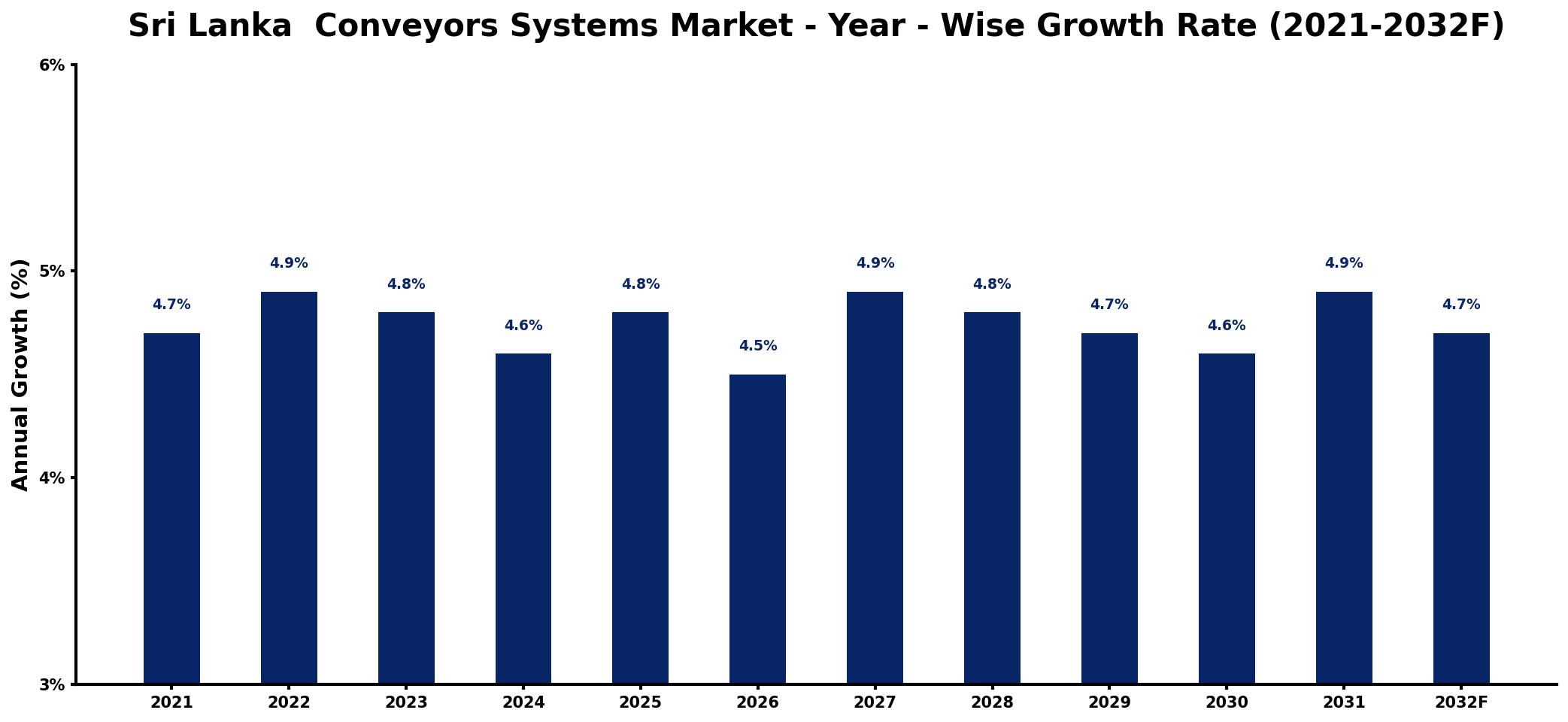
The table below presents the year‑wise growth rates along with the key drivers influencing the market
| Year | Growth Rate | Major Drivers |
| 2021 | 4.7% | Rising demand in manufacturing sector |
| 2022 | 4.9% | Increased investments in automation |
| 2023 | 4.8% | Expansion of logistics infrastructure |
| 2024 | 4.6% | Growth in retail distribution networks |
| 2025 | 4.8% | Boost in e-commerce activities |
| 2026 | 4.5% | Advancements in technology adoption |
| 2027 | 4.9% | Surge in food processing industry |
| 2028 | 4.8% | Development of renewable energy projects |
| 2029 | 4.7% | rising procurement volume requirements |
| 2030 | 4.6% | Rising need for efficient warehousing |
| 2031 | 4.9% | strengthening international trade flows |
| 2032 | 4.7% | Increased focus on supply chain |
Note: Market size estimations and growth projections presented in this report are based on 6Wresearch's proprietary forecasting methodology, utilizing the latest available industry data, government publications, and primary research inputs.
Sri Lanka Conveyors Systems Market Synopsis
The most compelling force shaping the Sri Lanka Conveyors Systems Market right now is the rapid expansion of industries such as food processing and packaging. These sectors are increasingly adopting conveyor systems to streamline operations and enhance productivity. As industries seek to improve efficiency, the demand for advanced material handling solutions becomes paramount.
Another major influence is the integration of automation technologies within these sectors. As businesses strive for operational excellence, the deployment of conveyor systems equipped with IoT capabilities for real-time monitoring and control is becoming more prevalent, driving innovation and investment within the market.
Sri Lanka Conveyors Systems Market Key Takeaways
- The market is set to grow steadily, driven by industrialization and automation across various sectors.
- Government initiatives are enhancing infrastructure and supporting market expansion.
- Technological advancements, particularly in automation and IoT, are shaping the future of conveyor systems.
- Customization and energy efficiency are becoming key focus areas for manufacturers.
- Investment opportunities are abundant, particularly in sectors like manufacturing and logistics.
Evaluation of Restraints in Sri Lanka Conveyors Systems Market
Despite the promising outlook, the Sri Lanka Conveyors Systems Market faces several constraints that could hinder growth. Limited awareness of advanced conveyor technologies among businesses leads to lower adoption rates. Furthermore, the market is saturated with small-scale manufacturers, resulting in varying quality levels that can affect customer trust. Inadequate infrastructure, high initial investment costs, and lingering reliance on manual labor practices in certain sectors further challenge the uptake of conveyor systems. Addressing these issues will require focused efforts in education, standardization, and collaboration with government agencies.
Sri Lanka Conveyors Systems Market Trends
A significant trend in the Sri Lanka Conveyors Systems Market is the shift toward automation technology aimed at improving efficiency and productivity. This is coupled with a growing interest in modular conveyor systems that provide flexibility and scalability for evolving production needs. Additionally, the market is seeing an increasing emphasis on sustainability, with businesses opting for eco-friendly materials and energy-efficient components in their conveyor solutions. Integration of IoT for enhanced monitoring and control is also a defining trend, enabling businesses to optimize their operations in real-time.
Sri Lanka Conveyors Systems Market Opportunities
The market offers numerous investment opportunities, particularly in developing customized conveyor systems tailored to meet the specific needs of sectors like agriculture, food processing, and logistics. The rising trend towards automation creates pathways for innovation in components such as sensors, software, and robotics. Furthermore, collaboration with local partners and leveraging governmental support for infrastructure development can yield significant returns as the demand for advanced material handling solutions increases.
Government Initiatives in the Sri Lanka Conveyors Systems Market
The Sri Lankan government has been proactive in promoting the use of conveyor systems as a means to enhance operational efficiency across industries. Various incentives and subsidies have been introduced to encourage companies to invest in modern conveyor solutions. Moreover, regulatory measures ensure safety and quality standards for conveyor systems, with regular compliance checks implemented to maintain industry integrity. The government also supports research and development in conveyor technologies, fostering innovation and growth in this crucial sector.
Future Insights of the Sri Lanka Conveyors Systems Market
Looking ahead to 2026-2032, the Sri Lanka Conveyors Systems Market is anticipated to continue its growth trajectory, driven by industrial activities and ongoing infrastructure projects. The demand for efficient material handling solutions across various sectors is set to rise, particularly as businesses embrace technological advancements. With government policies geared towards enhancing industrial productivity and improving transportation networks, the market is well-positioned for substantial development in the coming years.
Sri Lanka Conveyors Systems Market Latest Developments (2025 - 2026)
Recent industry trends indicate a strong push towards the adoption of smart conveyor systems integrated with IoT capabilities, enabling businesses to optimize operations efficiently. A notable emphasis on sustainability has led to the exploration of eco-friendly materials in conveyor manufacturing. Additionally, collaborations between governmental bodies and private enterprises are gaining traction, aimed at fostering innovation and driving growth in the market.
Sri Lanka Conveyors Systems Market - Key Attractiveness of the Report
- 10 Years of Market Numbers
- Historical Data Starting from 2022 to 2025
- Base Year: 2025
- Forecast Data until 2032
- Key Performance Indicators Impacting the Market
- Major Upcoming Developments and Projects
Key Highlights of the Report:
- Sri Lanka Conveyors Systems Market Outlook
- Market Size of Sri Lanka Conveyors Systems Market, 2025
- Forecast of Sri Lanka Conveyors Systems Market, 2032
- Historical Data and Forecast of Sri Lanka Conveyors Systems Revenues & Volume for the Period 2022-2032F
- Sri Lanka Conveyors Systems Market Trend Evolution
- Sri Lanka Conveyors Systems Market Drivers and Challenges
- Sri Lanka Conveyors Systems Price Trends
- Sri Lanka Conveyors Systems Porter's Five Forces
- Sri Lanka Conveyors Systems Industry Life Cycle
- Historical Data and Forecast of Sri Lanka Conveyors Systems Market Revenues & Volume By Type for the Period 2022-2032F
- Historical Data and Forecast of Sri Lanka Conveyors Systems Market Revenues & Volume By Roller for the Period 2022-2032F
- Historical Data and Forecast of Sri Lanka Conveyors Systems Market Revenues & Volume By Flat Belt for the Period 2022-2032F
- Historical Data and Forecast of Sri Lanka Conveyors Systems Market Revenues & Volume By Wheel for the Period 2022-2032F
- Historical Data and Forecast of Sri Lanka Conveyors Systems Market Revenues & Volume By Vertical for the Period 2022-2032F
- Historical Data and Forecast of Sri Lanka Conveyors Systems Market Revenues & Volume By Others for the Period 2022-2032F
- Historical Data and Forecast of Sri Lanka Conveyors Systems Market Revenues & Volume By Location for the Period 2022-2032F
- Historical Data and Forecast of Sri Lanka Conveyors Systems Market Revenues & Volume By In-floor for the Period 2022-2032F
- Historical Data and Forecast of Sri Lanka Conveyors Systems Market Revenues & Volume By On-floor for the Period 2022-2032F
- Historical Data and Forecast of Sri Lanka Conveyors Systems Market Revenues & Volume By Overhead for the Period 2022-2032F
- Historical Data and Forecast of Sri Lanka Conveyors Systems Market Revenues & Volume By Load for the Period 2022-2032F
- Historical Data and Forecast of Sri Lanka Conveyors Systems Market Revenues & Volume By Unit Load for the Period 2022-2032F
- Historical Data and Forecast of Sri Lanka Conveyors Systems Market Revenues & Volume By Bulk Load for the Period 2022-2032F
- Historical Data and Forecast of Sri Lanka Conveyors Systems Market Revenues & Volume By Application for the Period 2022-2032F
- Historical Data and Forecast of Sri Lanka Conveyors Systems Market Revenues & Volume By Food & Beverages for the Period 2022-2032F
- Historical Data and Forecast of Sri Lanka Conveyors Systems Market Revenues & Volume By Pharmaceuticals for the Period 2022-2032F
- Historical Data and Forecast of Sri Lanka Conveyors Systems Market Revenues & Volume By Supply chain & Logistics for the Period 2022-2032F
- Historical Data and Forecast of Sri Lanka Conveyors Systems Market Revenues & Volume By Manufacturing for the Period 2022-2032F
- Historical Data and Forecast of Sri Lanka Conveyors Systems Market Revenues & Volume By Mining for the Period 2022-2032F
- Historical Data and Forecast of Sri Lanka Conveyors Systems Market Revenues & Volume By Others for the Period 2022-2032F
- Sri Lanka Conveyors Systems Import Export Trade Statistics
- Market Opportunity Assessment By Type
- Market Opportunity Assessment By Location
- Market Opportunity Assessment By Load
- Market Opportunity Assessment By Application
- Sri Lanka Conveyors Systems Top Companies Market Share
- Sri Lanka Conveyors Systems Competitive Benchmarking By Technical and Operational Parameters
- Sri Lanka Conveyors Systems Company Profiles
- Sri Lanka Conveyors Systems Key Strategic Recommendations






































