Sri Lanka Cultured Meat Market Size, Share & Growth Rate
The Sri Lanka Cultured Meat Market was estimated at USD 731 Million in 2025 and is projected to reach USD 1055 Million by 2032, growing at a CAGR of 5.4% from 2026 to 2032. This anticipated growth is underpinned by a rising consumer demand for sustainable and ethical food alternatives, which have gained traction in the wake of increasing awareness surrounding environmental issues and animal welfare. Additionally, advancements in biotechnology and cellular agriculture are paving the way for more efficient production methods, further fueling the market's development.
Sri Lanka Cultured Meat Market Year-wise Growth Rate and Key Drivers
This graph highlights how the Sri Lanka Cultured Meat Market has steadily grown over the years, supported by major growth factors.
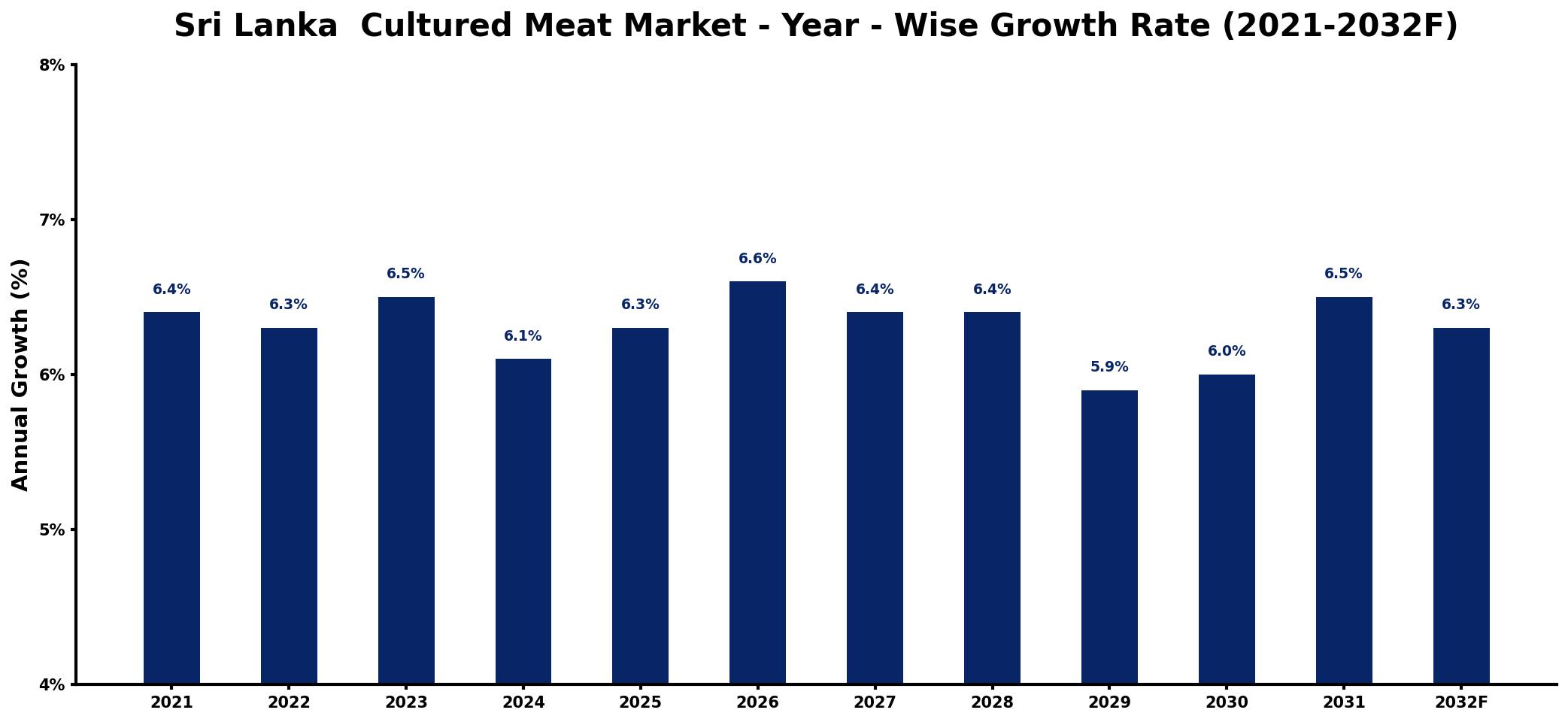
The table below presents the year‑wise growth rates along with the key drivers influencing the market
| Year | Growth Rate | Major Drivers |
| 2021 | 6.4% | Increased consumer health awareness |
| 2022 | 6.3% | Rising investment in alternatives |
| 2023 | 6.5% | Growing environmental sustainability focus |
| 2024 | 6.1% | Expansion of distribution networks |
| 2025 | 6.3% | Enhanced technology in production |
| 2026 | 6.6% | Growing demand for protein sources |
| 2027 | 6.4% | Increase in regulatory support |
| 2028 | 6.4% | Emerging market opportunities identified |
| 2029 | 5.9% | Shift towards ethical consumption trends |
| 2030 | 6.0% | Innovations in food technology |
| 2031 | 6.5% | Strengthened international partnerships formed |
| 2032 | 6.3% | Heightened awareness of food security |
Note: Market size estimations and growth projections presented in this report are based on 6Wresearch's proprietary forecasting methodology, utilizing the latest available industry data, government publications, and primary research inputs.
Sri Lanka Cultured Meat Market Synopsis
Sri Lanka's cultured meat market is at a critical juncture, reflecting a growing recognition of the need for sustainable food sources. Consumer interest is shifting towards lab-grown meat as awareness of its environmental benefits increases, presenting an opportunity for local innovators to make significant strides in this emerging sector.
Despite being in its infancy, the market for cultured meat is gaining momentum, driven by both local and global trends in food sustainability. However, public awareness remains limited, creating a pressing need for education and outreach initiatives that can bridge the knowledge gap and foster acceptance of this innovative food technology.
Sri Lanka Cultured Meat Market Key Takeaways
- Rapidly increasing consumer interest in ethical and sustainable food sources is propelling the cultured meat market.
- Biotechnology advancements are lowering production costs and enhancing the efficiency of cultured meat manufacturing.
- Low public awareness and cultural resistance present significant barriers to market penetration and acceptance.
- Government support through policy and funding can play a pivotal role in accelerating market development.
- Growth in food security concerns in Sri Lanka is creating a favorable environment for the acceptance of lab-grown meat.
Evaluation of Restraints in Sri Lanka Cultured Meat Market
The Sri Lanka cultured meat market faces several formidable barriers that could hinder its growth trajectory. High production costs, driven largely by the need for specialized biotechnological infrastructure, are a primary concern. Furthermore, the cultural context surrounding meat consumption in Sri Lanka brings ethical considerations into play, with many consumers remaining skeptical of lab-grown alternatives. Regulatory uncertainties surrounding commercialization and food safety standards further complicate the landscape, adding layers of complexity that must be navigated to achieve market growth.
Sri Lanka Cultured Meat Market Trends
A notable trend in the Sri Lanka cultured meat market is the increasing collaboration between startups and research institutions aimed at developing more accessible production techniques. Additionally, the rise of plant-based diets is indirectly fueling interest in alternative protein sources, including cultured meat. There is also a growing emphasis on transparency and traceability in food production, prompting consumers to seek out ethically produced options. This reflects a broader global trend toward conscious consumerism.
Sri Lanka Cultured Meat Market Opportunities
Opportunities in the Sri Lanka cultured meat market lie predominantly in technological innovation and consumer education. By focusing on reducing production costs through biotechnological advances, companies can offer more competitive pricing. Moreover, strategic partnerships with educational institutions could enhance public awareness and acceptance of cultured meat products. As consumer concerns over climate change and food security mount, the demand for lab-grown meat as a sustainable alternative could well increase, positioning early movers favorably in the market.
Government Initiatives in the Sri Lanka Cultured Meat Market
The Sri Lankan government has begun to recognize the potential of cultured meat as part of its broader food security and sustainability agenda. Current policies are focusing on enhancing food safety standards and encouraging innovations in food biotechnology. Grants and subsidies for research and development in alternative protein sources are also on the rise, indicating a supportive framework for startups and established entities looking to invest in cultured meat. These initiatives can significantly impact market entry and growth.
Future Insights of the Sri Lanka Cultured Meat Market
Looking ahead to 2026-2032, the Sri Lanka cultured meat market is poised for substantial evolution. As consumer perceptions shift towards sustainability, the demand for cultured meat is expected to rise significantly. With ongoing advancements in production technology and increased investment from both the public and private sectors, the market can anticipate a diversification of product offerings. As regulatory frameworks become clearer, the path for commercialization will likely become more navigable, fostering a new era for this innovative sector.
Sri Lanka Cultured Meat Market Latest Developments (2025 - 2026)
Recent developments in the Sri Lanka cultured meat market indicate a growing interest from local entrepreneurs in establishing bioprocessing facilities. Collaborative research projects are being initiated to explore innovative production methods, which could significantly reduce costs. Additionally, educational campaigns are being launched to inform consumers about the benefits and safety of lab-grown meat, aiming to enhance public acceptance and awareness in the coming years. These initiatives reflect a holistic approach to addressing the challenges faced by the market.
Sri Lanka Cultured Meat Market - Key Attractiveness of the Report
- 10 Years of Market Numbers
- Historical Data Starting from 2022 to 2025
- Base Year: 2025
- Forecast Data until 2032
- Key Performance Indicators Impacting the Market
- Major Upcoming Developments and Projects
Key Highlights of the Report:
- Sri Lanka Cultured Meat Market Outlook
- Market Size of Sri Lanka Cultured Meat Market, 2025
- Forecast of Sri Lanka Cultured Meat Market, 2032
- Historical Data and Forecast of Sri Lanka Cultured Meat Revenues & Volume for the Period 2022-2032F
- Sri Lanka Cultured Meat Market Trend Evolution
- Sri Lanka Cultured Meat Market Drivers and Challenges
- Sri Lanka Cultured Meat Price Trends
- Sri Lanka Cultured Meat Porter's Five Forces
- Sri Lanka Cultured Meat Industry Life Cycle
- Historical Data and Forecast of Sri Lanka Cultured Meat Market Revenues & Volume By Product Type for the Period 2022-2032F
- Historical Data and Forecast of Sri Lanka Cultured Meat Market Revenues & Volume By Poultry for the Period 2022-2032F
- Historical Data and Forecast of Sri Lanka Cultured Meat Market Revenues & Volume By Beef for the Period 2022-2032F
- Historical Data and Forecast of Sri Lanka Cultured Meat Market Revenues & Volume By Seafood for the Period 2022-2032F
- Historical Data and Forecast of Sri Lanka Cultured Meat Market Revenues & Volume By Pork for the Period 2022-2032F
- Historical Data and Forecast of Sri Lanka Cultured Meat Market Revenues & Volume By Duck for the Period 2022-2032F
- Historical Data and Forecast of Sri Lanka Cultured Meat Market Revenues & Volume By End-Use for the Period 2022-2032F
- Historical Data and Forecast of Sri Lanka Cultured Meat Market Revenues & Volume By Nuggets for the Period 2022-2032F
- Historical Data and Forecast of Sri Lanka Cultured Meat Market Revenues & Volume By Burgers for the Period 2022-2032F
- Historical Data and Forecast of Sri Lanka Cultured Meat Market Revenues & Volume By Meatballs for the Period 2022-2032F
- Historical Data and Forecast of Sri Lanka Cultured Meat Market Revenues & Volume By Sausage for the Period 2022-2032F
- Historical Data and Forecast of Sri Lanka Cultured Meat Market Revenues & Volume By Hot dogs for the Period 2022-2032F
- Historical Data and Forecast of Sri Lanka Cultured Meat Market Revenues & Volume By Others for the Period 2022-2032F
- Sri Lanka Cultured Meat Import Export Trade Statistics
- Market Opportunity Assessment By Product Type
- Market Opportunity Assessment By End-Use
- Sri Lanka Cultured Meat Top Companies Market Share
- Sri Lanka Cultured Meat Competitive Benchmarking By Technical and Operational Parameters
- Sri Lanka Cultured Meat Company Profiles
- Sri Lanka Cultured Meat Key Strategic Recommendations






































