Sri Lanka Data Migration Market Size & Growth Rate (2026-2032)
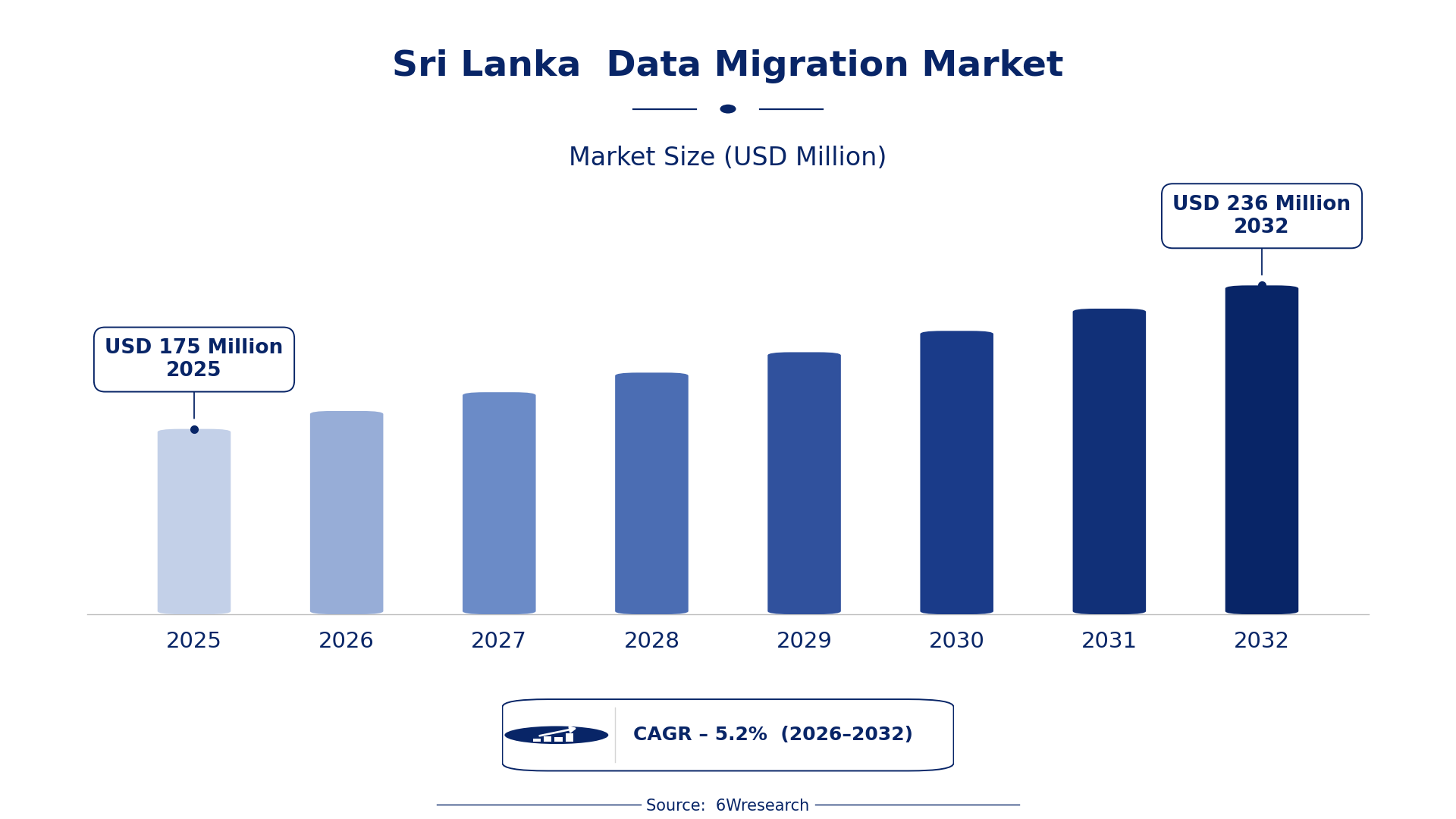
The Sri Lanka Data Migration Market was estimated at USD 175 Million in 2025 and is projected to reach USD 236 Million by 2032, growing at a CAGR of 5.2% from 2026 to 2032.
Sri Lanka Data Migration Market Synopsis
The Sri Lanka Data Migration Market is witnessing substantial growth as organizations pivot towards digitalization. This shift is primarily driven by the need to enhance operational efficiency and modernize IT infrastructures, particularly as businesses aim to transition from outdated legacy systems to more agile, cloud-based solutions.
However, as this momentum builds, challenges remain. Companies must address issues like data integrity and system compatibility while managing the complexities of large data transfers. As a result, the demand for sophisticated migration tools and expert services is only expected to rise, shaping a competitive market landscape.
Sri Lanka Data Migration Market Year-wise Growth Rate and Key Drivers
This graph illustrates the annual growth rates of the Sri Lanka Data Migration Market from 2021 to 2032, highlighting a steady upward trajectory and projected expansion over the forecast period.
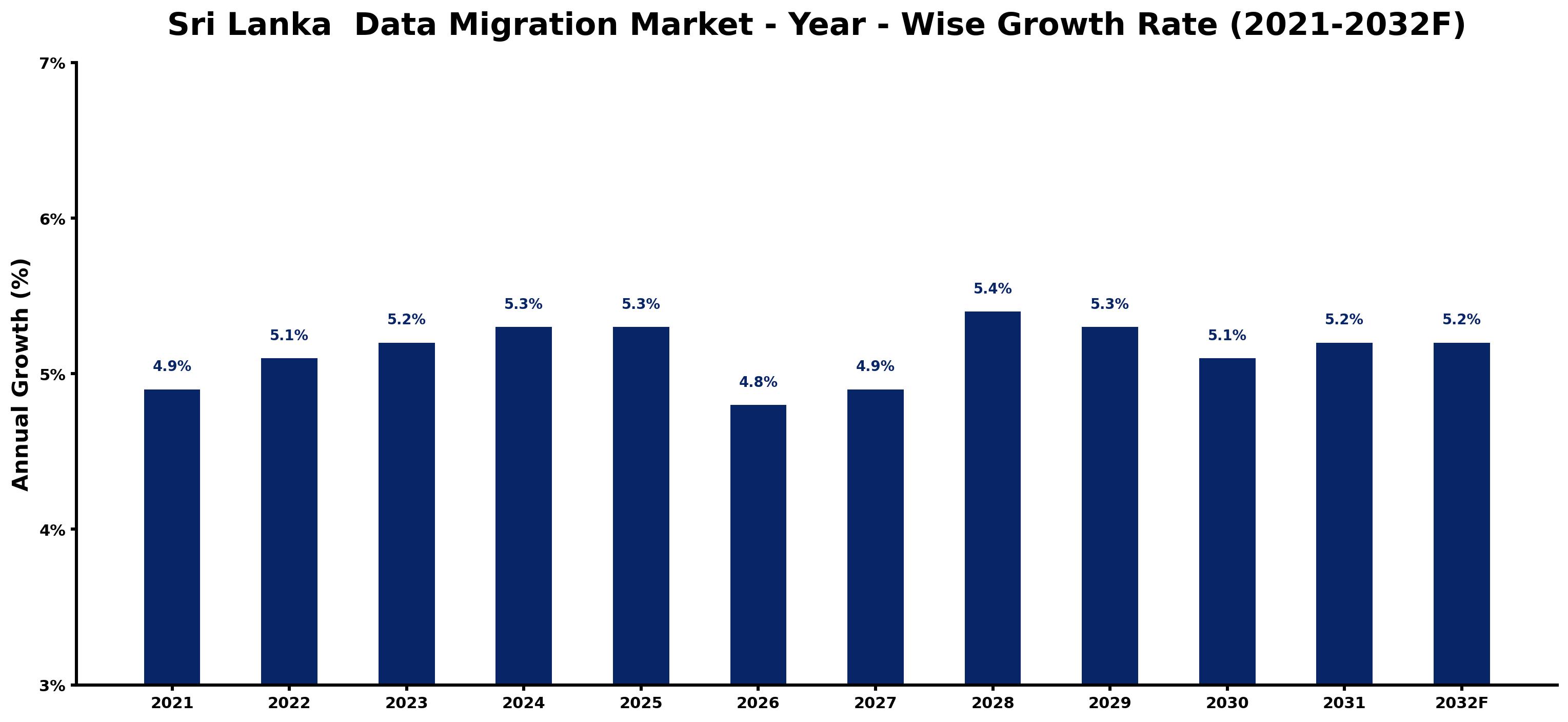
The table below presents the year‑wise growth rates along with the key drivers influencing the market
| Year | Growth Rate | Major Drivers |
| 2021 | 4.9% | National digital transformation initiative boosting cloud adoption |
| 2022 | 5.1% | Increased demand for secure data storage solutions post-pandemic |
| 2023 | 5.2% | Regulatory changes promoting data protection and compliance |
| 2024 | 5.3% | Growing local IT skills diminishing data transfer barriers |
| 2025 | 5.3% | Rising e-commerce sector driving data migration needs |
| 2026 | 4.8% | Government support for IT infrastructure development programs |
| 2027 | 4.9% | Expanding smartphone penetration enhancing data accessibility |
| 2028 | 5.4% | Enhanced cybersecurity fears heightening data migration urgency |
| 2029 | 5.3% | Emergence of local cloud service providers fostering competition |
| 2030 | 5.1% | Digital banking growth necessitating improved data strategies |
| 2031 | 5.2% | Increased foreign investments in tech infrastructure |
| 2032 | 5.2% | Advancements in AI analytics boosting data processing capabilities |
Note: Market size estimations and growth projections presented in this report are based on 6Wresearch's proprietary forecasting methodology, utilizing the latest available industry data, government publications, and primary research inputs.
Sri Lanka Data Migration Market Key Takeaways
Below are some of the specific key takeaways from the market, including:
- The market is expected to grow steadily, driven by increased cloud adoption and digital transformation initiatives.
- Businesses are prioritizing the automation of data migration processes to minimize downtime and ensure data integrity.
- Government guidelines are shaping best practices, helping organizations reduce risks associated with data migration.
- Investment in advanced data migration tools is critical for businesses to keep pace with evolving technological demands.
- Collaboration with service providers is becoming essential for effective migration strategies.
Evaluation of Restraints in Sri Lanka Data Migration Market
Despite its potential, the Sri Lanka Data Migration Market faces several restraints. High costs associated with data transfer, especially for larger organizations, remain a major hurdle. Additionally, ensuring data integrity during migration is paramount; any loss or corruption can have severe repercussions. Compatibility issues between legacy systems and modern platforms require meticulous planning, which can delay project timelines and inflate budgets. These factors necessitate a careful approach to data migration, limiting the pace at which some organizations can adapt.
Sri Lanka Data Migration Market Trends
The trend towards cloud computing is a primary catalyst for growth in the data migration sector. As businesses increasingly recognize the benefits of cloud solutions, there is a marked shift away from traditional data storage methods. Automation tools are also gaining traction, as they streamline migration processes and reduce the risk of human error. on top of that, organizations are focusing on data security during transfers, driving demand for robust encryption and compliance measures. The integration of AI and machine learning into migration tools is another emerging trend that promises to enhance efficiency and accuracy.
Sri Lanka Data Migration Market Opportunities
Opportunities abound in the Sri Lanka Data Migration Market, particularly for service providers who can offer tailored solutions. Companies looking to migrate to the cloud will require expert guidance and support, creating a demand for specialized consultancy services. Additionally, industries such as finance and healthcare, which handle sensitive data, are particularly poised for growth as they invest in secure migration strategies. With government backing for digital initiatives, new projects will likely emerge, offering fresh avenues for investment and development.
Government Initiatives in the Sri Lanka Data Migration Market
The Sri Lankan government is taking proactive steps to enhance the data migration environment. By establishing guidelines and policies, authorities aim to foster a secure and efficient migration process for organizations. These initiatives are crucial, especially as the nation seeks to modernize its IT infrastructure and encourage businesses to adopt advanced technologies.
- A national digital infrastructure upgrade programme is currently underway to enhance connectivity and facilitate easier data transfers.
- Regulatory guidelines introduced in early 2025 emphasize data integrity and minimal downtime during migration projects.
- A recently completed initiative provided funding for local organizations to invest in data migration technologies, bolstering modernization efforts.
- A planned public-private partnership is expected to launch in 2026, focusing on developing comprehensive training programs for data migration specialists.
- Ongoing efforts to streamline compliance regulations are in effect, aimed at simplifying the process for companies undertaking data migrations.
Future Insights of the Sri Lanka Data Migration Market
Looking ahead to 2026-2032, the Sri Lanka Data Migration Market is set for continued growth. As digital transformation becomes a priority across various sectors, the demand for efficient data migration solutions will only intensify. The integration of advanced technologies, alongside increasing government support, will pave the way for innovative migration strategies. Companies that can effectively address the challenges of data integrity and system compatibility will find themselves well-positioned to capitalize on the opportunities this market presents.
Sri Lanka Data Migration Market Latest Developments
In the past year, the Sri Lanka Data Migration Market has seen a flurry of activity as businesses ramp up their digital transformation efforts. The focus has shifted towards implementing sophisticated migration solutions to enhance operational efficiency and safeguard data integrity.
- A major technology vendor launched an advanced data migration tool in Q2 2025, designed to automate large-scale transfers with improved accuracy.
- A partnership between local IT firms was established in early 2025 to share best practices and enhance the skill sets of data migration professionals.
- In mid-2025, a leading regional operator rolled out a cloud-based migration service that simplifies the transition for small and medium enterprises.
- A new training programme aimed at upskilling IT staff for data migration projects is currently underway, launched in early 2025 and expected to conclude by late 2025.
- Upcoming regulatory revisions are planned for late 2026, which will address emerging data privacy concerns during migration processes.
Sri Lanka Data Migration Market - Key Attractiveness of the Report
- 10 Years of Market Numbers
- Historical Data Starting from 2022 to 2025
- Base Year: 2025
- Forecast Data until 2032
- Key Performance Indicators Impacting the Market
- Major Upcoming Developments and Projects
Key Highlights of the Report:
- Sri Lanka Data Migration Market Outlook
- Market Size of Sri Lanka Data Migration Market, 2025
- Forecast of Sri Lanka Data Migration Market, 2032
- Historical Data and Forecast of Sri Lanka Data Migration Revenues & Volume for the Period 2022-2032F
- Sri Lanka Data Migration Market Trend Evolution
- Sri Lanka Data Migration Market Drivers and Challenges
- Sri Lanka Data Migration Price Trends
- Sri Lanka Data Migration Porter's Five Forces
- Sri Lanka Data Migration Industry Life Cycle
- Historical Data and Forecast of Sri Lanka Data Migration Market Revenues & Volume By Data Type for the Period 2022-2032F
- Historical Data and Forecast of Sri Lanka Data Migration Market Revenues & Volume By Customer data for the Period 2022-2032F
- Historical Data and Forecast of Sri Lanka Data Migration Market Revenues & Volume By Product data for the Period 2022-2032F
- Historical Data and Forecast of Sri Lanka Data Migration Market Revenues & Volume By Financial data for the Period 2022-2032F
- Historical Data and Forecast of Sri Lanka Data Migration Market Revenues & Volume By Compliance data for the Period 2022-2032F
- Historical Data and Forecast of Sri Lanka Data Migration Market Revenues & Volume By Supplier data for the Period 2022-2032F
- Historical Data and Forecast of Sri Lanka Data Migration Market Revenues & Volume By Business Function for the Period 2022-2032F
- Historical Data and Forecast of Sri Lanka Data Migration Market Revenues & Volume By Marketing for the Period 2022-2032F
- Historical Data and Forecast of Sri Lanka Data Migration Market Revenues & Volume By Sales for the Period 2022-2032F
- Historical Data and Forecast of Sri Lanka Data Migration Market Revenues & Volume By Finance for the Period 2022-2032F
- Historical Data and Forecast of Sri Lanka Data Migration Market Revenues & Volume By Legal for the Period 2022-2032F
- Historical Data and Forecast of Sri Lanka Data Migration Market Revenues & Volume By Operations for the Period 2022-2032F
- Historical Data and Forecast of Sri Lanka Data Migration Market Revenues & Volume By Human Resources (HR) for the Period 2022-2032F
- Historical Data and Forecast of Sri Lanka Data Migration Market Revenues & Volume By Component for the Period 2022-2032F
- Historical Data and Forecast of Sri Lanka Data Migration Market Revenues & Volume By Software for the Period 2022-2032F
- Historical Data and Forecast of Sri Lanka Data Migration Market Revenues & Volume By Services for the Period 2022-2032F
- Historical Data and Forecast of Sri Lanka Data Migration Market Revenues & Volume By Deployment Model for the Period 2022-2032F
- Historical Data and Forecast of Sri Lanka Data Migration Market Revenues & Volume By On-premises for the Period 2022-2032F
- Historical Data and Forecast of Sri Lanka Data Migration Market Revenues & Volume By Cloud for the Period 2022-2032F
- Historical Data and Forecast of Sri Lanka Data Migration Market Revenues & Volume By Organization Size for the Period 2022-2032F
- Historical Data and Forecast of Sri Lanka Data Migration Market Revenues & Volume By Small and Medium-sized Enterprises (SMEs) for the Period 2022-2032F
- Historical Data and Forecast of Sri Lanka Data Migration Market Revenues & Volume By Large enterprises for the Period 2022-2032F
- Historical Data and Forecast of Sri Lanka Data Migration Market Revenues & Volume By Industry Vertical for the Period 2022-2032F
- Historical Data and Forecast of Sri Lanka Data Migration Market Revenues & Volume By Banking, Financial Services, and Insurance (BFSI) for the Period 2022-2032F
- Historical Data and Forecast of Sri Lanka Data Migration Market Revenues & Volume By Retail and consumer goods for the Period 2022-2032F
- Historical Data and Forecast of Sri Lanka Data Migration Market Revenues & Volume By Government and defense for the Period 2022-2032F
- Historical Data and Forecast of Sri Lanka Data Migration Market Revenues & Volume By Healthcare and life sciences for the Period 2022-2032F
- Historical Data and Forecast of Sri Lanka Data Migration Market Revenues & Volume By Manufacturing for the Period 2022-2032F
- Historical Data and Forecast of Sri Lanka Data Migration Market Revenues & Volume By Telecommunications and IT for the Period 2022-2032F
- Historical Data and Forecast of Sri Lanka Data Migration Market Revenues & Volume By Energy and utilities for the Period 2022-2032F
- Historical Data and Forecast of Sri Lanka Data Migration Market Revenues & Volume By Media and entertainment for the Period 2022-2032F
- Sri Lanka Data Migration Import Export Trade Statistics
- Market Opportunity Assessment By Data Type
- Market Opportunity Assessment By Business Function
- Market Opportunity Assessment By Component
- Market Opportunity Assessment By Deployment Model
- Market Opportunity Assessment By Organization Size
- Market Opportunity Assessment By Industry Vertical
- Sri Lanka Data Migration Top Companies Market Share
- Sri Lanka Data Migration Competitive Benchmarking By Technical and Operational Parameters
- Sri Lanka Data Migration Company Profiles
- Sri Lanka Data Migration Key Strategic Recommendations






































