Sri Lanka Data Monetization Market Size & Growth Rate (2026-2032)
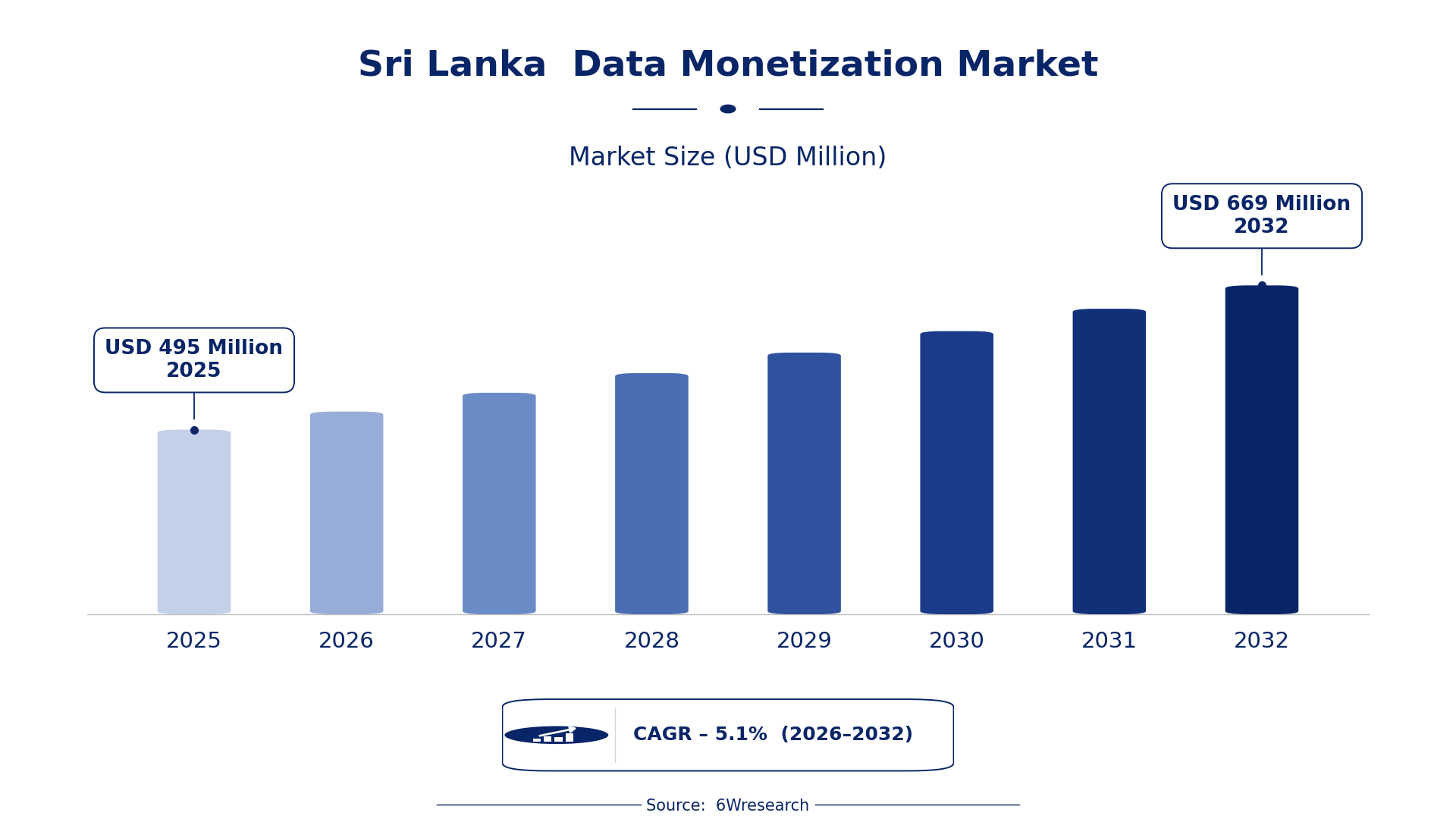
The Sri Lanka Data Monetization Market was estimated at USD 495 Million in 2025 and is projected to reach USD 669 Million by 2032, growing at a CAGR of 5.1% from 2026 to 2032.
Sri Lanka Data Monetization Market Synopsis
The driving force behind the Sri Lanka Data Monetization Market is the rapidly increasing adoption of digital technologies across various industries. Organizations are beginning to recognize the intrinsic value of their data and are keen to explore innovative channels for monetization.
Industries such as telecommunications, banking, and healthcare are at the forefront of this trend, actively seeking ways to leverage data for revenue generation. However, challenges like data privacy concerns and regulatory hurdles remain prevalent, requiring businesses to adopt comprehensive strategies to navigate these issues effectively.
Sri Lanka Data Monetization Market Year-wise Growth Rate and Key Drivers
This graph illustrates the annual growth rates of the Sri Lanka Data Monetization Market from 2021 to 2032, highlighting a steady upward trajectory and projected expansion over the forecast period.
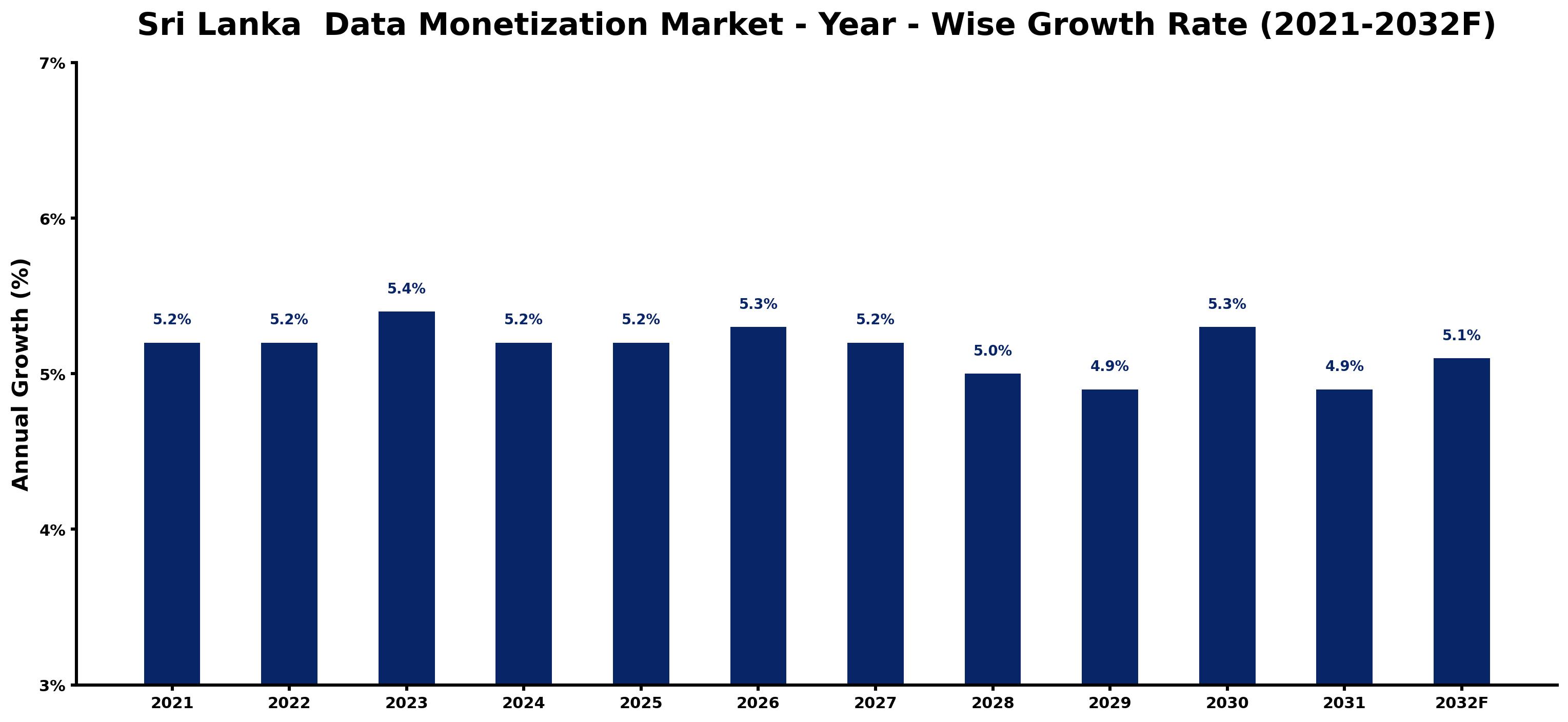
The table below presents the year‑wise growth rates along with the key drivers influencing the market
| Year | Growth Rate | Major Drivers |
| 2021 | 5.2% | Telecommunications Reform Act enhancing data privacy regulations |
| 2022 | 5.2% | Increased mobile penetration driving demand for data insights |
| 2023 | 5.4% | Emergence of local analytics startups fostering innovation growth |
| 2024 | 5.2% | Government push for digital economy through data utilization |
| 2025 | 5.2% | Rising fintech adoption fueling demand for data monetization |
| 2026 | 5.3% | Youth population growing interest in digital services analytics |
| 2027 | 5.2% | Partnerships with tech firms boosting data service offerings |
| 2028 | 5.0% | Increased e-commerce activity driving data utilization needs |
| 2029 | 4.9% | Growing importance of personalized marketing in local businesses |
| 2030 | 5.3% | Emerging AI applications demanding enhanced data strategies |
| 2031 | 4.9% | Regulatory incentives encouraging digital advertising data usage |
| 2032 | 5.1% | Local brands investing in data-driven customer engagement strategies |
Note: Market size estimations and growth projections presented in this report are based on 6Wresearch's proprietary forecasting methodology, utilizing the latest available industry data, government publications, and primary research inputs.
Sri Lanka Data Monetization Market Key Takeaways
Below are some of the specific key takeaways from the market, including:
- The market is expected to grow steadily, driven by the recognition of data's value across sectors.
- Investment in data analytics and management solutions is crucial for effective monetization.
- Regulatory compliance and data governance practices are increasingly influencing market dynamics.
- Emerging technologies like AI and machine learning are shaping the future of data monetization.
- Government initiatives aimed at digital transformation are creating a conducive environment for growth.
Evaluation of Restraints in Sri Lanka Data Monetization Market
A significant restraint in the Sri Lanka Data Monetization Market is the prevailing lack of awareness among businesses regarding the full potential of their data assets. Many organizations struggle with the effective collection, analysis, and monetization of data due to limited resources and expertise. Additionally, the existing concerns about data privacy and security regulations create hesitation to fully leverage data monetization strategies. Without a clear framework for data management, the market's growth is stunted, necessitating an educational shift in how businesses perceive and utilize their data.
Sri Lanka Data Monetization Market Trends
Current trends indicate a growing demand for advanced data analytics tools and platforms as businesses recognize the need for actionable insights. The push towards digital transformation is catalyzing this trend, with companies increasingly adopting data-as-a-service solutions. As awareness of data privacy regulations grows, organizations are investing in compliance measures, which in turn influences their monetization strategies. on top of that, the integration of AI and machine learning into analytics processes is helping organizations derive deeper insights from their data, enhancing monetization efforts.
Sri Lanka Data Monetization Market Opportunities
The Sri Lanka Data Monetization Market offers a plethora of investment opportunities across various sectors. The surge in data generation necessitates the development of data analytics services and management solutions. Industries such as finance and e-commerce are particularly ripe for the development of innovative data monetization strategies. on top of that, as organizations prioritize data security and compliance, investing in robust data governance frameworks presents a lucrative avenue for growth. Startups and established players alike can capitalize on these opportunities by providing tailored solutions that help businesses unlock the value of their data assets.
Government Initiatives in the Sri Lanka Data Monetization Market
The Sri Lankan government is fostering an environment conducive to digital transformation, which indirectly supports the Data Monetization Market. Through initiatives aimed at enhancing digital infrastructure and data governance, the government is addressing the needs of organizations striving to monetize their data effectively. These efforts are critical as businesses navigate the complexities of compliance and ethical data practices.
- A recently completed initiative focused on establishing the National Digital Economy Policy, aimed at promoting innovation and digitalization.
- A current project is underway to upgrade digital infrastructure across urban and rural areas, enhancing access to data-driven services.
- Upcoming plans include the introduction of a comprehensive regulatory framework aimed at strengthening data protection and privacy.
- The government is also promoting public-private partnerships to foster collaboration in technology adoption and data management.
- Ongoing workshops and training programs are being organized to educate businesses about data monetization strategies and best practices.
Future Insights of the Sri Lanka Data Monetization Market
Looking ahead to 2026-2032, the Sri Lanka Data Monetization Market is set to expand significantly. The growing reliance on advanced analytics and emerging technologies will drive demand for innovative data monetization solutions. As organizations increasingly recognize the value of their data assets, the focus will shift towards creating effective monetization strategies that align with regulatory requirements. This forward momentum will create opportunities for businesses that can effectively harness data for competitive advantage.
Sri Lanka Data Monetization Market Latest Developments
Recent activity in the Sri Lanka Data Monetization Market indicates a vibrant and dynamic environment. Organizations are actively exploring new avenues to capitalize on their data, with a marked increase in partnerships and technology rollouts. The focus is not only on monetization but also on ensuring compliance with evolving regulations.
- A major telecommunications operator launched a new data analytics platform in late 2025, aimed at providing businesses with actionable insights from their data.
- Current efforts are underway to develop an integrated data sharing platform that facilitates collaboration among various industries.
- In early 2026, a consortium of technology vendors initiated a program to enhance AI capabilities for local businesses, focusing on data-driven decision-making.
- An upcoming partnership between educational institutions and tech firms is planned to create training programs that build skills in data analytics and monetization.
- A new initiative to establish a national data registry is expected to begin in mid-2026, aimed at enhancing data governance and security.
Sri Lanka Data Monetization Market - Key Attractiveness of the Report
- 10 Years of Market Numbers
- Historical Data Starting from 2022 to 2025
- Base Year: 2025
- Forecast Data until 2032
- Key Performance Indicators Impacting the Market
- Major Upcoming Developments and Projects
Key Highlights of the Report:
- Sri Lanka Data Monetization Market Outlook
- Market Size of Sri Lanka Data Monetization Market, 2025
- Forecast of Sri Lanka Data Monetization Market, 2032
- Historical Data and Forecast of Sri Lanka Data Monetization Revenues & Volume for the Period 2022-2032F
- Sri Lanka Data Monetization Market Trend Evolution
- Sri Lanka Data Monetization Market Drivers and Challenges
- Sri Lanka Data Monetization Price Trends
- Sri Lanka Data Monetization Porter's Five Forces
- Sri Lanka Data Monetization Industry Life Cycle
- Historical Data and Forecast of Sri Lanka Data Monetization Market Revenues & Volume By Component for the Period 2022-2032F
- Historical Data and Forecast of Sri Lanka Data Monetization Market Revenues & Volume By Tools for the Period 2022-2032F
- Historical Data and Forecast of Sri Lanka Data Monetization Market Revenues & Volume By Services for the Period 2022-2032F
- Historical Data and Forecast of Sri Lanka Data Monetization Market Revenues & Volume By Consulting for the Period 2022-2032F
- Historical Data and Forecast of Sri Lanka Data Monetization Market Revenues & Volume By Support and Maintenance for the Period 2022-2032F
- Historical Data and Forecast of Sri Lanka Data Monetization Market Revenues & Volume By Implementation and Integration for the Period 2022-2032F
- Historical Data and Forecast of Sri Lanka Data Monetization Market Revenues & Volume By Data Type for the Period 2022-2032F
- Historical Data and Forecast of Sri Lanka Data Monetization Market Revenues & Volume By Customer Data for the Period 2022-2032F
- Historical Data and Forecast of Sri Lanka Data Monetization Market Revenues & Volume By Product Data for the Period 2022-2032F
- Historical Data and Forecast of Sri Lanka Data Monetization Market Revenues & Volume By Financial Data for the Period 2022-2032F
- Historical Data and Forecast of Sri Lanka Data Monetization Market Revenues & Volume By Supplier Data for the Period 2022-2032F
- Historical Data and Forecast of Sri Lanka Data Monetization Market Revenues & Volume By Business Function for the Period 2022-2032F
- Historical Data and Forecast of Sri Lanka Data Monetization Market Revenues & Volume By Supply Chain Management for the Period 2022-2032F
- Historical Data and Forecast of Sri Lanka Data Monetization Market Revenues & Volume By Sales and Marketing for the Period 2022-2032F
- Historical Data and Forecast of Sri Lanka Data Monetization Market Revenues & Volume By Operations for the Period 2022-2032F
- Historical Data and Forecast of Sri Lanka Data Monetization Market Revenues & Volume By Finance for the Period 2022-2032F
- Historical Data and Forecast of Sri Lanka Data Monetization Market Revenues & Volume By Others (Legal, R&D, and HR) for the Period 2022-2032F
- Historical Data and Forecast of Sri Lanka Data Monetization Market Revenues & Volume By Deployment Type for the Period 2022-2032F
- Historical Data and Forecast of Sri Lanka Data Monetization Market Revenues & Volume By On-premises for the Period 2022-2032F
- Historical Data and Forecast of Sri Lanka Data Monetization Market Revenues & Volume By Cloud for the Period 2022-2032F
- Historical Data and Forecast of Sri Lanka Data Monetization Market Revenues & Volume By Industry Vertical for the Period 2022-2032F
- Historical Data and Forecast of Sri Lanka Data Monetization Market Revenues & Volume By BFSI for the Period 2022-2032F
- Historical Data and Forecast of Sri Lanka Data Monetization Market Revenues & Volume By Telecom for the Period 2022-2032F
- Historical Data and Forecast of Sri Lanka Data Monetization Market Revenues & Volume By Consumer Goods and Retail for the Period 2022-2032F
- Historical Data and Forecast of Sri Lanka Data Monetization Market Revenues & Volume By Media and Entertainment for the Period 2022-2032F
- Historical Data and Forecast of Sri Lanka Data Monetization Market Revenues & Volume By Manufacturing for the Period 2022-2032F
- Historical Data and Forecast of Sri Lanka Data Monetization Market Revenues & Volume By Transportation and Logistics for the Period 2022-2032F
- Historical Data and Forecast of Sri Lanka Data Monetization Market Revenues & Volume By Energy and Utilities for the Period 2022-2032F
- Historical Data and Forecast of Sri Lanka Data Monetization Market Revenues & Volume By Healthcare for the Period 2022-2032F
- Historical Data and Forecast of Sri Lanka Data Monetization Market Revenues & Volume By Organization Size for the Period 2022-2032F
- Historical Data and Forecast of Sri Lanka Data Monetization Market Revenues & Volume By Small and Medium-Sized Enterprises(SMEs) for the Period 2022-2032F
- Historical Data and Forecast of Sri Lanka Data Monetization Market Revenues & Volume By Large Enterprises for the Period 2022-2032F
- Sri Lanka Data Monetization Import Export Trade Statistics
- Market Opportunity Assessment By Component
- Market Opportunity Assessment By Data Type
- Market Opportunity Assessment By Business Function
- Market Opportunity Assessment By Deployment Type
- Market Opportunity Assessment By Industry Vertical
- Market Opportunity Assessment By Organization Size
- Sri Lanka Data Monetization Top Companies Market Share
- Sri Lanka Data Monetization Competitive Benchmarking By Technical and Operational Parameters
- Sri Lanka Data Monetization Company Profiles
- Sri Lanka Data Monetization Key Strategic Recommendations






































