Sri Lanka Dehydrated Onions Market Size, Share & Growth Rate
The Sri Lanka Dehydrated Onions Market was estimated at USD 454 Million in 2025 and is projected to reach USD 630 Million by 2032, growing at a CAGR of 4.8% from 2026 to 2032. This growth is fueled by a notable shift in consumer behavior towards convenience foods, driven by increasingly hectic lifestyles. Furthermore, the expanding food processing sector is amplifying demand as manufacturers seek to optimize their production processes with long-lasting, easy-to-use ingredients.
Sri Lanka Dehydrated Onions Market Year-wise Growth Rate and Key Drivers
This graph highlights how the Sri Lanka Dehydrated Onions Market has steadily grown over the years, supported by major growth factors.
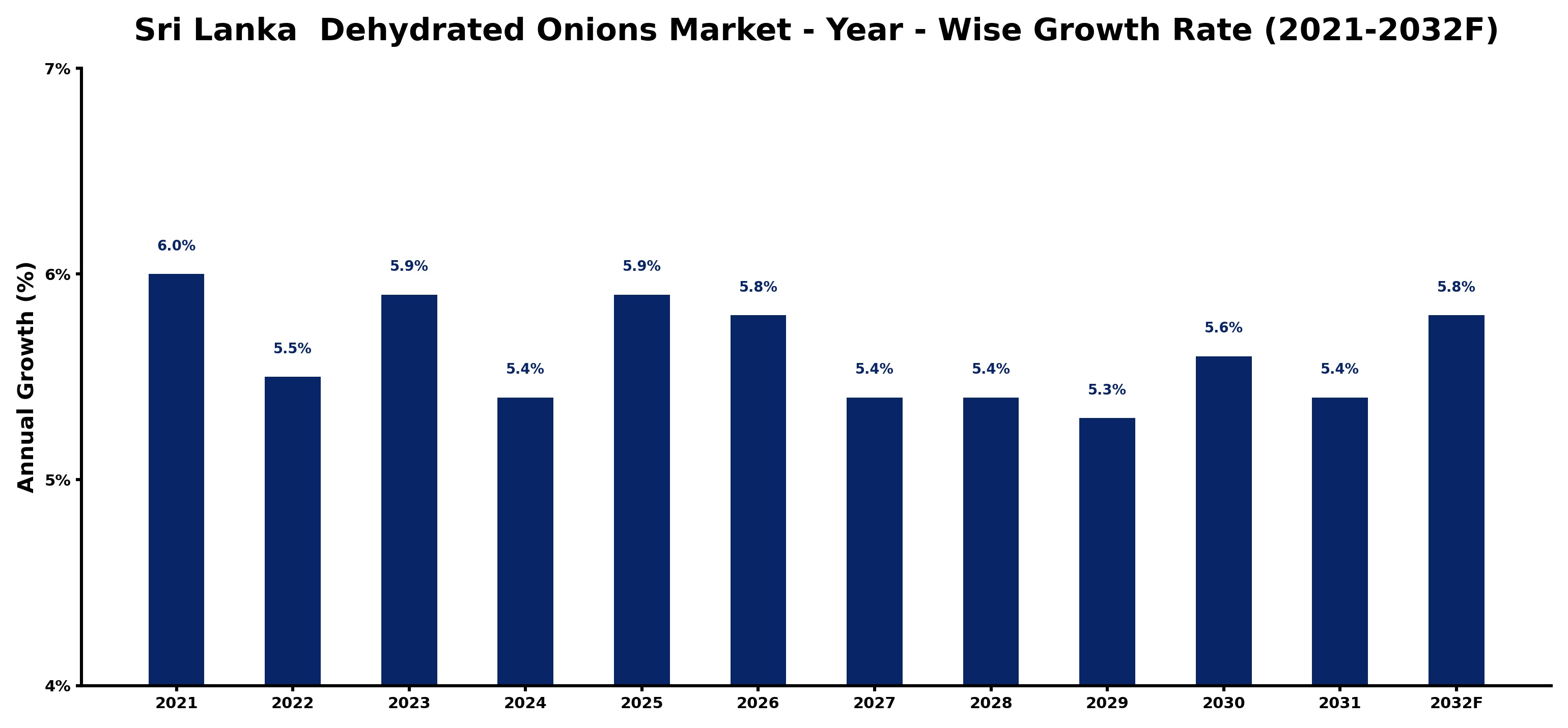
The table below presents the year‑wise growth rates along with the key drivers influencing the market
| Year | Growth Rate | Major Drivers |
| 2021 | 6.0% | Increased demand for convenience foods |
| 2022 | 5.5% | Rising health consciousness among consumers |
| 2023 | 5.9% | Growth in export opportunities emerged |
| 2024 | 5.4% | Expansion of food processing sector |
| 2025 | 5.9% | Adoption of organic products increased |
| 2026 | 5.8% | E-commerce platforms enhanced accessibility |
| 2027 | 5.4% | Culinary trends favored dehydrated products |
| 2028 | 5.4% | Rising popularity of plant-based diets |
| 2029 | 5.3% | Innovative packaging attracted new buyers |
| 2030 | 5.6% | Increased culinary tourism boosted sales |
| 2031 | 5.4% | Home cooking trends drove demand |
| 2032 | 5.8% | Sustainability initiatives enhanced brand loyalty |
Note - Market size estimations and growth projections presented in this report are based on 6Wresearch’s advanced forecasting approach, validated with industry datasets as of June 2026.
Sri Lanka Dehydrated Onions Market Synopsis
The key force shaping the Sri Lanka dehydrated onions market is the burgeoning preference for convenience and longer shelf-life products among consumers. As busy lifestyles take precedence, more individuals are gravitating towards dehydrated options that simplify meal preparation without compromising on flavor.
Moreover, traditional Sri Lankan cuisines are increasingly incorporating dehydrated onions, further solidifying their place in both homes and commercial kitchens. This trend is paving the way for significant expansion opportunities, benefiting both producers and consumers alike.
Sri Lanka Dehydrated Onions Market Key Takeaways
- The market is witnessing a steady increase in demand due to changing consumer preferences towards convenience foods.
- Long shelf life and ease of storage are key factors driving the popularity of dehydrated onions among consumers.
- The food processing industry in Sri Lanka is a major contributor to market growth as it adopts dehydrated products for enhanced efficiency.
- Investment opportunities are emerging in local processing facilities, high-quality raw material sourcing, and innovative packaging solutions.
- The Sri Lankan government is actively promoting initiatives to bolster domestic production and enhance market competitiveness.
Evaluation of Restraints in Sri Lanka Dehydrated Onions Market
Despite the promising growth, the Sri Lanka dehydrated onions market faces significant challenges. Fluctuations in raw material prices, often influenced by adverse weather conditions and varying crop yields, can adversely impact production costs and profitability. The infrastructure for processing and storage remains underdeveloped in certain regions, potentially stifling local producers' capabilities. Additionally, competition from imported dehydrated onions at lower prices continues to exert pressure on domestic manufacturers. Addressing these issues will be crucial for sustained market growth and success.
Sri Lanka Dehydrated Onions Market Trends
The market is currently seeing heightened interest in product innovation, as companies strive to enhance their offerings to meet evolving consumer demands. There is also an emerging trend toward organic and sustainably sourced dehydrated onions, aligning with global consumer expectations for health-conscious and environmentally friendly products. Additionally, marketing strategies are increasingly highlighting the versatility of dehydrated onions in various dishes, not just traditional cuisines, expanding their appeal.
Sri Lanka Dehydrated Onions Market Opportunities
Investment opportunities within the Sri Lanka dehydrated onions market are on the rise. With a growing demand for convenience foods, there are prospects for establishing new processing facilities that can efficiently cater to both domestic and export markets. Collaborating with local farmers to source high-quality onions not only supports the agricultural sector but also ensures a reliable supply chain. Furthermore, investments in innovative packaging technologies could significantly extend product shelf life and improve marketability.
Government Initiatives in the Sri Lanka Dehydrated Onions Market
The Sri Lankan government has instituted various supportive measures aimed at enhancing the dehydrated onions market. These initiatives include promoting sustainable agricultural practices and providing financial assistance to local farmers, thereby encouraging domestic production. Infrastructure improvements, particularly in storage and transportation, are also being prioritized to facilitate better access to markets. Additionally, the government is focused on maintaining quality standards and ensuring compliance with international food safety regulations, fostering consumer confidence.
Future Insights of the Sri Lanka Dehydrated Onions Market
Looking ahead to 2026-2032, the Sri Lanka dehydrated onions market is positioned for robust growth. Increasing consumer awareness about the benefits of dehydrated foods and their convenience will drive further demand, particularly in the food processing sector. Additionally, the potential for export will attract new entrants to the market, fostering innovation and competition. As consumers increasingly seek long-lasting and versatile food options, the dehydrated onions market is set to thrive in the upcoming years.
Sri Lanka Dehydrated Onions Market Latest Developments (May 2025 - June 2026)
Recent developments in the Sri Lanka dehydrated onions market indicate a strategic shift towards enhancing local production capabilities. Ongoing improvements in processing technologies and sustainability practices are being adopted by several players. There is also a noticeable increase in collaboration between producers and agricultural cooperatives aimed at ensuring a steady supply of quality raw materials, which aligns with both market needs and consumer expectations.
Sri Lanka Dehydrated Onions Market - Key Attractiveness of the Report
- 10 Years of Market Numbers
- Historical Data Starting from 2022 to 2025
- Base Year: 2025
- Forecast Data until 2032
- Key Performance Indicators Impacting the Market
- Major Upcoming Developments and Projects
Key Highlights of the Report:
- Sri Lanka Dehydrated Onions Market Outlook
- Market Size of Sri Lanka Dehydrated Onions Market, 2025
- Forecast of Sri Lanka Dehydrated Onions Market, 2032
- Historical Data and Forecast of Sri Lanka Dehydrated Onions Revenues & Volume for the Period 2022-2032F
- Sri Lanka Dehydrated Onions Market Trend Evolution
- Sri Lanka Dehydrated Onions Market Drivers and Challenges
- Sri Lanka Dehydrated Onions Price Trends
- Sri Lanka Dehydrated Onions Porter's Five Forces
- Sri Lanka Dehydrated Onions Industry Life Cycle
- Historical Data and Forecast of Sri Lanka Dehydrated Onions Market Revenues & Volume By Nature for the Period 2022-2032F
- Historical Data and Forecast of Sri Lanka Dehydrated Onions Market Revenues & Volume By Organic for the Period 2022-2032F
- Historical Data and Forecast of Sri Lanka Dehydrated Onions Market Revenues & Volume By Conventional for the Period 2022-2032F
- Historical Data and Forecast of Sri Lanka Dehydrated Onions Market Revenues & Volume By Variety for the Period 2022-2032F
- Historical Data and Forecast of Sri Lanka Dehydrated Onions Market Revenues & Volume By White Onion for the Period 2022-2032F
- Historical Data and Forecast of Sri Lanka Dehydrated Onions Market Revenues & Volume By Red Onion for the Period 2022-2032F
- Historical Data and Forecast of Sri Lanka Dehydrated Onions Market Revenues & Volume By Pink Onion for the Period 2022-2032F
- Historical Data and Forecast of Sri Lanka Dehydrated Onions Market Revenues & Volume By Hybrid for the Period 2022-2032F
- Historical Data and Forecast of Sri Lanka Dehydrated Onions Market Revenues & Volume By Form for the Period 2022-2032F
- Historical Data and Forecast of Sri Lanka Dehydrated Onions Market Revenues & Volume By Chopped for the Period 2022-2032F
- Historical Data and Forecast of Sri Lanka Dehydrated Onions Market Revenues & Volume By Minced for the Period 2022-2032F
- Historical Data and Forecast of Sri Lanka Dehydrated Onions Market Revenues & Volume By Granules for the Period 2022-2032F
- Historical Data and Forecast of Sri Lanka Dehydrated Onions Market Revenues & Volume By Powder for the Period 2022-2032F
- Historical Data and Forecast of Sri Lanka Dehydrated Onions Market Revenues & Volume By Flakes for the Period 2022-2032F
- Historical Data and Forecast of Sri Lanka Dehydrated Onions Market Revenues & Volume By Kibbled for the Period 2022-2032F
- Historical Data and Forecast of Sri Lanka Dehydrated Onions Market Revenues & Volume By Sliced for the Period 2022-2032F
- Historical Data and Forecast of Sri Lanka Dehydrated Onions Market Revenues & Volume By End-use for the Period 2022-2032F
- Historical Data and Forecast of Sri Lanka Dehydrated Onions Market Revenues & Volume By Food Proccessing for the Period 2022-2032F
- Historical Data and Forecast of Sri Lanka Dehydrated Onions Market Revenues & Volume By Food Service Providers for the Period 2022-2032F
- Historical Data and Forecast of Sri Lanka Dehydrated Onions Market Revenues & Volume By Retail/Household for the Period 2022-2032F
- Historical Data and Forecast of Sri Lanka Dehydrated Onions Market Revenues & Volume By Technology for the Period 2022-2032F
- Historical Data and Forecast of Sri Lanka Dehydrated Onions Market Revenues & Volume By Air Drying for the Period 2022-2032F
- Historical Data and Forecast of Sri Lanka Dehydrated Onions Market Revenues & Volume By Vaccum Drying for the Period 2022-2032F
- Historical Data and Forecast of Sri Lanka Dehydrated Onions Market Revenues & Volume By Freeze Drying for the Period 2022-2032F
- Historical Data and Forecast of Sri Lanka Dehydrated Onions Market Revenues & Volume By Microwave Drying for the Period 2022-2032F
- Historical Data and Forecast of Sri Lanka Dehydrated Onions Market Revenues & Volume By Spray Drying for the Period 2022-2032F
- Historical Data and Forecast of Sri Lanka Dehydrated Onions Market Revenues & Volume By Others for the Period 2022-2032F
- Historical Data and Forecast of Sri Lanka Dehydrated Onions Market Revenues & Volume By Distribution Channel for the Period 2022-2032F
- Historical Data and Forecast of Sri Lanka Dehydrated Onions Market Revenues & Volume By B2B for the Period 2022-2032F
- Historical Data and Forecast of Sri Lanka Dehydrated Onions Market Revenues & Volume By B2C for the Period 2022-2032F
- Sri Lanka Dehydrated Onions Import Export Trade Statistics
- Market Opportunity Assessment By Nature
- Market Opportunity Assessment By Variety
- Market Opportunity Assessment By Form
- Market Opportunity Assessment By End-use
- Market Opportunity Assessment By Technology
- Market Opportunity Assessment By Distribution Channel
- Sri Lanka Dehydrated Onions Top Companies Market Share
- Sri Lanka Dehydrated Onions Competitive Benchmarking By Technical and Operational Parameters
- Sri Lanka Dehydrated Onions Company Profiles
- Sri Lanka Dehydrated Onions Key Strategic Recommendations






































