Sri Lanka Deli Meat Market Size, Share & Growth Rate
The Sri Lanka Deli Meat Market was estimated at USD 180 Million in 2025 and is projected to reach USD 254 Million by 2032, growing at a CAGR of 5.0% from 2026 to 2032. This growth trajectory is significantly influenced by urbanization and evolving consumer preferences, with a marked shift towards ready-to-eat meat products. As busy lifestyles become the norm, the demand for convenient deli meats, such as ham, salami, and sausages, is on the rise, further bolstered by innovations in product preservation and packaging.
Sri Lanka Deli Meat Market Year-wise Growth Rate and Key Drivers
This graph highlights how the Sri Lanka Deli Meat Market has steadily grown over the years, supported by major growth factors.
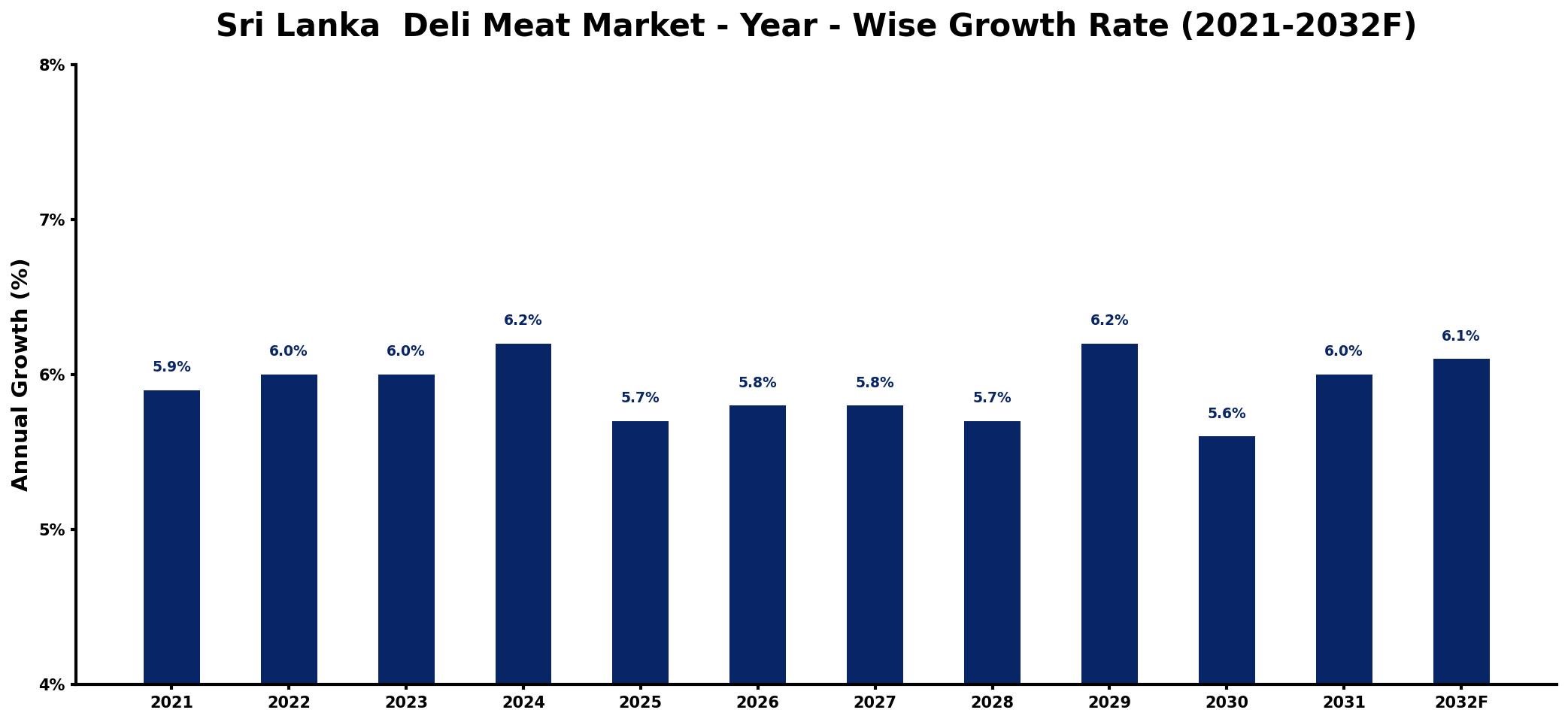
The table below presents the year‑wise growth rates along with the key drivers influencing the market
| Year | Growth Rate | Major Drivers |
| 2021 | 5.9% | Rising consumer health consciousness |
| 2022 | 6.0% | Increased demand for convenience foods |
| 2023 | 6.0% | Growth in retail distribution channels |
| 2024 | 6.2% | Expansion of gourmet food offerings |
| 2025 | 5.7% | Shift towards sustainable sourcing practices |
| 2026 | 5.8% | Emergence of online grocery shopping |
| 2027 | 5.8% | Increase in food service establishments |
| 2028 | 5.7% | Growing popularity of protein-rich diets |
| 2029 | 6.2% | Investments in cold chain logistics |
| 2030 | 5.6% | Development of innovative flavor profiles |
| 2031 | 6.0% | Boost in local production capabilities |
| 2032 | 6.1% | Enhanced marketing strategies targeting youth |
Note: Market size estimations and growth projections presented in this report are based on 6Wresearch's proprietary forecasting methodology, utilizing the latest available industry data, government publications, and primary research inputs.
Sri Lanka Deli Meat Market Synopsis
The Sri Lanka Deli Meat Market is witnessing a transformation, driven by an increasingly urban population eager for on-the-go meal solutions. Consumers are becoming more adventurous with their food choices, prompting manufacturers to diversify their offerings and cater to a wider array of tastes.
A notable aspect of this market is the rising influence of retail chains, which are expanding access to deli meat products. This enhanced availability, combined with effective marketing strategies, is making deli meats a staple in many households across Sri Lanka.
Sri Lanka Deli Meat Market Key Takeaways
- The market is experiencing robust growth due to shifting dietary habits and a preference for convenient meal options.
- Innovations in processing and packaging are enhancing product quality and shelf life, fueling consumer interest.
- Retail chain expansions are providing greater accessibility, making deli meats increasingly popular among urban consumers.
- Health-conscious trends are prompting manufacturers to explore healthier deli meat options, aligning with evolving consumer preferences.
- The government's supportive food safety regulations are ensuring the quality and safety of products in the market.
Evaluation of Restraints in Sri Lanka Deli Meat Market
Despite the promising growth, the Sri Lanka Deli Meat Market grapples with several constraints. Stringent food safety regulations necessitate a high level of quality control, which can drive up production costs. Furthermore, a growing consumer inclination towards fresh and healthier food options poses challenges for processed deli meats. Limited access to high-quality raw materials and fluctuating production costs also restrict the market's potential, making it essential for stakeholders to navigate these hurdles effectively.
Sri Lanka Deli Meat Market Trends
Several trends are currently shaping the Sri Lanka Deli Meat Market. First, there's an increasing demand for organic and preservative-free deli meat products, as health-conscious consumers seek cleaner food options. Additionally, sustainability practices are gaining traction, with more brands exploring environmentally friendly packaging solutions. E-commerce is also emerging as a pivotal channel for distribution, enabling consumers to access a wider selection of deli meats conveniently. These trends signify a market in evolution, responding to the dynamic needs of the modern consumer.
Sri Lanka Deli Meat Market Opportunities
The Sri Lanka Deli Meat Market presents numerous growth opportunities for businesses willing to innovate. The introduction of healthier alternatives—such as low-fat and plant-based deli meats—could capture the attention of a broader audience. Moreover, enhancing supply chain efficiencies can reduce costs and increase profitability. Expanding into rural areas, where access to deli products is currently limited, offers untapped potential for market players. Furthermore, leveraging social media for marketing campaigns can help build brand loyalty and attract younger consumers.
Government Initiatives in the Sri Lanka Deli Meat Market
The Sri Lankan government plays a vital role in supporting the deli meat market through stringent food safety regulations. These measures are designed to promote high standards in meat processing, packaging, and storage, ensuring that consumer safety is prioritized. Furthermore, incentives for local meat producers to adopt modern processing technologies are fostering advancements in the industry, encouraging a higher quality of deli meat offerings in the market.
Future Insights of the Sri Lanka Deli Meat Market
Looking ahead to the years 2026-2032, the Sri Lanka Deli Meat Market is poised for notable growth. As urbanization continues, the demand for convenient food solutions will likely rise, pushing deli meats further into the mainstream. Innovations in product development and marketing will be crucial in capturing the interest of health-conscious consumers. Moreover, embracing sustainability and eco-friendly practices could set businesses apart in a competitive market landscape. Overall, the future appears bright, contingent on adaptive strategies that align with evolving consumer expectations.
Sri Lanka Deli Meat Market Latest Developments (2025 - 2026)
Recent developments in the Sri Lanka Deli Meat Market indicate a strategic shift towards product diversification and health-oriented offerings. Industry players are increasingly focusing on developing low-sodium and organic options in response to consumer demand for healthier choices. Simultaneously, advancements in technology are enhancing preservation methods, which in turn improves product shelf life and safety. Retailers are also ramping up their e-commerce capabilities to cater to a digitally savvy consumer base, fostering wider market reach.
Sri Lanka Deli Meat Market - Key Attractiveness of the Report
- 10 Years of Market Numbers
- Historical Data Starting from 2022 to 2025
- Base Year: 2025
- Forecast Data until 2032
- Key Performance Indicators Impacting the Market
- Major Upcoming Developments and Projects
Key Highlights of the Report:
- Sri Lanka Deli Meat Market Outlook
- Market Size of Sri Lanka Deli Meat Market, 2025
- Forecast of Sri Lanka Deli Meat Market, 2032
- Historical Data and Forecast of Sri Lanka Deli Meat Revenues & Volume for the Period 2022-2032F
- Sri Lanka Deli Meat Market Trend Evolution
- Sri Lanka Deli Meat Market Drivers and Challenges
- Sri Lanka Deli Meat Price Trends
- Sri Lanka Deli Meat Porter's Five Forces
- Sri Lanka Deli Meat Industry Life Cycle
- Historical Data and Forecast of Sri Lanka Deli Meat Market Revenues & Volume By Source for the Period 2022-2032F
- Historical Data and Forecast of Sri Lanka Deli Meat Market Revenues & Volume By Beef for the Period 2022-2032F
- Historical Data and Forecast of Sri Lanka Deli Meat Market Revenues & Volume By Pork for the Period 2022-2032F
- Historical Data and Forecast of Sri Lanka Deli Meat Market Revenues & Volume By Chicken for the Period 2022-2032F
- Historical Data and Forecast of Sri Lanka Deli Meat Market Revenues & Volume By Others for the Period 2022-2032F
- Historical Data and Forecast of Sri Lanka Deli Meat Market Revenues & Volume By Product Type for the Period 2022-2032F
- Historical Data and Forecast of Sri Lanka Deli Meat Market Revenues & Volume By Cured Meat for the Period 2022-2032F
- Historical Data and Forecast of Sri Lanka Deli Meat Market Revenues & Volume By Uncured Meat for the Period 2022-2032F
- Historical Data and Forecast of Sri Lanka Deli Meat Market Revenues & Volume By Sales Channel for the Period 2022-2032F
- Historical Data and Forecast of Sri Lanka Deli Meat Market Revenues & Volume By Hypermarkets/Supermarkets for the Period 2022-2032F
- Historical Data and Forecast of Sri Lanka Deli Meat Market Revenues & Volume By Specialty Stores for the Period 2022-2032F
- Historical Data and Forecast of Sri Lanka Deli Meat Market Revenues & Volume By Convenience Stores for the Period 2022-2032F
- Historical Data and Forecast of Sri Lanka Deli Meat Market Revenues & Volume By Online Channels for the Period 2022-2032F
- Historical Data and Forecast of Sri Lanka Deli Meat Market Revenues & Volume By Others for the Period 2022-2032F
- Sri Lanka Deli Meat Import Export Trade Statistics
- Market Opportunity Assessment By Source
- Market Opportunity Assessment By Product Type
- Market Opportunity Assessment By Sales Channel
- Sri Lanka Deli Meat Top Companies Market Share
- Sri Lanka Deli Meat Competitive Benchmarking By Technical and Operational Parameters
- Sri Lanka Deli Meat Company Profiles
- Sri Lanka Deli Meat Key Strategic Recommendations






































