Sri Lanka Digital Insurance Platform Market Size & Growth Rate (2026-2032)
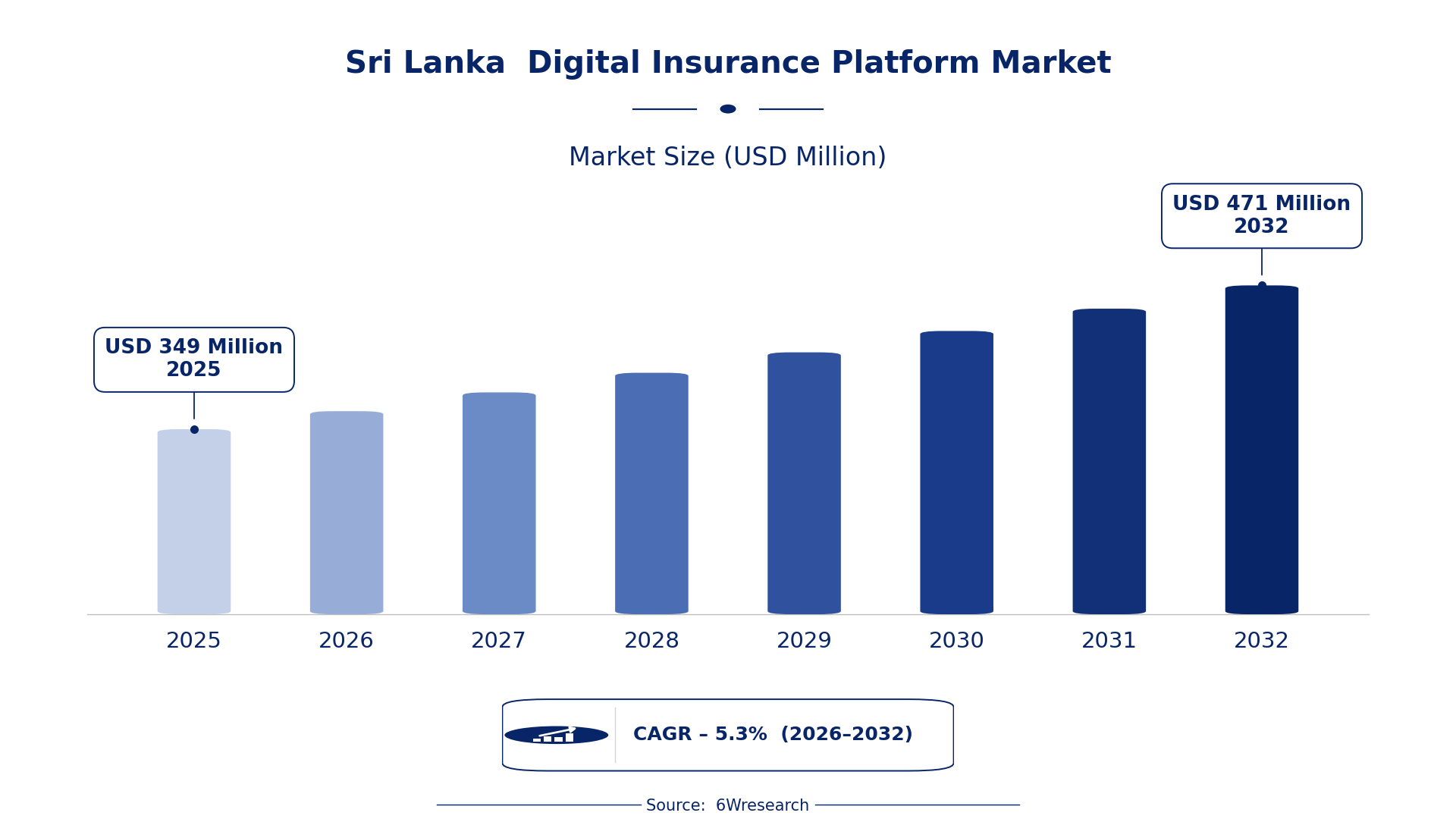
The Sri Lanka Digital Insurance Platform Market was estimated at USD 349 Million in 2025 and is projected to reach USD 471 Million by 2032, growing at a CAGR of 5.3% from 2026 to 2032.
Sri Lanka Digital Insurance Platform Market Synopsis
Sri Lanka's digital insurance platform market is witnessing a surge, driven by the increasing demand for technology-enhanced insurance solutions. Insurers are actively seeking to improve customer interactions and streamline operations, leading to a notable rise in the adoption of digital platforms.
A blend of insurtech startups and established insurers is reshaping the market. These players recognize the need to cater to tech-savvy consumers who expect personalized, efficient services through online channels. This evolution reflects a broader trend of digitization across the insurance sector.
Sri Lanka Digital Insurance Platform Market Year-wise Growth Rate and Key Drivers
This graph illustrates the annual growth rates of the Sri Lanka Digital Insurance Platform Market from 2021 to 2032, highlighting a steady upward trajectory and projected expansion over the forecast period.
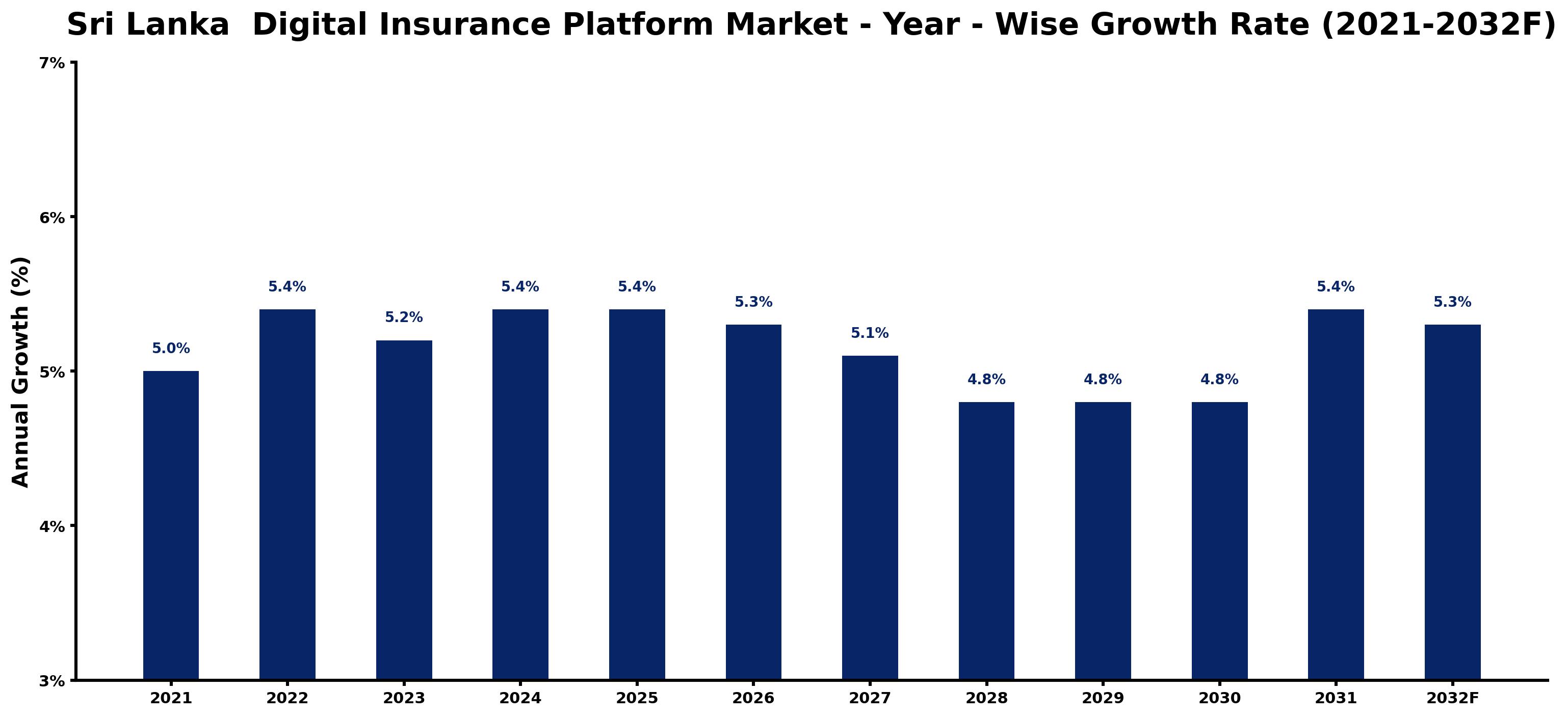
The table below presents the year‑wise growth rates along with the key drivers influencing the market
| Year | Growth Rate | Major Drivers |
| 2021 | 5.0% | Insurance Regulatory Commission promotes digital service adoption. |
| 2022 | 5.4% | Increased smartphone penetration enhances digital insurance accessibility. |
| 2023 | 5.2% | Adoption of cloud technology boosts platform innovation capabilities. |
| 2024 | 5.4% | Government tax incentives encourage digital insurance service providers. |
| 2025 | 5.4% | Growing urban population drives demand for convenient insurance solutions. |
| 2026 | 5.3% | Partnerships with fintech companies enhance product offerings. |
| 2027 | 5.1% | Public awareness campaigns highlight benefits of digital insurance. |
| 2028 | 4.8% | Regulatory push for efficient claim processes via digital platforms. |
| 2029 | 4.8% | Rising internet usage accelerates online insurance transactions. |
| 2030 | 4.8% | Enhanced data analytics improve risk assessment strategies. |
| 2031 | 5.4% | Youth demographic increasingly prefers digital insurance solutions. |
| 2032 | 5.3% | Increased focus on cybersecurity ensures user trust in platforms. |
Note: Market size estimations and growth projections presented in this report are based on 6Wresearch's proprietary forecasting methodology, utilizing the latest available industry data, government publications, and primary research inputs.
Sri Lanka Digital Insurance Platform Market Key Takeaways
Below are some of the specific key takeaways from the market, including:
- The market is set to grow significantly, reaching USD 471 Million by 2032.
- Adoption of digital platforms is reshaping policy management and claims processing.
- Consumer demand for personalized experiences is pushing insurers toward digital transformation.
- Data security and regulatory compliance remain crucial challenges for market players.
- Government initiatives are increasingly supporting digital solutions in the insurance sector.
Evaluation of Restraints in Sri Lanka Digital Insurance Platform Market
The growth of the digital insurance platform market in Sri Lanka is hindered by a few key restraints. A primary concern is data security, as insurers face growing threats in an increasingly digital environment. Compliance with regulatory frameworks adds another layer of complexity, making it essential for companies to integrate new digital solutions with existing legacy systems. on top of that, while consumers are becoming more comfortable with technology, skepticism around digital transactions remains, impacting market penetration and adoption rates.
Sri Lanka Digital Insurance Platform Market Trends
Several trends are currently shaping the digital insurance platform market in Sri Lanka. The move towards automation is gaining momentum, with insurers implementing AI-driven tools for claims processing and customer service. Data analytics is becoming essential, providing insights that help in tailoring products to meet specific consumer needs. Additionally, there is a growing emphasis on enhancing user experience through intuitive design in mobile and online platforms.
Sri Lanka Digital Insurance Platform Market Opportunities
The opportunities in the Sri Lanka digital insurance platform market are substantial. With increasing insurance penetration, there is a clear opportunity for insurers to attract new customers through personalized digital offerings. The rise of mobile internet usage opens doors for innovative app-based solutions that cater to consumer preferences. on top of that, partnerships between traditional insurers and insurtech firms can lead to enhanced capabilities and expanded market reach.
Government Initiatives in the Sri Lanka Digital Insurance Platform Market
Government policies in Sri Lanka are increasingly focused on fostering a conducive environment for digital insurance solutions. By establishing regulatory frameworks and consumer protection measures, the government aims to bolster the adoption of technology in the insurance sector. This strategic direction is crucial for enhancing efficiency and accessibility, ultimately improving customer experiences.
- A recent initiative launched in early 2025 introduced a regulatory framework that encourages digital transformation among insurers.
- Currently, the government is undertaking a public awareness campaign to educate consumers about the benefits of digital insurance solutions, aimed at increasing trust in digital transactions.
- A planned public-private partnership is expected to roll out by late 2026, focusing on enhancing digital infrastructure across the insurance sector.
- Ongoing efforts are aimed at streamlining compliance processes for insurers adopting digital platforms, set to be finalized by mid-2025.
Future Insights of the Sri Lanka Digital Insurance Platform Market
Looking ahead to 2026-2032, the Sri Lanka digital insurance platform market is on a clear upward trajectory. The integration of advanced technologies like artificial intelligence and machine learning will likely transform traditional insurance models. As consumer expectations evolve, insurers will need to focus on delivering not only products but also experiences that resonate with a digital-first audience. The market's growth will be propelled by strategic collaborations and the continuous adaptation of services to meet diverse consumer needs.
Sri Lanka Digital Insurance Platform Market Latest Developments
In the past year, the Sri Lanka digital insurance platform market has seen notable activity as insurers ramp up their digital transformation efforts. This momentum reflects a proactive approach to meeting the demands of a digitally savvy consumer base while navigating regulatory requirements.
- A major technology vendor launched a new mobile app designed to streamline customer interactions and claims processing, with a rollout completed in Q1 2025.
- An initiative began in early 2025 to enhance data security protocols, currently underway, aiming to bolster consumer trust in digital transactions.
- A leading regional operator is planning to introduce AI-driven customer support solutions, with a projected launch by mid-2026.
- By late 2025, several insurers are expected to have completed their migration to cloud-based platforms, enhancing operational efficiency and scalability.
Sri Lanka Digital Insurance Platform Market - Key Attractiveness of the Report
- 10 Years of Market Numbers
- Historical Data Starting from 2022 to 2025
- Base Year: 2025
- Forecast Data until 2032
- Key Performance Indicators Impacting the Market
- Major Upcoming Developments and Projects
Key Highlights of the Report:
- Sri Lanka Digital Insurance Platform Market Outlook
- Market Size of Sri Lanka Digital Insurance Platform Market, 2025
- Forecast of Sri Lanka Digital Insurance Platform Market, 2032
- Historical Data and Forecast of Sri Lanka Digital Insurance Platform Revenues & Volume for the Period 2022-2032F
- Sri Lanka Digital Insurance Platform Market Trend Evolution
- Sri Lanka Digital Insurance Platform Market Drivers and Challenges
- Sri Lanka Digital Insurance Platform Price Trends
- Sri Lanka Digital Insurance Platform Porter's Five Forces
- Sri Lanka Digital Insurance Platform Industry Life Cycle
- Historical Data and Forecast of Sri Lanka Digital Insurance Platform Market Revenues & Volume By Component for the Period 2022-2032F
- Historical Data and Forecast of Sri Lanka Digital Insurance Platform Market Revenues & Volume By Tools for the Period 2022-2032F
- Historical Data and Forecast of Sri Lanka Digital Insurance Platform Market Revenues & Volume By Services for the Period 2022-2032F
- Historical Data and Forecast of Sri Lanka Digital Insurance Platform Market Revenues & Volume By Service for the Period 2022-2032F
- Historical Data and Forecast of Sri Lanka Digital Insurance Platform Market Revenues & Volume By Managed services for the Period 2022-2032F
- Historical Data and Forecast of Sri Lanka Digital Insurance Platform Market Revenues & Volume By Professional services for the Period 2022-2032F
- Historical Data and Forecast of Sri Lanka Digital Insurance Platform Market Revenues & Volume By End-user for the Period 2022-2032F
- Historical Data and Forecast of Sri Lanka Digital Insurance Platform Market Revenues & Volume By Insurance companies for the Period 2022-2032F
- Historical Data and Forecast of Sri Lanka Digital Insurance Platform Market Revenues & Volume By Third-party administrators and brokers for the Period 2022-2032F
- Historical Data and Forecast of Sri Lanka Digital Insurance Platform Market Revenues & Volume By Aggregators for the Period 2022-2032F
- Historical Data and Forecast of Sri Lanka Digital Insurance Platform Market Revenues & Volume By Insurance Application for the Period 2022-2032F
- Historical Data and Forecast of Sri Lanka Digital Insurance Platform Market Revenues & Volume By Automotive and transportation for the Period 2022-2032F
- Historical Data and Forecast of Sri Lanka Digital Insurance Platform Market Revenues & Volume By Home and commercial buildings for the Period 2022-2032F
- Historical Data and Forecast of Sri Lanka Digital Insurance Platform Market Revenues & Volume By Life and health for the Period 2022-2032F
- Historical Data and Forecast of Sri Lanka Digital Insurance Platform Market Revenues & Volume By Business and enterprise for the Period 2022-2032F
- Historical Data and Forecast of Sri Lanka Digital Insurance Platform Market Revenues & Volume By Consumer electronics and industrial machines for the Period 2022-2032F
- Historical Data and Forecast of Sri Lanka Digital Insurance Platform Market Revenues & Volume By Travel for the Period 2022-2032F
- Historical Data and Forecast of Sri Lanka Digital Insurance Platform Market Revenues & Volume By Organization Size for the Period 2022-2032F
- Historical Data and Forecast of Sri Lanka Digital Insurance Platform Market Revenues & Volume By Small and Medium-sized Enterprises (SMEs) for the Period 2022-2032F
- Historical Data and Forecast of Sri Lanka Digital Insurance Platform Market Revenues & Volume By Large enterprises for the Period 2022-2032F
- Sri Lanka Digital Insurance Platform Import Export Trade Statistics
- Market Opportunity Assessment By Component
- Market Opportunity Assessment By Service
- Market Opportunity Assessment By End-user
- Market Opportunity Assessment By Insurance Application
- Market Opportunity Assessment By Organization Size
- Sri Lanka Digital Insurance Platform Top Companies Market Share
- Sri Lanka Digital Insurance Platform Competitive Benchmarking By Technical and Operational Parameters
- Sri Lanka Digital Insurance Platform Company Profiles
- Sri Lanka Digital Insurance Platform Key Strategic Recommendations






































