Sri Lanka Digital Printing Market Size, Share & Growth Rate
The Sri Lanka Digital Printing Market was estimated at USD 249 Million in 2025 and is projected to reach USD 352 Million by 2032, growing at a CAGR of 5.1% from 2026 to 2032. This upward trajectory is fueled by an increasing shift towards digital solutions across industries such as advertising, textiles, and packaging. The market is particularly benefiting from the demand for short print runs and customized solutions that digital technologies can efficiently provide.
Sri Lanka Digital Printing Market Year-wise Growth Rate and Key Drivers
This graph highlights how the Sri Lanka Digital Printing Market has steadily grown over the years, supported by major growth factors.
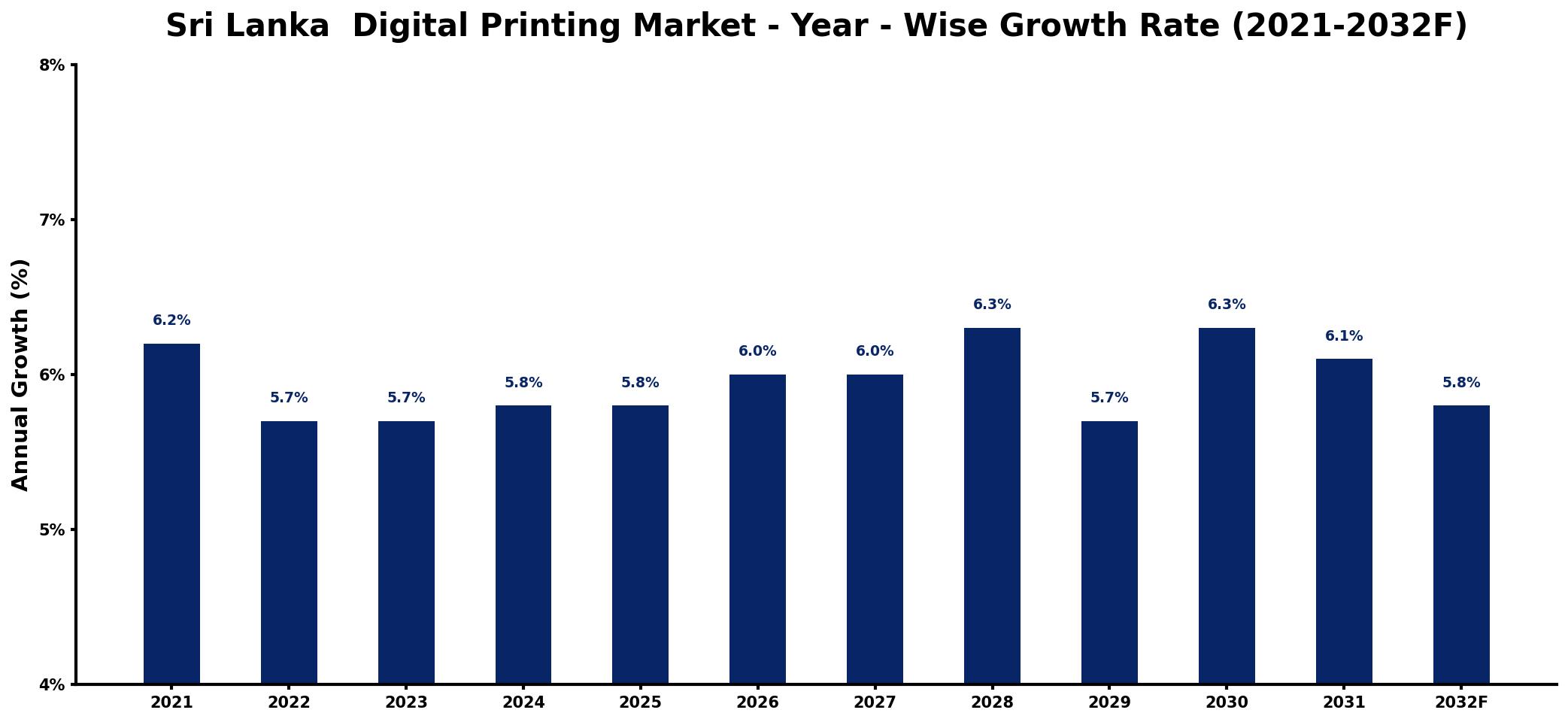
The table below presents the year‑wise growth rates along with the key drivers influencing the market
| Year | Growth Rate | Major Drivers |
| 2021 | 6.2% | increased demand from packaging sector |
| 2022 | 5.7% | growth in personalized marketing strategies |
| 2023 | 5.7% | expansion of e-commerce businesses |
| 2024 | 5.8% | rising popularity of custom designs |
| 2025 | 5.8% | investment in sustainable materials |
| 2026 | 6.0% | enhanced technology adoption rates |
| 2027 | 6.0% | emergence of new market players |
| 2028 | 6.3% | growing trend of short runs |
| 2029 | 5.7% | advancements in automation technologies |
| 2030 | 6.3% | increased focus on eco-friendly solutions |
| 2031 | 6.1% | surge in event-based promotions |
| 2032 | 5.8% | heightened demand for local production |
Note: Market size estimations and growth projections presented in this report are based on 6Wresearch's proprietary forecasting methodology, utilizing the latest available industry data, government publications, and primary research inputs.
Sri Lanka Digital Printing Market Synopsis
In Sri Lanka, the digital printing landscape is rapidly evolving, characterized by a robust embrace of advanced printing technologies. Industries are increasingly recognizing the value of quick turnaround times and cost-effective solutions that digital printing offers, driving a significant transformation in traditional printing paradigms.
The rise of e-commerce has also been pivotal in reshaping the demand for digital printing services. Businesses are keen to enhance their branding and marketing efforts, relying heavily on digital solutions to meet the personalized demands of their customers and adapt to changing consumer behaviors.
Sri Lanka Digital Printing Market Key Takeaways
- Rapid growth driven by increased demand for short print runs and customization.
- Technological advancements, particularly in UV and dye-sublimation printing.
- Emphasis on eco-friendly practices to meet sustainability goals.
- Emerging online printing services are changing the landscape of access and convenience.
- Government incentives are fostering innovation and competitiveness in the sector.
Evaluation of Restraints in Sri Lanka Digital Printing Market
Despite its promising outlook, the Sri Lanka Digital Printing Market faces several challenges. One significant barrier is the high initial investment required for advanced digital printing technologies, which can deter smaller businesses from entering the market. Additionally, there is a shortage of skilled professionals who can operate and maintain sophisticated digital printing equipment. This skills gap, combined with the fast-paced evolution of technology, necessitates constant updates and training, further complicating market entry for new players. Competitive pressures also contribute to margin erosion, compelling businesses to continually innovate while managing operational costs effectively.
Sri Lanka Digital Printing Market Trends
Key trends shaping the Sri Lanka Digital Printing Market include the growing popularity of advanced printing techniques such as UV printing and dye-sublimation printing. These technologies are celebrated for their high-quality output and efficiency. Furthermore, there is a rising focus on sustainability, with businesses increasingly adopting eco-friendly inks and materials to meet both consumer demand and regulatory expectations.
The proliferation of online printing services is another trend that is significantly impacting the market. These platforms are not only simplifying access to printing solutions but also fostering a culture of personalization, allowing customers to design and order print products conveniently, further stimulating market growth.
Sri Lanka Digital Printing Market Opportunities
The Sri Lanka Digital Printing Market presents numerous investment opportunities, particularly in personalized and on-demand printing services. Industries such as advertising, textiles, and packaging are ripe for growth, as they increasingly seek tailored solutions that digital printing can deliver. Additionally, as digitalization and e-commerce continue to grow, there is a pressing need for fast, high-quality printing solutions. Investing in innovative printing infrastructure will not only capitalize on current market demands but also position businesses favorably for future developments.
Government Initiatives in the Sri Lanka Digital Printing Market
The Sri Lankan government has actively implemented several policies to support the digital printing sector's growth. These policies include incentives aimed at encouraging businesses to adopt advanced printing technologies and promoting research and development initiatives within the industry. Furthermore, the government is facilitating access to finance for small and medium-sized enterprises, which are pivotal to the digital printing landscape. Efforts to streamline regulations and improve infrastructure create a supportive environment for innovation and competitiveness, fostering an overall boost to the market.
Future Insights of the Sri Lanka Digital Printing Market
Looking ahead to 2026-2032, the Sri Lanka Digital Printing Market is set to expand further, underpinned by continuous technological advancements and a growing appetite for customization among consumers. Businesses will increasingly leverage digital printing's capabilities to enhance their branding and market presence. The trend towards sustainable practices will also play a crucial role, as more companies seek to minimize waste and environmental impact. Overall, the outlook remains bright for the digital printing sector in Sri Lanka, offering abundant opportunities for innovation and growth.
Sri Lanka Digital Printing Market Latest Developments (2025 - 2026)
In recent months, the Sri Lanka Digital Printing Market has seen a flurry of developments. Companies are increasingly investing in state-of-the-art digital printing technologies, responding to the rising demand for customized printing solutions. Innovations in eco-friendly printing materials have emerged, reflecting a heightened awareness of sustainability among businesses and consumers alike. Additionally, collaborations between local firms and international technology providers are becoming more common, enhancing the competitive landscape and driving market evolution.
Sri Lanka Digital Printing Market - Key Attractiveness of the Report
- 10 Years of Market Numbers
- Historical Data Starting from 2022 to 2025
- Base Year: 2025
- Forecast Data until 2032
- Key Performance Indicators Impacting the Market
- Major Upcoming Developments and Projects
Key Highlights of the Report:
- Sri Lanka DigitalPrinting Market Outlook
- Market Size of Sri Lanka DigitalPrinting Market, 2025
- Forecast of Sri Lanka DigitalPrinting Market, 2032
- Historical Data and Forecast of Sri Lanka DigitalPrinting Revenues & Volume for the Period 2022-2032F
- Sri Lanka DigitalPrinting Market Trend Evolution
- Sri Lanka DigitalPrinting Market Drivers and Challenges
- Sri Lanka DigitalPrinting Price Trends
- Sri Lanka DigitalPrinting Porter's Five Forces
- Sri Lanka DigitalPrinting Industry Life Cycle
- Historical Data and Forecast of Sri Lanka DigitalPrinting Market Revenues & Volume By Printing Process for the Period 2022-2032F
- Historical Data and Forecast of Sri Lanka DigitalPrinting Market Revenues & Volume By Electrophotography for the Period 2022-2032F
- Historical Data and Forecast of Sri Lanka DigitalPrinting Market Revenues & Volume By Inkjet for the Period 2022-2032F
- Historical Data and Forecast of Sri Lanka DigitalPrinting Market Revenues & Volume By Application for the Period 2022-2032F
- Historical Data and Forecast of Sri Lanka DigitalPrinting Market Revenues & Volume By Books for the Period 2022-2032F
- Historical Data and Forecast of Sri Lanka DigitalPrinting Market Revenues & Volume By Commercial Printing for the Period 2022-2032F
- Historical Data and Forecast of Sri Lanka DigitalPrinting Market Revenues & Volume By Packaging for the Period 2022-2032F
- Historical Data and Forecast of Sri Lanka DigitalPrinting Market Revenues & Volume By Labels for the Period 2022-2032F
- Historical Data and Forecast of Sri Lanka DigitalPrinting Market Revenues & Volume By Corrugated Packaging for the Period 2022-2032F
- Historical Data and Forecast of Sri Lanka DigitalPrinting Market Revenues & Volume By Cartons for the Period 2022-2032F
- Historical Data and Forecast of Sri Lanka DigitalPrinting Market Revenues & Volume By Flexible Packaging for the Period 2022-2032F
- Historical Data and Forecast of Sri Lanka DigitalPrinting Market Revenues & Volume By Rigid Plastic Packaging for the Period 2022-2032F
- Historical Data and Forecast of Sri Lanka DigitalPrinting Market Revenues & Volume By Metal Packaging for the Period 2022-2032F
- Sri Lanka DigitalPrinting Import Export Trade Statistics
- Market Opportunity Assessment By Printing Process
- Market Opportunity Assessment By Application
- Market Opportunity Assessment By Packaging
- Sri Lanka DigitalPrinting Top Companies Market Share
- Sri Lanka DigitalPrinting Competitive Benchmarking By Technical and Operational Parameters
- Sri Lanka DigitalPrinting Company Profiles
- Sri Lanka DigitalPrinting Key Strategic Recommendations






































