Sri Lanka Educational Toys Market Size, Share & Growth Rate
The Sri Lanka Educational Toys Market was estimated at USD 428 Million in 2025 and is projected to reach USD 589 Million by 2032, growing at a CAGR of 4.7% from 2026 to 2032. This upward trajectory is primarily driven by the increasing emphasis on early childhood education, as parents become more aware of the critical role educational toys play in cognitive and social development. Additionally, the growing middle-class population in Sri Lanka is likely to enhance purchasing power, leading to heightened demand for innovative educational play products.
Sri Lanka Educational Toys Market Year-wise Growth Rate and Key Drivers
This graph highlights how the Sri Lanka Educational Toys Market has steadily grown over the years, supported by major growth factors.
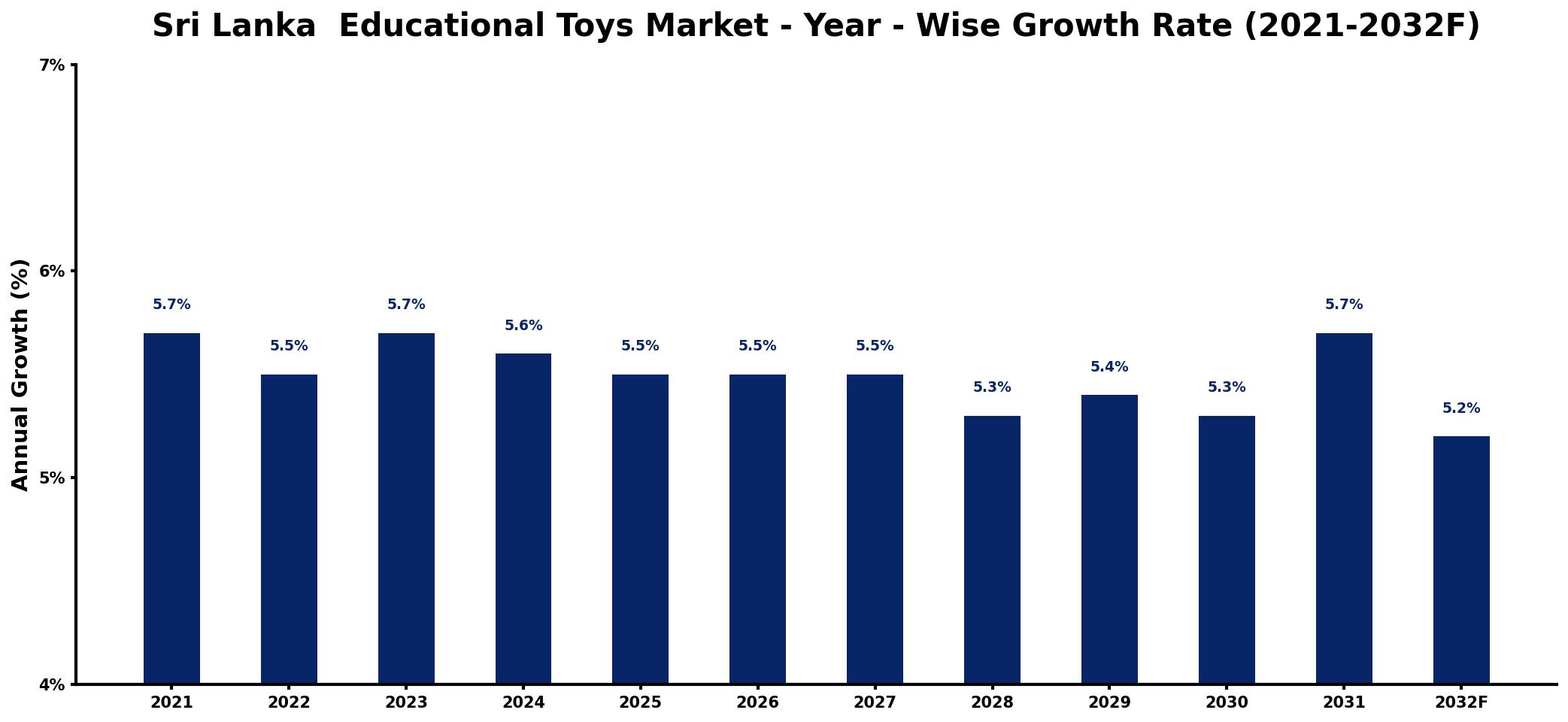
The table below presents the year‑wise growth rates along with the key drivers influencing the market
| Year | Growth Rate | Major Drivers |
| 2021 | 5.7% | Rising parental investment in learning |
| 2022 | 5.5% | Expansion of online learning platforms |
| 2023 | 5.7% | Increased focus on STEM education |
| 2024 | 5.6% | Growth in child development awareness |
| 2025 | 5.5% | Surge in product variety availability |
| 2026 | 5.5% | Enhanced digital learning integration |
| 2027 | 5.5% | expanding manufacturing base activity |
| 2028 | 5.3% | Shift towards sustainable materials usage |
| 2029 | 5.4% | Emergence of collaborative learning environments |
| 2030 | 5.3% | Increase in government funding initiatives |
| 2031 | 5.7% | Development of innovative learning methods |
| 2032 | 5.2% | Heightened emphasis on cognitive skills |
Note: Market size estimations and growth projections presented in this report are based on 6Wresearch's proprietary forecasting methodology, utilizing the latest available industry data, government publications, and primary research inputs.
Sri Lanka Educational Toys Market Synopsis
Recent momentum in the Sri Lanka Educational Toys Market underscores a transformative shift towards interactive and developmental products. As awareness about the benefits of educational toys rises, parents are increasingly seeking options that foster creativity and critical thinking in their children. However, the market is on the cusp of even greater expansion as the integration of technology in toys becomes more prominent, enabling enhanced learning experiences.
Looking forward, the market is projected to continue its growth, fueled by a combination of evolving consumer preferences and government initiatives aimed at promoting educational development. With both local and international manufacturers recognizing the potential, innovations in eco-friendly and STEM-oriented toys are poised to shape the future landscape of educational play.
Sri Lanka Educational Toys Market Key Takeaways
- The market is witnessing a surge in demand for educational toys that enhance cognitive skills and creativity.
- Technological integration in educational toys, such as coding kits and robotics, is reshaping consumer preferences.
- Parents are increasingly investing in sustainable and eco-friendly toys in response to environmental concerns.
- Government policies are promoting quality standards and increasing consumer awareness regarding educational toys.
- Investment opportunities abound in the manufacturing and distribution of innovative educational products.
Evaluation of Restraints in Sri Lanka Educational Toys Market
Despite the robust growth potential, the Sri Lanka Educational Toys Market faces several restraints that could hinder its full development. A notable challenge is the limited awareness among parents and educators about the significant benefits that educational toys offer. Many consumers remain unconvinced of the value these products provide compared to traditional toys. Furthermore, pricing barriers exist, as many educational toys are perceived to be more expensive, which may deter price-sensitive consumers. Additionally, distribution challenges, particularly in accessing both retail and online channels, further complicate market penetration efforts. Addressing these restraints through targeted awareness campaigns and enhancing distribution channels will be essential for unlocking the market's full potential.
Sri Lanka Educational Toys Market Trends
Current trends in the Sri Lanka Educational Toys Market reveal a strong preference for interactive and technology-enhanced products. STEM-focused toys are particularly in demand, with parents and educators looking for ways to integrate science, technology, engineering, arts, and mathematics into play. Eco-friendly toys are also gaining traction, aligning with a global shift towards sustainability. Moreover, there is a growing expectation for toys to not only entertain but also to contribute to holistic developmental outcomes for children, blending fun with education.
Sri Lanka Educational Toys Market Opportunities
Investment opportunities in the Sri Lanka Educational Toys Market are extensive, particularly in the development and distribution of innovative toys that combine educational value with entertainment. Manufacturers can capitalize on the rising interest in STEM education by creating products that engage children in hands-on learning experiences. There is also potential for integrating advanced technology, such as augmented reality, to create immersive educational experiences. Collaborating with educational institutions and leveraging e-commerce platforms for distribution can further enhance market access, attracting tech-savvy parents and diverse consumer segments.
Government Initiatives in the Sri Lanka Educational Toys Market
The Sri Lankan government has enacted various policies aimed at fostering the growth of the educational toys market. These initiatives include the establishment of safety standards that ensure toys are non-toxic and safe for children. Import regulations have been introduced to maintain the quality of educational toys available in the market, while incentives for local manufacturers encourage domestic production. Moreover, public awareness campaigns are being initiated to educate parents and caregivers about the developmental benefits of educational toys, ultimately supporting market expansion.
Future Insights of the Sri Lanka Educational Toys Market
Looking ahead to 2026-2032, the Sri Lanka Educational Toys Market is set to flourish, driven by increasing parental awareness of the importance of educational play in child development. The rise of disposable incomes and a growing middle-class demographic will likely boost spending on quality educational products. Additionally, the demand for interactive and eco-friendly toys will continue to shape product innovation. The expansion of e-commerce platforms will further enhance accessibility, enabling both local and international manufacturers to tap into this emerging market, thus paving the way for sustained growth.
Sri Lanka Educational Toys Market Latest Developments (2025 - 2026)
In the last year, the educational toys market in Sri Lanka has seen a notable shift towards online retail, with an increase in platforms dedicated to educational products. Industry stakeholders have been actively participating in awareness programs, highlighting the importance of educational toys in early childhood development. Additionally, manufacturers are launching new lines of STEM-focused toys that combine learning with play, meeting the evolving needs of consumers. Environmental sustainability has also gained traction, with several brands emphasizing eco-friendly materials in their product offerings.
Sri Lanka Educational Toys Market - Key Attractiveness of the Report
- 10 Years of Market Numbers
- Historical Data Starting from 2022 to 2025
- Base Year: 2025
- Forecast Data until 2032
- Key Performance Indicators Impacting the Market
- Major Upcoming Developments and Projects
Key Highlights of the Report:
- Sri Lanka Educational Toys Market Outlook
- Market Size of Sri Lanka Educational Toys Market, 2025
- Forecast of Sri Lanka Educational Toys Market, 2032
- Historical Data and Forecast of Sri Lanka Educational Toys Revenues & Volume for the Period 2022-2032F
- Sri Lanka Educational Toys Market Trend Evolution
- Sri Lanka Educational Toys Market Drivers and Challenges
- Sri Lanka Educational Toys Price Trends
- Sri Lanka Educational Toys Porter's Five Forces
- Sri Lanka Educational Toys Industry Life Cycle
- Historical Data and Forecast of Sri Lanka Educational Toys Market Revenues & Volume By Product Type for the Period 2022-2032F
- Historical Data and Forecast of Sri Lanka Educational Toys Market Revenues & Volume By Academic toys for the Period 2022-2032F
- Historical Data and Forecast of Sri Lanka Educational Toys Market Revenues & Volume By Cognitive toys for the Period 2022-2032F
- Historical Data and Forecast of Sri Lanka Educational Toys Market Revenues & Volume By Motor skills toys for the Period 2022-2032F
- Historical Data and Forecast of Sri Lanka Educational Toys Market Revenues & Volume By Others for the Period 2022-2032F
- Historical Data and Forecast of Sri Lanka Educational Toys Market Revenues & Volume By Age Group for the Period 2022-2032F
- Historical Data and Forecast of Sri Lanka Educational Toys Market Revenues & Volume By 1 ?? 4 years for the Period 2022-2032F
- Historical Data and Forecast of Sri Lanka Educational Toys Market Revenues & Volume By 4 ?? 8 years for the Period 2022-2032F
- Historical Data and Forecast of Sri Lanka Educational Toys Market Revenues & Volume By Above 8 years for the Period 2022-2032F
- Historical Data and Forecast of Sri Lanka Educational Toys Market Revenues & Volume By Others for the Period 2022-2032F
- Historical Data and Forecast of Sri Lanka Educational Toys Market Revenues & Volume By End-Users for the Period 2022-2032F
- Historical Data and Forecast of Sri Lanka Educational Toys Market Revenues & Volume By Residential for the Period 2022-2032F
- Historical Data and Forecast of Sri Lanka Educational Toys Market Revenues & Volume By Commercial for the Period 2022-2032F
- Sri Lanka Educational Toys Import Export Trade Statistics
- Market Opportunity Assessment By Product Type
- Market Opportunity Assessment By Age Group
- Market Opportunity Assessment By End-Users
- Sri Lanka Educational Toys Top Companies Market Share
- Sri Lanka Educational Toys Competitive Benchmarking By Technical and Operational Parameters
- Sri Lanka Educational Toys Company Profiles
- Sri Lanka Educational Toys Key Strategic Recommendations






































