Sri Lanka Electrical Components Market Size, Share & Growth Rate
The Sri Lanka Electrical Components Market was estimated at USD 370 Million in 2025 and is projected to reach USD 506 Million by 2032, growing at a CAGR of 4.6% from 2026 to 2032. This growth trajectory is fueled by significant infrastructure development, rapid urbanization, and increasing industrial activity across the nation. The governments focus on enhancing energy efficiency and promoting renewable energy further catalyzes demand for innovative electrical solutions.
Sri Lanka Electrical Components Market Year-wise Growth Rate and Key Drivers
This graph highlights how the Sri Lanka Electrical Components Market has steadily grown over the years, supported by major growth factors.
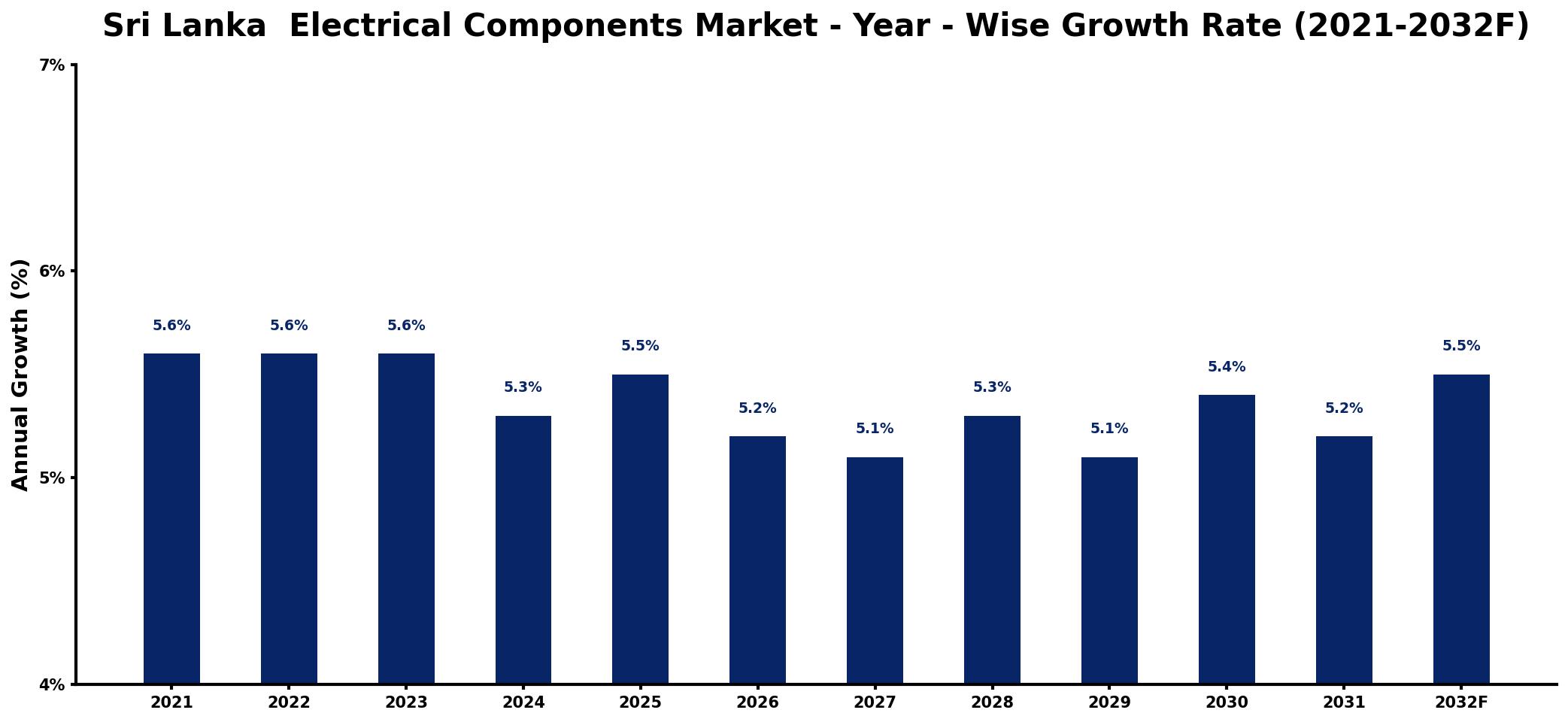
The table below presents the year‑wise growth rates along with the key drivers influencing the market
| Year | Growth Rate | Major Drivers |
| 2021 | 5.6% | Rising construction and infrastructure projects |
| 2022 | 5.6% | Increasing demand for renewable energy |
| 2023 | 5.6% | Expansion of manufacturing capabilities |
| 2024 | 5.3% | Growing urbanization and smart cities |
| 2025 | 5.5% | Investment in technological advancements |
| 2026 | 5.2% | Surge in residential automation systems |
| 2027 | 5.1% | Heightened focus on energy efficiency |
| 2028 | 5.3% | Development of transportation networks |
| 2029 | 5.1% | Boost in telecommunications infrastructure |
| 2030 | 5.4% | Growth in electric vehicle adoption |
| 2031 | 5.2% | Enhancement of industrial automation systems |
| 2032 | 5.5% | Rising trend in smart homes |
Note: Market size estimations and growth projections presented in this report are based on 6Wresearch's proprietary forecasting methodology, utilizing the latest available industry data, government publications, and primary research inputs.
Sri Lanka Electrical Components Market Synopsis
The most influential force currently shaping the Sri Lanka Electrical Components Market is the ongoing urbanization and infrastructure projects. These developments are leading to a heightened demand for a wide array of electrical products such as wires, cables, and energy-efficient lighting systems. As the nation modernizes, the necessity for reliable and innovative electrical solutions is increasingly prominent.
In parallel, the surge in renewable energy projects is creating a robust market for solar components and energy-efficient devices. Local manufacturers are adapting to meet the evolving needs, while international companies are also keen to explore the burgeoning opportunities presented by this dynamic market landscape.
Sri Lanka Electrical Components Market Key Takeaways
- The market is witnessing a strong shift towards energy-efficient and sustainable electrical products.
- Government initiatives are fostering local manufacturing and reducing dependency on imports.
- Technological advancements in automation and smart home solutions are gaining traction.
- Investment opportunities are growing, particularly in renewable energy and smart technologies.
- Infrastructure development is a key driver of demand in the electrical components sector.
Evaluation of Restraints in Sri Lanka Electrical Components Market
Despite the promising growth trajectory, several restraints limit the Sri Lanka Electrical Components Market. Fluctuating raw material prices pose significant challenges for manufacturers, complicating pricing stability. Furthermore, infrastructure inadequacies, particularly related to power supply and transportation, hinder efficient distribution. Additionally, competition from low-cost imports, particularly from neighboring countries, pressures local manufacturers to innovate constantly while maintaining competitive pricing. Addressing these challenges will require strategic planning and collaboration between stakeholders to foster a more resilient market environment.
Sri Lanka Electrical Components Market Trends
Currently, the market is undergoing a transformation characterized by a notable demand for energy-efficient and sustainable products. The government's commitment to renewable energy is enhancing the adoption of solar technologies and LED lighting solutions. Moreover, the rise of digitalization across various sectors is driving demand for smart components like sensors and smart meters. The trend towards smart home solutions is also gaining momentum, with consumers increasingly looking for integrated systems that enhance efficiency and control.
Sri Lanka Electrical Components Market Opportunities
The Sri Lanka Electrical Components Market is ripe with investment opportunities, particularly in sectors aligned with infrastructure development and renewable energy. The growing need for reliable electrical products such as cables, switches, and circuit breakers offers avenues for local manufacturing and distribution. Additionally, the push towards solar and wind energy solutions presents opportunities for companies to provide complementary electrical components. The advent of smart technologies within the electrical sector further amplifies potential growth areas for investors looking to capitalize on evolving market demands.
Government Initiatives in the Sri Lanka Electrical Components Market
The Sri Lankan government has instituted various policies aimed at fostering growth within the Electrical Components Market. These policies include import restrictions on specific electrical goods to stimulate local manufacturing, alongside tax incentives for companies investing domestically. Furthermore, initiatives promoting renewable energy technologies are designed to bolster demand for associated components. The government is also committed to enhancing infrastructure and supporting research and development efforts, thereby nurturing a more competitive local manufacturing landscape.
Future Insights of the Sri Lanka Electrical Components Market
The outlook for the Sri Lanka Electrical Components Market from 2026 to 2032 is optimistic, driven by continued urbanization, infrastructure enhancements, and industrial growth. The increasing focus on energy-efficient products, along with the rise of automation technologies, is expected to create additional avenues for market expansion. Moreover, the government's ongoing efforts to upgrade the electrical grid and promote renewable energy are poised to attract both local and international players, ensuring a vibrant competitive landscape. However, monitoring raw material price fluctuations and regulatory developments will be crucial as the market progresses.
Sri Lanka Electrical Components Market Latest Developments (2025 - 2026)
Recent developments within the Sri Lanka Electrical Components Market indicate a growing trend toward innovative electrical solutions. Companies are increasingly investing in research and development to enhance product offerings and cater to the rising demand for energy-efficient technologies. In response to government initiatives, many manufacturers are exploring partnerships to bolster local production capabilities while also tapping into renewable energy markets. This period also sees a heightened emphasis on sustainability as businesses align their strategies with global environmental standards.
Sri Lanka Electrical Components Market - Key Attractiveness of the Report
- 10 Years of Market Numbers
- Historical Data Starting from 2022 to 2025
- Base Year: 2025
- Forecast Data until 2032
- Key Performance Indicators Impacting the Market
- Major Upcoming Developments and Projects
Key Highlights of the Report:
- Sri Lanka Electrical Components Market Outlook
- Market Size of Sri Lanka Electrical Components Market, 2025
- Forecast of Sri Lanka Electrical Components Market, 2032
- Historical Data and Forecast of Sri Lanka Electrical Components Revenues & Volume for the Period 2022-2032F
- Sri Lanka Electrical Components Market Trend Evolution
- Sri Lanka Electrical Components Market Drivers and Challenges
- Sri Lanka Electrical Components Price Trends
- Sri Lanka Electrical Components Porter's Five Forces
- Sri Lanka Electrical Components Industry Life Cycle
- Historical Data and Forecast of Sri Lanka Electrical Components Market Revenues & Volume By Building Automation for the Period 2022-2032F
- Historical Data and Forecast of Sri Lanka Electrical Components Market Revenues & Volume By Datacom Accessories for the Period 2022-2032F
- Historical Data and Forecast of Sri Lanka Electrical Components Market Revenues & Volume By Security & wiring Accessories for the Period 2022-2032F
- Historical Data and Forecast of Sri Lanka Electrical Components Market Revenues & Volume By Cables & Wires for the Period 2022-2032F
- Historical Data and Forecast of Sri Lanka Electrical Components Market Revenues & Volume By Datacom Cables for the Period 2022-2032F
- Historical Data and Forecast of Sri Lanka Electrical Components Market Revenues & Volume By LV Cables for the Period 2022-2032F
- Historical Data and Forecast of Sri Lanka Electrical Components Market Revenues & Volume By MV&HV Cables for the Period 2022-2032F
- Historical Data and Forecast of Sri Lanka Electrical Components Market Revenues & Volume By Special Cables for the Period 2022-2032F
- Historical Data and Forecast of Sri Lanka Electrical Components Market Revenues & Volume By Industrial Automation for the Period 2022-2032F
- Historical Data and Forecast of Sri Lanka Electrical Components Market Revenues & Volume By Automation Controls for the Period 2022-2032F
- Historical Data and Forecast of Sri Lanka Electrical Components Market Revenues & Volume By Auxiliary Controls for the Period 2022-2032F
- Historical Data and Forecast of Sri Lanka Electrical Components Market Revenues & Volume By Drives & Motion Controls for the Period 2022-2032F
- Historical Data and Forecast of Sri Lanka Electrical Components Market Revenues & Volume By Measurement Controls and Relays for the Period 2022-2032F
- Historical Data and Forecast of Sri Lanka Electrical Components Market Revenues & Volume By Lighting for the Period 2022-2032F
- Historical Data and Forecast of Sri Lanka Electrical Components Market Revenues & Volume By Fixtures for the Period 2022-2032F
- Historical Data and Forecast of Sri Lanka Electrical Components Market Revenues & Volume By Lamps & LEDs for the Period 2022-2032F
- Historical Data and Forecast of Sri Lanka Electrical Components Market Revenues & Volume By Power Distribution for the Period 2022-2032F
- Historical Data and Forecast of Sri Lanka Electrical Components Market Revenues & Volume By Cable Management for the Period 2022-2032F
- Historical Data and Forecast of Sri Lanka Electrical Components Market Revenues & Volume By Enclosures & Panels for the Period 2022-2032F
- Historical Data and Forecast of Sri Lanka Electrical Components Market Revenues & Volume By LV Electrical Distribution for the Period 2022-2032F
- Historical Data and Forecast of Sri Lanka Electrical Components Market Revenues & Volume By Renewable Energies for the Period 2022-2032F
- Historical Data and Forecast of Sri Lanka Electrical Components Market Revenues & Volume By HVAC for the Period 2022-2032F
- Historical Data and Forecast of Sri Lanka Electrical Components Market Revenues & Volume By Renewable energy for the Period 2022-2032F
- Historical Data and Forecast of Sri Lanka Electrical Components Market Revenues & Volume By Safety & Tools for the Period 2022-2032F
- Historical Data and Forecast of Sri Lanka Electrical Components Market Revenues & Volume By Safety Equipment for the Period 2022-2032F
- Historical Data and Forecast of Sri Lanka Electrical Components Market Revenues & Volume By Working Tools & Accessories for the Period 2022-2032F
- Sri Lanka Electrical Components Import Export Trade Statistics
- Market Opportunity Assessment By Building Automation
- Market Opportunity Assessment By Cables & Wires
- Market Opportunity Assessment By Industrial Automation
- Market Opportunity Assessment By Lighting
- Market Opportunity Assessment By Power Distribution
- Market Opportunity Assessment By Renewable Energies
- Market Opportunity Assessment By Safety & Tools
- Sri Lanka Electrical Components Top Companies Market Share
- Sri Lanka Electrical Components Competitive Benchmarking By Technical and Operational Parameters
- Sri Lanka Electrical Components Company Profiles
- Sri Lanka Electrical Components Key Strategic Recommendations






































