Sri Lanka Feldspar Market Size, Share & Growth Rate
The Sri Lanka Feldspar Market was estimated at USD 353 Million in 2025 and is projected to reach USD 477 Million by 2032, growing at a CAGR of 4.4% from 2026 to 2032. This robust growth trajectory is primarily fueled by escalating demand across key sectors, including ceramics, glass, and construction. As these industries expand, their reliance on feldspar as a crucial raw material for manufacturing processes continues to strengthen, ensuring sustained market momentum.
Sri Lanka Feldspar Market Year-wise Growth Rate and Key Drivers
This graph highlights how the Sri Lanka Feldspar Market has steadily grown over the years, supported by major growth factors.
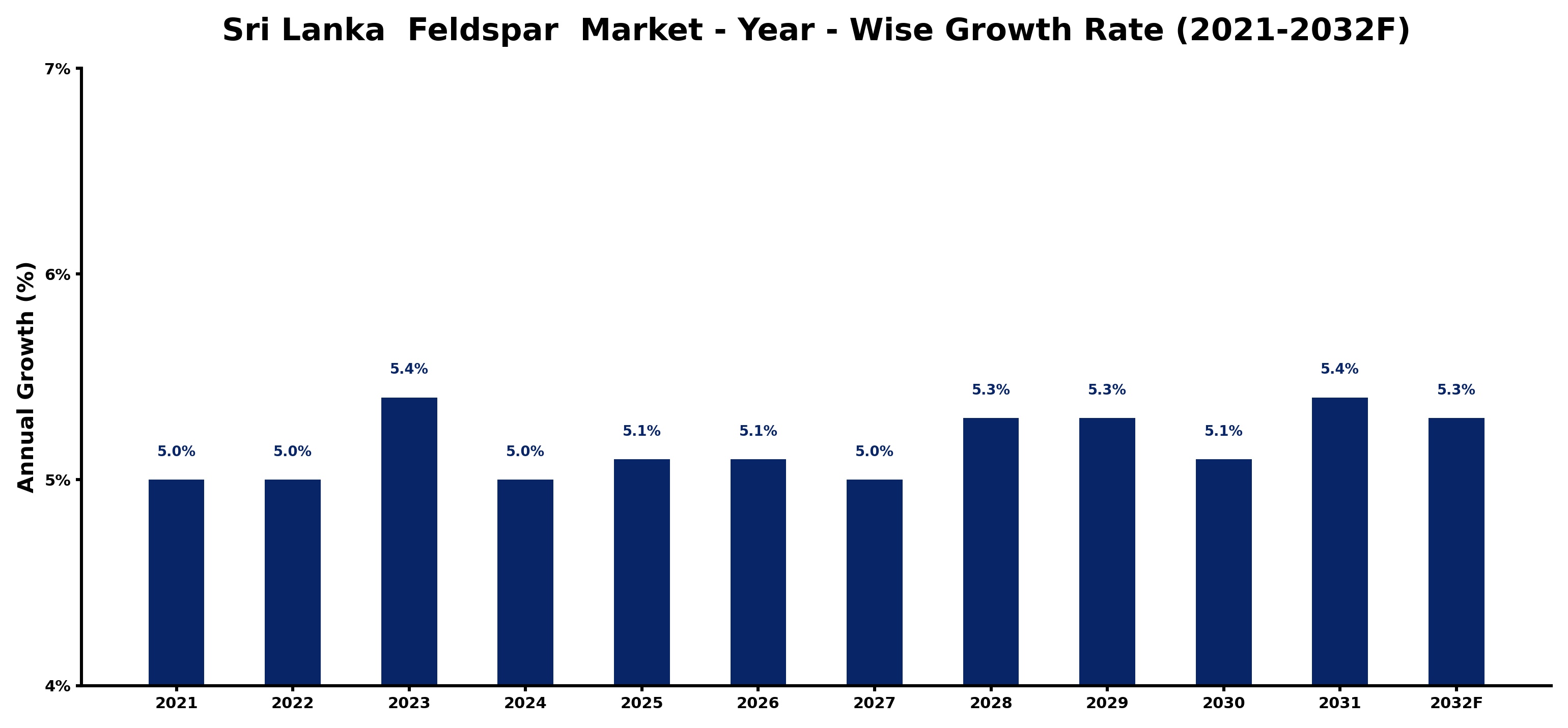
The table below presents the year‑wise growth rates along with the key drivers influencing the market
| Year | Growth Rate | Major Drivers |
| 2021 | 5.0% | Technology adoption in feldspar processing enhanced export competitiveness and quality |
| 2022 | 5.0% | Local ceramic industry revival boosted feldspar mining operations |
| 2023 | 5.4% | Domestic feldspar production adjustments optimized ceramic manufacturing processes |
| 2024 | 5.0% | Local ceramics sector expansion drives feldspar demand surge |
| 2025 | 5.1% | Domestic construction boom boosts feldspar demand for ceramic manufacturing |
| 2026 | 5.1% | Export driven feldspar production ramped up due to ceramic demand |
| 2027 | 5.0% | Export driven feldspar demand spurred local processing facility investments |
| 2028 | 5.3% | Strategic infrastructure upgrades bolstered feldspar mining efficiency in Sri Lanka |
| 2029 | 5.3% | Modernized mining techniques boosted feldspar extraction efficiency in Sri Lanka |
| 2030 | 5.1% | Export driven feldspar demand bolstered local ceramic industry investments |
| 2031 | 5.4% | Technological upgrades in feldspar processing boosted export readiness significantly |
| 2032 | 5.3% | Strengthened local ceramic production boosts feldspar demand and pricing |
Note - Market size estimations and growth projections presented in this report are based on 6Wresearch's advanced forecasting approach, validated with industry datasets as of June 2026.
Sri Lanka Feldspar Market Synopsis
The strongest force shaping the Sri Lanka feldspar market right now is the booming construction industry. With significant investments in infrastructure development and an increasing number of residential projects, demand for high-quality feldspar in tiles and sanitary ware remains at an all-time high.
Additionally, the ceramics and glass sectors are further catalyzing market growth due to feldspar's exceptional properties, such as low iron content and high alumina levels. This comprehensive utilization across diverse industries is enhancing the overall appeal and competitiveness of the Sri Lankan feldspar market.
Sri Lanka Feldspar Market Key Takeaways
- Feldspar's unique properties make it indispensable in ceramics, glass, and construction.
- The market is characterized by a competitive landscape, with both local and international participants.
- Sustainability practices are increasingly influencing production and operational strategies.
- Investment opportunities abound in mining and processing due to the nation's mineral wealth.
- Government policies are promoting environmentally responsible mining practices.
Evaluation of Restraints in Sri Lanka Feldspar Market
The Sri Lanka feldspar market faces several inherent restraints, particularly around fluctuating global demand and raw material prices. Such volatility can adversely affect local producers, who are also under pressure from international competition that often provides similar quality at lower prices. Additionally, logistical challenges, including inadequate infrastructure for transportation and storage, can hinder the efficient distribution of feldspar products. Lastly, evolving environmental regulations necessitate significant adaptations from operators in mining and processing, adding further complexity to market dynamics.
Sri Lanka Feldspar Market Trends
Current trends indicate a pronounced shift toward sustainability in the Sri Lanka feldspar market. Companies are adopting eco-friendly mining and processing practices to align with global standards and consumer preferences for environmentally responsible products. Furthermore, product innovation and quality enhancements are crucial as manufacturers seek to meet the increasingly sophisticated demands of end-users in the ceramics and glass industries. The commitment to sustainability is expected to influence future product offerings and operational methodologies.
Sri Lanka Feldspar Market Opportunities
The opportunities for investment in the Sri Lanka feldspar market are significant, spurred by the country's abundant mineral reserves and a burgeoning demand for feldspar in key sectors. Prospective investors can benefit from establishing mining operations or processing facilities, particularly as the production of tiles, sanitary ware, and glass products continues to rise. Additionally, the potential for enhancing the value chain through beneficiation and exporting processed feldspar products presents an appealing avenue for growth.
Government Initiatives in the Sri Lanka Feldspar Market
The Sri Lankan government has taken active steps to regulate the feldspar market, with a focus on promoting sustainable mining practices and protecting the environment. Policies include licensing requirements that regulate extraction levels, aiming to minimize ecological impacts. Furthermore, efforts to monitor product quality support local producers in enhancing their competitiveness on the global stage. The government also facilitates support programs, such as financial assistance and training for local miners, aimed at developing a responsible and sustainable feldspar industry.
Future Insights of the Sri Lanka Feldspar Market
Looking ahead to 2026-2032, the outlook for the Sri Lanka feldspar market is optimistic. The anticipated increase in construction activities, coupled with ongoing developments in the ceramics and glass manufacturing sectors, is likely to drive demand further. The emphasis on sustainability and eco-friendly products will also bolster the market, given feldspar's status as a key raw material. However, fluctuations in raw material prices and competition from global suppliers must be managed judiciously to maintain this positive growth trajectory.
Sri Lanka Feldspar Market Latest Developments (May 2025 - June 2026)
Recent developments in the Sri Lanka feldspar market indicate a continued push towards innovation and sustainability. Companies are increasingly investing in advanced processing technologies aimed at enhancing product quality and reducing environmental impact. Furthermore, partnerships between local producers and international stakeholders are emerging, fostering knowledge transfer and improving operational efficiencies. This collaborative approach is expected to play a vital role in meeting the growing demand and navigating the complexities of the global market.
Sri Lanka Feldspar Market - Key Attractiveness of the Report
- 10 Years of Market Numbers
- Historical Data Starting from 2022 to 2025
- Base Year: 2025
- Forecast Data until 2032
- Key Performance Indicators Impacting the Market
- Major Upcoming Developments and Projects
Key Highlights of the Report:
- Sri Lanka Feldspar Market Outlook
- Market Size of Sri Lanka Feldspar Market, 2025
- Forecast of Sri Lanka Feldspar Market, 2032
- Historical Data and Forecast of Sri Lanka Feldspar Revenues & Volume for the Period 2022-2032F
- Sri Lanka Feldspar Market Trend Evolution
- Sri Lanka Feldspar Market Drivers and Challenges
- Sri Lanka Feldspar Price Trends
- Sri Lanka Feldspar Porter's Five Forces
- Sri Lanka Feldspar Industry Life Cycle
- Historical Data and Forecast of Sri Lanka Feldspar Market Revenues & Volume By Type for the Period 2022-2032F
- Historical Data and Forecast of Sri Lanka Feldspar Market Revenues & Volume By Plagioclase feldspar for the Period 2022-2032F
- Historical Data and Forecast of Sri Lanka Feldspar Market Revenues & Volume By K-feldspar for the Period 2022-2032F
- Historical Data and Forecast of Sri Lanka Feldspar Market Revenues & Volume By End-users for the Period 2022-2032F
- Historical Data and Forecast of Sri Lanka Feldspar Market Revenues & Volume By Glassmaking for the Period 2022-2032F
- Historical Data and Forecast of Sri Lanka Feldspar Market Revenues & Volume By Ceramics for the Period 2022-2032F
- Historical Data and Forecast of Sri Lanka Feldspar Market Revenues & Volume By Pottery for the Period 2022-2032F
- Historical Data and Forecast of Sri Lanka Feldspar Market Revenues & Volume By Others for the Period 2022-2032F
- Sri Lanka Feldspar Import Export Trade Statistics
- Market Opportunity Assessment By Type
- Market Opportunity Assessment By End-users
- Sri Lanka Feldspar Top Companies Market Share
- Sri Lanka Feldspar Competitive Benchmarking By Technical and Operational Parameters
- Sri Lanka Feldspar Company Profiles
- Sri Lanka Feldspar Key Strategic Recommendations






































