Sri Lanka Fiber Optic Components Market Size, Share & Growth Rate
The Sri Lanka Fiber Optic Components Market was estimated at USD 491 Million in 2025 and is projected to reach USD 675 Million by 2032, growing at a CAGR of 4.7% from 2026 to 2032. This growth is primarily fueled by the robust expansion of telecommunications infrastructure and the increasing need for high-speed internet connectivity across the nation. As industries increasingly embrace digital transformation, the demand for reliable data transmission solutions is expected to escalate, making fiber optic components essential to the evolving landscape.
Sri Lanka Fiber Optic Components Market Year-wise Growth Rate and Key Drivers
This graph highlights how the Sri Lanka Fiber Optic Components Market has steadily grown over the years, supported by major growth factors.
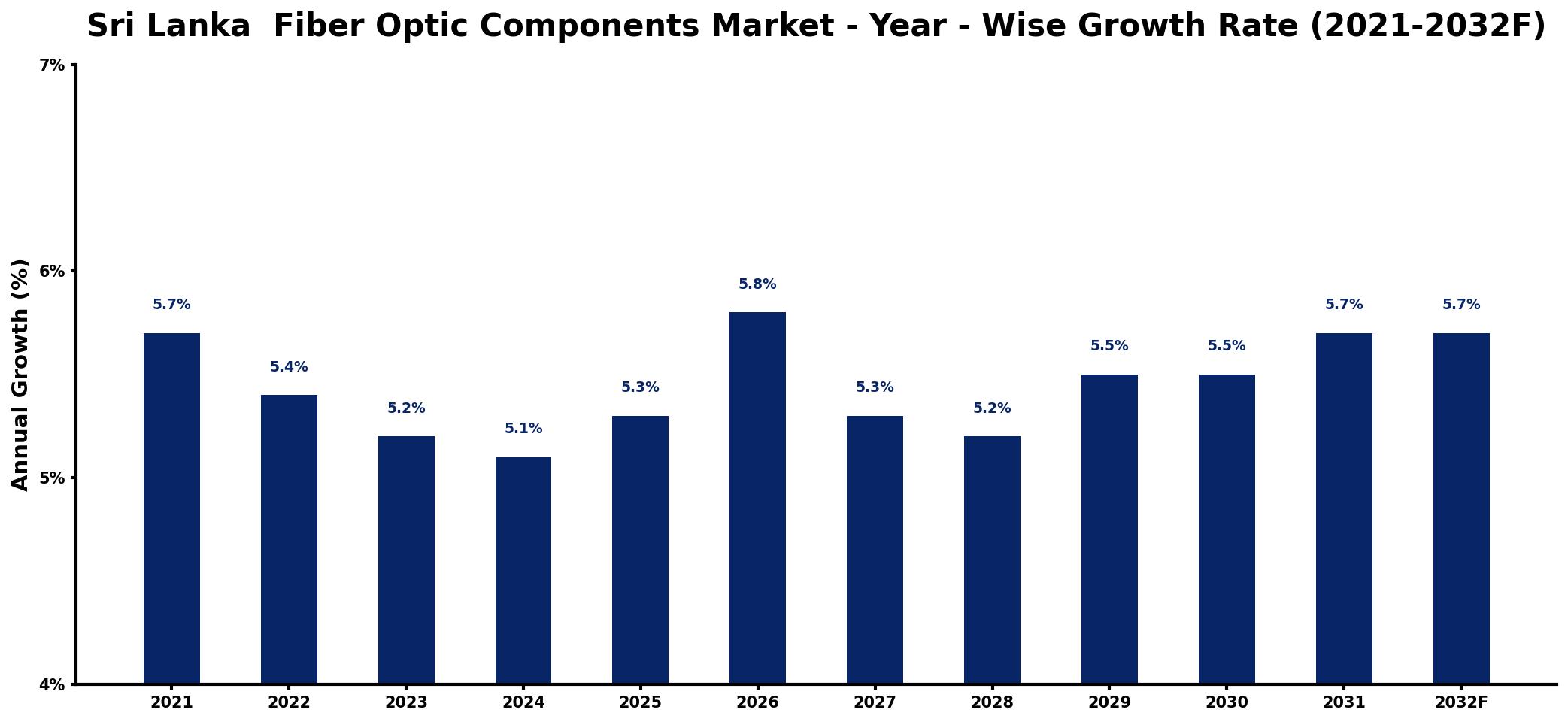
The table below presents the year‑wise growth rates along with the key drivers influencing the market
| Year | Growth Rate | Major Drivers |
| 2021 | 5.7% | Rising telecommunications infrastructure investments |
| 2022 | 5.4% | Increased demand for broadband services |
| 2023 | 5.2% | Expansion of data center facilities |
| 2024 | 5.1% | Growth in smart city initiatives |
| 2025 | 5.3% | Surge in cloud computing adoption |
| 2026 | 5.8% | Enhanced government digitalization efforts |
| 2027 | 5.3% | Boost in renewable energy projects |
| 2028 | 5.2% | Advancements in IoT applications |
| 2029 | 5.5% | Growing e-commerce market penetration |
| 2030 | 5.5% | Increased focus on cybersecurity solutions |
| 2031 | 5.7% | enhanced product quality standards |
| 2032 | 5.7% | rising infrastructure development spending |
Note: Market size estimations and growth projections presented in this report are based on 6Wresearch's proprietary forecasting methodology, utilizing the latest available industry data, government publications, and primary research inputs.
Sri Lanka Fiber Optic Components Market Synopsis
Recent momentum in the Sri Lanka Fiber Optic Components Market is marked by substantial investments in digital infrastructure. However, as the market matures, a strategic focus on innovative technologies and sustainable practices will be necessary for sustained growth. With increasing governmental support and an evolving telecommunications sector, the market is well-positioned for expansion.
The shift toward advanced solutions like 5G and IoT presents both opportunities and challenges for local businesses. As awareness grows, industries are more likely to invest in fiber optic technology, realizing its long-term benefits over traditional copper-based alternatives. This transition is essential for capitalizing on the burgeoning demand for high-performance communication networks.
Sri Lanka Fiber Optic Components Market Key Takeaways
- Strong government initiatives are boosting fiber optic infrastructure development.
- The market is experiencing a significant shift toward high-speed, reliable data transmission solutions.
- Investment in advanced optical technologies, such as those supporting 5G, is on the rise.
- Environmental sustainability is becoming a priority in component design and manufacturing.
- Educational programs are needed to raise awareness and build a skilled workforce in fiber optics.
Evaluation of Restraints in Sri Lanka Fiber Optic Components Market
Despite its promising trajectory, the Sri Lanka Fiber Optic Components Market faces notable restraints. A general lack of awareness and understanding of fiber optic technology among businesses can slow adoption rates. Additionally, the high costs associated with establishing fiber optic networks create financial hurdles for many organizations. A skills gap in fiber optics further complicates the landscape, as inadequate training hampers both development and maintenance efforts. Lastly, competition from established copper-based networks remains a significant challenge, leading to hesitation among some businesses to transition to fiber optics.
Sri Lanka Fiber Optic Components Market Trends
Current trends in the Sri Lanka Fiber Optic Components Market showcase an increasing demand for advanced components as organizations migrate to cloud services and digital solutions. The integration of IoT devices necessitates robust and reliable connectivity, driving the need for high-performance fiber optic networks. Furthermore, companies are prioritizing energy efficiency and eco-friendly practices in their operations, reflecting a broader trend toward sustainability within the industry.
Sri Lanka Fiber Optic Components Market Opportunities
The Sri Lanka Fiber Optic Components Market presents numerous investment opportunities, particularly in the manufacturing and supply of cables, connectors, and transceivers essential for expanding telecommunications networks and data centers. Additionally, research and development of innovative optical technologies, especially those aligned with the deployment of 5G networks, promise significant long-term growth potential. These opportunities are further enhanced by government efforts to boost digital infrastructure, providing a fertile ground for market players to flourish.
Government Initiatives in the Sri Lanka Fiber Optic Components Market
The Sri Lankan government is actively involved in promoting the growth of the Fiber Optic Components Market through various policies and initiatives. The National Digital Economy Policy is a cornerstone of this effort, aimed at enhancing connectivity infrastructure, including fiber optic networks. Additionally, tax incentives and duty concessions have been implemented to attract domestic and foreign investments in fiber optic technology. Regulatory bodies, such as the Telecommunications Regulatory Commission of Sri Lanka, play a vital role in ensuring quality and reliability standards for components in the market.
Future Insights of the Sri Lanka Fiber Optic Components Market
The future outlook for the Sri Lanka Fiber Optic Components Market appears bright, with anticipated steady growth from 2026 to 2032. The ongoing demand for high-speed internet, coupled with rising investments in telecommunications infrastructure, will continue to drive market expansion. The rollout of 5G technology and the increasing number of data centers are set to further elevate the need for fiber optic components. As organizations prioritize enhancing network reliability and efficiency, technological advancements in fiber optics are expected to play a significant role in shaping the market's future.
Sri Lanka Fiber Optic Components Market Latest Developments (2025 - 2026)
In recent months, the Sri Lanka Fiber Optic Components Market has witnessed notable developments, including increased partnerships between local manufacturers and international technology providers. These collaborations focus on enhancing production capabilities and introducing cutting-edge fiber optic technologies tailored for the Sri Lankan market. Additionally, various public initiatives aimed at upgrading broadband connectivity have gained momentum, reinforcing the government's commitment to fostering a digitally connected society.
Sri Lanka Fiber Optic Components Market - Key Attractiveness of the Report
- 10 Years of Market Numbers
- Historical Data Starting from 2022 to 2025
- Base Year: 2025
- Forecast Data until 2032
- Key Performance Indicators Impacting the Market
- Major Upcoming Developments and Projects
Key Highlights of the Report:
- Sri Lanka Fiber Optic Components Market Outlook
- Market Size of Sri Lanka Fiber Optic Components Market, 2025
- Forecast of Sri Lanka Fiber Optic Components Market, 2032
- Historical Data and Forecast of Sri Lanka Fiber Optic Components Revenues & Volume for the Period 2022-2032F
- Sri Lanka Fiber Optic Components Market Trend Evolution
- Sri Lanka Fiber Optic Components Market Drivers and Challenges
- Sri Lanka Fiber Optic Components Price Trends
- Sri Lanka Fiber Optic Components Porter's Five Forces
- Sri Lanka Fiber Optic Components Industry Life Cycle
- Historical Data and Forecast of Sri Lanka Fiber Optic Components Market Revenues & Volume By Type for the Period 2022-2032F
- Historical Data and Forecast of Sri Lanka Fiber Optic Components Market Revenues & Volume By Cables for the Period 2022-2032F
- Historical Data and Forecast of Sri Lanka Fiber Optic Components Market Revenues & Volume By Active Optical Cables for the Period 2022-2032F
- Historical Data and Forecast of Sri Lanka Fiber Optic Components Market Revenues & Volume By Amplifiers for the Period 2022-2032F
- Historical Data and Forecast of Sri Lanka Fiber Optic Components Market Revenues & Volume By Splitters for the Period 2022-2032F
- Historical Data and Forecast of Sri Lanka Fiber Optic Components Market Revenues & Volume By Connectors for the Period 2022-2032F
- Historical Data and Forecast of Sri Lanka Fiber Optic Components Market Revenues & Volume By Circulators for the Period 2022-2032F
- Historical Data and Forecast of Sri Lanka Fiber Optic Components Market Revenues & Volume By Transceivers for the Period 2022-2032F
- Historical Data and Forecast of Sri Lanka Cables Fiber Optic Components Market Revenues & Volume By Others for the Period 2022-2032F
- Historical Data and Forecast of Sri Lanka Fiber Optic Components Market Revenues & Volume By Data Rate for the Period 2022-2032F
- Historical Data and Forecast of Sri Lanka Fiber Optic Components Market Revenues & Volume By Less than 10Gbps for the Period 2022-2032F
- Historical Data and Forecast of Sri Lanka Fiber Optic Components Market Revenues & Volume By 10 Gbps to 40Gbps for the Period 2022-2032F
- Historical Data and Forecast of Sri Lanka Fiber Optic Components Market Revenues & Volume By 41 Gbps to 100Gbps for the Period 2022-2032F
- Historical Data and Forecast of Sri Lanka Fiber Optic Components Market Revenues & Volume By More than 100 Gbps for the Period 2022-2032F
- Historical Data and Forecast of Sri Lanka Fiber Optic Components Market Revenues & Volume By Application for the Period 2022-2032F
- Historical Data and Forecast of Sri Lanka Fiber Optic Components Market Revenues & Volume By Distributed Sensing for the Period 2022-2032F
- Historical Data and Forecast of Sri Lanka Fiber Optic Components Market Revenues & Volume By Analytical and Medical Equipment for the Period 2022-2032F
- Historical Data and Forecast of Sri Lanka Fiber Optic Components Market Revenues & Volume By Lighting for the Period 2022-2032F
- Historical Data and Forecast of Sri Lanka Fiber Optic Components Market Revenues & Volume By Communications for the Period 2022-2032F
- Sri Lanka Fiber Optic Components Import Export Trade Statistics
- Market Opportunity Assessment By Type
- Market Opportunity Assessment By Data Rate
- Market Opportunity Assessment By Application
- Sri Lanka Fiber Optic Components Top Companies Market Share
- Sri Lanka Fiber Optic Components Competitive Benchmarking By Technical and Operational Parameters
- Sri Lanka Fiber Optic Components Company Profiles
- Sri Lanka Fiber Optic Components Key Strategic Recommendations






































