Sri Lanka Fish Farming Market Size, Share & Growth Rate
The Sri Lanka Fish Farming Market was estimated at USD 423 Million in 2025 and is projected to reach USD 577 Million by 2032, growing at a CAGR of 4.5% from 2026 to 2032. This upward trajectory is primarily fueled by increasing domestic and international demand for seafood, a growing population, and supportive government initiatives aimed at enhancing aquaculture practices. As consumers become more conscious of sustainability, the market is seeing a shift towards responsible sourcing and technology-driven farming solutions.
Sri Lanka Fish Farming Market Year-wise Growth Rate and Key Drivers
This graph highlights how the Sri Lanka Fish Farming Market has steadily grown over the years, supported by major growth factors.
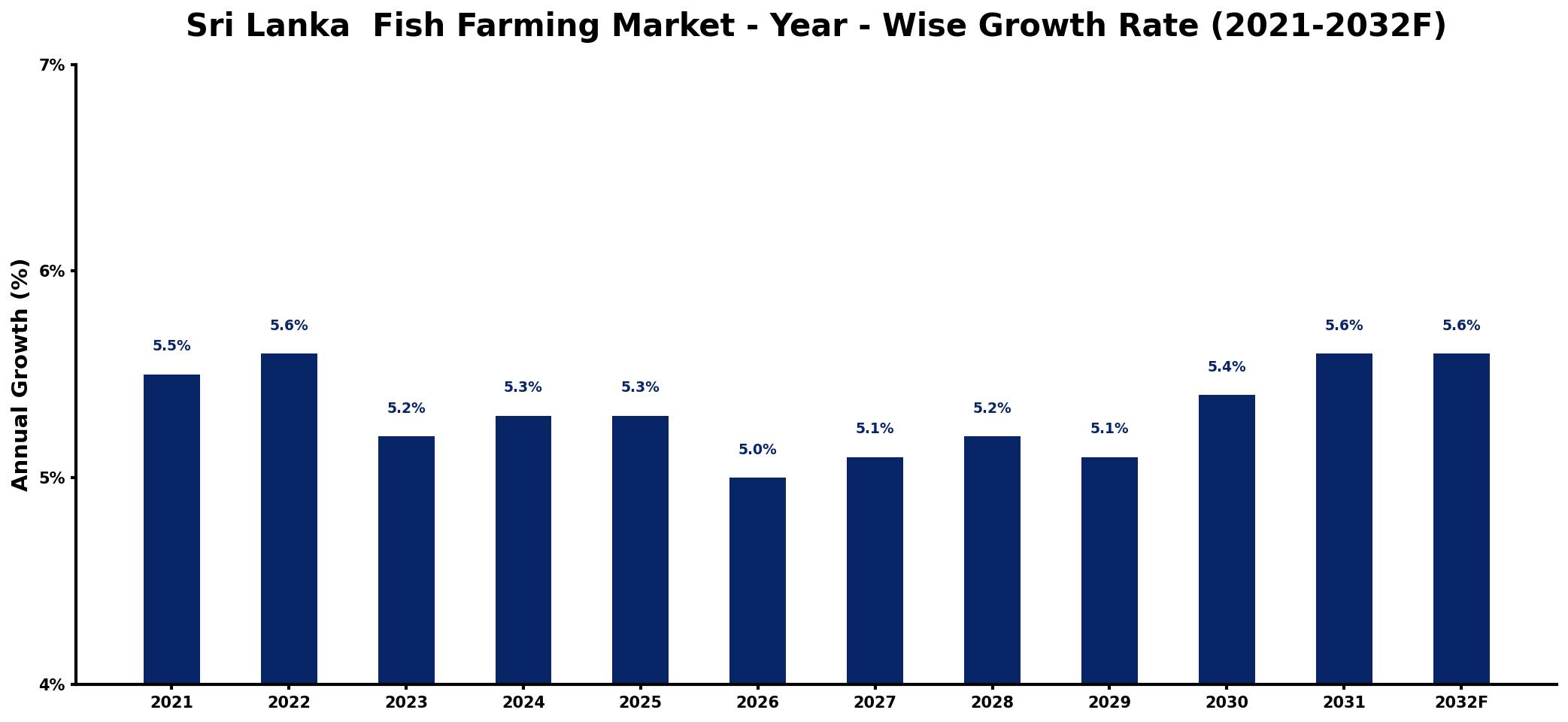
The table below presents the year‑wise growth rates along with the key drivers influencing the market
| Year | Growth Rate | Major Drivers |
| 2021 | 5.5% | Rising consumer health awareness |
| 2022 | 5.6% | Increased export market opportunities |
| 2023 | 5.2% | Growing interest in aquaculture technology |
| 2024 | 5.3% | Enhanced government support initiatives |
| 2025 | 5.3% | Expansion of local processing facilities |
| 2026 | 5.0% | Diversification of aquaculture species |
| 2027 | 5.1% | Strengthening supply chain networks |
| 2028 | 5.2% | Investment in sustainable practices |
| 2029 | 5.1% | Growing popularity of organic products |
| 2030 | 5.4% | Increase in foreign direct investment |
| 2031 | 5.6% | Development of community co-operatives |
| 2032 | 5.6% | Rising demand for premium products |
Note: Market size estimations and growth projections presented in this report are based on 6Wresearch's proprietary forecasting methodology, utilizing the latest available industry data, government publications, and primary research inputs.
Sri Lanka Fish Farming Market Synopsis
Currently, the Sri Lanka fish farming market is witnessing a robust evolution, driven by an expansive coastline and fertile inland water bodies. This geographical advantage provides a perfect backdrop for cultivating high-demand species such as tilapia, carp, and shrimp, with tilapia emerging as the favored choice for farmers due to its adaptability and rapid growth.
Despite the promising potential, the sector grapples with obstacles such as limited access to advanced technology and quality feed. The government is working diligently to promote aquaculture through various initiatives, yet the challenges of inconsistent market prices and infrastructure inadequacies continue to hinder optimal growth in the fish farming landscape.
Sri Lanka Fish Farming Market Key Takeaways
- The market is projected to grow from USD 423 Million in 2025 to USD 577 Million by 2032.
- Increased consumer awareness of sustainable seafood is driving market innovation.
- Integration of technology, such as data analytics, is enhancing operational efficiency.
- Government policies are evolving to support aquaculture growth and export promotion.
- Challenges such as infrastructure and disease management remain critical for farmers.
Evaluation of Restraints in Sri Lanka Fish Farming Market
The Sri Lanka fish farming market faces significant restraints that hinder its growth potential. A primary challenge is the limited access to quality feed and modern aquaculture technology, which stifles productivity and profitability for many farmers. Additionally, inadequate infrastructure, including insufficient water supply systems and storage facilities, poses logistical hurdles that complicate operations. Uncertainty stemming from inconsistent government regulations further complicates the landscape, creating challenges in long-term planning and investment. Moreover, disease outbreaks can severely impact fish stocks, leading to financial instability for farmers who struggle with fluctuating market prices.
Sri Lanka Fish Farming Market Trends
Several key trends are shaping the Sri Lanka fish farming market. One prominent trend is the increasing shift towards sustainable aquaculture practices, motivated by rising consumer demand for responsibly sourced seafood. This is leading to the adoption of integrated multi-trophic aquaculture systems, which balance diverse species for ecological efficiency. Furthermore, the integration of technology into fish farming operations—such as automated feeding systems and advanced water quality monitoring—enhances productivity and streamlines operations. Lastly, there is a notable diversification in species cultivated, with a rising interest in high-value species like shrimp and ornamental fish.
Sri Lanka Fish Farming Market Opportunities
The opportunities in the Sri Lanka fish farming market are abundant, particularly as the demand for seafood continues to escalate. Investing in modern aquaculture technologies, such as recirculating aquaculture systems (RAS) or integrated multitrophic aquaculture (IMTA), presents lucrative avenues for growth. Additionally, there is significant potential for establishing value-added processing facilities to cater to the increasing consumer appetite for processed fish products. Collaborating with local fish farmers to enhance market access and technical capabilities can further enhance investment returns in this evolving sector.
Government Initiatives in the Sri Lanka Fish Farming Market
The Sri Lankan government has taken multiple proactive measures to bolster the fish farming industry. Initiatives include providing financial assistance and subsidies to farmers, promoting sustainable practices through regulatory enforcement, and facilitating access to training and technology. To enhance export capabilities, the government is working on streamlining export procedures and offering incentives aimed at expanding the international market for Sri Lankan seafood products. These initiatives collectively aim to boost domestic production while ensuring environmental sustainability.
Future Insights of the Sri Lanka Fish Farming Market
The outlook for the Sri Lanka fish farming market between 2026 and 2032 is promising, driven by persistent consumer demand for seafood amidst growing population numbers and dwindling natural fish stocks. Enhanced government support for aquaculture is expected to spur sector growth, while technological advancements in farming practices are likely to elevate productivity levels. Despite potential challenges, including environmental concerns and the volatility of fish prices, the market presents significant opportunities for sustainable practices and innovative solutions to meet escalating demands.
Sri Lanka Fish Farming Market Latest Developments (2025 - 2026)
Recent developments in the Sri Lanka fish farming sector indicate a shift towards greater sustainability and innovation. As farmers increasingly adopt eco-friendly practices, there is a notable rise in research initiatives focusing on disease management and crop diversification. Additionally, collaborations between governmental agencies and private sectors are enhancing access to modern aquaculture technologies. This direction aims to bolster productivity while addressing environmental concerns, setting the stage for a more resilient and competitive market.
Sri Lanka Fish Farming Market - Key Attractiveness of the Report
- 10 Years of Market Numbers
- Historical Data Starting from 2022 to 2025
- Base Year: 2025
- Forecast Data until 2032
- Key Performance Indicators Impacting the Market
- Major Upcoming Developments and Projects
Key Highlights of the Report:
- Sri Lanka Fish Farming Market Outlook
- Market Size of Sri Lanka Fish Farming Market, 2025
- Forecast of Sri Lanka Fish Farming Market, 2032
- Historical Data and Forecast of Sri Lanka Fish Farming Revenues & Volume for the Period 2022-2032F
- Sri Lanka Fish Farming Market Trend Evolution
- Sri Lanka Fish Farming Market Drivers and Challenges
- Sri Lanka Fish Farming Price Trends
- Sri Lanka Fish Farming Porter's Five Forces
- Sri Lanka Fish Farming Industry Life Cycle
- Historical Data and Forecast of Sri Lanka Fish Farming Market Revenues & Volume By Environment for the Period 2022-2032F
- Historical Data and Forecast of Sri Lanka Fish Farming Market Revenues & Volume By Marine Water for the Period 2022-2032F
- Historical Data and Forecast of Sri Lanka Fish Farming Market Revenues & Volume By Fresh Water for the Period 2022-2032F
- Historical Data and Forecast of Sri Lanka Fish Farming Market Revenues & Volume By Brackish Water for the Period 2022-2032F
- Historical Data and Forecast of Sri Lanka Fish Farming Market Revenues & Volume By Fish Type for the Period 2022-2032F
- Historical Data and Forecast of Sri Lanka Fish Farming Market Revenues & Volume By Pompano for the Period 2022-2032F
- Historical Data and Forecast of Sri Lanka Fish Farming Market Revenues & Volume By Snappers for the Period 2022-2032F
- Historical Data and Forecast of Sri Lanka Fish Farming Market Revenues & Volume By Groupers for the Period 2022-2032F
- Historical Data and Forecast of Sri Lanka Fish Farming Market Revenues & Volume By Salmon for the Period 2022-2032F
- Historical Data and Forecast of Sri Lanka Fish Farming Market Revenues & Volume By Milkfish for the Period 2022-2032F
- Historical Data and Forecast of Sri Lanka Fish Farming Market Revenues & Volume By Tuna for the Period 2022-2032F
- Historical Data and Forecast of Sri Lanka Fish Farming Market Revenues & Volume By Tilapia for the Period 2022-2032F
- Historical Data and Forecast of Sri Lanka Fish Farming Market Revenues & Volume By Others for the Period 2022-2032F
- Sri Lanka Fish Farming Import Export Trade Statistics
- Market Opportunity Assessment By Environment
- Market Opportunity Assessment By Fish Type
- Sri Lanka Fish Farming Top Companies Market Share
- Sri Lanka Fish Farming Competitive Benchmarking By Technical and Operational Parameters
- Sri Lanka Fish Farming Company Profiles
- Sri Lanka Fish Farming Key Strategic Recommendations






































