Sri Lanka Foot Care Products Market Size, Share & Growth Rate
The Sri Lanka Foot Care Products Market was estimated at USD 849 Million in 2025 and is projected to reach USD 1222 Million by 2032, growing at a CAGR of 5.3% from 2026 to 2032. This impressive trajectory is being fueled by an increasing awareness of foot health among consumers and a growing emphasis on self-care and personal grooming. Moreover, a shift towards natural and organic foot care products is resonating well with the environmentally-conscious consumers, further driving market dynamics.
Sri Lanka Foot Care Products Market Year-wise Growth Rate and Key Drivers
This graph highlights how the Sri Lanka Foot Care Products Market has steadily grown over the years, supported by major growth factors.
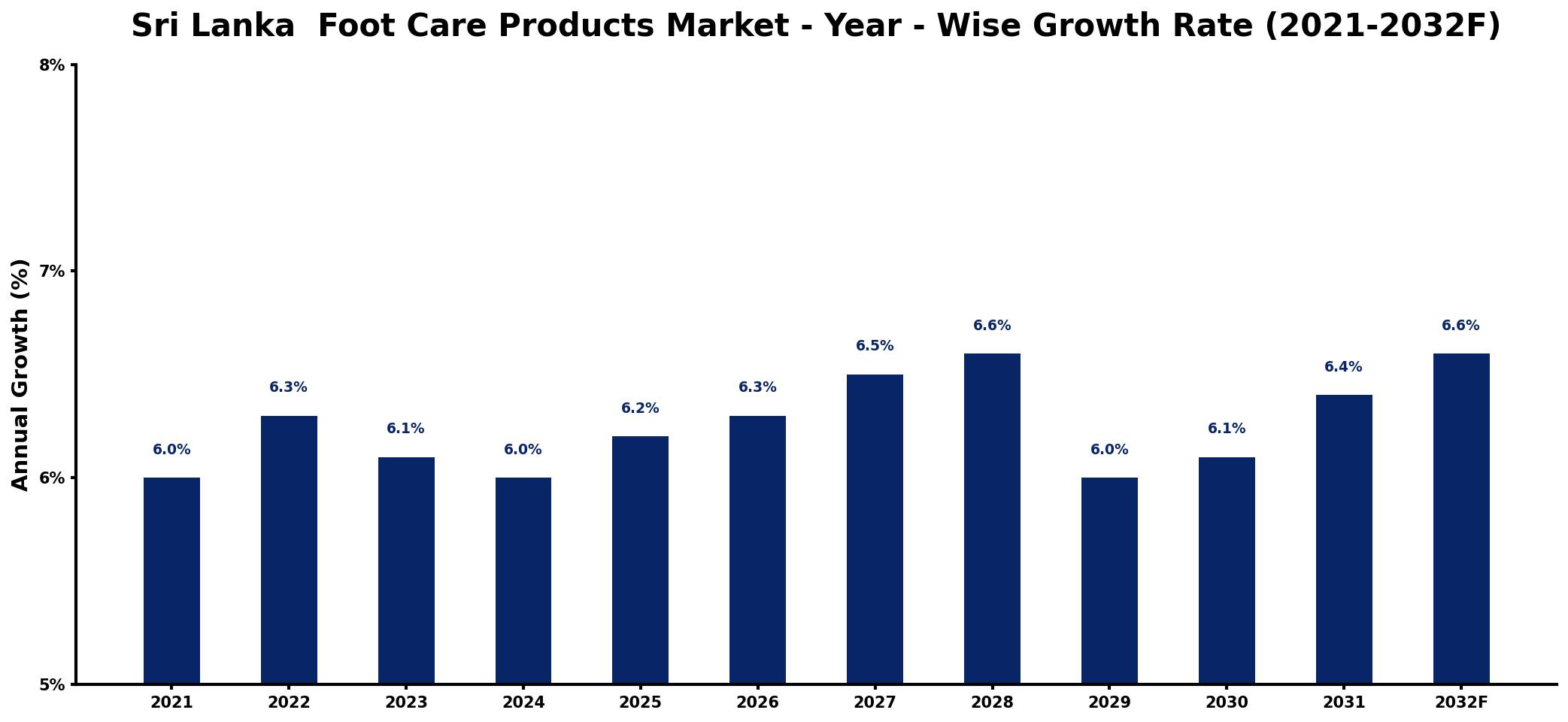
The table below presents the year‑wise growth rates along with the key drivers influencing the market
| Year | Growth Rate | Major Drivers |
| 2021 | 6.0% | Increased consumer health awareness |
| 2022 | 6.3% | Growing e-commerce market expansion |
| 2023 | 6.1% | Rise in disposable income levels |
| 2024 | 6.0% | Increased investment in research |
| 2025 | 6.2% | Expansion of retail distribution channels |
| 2026 | 6.3% | Emergence of innovative technologies |
| 2027 | 6.5% | Growing trend of wellness tourism |
| 2028 | 6.6% | rising end-use demand growth |
| 2029 | 6.0% | Rising popularity of organic ingredients |
| 2030 | 6.1% | rising infrastructure development spending |
| 2031 | 6.4% | Collaboration with health professionals |
| 2032 | 6.6% | Growing demand for sustainable practices |
Note: Market size estimations and growth projections presented in this report are based on 6Wresearch's proprietary forecasting methodology, utilizing the latest available industry data, government publications, and primary research inputs.
Sri Lanka Foot Care Products Market Synopsis
The landscape of the Sri Lanka Foot Care Products Market is evolving, with a notable rise in consumer interest towards products that promote foot health and hygiene. This is reflected in the diverse range of offerings, from creams and lotions to specialized footwear designed to cater to specific needs like fungal infections and dry skin.
Current market trends indicate a strong consumer shift towards natural ingredients and eco-friendly formulations, driven by rising health consciousness. Brands are not only innovating their product lines but also enhancing packaging and marketing strategies to stand out amidst increasing competition in this burgeoning market.
Sri Lanka Foot Care Products Market Key Takeaways
- Growing consumer awareness of foot health is driving demand for specialized foot care products.
- Natural and organic foot care solutions are becoming increasingly popular among consumers.
- Product innovation and effective marketing strategies are essential for brand differentiation.
- The market is expanding as e-commerce platforms enhance product accessibility.
- Investors are presented with numerous opportunities for growth in niche foot care segments.
Evaluation of Restraints in Sri Lanka Foot Care Products Market
Despite the promising growth, the Sri Lanka Foot Care Products Market faces several notable restraints. One of the primary challenges is the limited consumer awareness regarding the importance of foot care, which hinders the demand for specialized products. Additionally, the fragmented nature of the market poses difficulty for brands in establishing a strong identity. Access to distribution channels, particularly in rural areas, further complicates market penetration. Economic fluctuations can also impact consumer spending on non-essential foot care items, leading to variability in market performance. Lastly, the absence of stringent regulations can undermine product safety and efficacy, causing skepticism among potential buyers.
Sri Lanka Foot Care Products Market Trends
The Sri Lanka Foot Care Products Market is currently witnessing significant trends that are shaping its landscape. The increasing preference for natural and organic products is one of the most critical drivers, as consumers actively seek formulations devoid of harmful chemicals. Furthermore, the demand for specialized products targeting specific conditions—such as calluses, cracked heels, and foot odor—is on the rise. Brands are enhancing their offerings to include multifunctional benefits, like moisturizing and exfoliating properties, appealing to the health-conscious consumer base. Innovative packaging and convenient application methods are also becoming a focal point, as they greatly enhance the user experience.
Sri Lanka Foot Care Products Market Opportunities
The market for foot care products in Sri Lanka presents numerous opportunities for investors looking to capitalize on emerging trends. With consumers becoming increasingly aware of foot health and hygiene, there is a significant demand for high-quality products such as orthotic insoles and specialized foot care solutions. Collaborations with local healthcare professionals can lead to the development of targeted products that address specific foot care needs, enhancing market reach. Additionally, the expansion of e-commerce provides a unique platform for brands to tap into wider consumer segments, making it an ideal avenue for investment and growth.
Government Initiatives in the Sri Lanka Foot Care Products Market
The Sri Lankan government has implemented various initiatives aimed at enhancing the Foot Care Products Market. These include the establishment of quality and safety regulations for foot care products, as well as import restrictions designed to protect local manufacturers from foreign competition. Furthermore, the government is actively encouraging domestic production through incentives and funding opportunities. Collaborations with academic institutions are also being fostered to promote research and innovation, ensuring a competitive and sustainable market for foot care products that prioritizes consumer safety and supports local industry growth.
Future Insights of the Sri Lanka Foot Care Products Market
Looking ahead, the Sri Lanka Foot Care Products Market is poised for sustained growth from 2026 to 2032. As disposable incomes rise, consumer spending on personal grooming and foot health is expected to increase significantly. With a greater emphasis on wellness and self-care among the population, the demand for effective and safe foot care products will likely expand. Additionally, the continuous growth of the e-commerce sector will facilitate easier access to a wider range of products, further propelling market dynamics. Overall, innovation in product development and a commitment to quality will be crucial for brands aiming to thrive in this evolving landscape.
Sri Lanka Foot Care Products Market Latest Developments (2025 - 2026)
Recent developments in the Sri Lanka Foot Care Products Market indicate a proactive shift towards enhancing consumer experience through improved product formulations and innovative packaging. Brands are increasingly focusing on sustainability, with many introducing eco-friendly products to align with consumer preferences. Furthermore, there has been a notable rise in the number of local entrepreneurs entering the market, offering unique and specialized foot care solutions that cater to regional needs. E-commerce platforms are becoming crucial, serving as effective channels for brands to reach consumers directly and expand their market presence.
Sri Lanka Foot Care Products Market - Key Attractiveness of the Report
- 10 Years of Market Numbers
- Historical Data Starting from 2022 to 2025
- Base Year: 2025
- Forecast Data until 2032
- Key Performance Indicators Impacting the Market
- Major Upcoming Developments and Projects
Key Highlights of the Report:
- Sri Lanka Foot Care Products Market Outlook
- Market Size of Sri Lanka Foot Care Products Market, 2025
- Forecast of Sri Lanka Foot Care Products Market, 2032
- Historical Data and Forecast of Sri Lanka Foot Care Products Revenues & Volume for the Period 2022-2032F
- Sri Lanka Foot Care Products Market Trend Evolution
- Sri Lanka Foot Care Products Market Drivers and Challenges
- Sri Lanka Foot Care Products Price Trends
- Sri Lanka Foot Care Products Porter's Five Forces
- Sri Lanka Foot Care Products Industry Life Cycle
- Historical Data and Forecast of Sri Lanka Foot Care Products Market Revenues & Volume By Application for the Period 2022-2032F
- Historical Data and Forecast of Sri Lanka Foot Care Products Market Revenues & Volume By Sports & Athletics for the Period 2022-2032F
- Historical Data and Forecast of Sri Lanka Foot Care Products Market Revenues & Volume By Medical for the Period 2022-2032F
- Historical Data and Forecast of Sri Lanka Foot Care Products Market Revenues & Volume By Personal Comfort for the Period 2022-2032F
- Historical Data and Forecast of Sri Lanka Foot Care Products Market Revenues & Volume By Distribution Channel for the Period 2022-2032F
- Historical Data and Forecast of Sri Lanka Foot Care Products Market Revenues & Volume By Drug Stores & Pharmacies for the Period 2022-2032F
- Historical Data and Forecast of Sri Lanka Foot Care Products Market Revenues & Volume By Hospitals & Specialty Clinics for the Period 2022-2032F
- Historical Data and Forecast of Sri Lanka Foot Care Products Market Revenues & Volume By Online Stores for the Period 2022-2032F
- Historical Data and Forecast of Sri Lanka Foot Care Products Market Revenues & Volume By Others for the Period 2022-2032F
- Sri Lanka Foot Care Products Import Export Trade Statistics
- Market Opportunity Assessment By Application
- Market Opportunity Assessment By Distribution Channel
- Sri Lanka Foot Care Products Top Companies Market Share
- Sri Lanka Foot Care Products Competitive Benchmarking By Technical and Operational Parameters
- Sri Lanka Foot Care Products Company Profiles
- Sri Lanka Foot Care Products Key Strategic Recommendations






































