Sri Lanka Glass Tiles Market Size, Share & Growth Rate
The Sri Lanka Glass Tiles Market was estimated at USD 183 Million in 2025 and is projected to reach USD 258 Million by 2032, growing at a CAGR of 5.0% from 2026 to 2032. This upward trajectory is driven by escalating construction activities and a growing inclination towards modern, aesthetically appealing designs in both residential and commercial spaces. The increasing urbanization within Sri Lanka further enhances the demand for stylish and durable glass tiles, fostering a vibrant market landscape.
Sri Lanka Glass Tiles Market Year-wise Growth Rate and Key Drivers
This graph highlights how the Sri Lanka Glass Tiles Market has steadily grown over the years, supported by major growth factors.
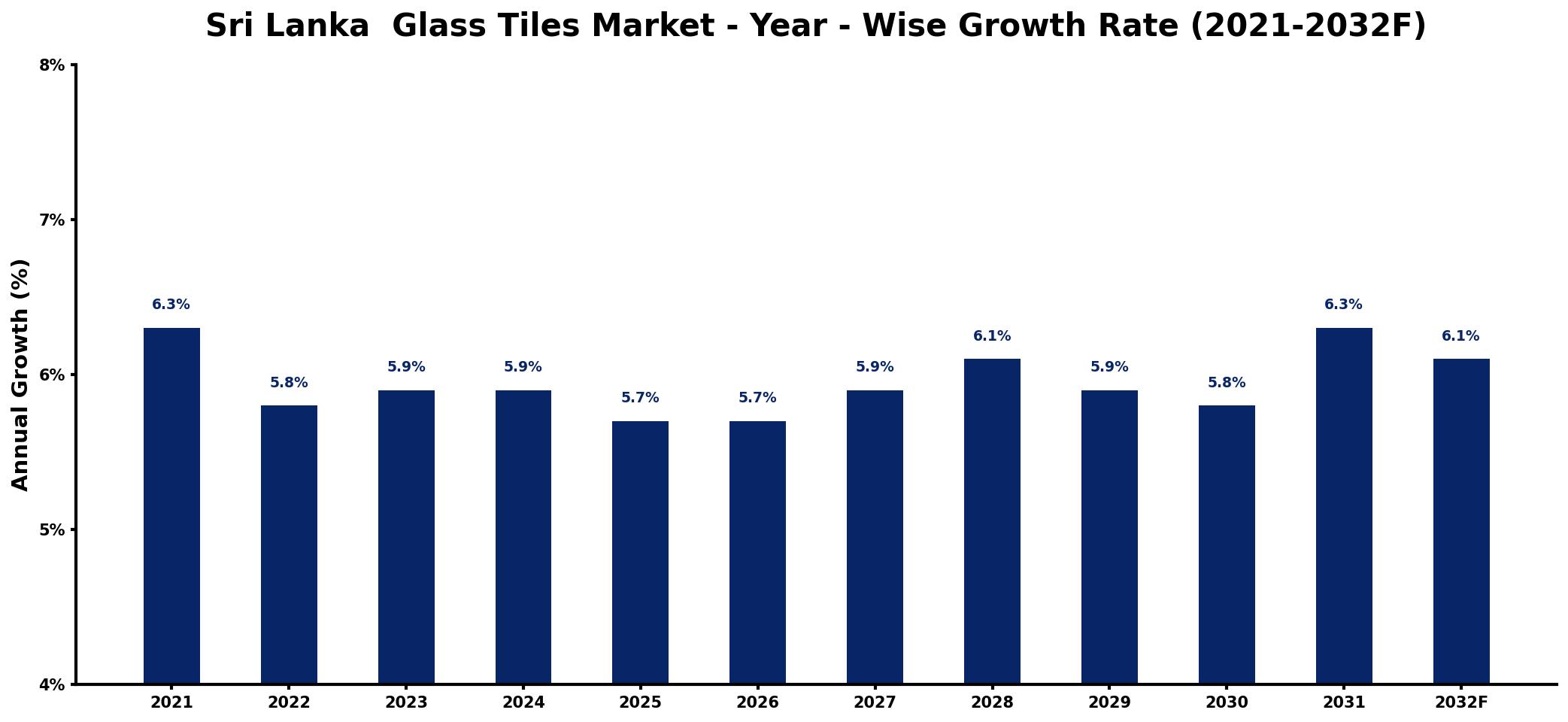
The table below presents the year‑wise growth rates along with the key drivers influencing the market
| Year | Growth Rate | Major Drivers |
| 2021 | 6.3% | Increased demand for sustainable materials |
| 2022 | 5.8% | Growth in construction industry projects |
| 2023 | 5.9% | Rising consumer preference for aesthetics |
| 2024 | 5.9% | Expansion of luxury housing market |
| 2025 | 5.7% | Investments in home renovation projects |
| 2026 | 5.7% | Surge in interior design trends |
| 2027 | 5.9% | Boost in residential property sales |
| 2028 | 6.1% | Growing popularity of eco-friendly options |
| 2029 | 5.9% | Increase in commercial building developments |
| 2030 | 5.8% | Rising demand for innovative designs |
| 2031 | 6.3% | strengthening underlying market demand |
| 2032 | 6.1% | Strengthening of local manufacturing capabilities |
Note: Market size estimations and growth projections presented in this report are based on 6Wresearch's proprietary forecasting methodology, utilizing the latest available industry data, government publications, and primary research inputs.
Sri Lanka Glass Tiles Market Synopsis
The Sri Lanka glass tiles market has become increasingly prominent, characterized by a notable demand for high-quality and visually appealing materials. With applications in kitchens, bathrooms, and commercial spaces, glass tiles are favored for their durability and ease of maintenance, marking a significant shift in consumer preferences.
As sustainable building practices gain traction, the market for glass tiles stands to benefit from this movement. The governments encouragement of eco-friendly materials not only enhances the appeal of glass tiles but also aligns with a broader trend toward sustainable construction in the region.
Sri Lanka Glass Tiles Market Key Takeaways
- The market is driven by a rising trend in urbanization and construction activities.
- Glass tiles are increasingly preferred for their aesthetic appeal and durability.
- Government initiatives promote eco-friendly materials, bolstering market growth.
- Consumer awareness and understanding of glass tiles are gradually improving.
- There remains a reliance on imports due to limited local production capabilities.
Evaluation of Restraints in Sri Lanka Glass Tiles Market
Despite its growth, the Sri Lanka glass tiles market faces considerable constraints. One significant challenge lies in the high cost associated with raw materials and production processes, which often renders glass tiles less competitive against ceramic and porcelain alternatives. Additionally, the market struggles with limited local production capacity, leading to a dependency on imports that exposes it to potential supply chain disruptions. A lack of awareness among potential consumers regarding the advantages and versatility of glass tiles further hampers wider adoption across various construction projects.
Sri Lanka Glass Tiles Market Trends
Currently, there is a noticeable shift toward the incorporation of glass tiles in modern architectural designs, underscoring their aesthetic and functional benefits. Additionally, the trend towards sustainability is compelling manufacturers to explore innovative solutions in glass tile production, such as the use of recycled materials. Furthermore, as designers and homeowners increasingly recognize the versatility of glass tiles, their applications are expanding beyond traditional settings, reaching new segments such as commercial interiors and outdoor spaces.
Sri Lanka Glass Tiles Market Opportunities
The Sri Lanka glass tiles market presents substantial growth opportunities, particularly in urban areas where construction is booming. As awareness regarding the benefits of glass tiles improves, there is potential for increased adoption in residential projects. Additionally, the governments support for sustainable construction materials could foster new collaborations between manufacturers and eco-friendly developers, paving the way for innovative product offerings and marketing strategies tailored to evolving consumer preferences.
Government Initiatives in the Sri Lanka Glass Tiles Market
Government policies in Sri Lanka increasingly focus on promoting sustainable construction practices. Through green building regulations, the government encourages the integration of environmentally friendly materials like glass tiles. Incentives, such as subsidies and tax breaks for builders who adopt these materials, further illustrate the administrations commitment to sustainable development. Furthermore, initiatives aimed at developing recycling facilities for glass waste highlight a proactive approach to minimize environmental impact within the construction sector.
Future Insights of the Sri Lanka Glass Tiles Market
Looking ahead to 2026-2032, the Sri Lanka glass tiles market is expected to witness continued growth spurred by evolving consumer preferences and expanding urbanization. As builders and homeowners prioritize design and sustainability, glass tiles are likely to gain a stronger foothold across various applications. Coupled with supportive government policies, the market is poised to embrace innovation and diversification, ultimately leading to a richer product landscape and enhanced consumer engagement.
Sri Lanka Glass Tiles Market Latest Developments (2025 - 2026)
Recent developments within the Sri Lanka glass tiles market indicate a robust movement toward innovation and sustainability. Manufacturers are exploring advanced production technologies to enhance the efficiency and quality of glass tile offerings. Concurrently, various industry stakeholders are collaborating to raise awareness about the benefits of glass tiles, aiming to educate consumers and architects on their applications. Additionally, ongoing discussions regarding regulations in the construction sector promise to further incentivize the use of eco-friendly materials, signaling a shift in market dynamics.
Sri Lanka Glass Tiles Market - Key Attractiveness of the Report
- 10 Years of Market Numbers
- Historical Data Starting from 2022 to 2025
- Base Year: 2025
- Forecast Data until 2032
- Key Performance Indicators Impacting the Market
- Major Upcoming Developments and Projects
Key Highlights of the Report:
- Sri Lanka Glass Tiles Market Outlook
- Market Size of Sri Lanka Glass Tiles Market, 2025
- Forecast of Sri Lanka Glass Tiles Market, 2032
- Historical Data and Forecast of Sri Lanka Glass Tiles Revenues & Volume for the Period 2022-2032F
- Sri Lanka Glass Tiles Market Trend Evolution
- Sri Lanka Glass Tiles Market Drivers and Challenges
- Sri Lanka Glass Tiles Price Trends
- Sri Lanka Glass Tiles Porter's Five Forces
- Sri Lanka Glass Tiles Industry Life Cycle
- Historical Data and Forecast of Sri Lanka Glass Tiles Market Revenues & Volume By Manufacturing Process for the Period 2022-2032F
- Historical Data and Forecast of Sri Lanka Glass Tiles Market Revenues & Volume By Smalti Tiles for the Period 2022-2032F
- Historical Data and Forecast of Sri Lanka Glass Tiles Market Revenues & Volume By Fused Tiles for the Period 2022-2032F
- Historical Data and Forecast of Sri Lanka Glass Tiles Market Revenues & Volume By Sintered Tiles for the Period 2022-2032F
- Historical Data and Forecast of Sri Lanka Glass Tiles Market Revenues & Volume By Cast Tiles for the Period 2022-2032F
- Historical Data and Forecast of Sri Lanka Glass Tiles Market Revenues & Volume By Other for the Period 2022-2032F
- Historical Data and Forecast of Sri Lanka Glass Tiles Market Revenues & Volume By Product Type for the Period 2022-2032F
- Historical Data and Forecast of Sri Lanka Glass Tiles Market Revenues & Volume By Matte-finished Glass Tile for the Period 2022-2032F
- Historical Data and Forecast of Sri Lanka Glass Tiles Market Revenues & Volume By Smooth Glass Tile for the Period 2022-2032F
- Historical Data and Forecast of Sri Lanka Glass Tiles Market Revenues & Volume By End-User Industry for the Period 2022-2032F
- Historical Data and Forecast of Sri Lanka Glass Tiles Market Revenues & Volume By Residential for the Period 2022-2032F
- Historical Data and Forecast of Sri Lanka Glass Tiles Market Revenues & Volume By Commercial for the Period 2022-2032F
- Historical Data and Forecast of Sri Lanka Glass Tiles Market Revenues & Volume By Infrastructure for the Period 2022-2032F
- Sri Lanka Glass Tiles Import Export Trade Statistics
- Market Opportunity Assessment By Manufacturing Process
- Market Opportunity Assessment By Product Type
- Market Opportunity Assessment By End-User Industry
- Sri Lanka Glass Tiles Top Companies Market Share
- Sri Lanka Glass Tiles Competitive Benchmarking By Technical and Operational Parameters
- Sri Lanka Glass Tiles Company Profiles
- Sri Lanka Glass Tiles Key Strategic Recommendations






































