Sri Lanka Hiking Gear & Equipment Market Size, Share & Growth Rate
The Sri Lanka Hiking Gear & Equipment Market was estimated at USD 260 Million in 2025 and is projected to reach USD 344 Million by 2032, growing at a CAGR of 4.1% from 2026 to 2032. This growth trajectory is fueled by the increasing local and international interest in hiking and outdoor activities, particularly in scenic areas like Ella and Horton Plains. As awareness of the importance of quality gear for safety and comfort rises, consumers are increasingly investing in specialized equipment.
Sri Lanka Hiking Gear & Equipment Market Year-wise Growth Rate and Key Drivers
This graph highlights how the Sri Lanka Hiking Gear & Equipment Market has steadily grown over the years, supported by major growth factors.
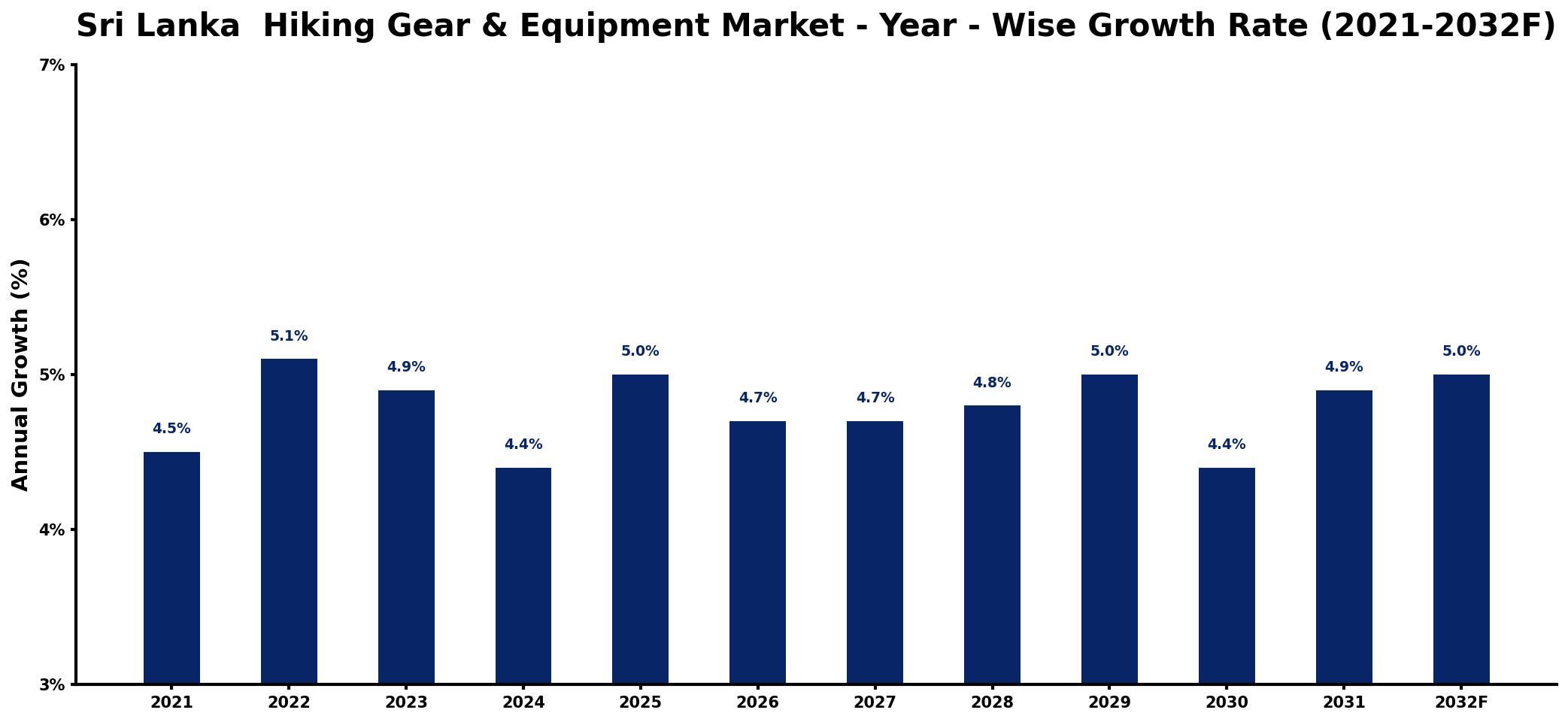
The table below presents the year‑wise growth rates along with the key drivers influencing the market
| Year | Growth Rate | Major Drivers |
| 2021 | 4.5% | Increase in outdoor tourism participation |
| 2022 | 5.1% | Growth in adventure travel popularity |
| 2023 | 4.9% | Rising health consciousness among consumers |
| 2024 | 4.4% | Expansion of local tourism infrastructure |
| 2025 | 5.0% | Increased disposable income for leisure |
| 2026 | 4.7% | Emergence of eco-friendly travel trends |
| 2027 | 4.7% | Development of new scenic trails |
| 2028 | 4.8% | Enhanced marketing strategies for tourism |
| 2029 | 5.0% | Collaboration with travel influencers |
| 2030 | 4.4% | Government support for outdoor activities |
| 2031 | 4.9% | growing emerging market penetration |
| 2032 | 5.0% | Rise in community outdoor events |
Note: Market size estimations and growth projections presented in this report are based on 6Wresearch's proprietary forecasting methodology, utilizing the latest available industry data, government publications, and primary research inputs.
Sri Lanka Hiking Gear & Equipment Market Synopsis
The strongest force shaping the Sri Lanka Hiking Gear & Equipment Market currently is the rising interest in adventure tourism, driven by both locals and international visitors. The country's diverse terrain, ranging from lush mountains to pristine coastlines, creates a unique landscape that encourages outdoor exploration.
This growing trend has spurred local retailers and online platforms to expand their offerings, providing a wider range of hiking gear such as backpacks, trekking poles, and eco-friendly equipment. As awareness about environmental conservation increases, consumers are beginning to seek sustainable gear options, aligning their purchases with personal values.
- The market is driven by a blend of local hiking enthusiasts and an influx of international adventure tourists.
- Investment in eco-friendly and sustainable hiking gear is becoming a priority for both retailers and consumers.
- Online shopping platforms are emerging as significant sales channels, enhancing consumer access to quality gear.
- The government's initiatives to promote eco-tourism are creating supportive frameworks for market growth.
- There is a notable demand for lightweight and versatile hiking equipment suitable for varying terrains.
Despite the positive outlook, the Sri Lanka Hiking Gear & Equipment Market faces specific restraints that could hinder its growth. A primary concern is the limited availability of specialized hiking gear, which often results in reliance on imports. This dependency can impose higher costs on both retailers and consumers, as import duties and shipping fees add to the overall pricing structure. Additionally, while awareness of hiking is increasing, many potential consumers remain unfamiliar with the recreational opportunities available, thereby limiting the target market size for retailers.
The current trend toward lightweight and versatile hiking products is gaining momentum as both casual hikers and serious outdoor enthusiasts seek gear that enhances their hiking experiences. Companies are prioritizing innovation in materials and technologies, focusing on creating durable yet lightweight options that are conducive to various hiking conditions. Furthermore, the demand for eco-friendly products is rising as consumers increasingly prioritize sustainability in their purchasing decisions. Additionally, guided hiking tours are becoming popular, thus driving demand for specialized equipment tailored to specific terrains and climates.
As the interest in outdoor activities continues to grow, numerous investment opportunities are emerging within the Sri Lanka Hiking Gear & Equipment Market. There is a clear demand for high-quality local manufacturing of hiking gear designed to suit the country's climate and diverse landscapes. Investment in eco-friendly hiking gear can cater to the rising demographic of environmentally conscious consumers. Developing dedicated online retail platforms, especially in popular hiking areas, can also prove lucrative. Collaborating with local tour operators to offer gear rental services could further enhance market engagement.
The Sri Lankan government has implemented several initiatives that positively influence the Hiking Gear & Equipment Market. These include regulatory policies aimed at protecting local manufacturers through import tariffs and the promotion of eco-friendly products. The government is also focusing on developing hiking trails and promoting adventure tourism, which is expected to indirectly boost the demand for hiking equipment. However, challenges remain, including infrastructure limitations and bureaucratic procedures that could affect market accessibility.
Looking ahead to 2026-2032, the future of the Sri Lanka Hiking Gear & Equipment Market appears bright. With increasing disposable incomes and heightened awareness about health and wellness, more individuals are likely to invest in hiking gear for recreational use. The government's focus on promoting eco-tourism, along with the growing presence of social media influencers showcasing hiking experiences, will further amplify market demand. By offering innovative, durable, and sustainable gear, companies can align themselves with evolving consumer preferences and capture a significant share of this expanding market.
In recent months, the Sri Lanka Hiking Gear & Equipment Market has seen a surge in local retailers expanding their online presence, catering to the growing preference for e-commerce. Additionally, outdoor events and festivals promoting hiking and adventure sports are gaining traction, further engaging the community and raising awareness about the importance of quality hiking gear. Companies are increasingly collaborating with environmental organizations to promote eco-friendly practices and products.
- 10 Years of Market Numbers
- Historical Data Starting from 2022 to 2025
- Base Year: 2025
- Forecast Data until 2032
- Key Performance Indicators Impacting the Market
- Major Upcoming Developments and Projects
Key Highlights of the Report:
- Sri Lanka Hiking Gear & Equipment Market Outlook
- Market Size of Sri Lanka Hiking Gear & Equipment Market, 2025
- Forecast of Sri Lanka Hiking Gear & Equipment Market, 2032
- Historical Data and Forecast of Sri Lanka Hiking Gear & Equipment Revenues & Volume for the Period 2022-2032F
- Sri Lanka Hiking Gear & Equipment Market Trend Evolution
- Sri Lanka Hiking Gear & Equipment Market Drivers and Challenges
- Sri Lanka Hiking Gear & Equipment Price Trends
- Sri Lanka Hiking Gear & Equipment Porter's Five Forces
- Sri Lanka Hiking Gear & Equipment Industry Life Cycle
- Historical Data and Forecast of Sri Lanka Hiking Gear & Equipment Market Revenues & Volume By Product for the Period 2022-2032F
- Historical Data and Forecast of Sri Lanka Hiking Gear & Equipment Market Revenues & Volume By Clothes for the Period 2022-2032F
- Historical Data and Forecast of Sri Lanka Hiking Gear & Equipment Market Revenues & Volume By Footwear for the Period 2022-2032F
- Historical Data and Forecast of Sri Lanka Hiking Gear & Equipment Market Revenues & Volume By Backpack for the Period 2022-2032F
- Historical Data and Forecast of Sri Lanka Hiking Gear & Equipment Market Revenues & Volume By Equipment for the Period 2022-2032F
- Historical Data and Forecast of Sri Lanka Hiking Gear & Equipment Market Revenues & Volume By Others for the Period 2022-2032F
- Historical Data and Forecast of Sri Lanka Hiking Gear & Equipment Market Revenues & Volume By Distribution Channel for the Period 2022-2032F
- Historical Data and Forecast of Sri Lanka Hiking Gear & Equipment Market Revenues & Volume By Specialty stores for the Period 2022-2032F
- Historical Data and Forecast of Sri Lanka Hiking Gear & Equipment Market Revenues & Volume By Retail stores for the Period 2022-2032F
- Historical Data and Forecast of Sri Lanka Hiking Gear & Equipment Market Revenues & Volume By Online for the Period 2022-2032F
- Sri Lanka Hiking Gear & Equipment Import Export Trade Statistics
- Market Opportunity Assessment By Product
- Market Opportunity Assessment By Distribution Channel
- Sri Lanka Hiking Gear & Equipment Top Companies Market Share
- Sri Lanka Hiking Gear & Equipment Competitive Benchmarking By Technical and Operational Parameters
- Sri Lanka Hiking Gear & Equipment Company Profiles
- Sri Lanka Hiking Gear & Equipment Key Strategic Recommendations






































