Sri Lanka Hosiery Market Summary
The sri lanka hosiery market was estimated at USD 310 Million in 2025 and is projected to reach USD 438 Million by 2032, growing at a CAGR of 5.7% from 2026 to 2032.
Sri Lanka Hosiery Market Year-wise Growth Rate and Key Drivers
This graph highlights how the Sri Lanka Hosiery Market has steadily grown over the past five years, supported by major growth factors.
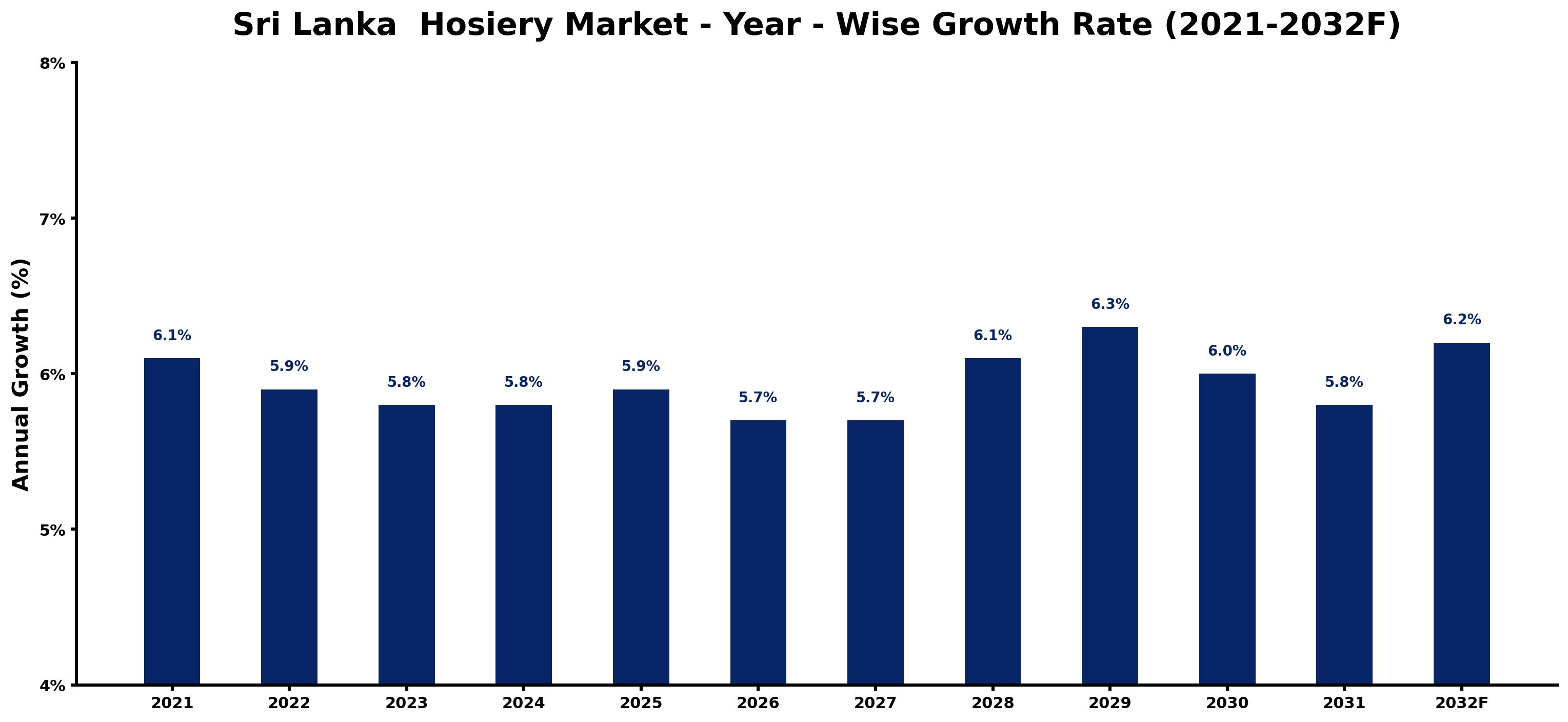
The table below presents the year wise growth rates along with the key drivers influencing the market
| Year | Growth Rate | Major Drivers |
| 2021 | 6.1% | Post-lockdown retail projects enhance offline shopping experiences in urban centers. |
| 2022 | 5.9% | E-commerce platforms increasingly offer diverse hosiery options for consumers online. |
| 2023 | 5.8% | Sustainable materials gain traction among environmentally conscious Sri Lankan consumers. |
| 2024 | 5.8% | Local manufacturers explore innovative designs catering to traditional and modern styles. |
| 2025 | 5.9% | Increased disposable income supports higher spending on quality hosiery products. |
| 2026 | 5.7% | Youth-driven fashion trends influence demand for vibrant and trendy hosiery styles. |
| 2027 | 5.7% | Collaborations with fashion designers boost brand visibility and consumer interest. |
| 2028 | 6.1% | Growing tourism sector leads to an uptick in hosiery sales at retail outlets. |
| 2029 | 6.3% | Expanding distribution networks enhance availability in rural and underserved markets. |
| 2030 | 6.0% | Health and wellness trends increase interest in hosiery with compression benefits. |
| 2031 | 5.8% | Digital marketing campaigns effectively engage younger audiences for brand loyalty. |
| 2032 | 6.2% | Investment in local manufacturing strengthens supply chains and reduces import dependencies. |
Note - Market size estimations and growth projections presented in this report are based on 6Wresearch's advanced forecasting approach, validated with industry datasets as of June 2026.
Sri Lanka Hosiery Market Synopsis
The Sri Lanka Hosiery Market is projected to reach 5.7% and witness significant growth during the forecast period (2026-2032). This expansion is primarily driven by the rising demand for comfortable and stylish legwear among consumers. The market encompasses a diverse assortment of hosiery products including socks, stockings, tights, and leggings, which cater to an array of age groups and fashion preferences. Notably, the market is experiencing a transformation influenced by several factors such as evolving fashion trends, advancements in manufacturing techniques, and the growing adoption of e-commerce platforms for hosiery sales.
Sri Lanka Hosiery Market Trends and Opportunities
The Sri Lanka hosiery market is currently characterized by several significant trends that are reshaping consumer behavior and market dynamics. One of the most notable trends is the increasing demand for sustainable and eco-friendly materials in hosiery products. This trend reflects a heightened consumer awareness regarding sustainability and environmental responsibility.
- There is a rising preference for athleisure wear, which is driving the sales of performance hosiery and specialized sports socks. This category of products appeals to consumers seeking functionality combined with style.
- The shift towards online shopping has significantly transformed the purchasing landscape in the hosiery market. Consumers increasingly appreciate the convenience and variety offered by e-commerce platforms, leading to higher sales volumes through these channels.
- Customizable hosiery options are gaining traction as consumers seek personalized experiences. The availability of unique designs and colors allows individuals to express their personal style more vividly.
- Technological advancements in production processes are enhancing product quality and design potential, enabling manufacturers to meet diverse consumer demands more effectively.
- The increasing focus on comfort, quality, and affordability in hosiery products is prompting innovations that cater specifically to local consumer preferences.
Sri Lanka Hosiery Market Challenges and Restraints
While the Sri Lanka hosiery market demonstrates considerable potential, it is not without its challenges. One prominent issue is the intense competition between both domestic and international brands, which creates pricing pressures and affects brand differentiation.
- Fluctuating raw material prices pose another significant challenge, impacting production costs and profit margins for manufacturers across the sector.
- The seasonal nature of demand can lead to inventory management complexities, affecting retailers and producers alike.
- Counterfeiting and imitation products may undermine consumer trust and loyalty toward authentic brands, presenting a legal and reputational risk.
- Despite growing awareness, there remains a lack of understanding among consumers regarding the benefits of high-quality hosiery, which can hinder purchasing decisions.
- Distribution and logistics issues, such as inadequate infrastructure and transportation inefficiencies, can further complicate the market landscape, leading to delays and increased costs for retailers.
Sri Lanka Hosiery Market Investment Opportunities
The Sri Lanka Hosiery Market offers an array of investment opportunities, particularly in light of the increasing consumer demand driven by shifting fashion trends and rising disposable income. Investors can capitalize on the local market by exploring the manufacture and distribution of various hosiery products.
- There is potential in developing innovative designs and high-quality products that align with growing consumer preferences for comfort and style.
- Investing in sustainable technologies can provide manufacturers with a competitive edge, attracting environmentally conscious consumers.
- Strategic collaborations with local retailers and e-commerce platforms may enhance market reach and facilitate consumer engagement.
- Enhancing marketing strategies to boost brand visibility will be crucial for companies aiming to capture a larger share of the market.
- Investment in supply chain efficiency can further streamline distribution processes, helping manufacturers to respond agilely to market demands.
Sri Lanka Hosiery Market Government Investment and Initiatives
The Sri Lankan government has enacted various policies aimed at enhancing the hosiery market's growth. With an emphasis on domestic production, the government has implemented import restrictions on hosiery products to bolster local manufacturing capabilities. Furthermore, it has introduced subsidies and incentives aimed at increasing the competitiveness of local manufacturers.
In addition to these support measures, the government actively promotes the export of domestically produced hosiery items, contributing to revenue generation and economic growth.
By ensuring that quality standards are upheld in the hosiery industry, the government seeks to protect consumer interests while enhancing the reputation of Sri Lankan hosiery products on a global scale.
These initiatives collectively aim to stimulate the hosiery sector's growth, create employment opportunities, and contribute positively to the nation's economic advancement.
Sri Lanka Hosiery Market Latest Developments (May 2025 - June 2026)
Recent developments in the Sri Lanka hosiery market from May 2025 to June 2026 indicate a continued trajectory of growth driven by evolving consumer preferences and increasing market dynamism. Manufacturers are increasingly focusing on sustainability, incorporating eco-friendly materials into their product lines to meet rising consumer expectations regarding environmental responsibility.
E-commerce platforms have seen a marked increase in sales, reflecting a broader trend towards digitization in retail. This shift is compelling traditional retailers to adapt by enhancing their online presence and exploring new sales channels.
Additionally, personalization features in product offerings are becoming more popular, enabling consumers to engage more deeply with brands by choosing unique designs that resonate with their personal style.
Overall, these developments indicate a promising landscape for the Sri Lanka hosiery market, marked by innovation, responsiveness to consumer needs, and a commitment to sustainability.
Sri Lanka Hosiery Market - Key Attractiveness of the Report
- 10 Years of Market Numbers
- Historical Data Starting from 2022 to 2025
- Base Year: 2025
- Forecast Data until 2032
- Key Performance Indicators Impacting the Market
- Major Upcoming Developments and Projects
Key Highlights of the Report:
- Sri Lanka Hosiery Market Outlook
- Market Size of Sri Lanka Hosiery Market, 2025
- Forecast of Sri Lanka Hosiery Market, 2032
- Historical Data and Forecast of Sri Lanka Hosiery Revenues & Volume for the Period 2022-2032F
- Sri Lanka Hosiery Market Trend Evolution
- Sri Lanka Hosiery Market Drivers and Challenges
- Sri Lanka Hosiery Price Trends
- Sri Lanka Hosiery Porter's Five Forces
- Sri Lanka Hosiery Industry Life Cycle
- Historical Data and Forecast of Sri Lanka Hosiery Market Revenues & Volume By Product for the Period 2022-2032F
- Historical Data and Forecast of Sri Lanka Hosiery Market Revenues & Volume By Body Stockings for the Period 2022-2032F
- Historical Data and Forecast of Sri Lanka Hosiery Market Revenues & Volume By Compression Stockings for the Period 2022-2032F
- Historical Data and Forecast of Sri Lanka Hosiery Market Revenues & Volume By Knee Highs, Hold-ups for the Period 2022-2032F
- Historical Data and Forecast of Sri Lanka Hosiery Market Revenues & Volume By Stockings for the Period 2022-2032F
- Historical Data and Forecast of Sri Lanka Hosiery Market Revenues & Volume By Socks for the Period 2022-2032F
- Historical Data and Forecast of Sri Lanka Hosiery Market Revenues & Volume By Tights for the Period 2022-2032F
- Historical Data and Forecast of Sri Lanka Hosiery Market Revenues & Volume By Toe Socks for the Period 2022-2032F
- Historical Data and Forecast of Sri Lanka Hosiery Market Revenues & Volume By Gender for the Period 2022-2032F
- Historical Data and Forecast of Sri Lanka Hosiery Market Revenues & Volume By Men for the Period 2022-2032F
- Historical Data and Forecast of Sri Lanka Hosiery Market Revenues & Volume By Women for the Period 2022-2032F
- Historical Data and Forecast of Sri Lanka Hosiery Market Revenues & Volume By Size for the Period 2022-2032F
- Historical Data and Forecast of Sri Lanka Hosiery Market Revenues & Volume By Small for the Period 2022-2032F
- Historical Data and Forecast of Sri Lanka Hosiery Market Revenues & Volume By Medium for the Period 2022-2032F
- Historical Data and Forecast of Sri Lanka Hosiery Market Revenues & Volume By Large for the Period 2022-2032F
- Historical Data and Forecast of Sri Lanka Hosiery Market Revenues & Volume By Plus for the Period 2022-2032F
- Historical Data and Forecast of Sri Lanka Hosiery Market Revenues & Volume By Price Range for the Period 2022-2032F
- Historical Data and Forecast of Sri Lanka Hosiery Market Revenues & Volume By Premium for the Period 2022-2032F
- Historical Data and Forecast of Sri Lanka Hosiery Market Revenues & Volume By Medium for the Period 2022-2032F
- Historical Data and Forecast of Sri Lanka Hosiery Market Revenues & Volume By Low for the Period 2022-2032F
- Historical Data and Forecast of Sri Lanka Hosiery Market Revenues & Volume By Distribution Channel for the Period 2022-2032F
- Historical Data and Forecast of Sri Lanka Hosiery Market Revenues & Volume By Mass Merchant for the Period 2022-2032F
- Historical Data and Forecast of Sri Lanka Hosiery Market Revenues & Volume By Mono Brand Outlet for the Period 2022-2032F
- Historical Data and Forecast of Sri Lanka Hosiery Market Revenues & Volume By Online Store for the Period 2022-2032F
- Historical Data and Forecast of Sri Lanka Hosiery Market Revenues & Volume By Departmental Store for the Period 2022-2032F
- Historical Data and Forecast of Sri Lanka Hosiery Market Revenues & Volume By Others for the Period 2022-2032F
- Sri Lanka Hosiery Import Export Trade Statistics
- Market Opportunity Assessment By Product
- Market Opportunity Assessment By Gender
- Market Opportunity Assessment By Size
- Market Opportunity Assessment By Price Range
- Market Opportunity Assessment By Distribution Channel
- Sri Lanka Hosiery Top Companies Market Share
- Sri Lanka Hosiery Competitive Benchmarking By Technical and Operational Parameters
- Sri Lanka Hosiery Company Profiles
- Sri Lanka Hosiery Key Strategic Recommendations






































