Sri Lanka Industrial Analytics Market Size & Growth Rate (2026-2032)
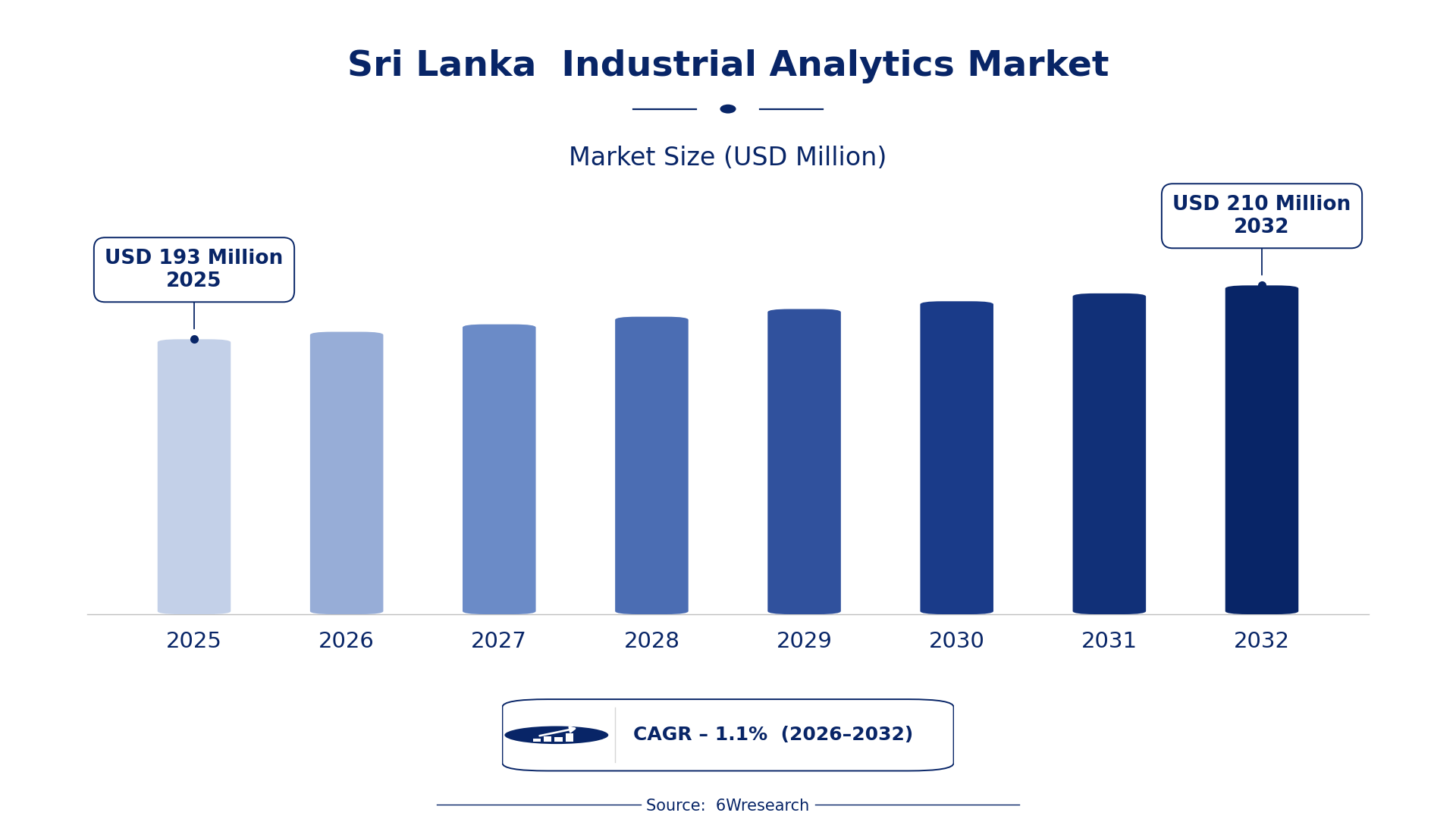
The Sri Lanka Industrial Analytics Market was estimated at USD 193 Million in 2025 and is projected to reach USD 210 Million by 2032, growing at a CAGR of 1.1% from 2026 to 2032.
Sri Lanka Industrial Analytics Market Synopsis
The surge in industrial IoT adoption is the strongest force driving the Sri Lanka Industrial Analytics Market. Various sectors, including manufacturing and energy, are investing in analytics tools to boost operational efficiency and productivity. As businesses recognize the importance of data-driven decision-making, the demand for advanced analytics solutions continues to rise.
on top of that, government initiatives aimed at promoting digital transformation and Industry 4.0 practices are further stimulating market growth. With a clear focus on enhancing competitiveness through technology, local industries are increasingly prioritizing investment in industrial analytics to stay relevant in an evolving global landscape.
Sri Lanka Industrial Analytics Market Year-wise Growth Rate and Key Drivers
This graph illustrates the annual growth rates of the Sri Lanka Industrial Analytics Market from 2021 to 2032, highlighting a steady upward trajectory and projected expansion over the forecast period.
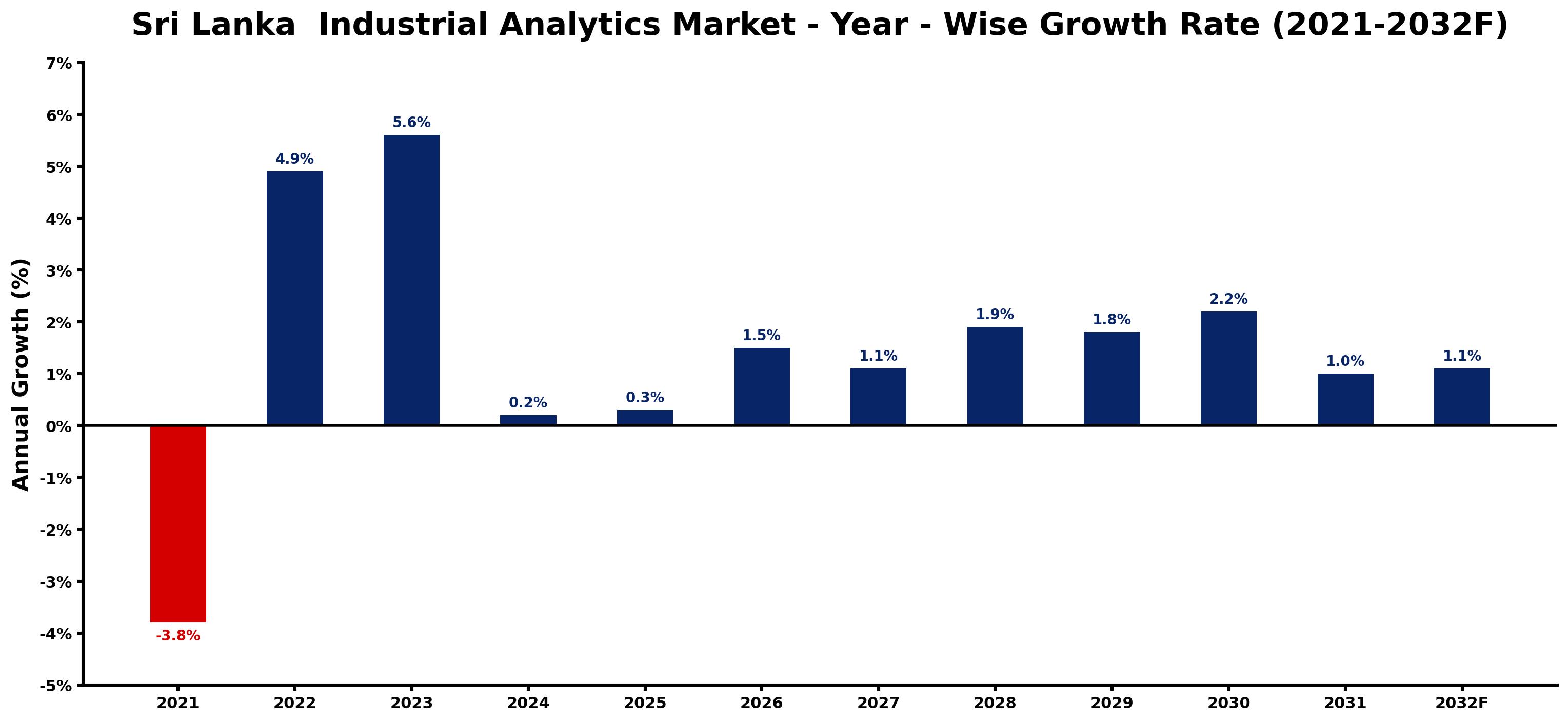
The table below presents the year‑wise growth rates along with the key drivers influencing the market
| Year | Growth Rate | Major Drivers |
| 2021 | -3.8% | Currency depreciation affecting technology investments significantly. |
| 2022 | 4.9% | Government's push for smart manufacturing initiatives. |
| 2023 | 5.6% | Increased investments in digital transformation by local manufacturers. |
| 2024 | 0.2% | Growing emphasis on sustainability in local manufacturing practices. |
| 2025 | 0.3% | Adoption of predictive maintenance technology by textile factories. |
| 2026 | 1.5% | Rising number of IoT-enabled devices in manufacturing sector. |
| 2027 | 1.1% | Increased focus on data-driven decision making in SMEs. |
| 2028 | 1.9% | Support from local universities for industrial analytics research. |
| 2029 | 1.8% | Enhanced supply chain management practices among consumer goods firms. |
| 2030 | 2.2% | Boost from government grants for technology adoption programs. |
| 2031 | 1.0% | Increased collaboration between industries and tech startups. |
| 2032 | 1.1% | Growth in demand for real-time operational dashboards. |
Note: Market size estimations and growth projections presented in this report are based on 6Wresearch's proprietary forecasting methodology, utilizing the latest available industry data, government publications, and primary research inputs.
Sri Lanka Industrial Analytics Market Key Takeaways
Below are some of the specific key takeaways from the market, including:
- The growing demand for predictive maintenance solutions is reshaping operational strategies across sectors.
- Investment in IoT integration services is critical for enhancing data collection and analysis capabilities.
- There is a marked increase in awareness regarding the importance of data security in analytics applications.
- Training programs for workforce upskilling are essential to address the skills gap in data analytics.
- Government policies are becoming increasingly favorable to foster innovation and attract foreign investment.
Evaluation of Restraints in Sri Lanka Industrial Analytics Market
Several factors are limiting the growth of the Sri Lanka Industrial Analytics Market. Data privacy and security concerns are prevalent, as companies grapple with protecting sensitive information while utilizing analytics tools. Additionally, a shortage of skilled professionals in data science and analytics hinders effective implementation. Many organizations are still in the early stages of understanding the potential benefits of industrial analytics, resulting in slower adoption rates. Addressing these challenges will require focused investments in training and security measures.
Sri Lanka Industrial Analytics Market Trends
Current trends indicate a growing integration of artificial intelligence and big data analytics in industrial operations. Companies are increasingly prioritizing real-time monitoring and data-driven insights to streamline processes and minimize downtime. The emphasis on predictive maintenance is becoming a standard practice, allowing firms to anticipate equipment failures before they occur. As businesses strive to enhance productivity and lower operational costs, the adoption of advanced analytics solutions is set to accelerate.
Sri Lanka Industrial Analytics Market Opportunities
With the rise of Industry 4.0 principles, the Sri Lanka Industrial Analytics Market presents significant investment opportunities. There is a pressing need for vendors to offer tailored analytics solutions that address the specific challenges faced by local industries. Opportunities exist in developing predictive maintenance software, providing data analytics consulting services, and integrating IoT solutions. Additionally, partnerships with local businesses can facilitate the adoption of analytics technologies, paving the way for sustained growth.
Government Initiatives in the Sri Lanka Industrial Analytics Market
The Sri Lankan government is actively promoting the growth of the Industrial Analytics Market through various initiatives. Recently, it launched incentive programs that offer tax breaks and grants to encourage businesses to adopt analytics technologies. Ongoing efforts include improving digital infrastructure and enhancing R&D capabilities, which are crucial for fostering innovation. Looking ahead, the government plans to implement additional training programs to upskill the workforce, ensuring the availability of skilled professionals in the analytics domain.
Future Insights of the Sri Lanka Industrial Analytics Market
The future for the Sri Lanka Industrial Analytics Market is promising, with an expected acceleration in the adoption of advanced technologies such as machine learning and IoT. As industries increasingly recognize the value of data in optimizing operations and improving competitiveness, demand for analytics solutions will continue to grow. The government's commitment to promoting smart manufacturing and automation is likely to further drive market expansion, positioning Sri Lanka as a key player in the regional industrial analytics arena.
Sri Lanka Industrial Analytics Market Latest Developments
Recent activity in the Sri Lanka Industrial Analytics Market has showcased a clear direction toward innovation and technology integration. A major technology vendor launched a new predictive maintenance solution in early 2025, successfully implemented by several local manufacturers by late 2025. Ongoing efforts include partnerships aimed at enhancing IoT integration services, which began in mid-2025 and remain underway. Looking forward, a significant initiative is expected to kick off in the second half of 2026, focusing on developing analytics training programs in collaboration with local educational institutions.
Sri Lanka Industrial Analytics Market - Key Attractiveness of the Report
- 10 Years of Market Numbers
- Historical Data Starting from 2022 to 2025
- Base Year: 2025
- Forecast Data until 2032
- Key Performance Indicators Impacting the Market
- Major Upcoming Developments and Projects
Key Highlights of the Report:
- Sri Lanka Industrial Analytics Market Outlook
- Market Size of Sri Lanka Industrial Analytics Market, 2025
- Forecast of Sri Lanka Industrial Analytics Market, 2032
- Historical Data and Forecast of Sri Lanka Industrial Analytics Revenues & Volume for the Period 2022-2032F
- Sri Lanka Industrial Analytics Market Trend Evolution
- Sri Lanka Industrial Analytics Market Drivers and Challenges
- Sri Lanka Industrial Analytics Price Trends
- Sri Lanka Industrial Analytics Porter's Five Forces
- Sri Lanka Industrial Analytics Industry Life Cycle
- Historical Data and Forecast of Sri Lanka Industrial Analytics Market Revenues & Volume By Component for the Period 2022-2032F
- Historical Data and Forecast of Sri Lanka Industrial Analytics Market Revenues & Volume By Software for the Period 2022-2032F
- Historical Data and Forecast of Sri Lanka Industrial Analytics Market Revenues & Volume By Service for the Period 2022-2032F
- Historical Data and Forecast of Sri Lanka Industrial Analytics Market Revenues & Volume By Software for the Period 2022-2032F
- Historical Data and Forecast of Sri Lanka Industrial Analytics Market Revenues & Volume By Operational analytics for the Period 2022-2032F
- Historical Data and Forecast of Sri Lanka Industrial Analytics Market Revenues & Volume By Risk analytics for the Period 2022-2032F
- Historical Data and Forecast of Sri Lanka Industrial Analytics Market Revenues & Volume By Financial analytics for the Period 2022-2032F
- Historical Data and Forecast of Sri Lanka Industrial Analytics Market Revenues & Volume By Marketing analytics for the Period 2022-2032F
- Historical Data and Forecast of Sri Lanka Industrial Analytics Market Revenues & Volume By Customer analytics for the Period 2022-2032F
- Historical Data and Forecast of Sri Lanka Industrial Analytics Market Revenues & Volume By Workforce analytics for the Period 2022-2032F
- Historical Data and Forecast of Sri Lanka Industrial Analytics Market Revenues & Volume By Service for the Period 2022-2032F
- Historical Data and Forecast of Sri Lanka Industrial Analytics Market Revenues & Volume By Managed services for the Period 2022-2032F
- Historical Data and Forecast of Sri Lanka Industrial Analytics Market Revenues & Volume By Professional services for the Period 2022-2032F
- Historical Data and Forecast of Sri Lanka Industrial Analytics Market Revenues & Volume By Analytics Type for the Period 2022-2032F
- Historical Data and Forecast of Sri Lanka Industrial Analytics Market Revenues & Volume By Descriptive for the Period 2022-2032F
- Historical Data and Forecast of Sri Lanka Industrial Analytics Market Revenues & Volume By Diagnostic for the Period 2022-2032F
- Historical Data and Forecast of Sri Lanka Industrial Analytics Market Revenues & Volume By Predictive for the Period 2022-2032F
- Historical Data and Forecast of Sri Lanka Industrial Analytics Market Revenues & Volume By Prescriptive for the Period 2022-2032F
- Historical Data and Forecast of Sri Lanka Industrial Analytics Market Revenues & Volume By Organization size for the Period 2022-2032F
- Historical Data and Forecast of Sri Lanka Industrial Analytics Market Revenues & Volume By Large enterprises for the Period 2022-2032F
- Historical Data and Forecast of Sri Lanka Industrial Analytics Market Revenues & Volume By Small and medium-sized enterprises for the Period 2022-2032F
- Sri Lanka Industrial Analytics Import Export Trade Statistics
- Market Opportunity Assessment By Component
- Market Opportunity Assessment By Software
- Market Opportunity Assessment By Service
- Market Opportunity Assessment By Analytics Type
- Market Opportunity Assessment By Organization size
- Sri Lanka Industrial Analytics Top Companies Market Share
- Sri Lanka Industrial Analytics Competitive Benchmarking By Technical and Operational Parameters
- Sri Lanka Industrial Analytics Company Profiles
- Sri Lanka Industrial Analytics Key Strategic Recommendations






































