Sri Lanka Industrial Vacuum Cleaner Market Size, Share & Growth Rate
The Sri Lanka Industrial Vacuum Cleaner Market was estimated at USD 88 Million in 2025 and is projected to reach USD 97 Million by 2032, growing at a CAGR of 1.4% from 2026 to 2032. This growth trajectory underscores the increasing recognition of the importance of cleanliness and hygiene in industrial settings. As industries push for better workplace safety standards and dust-free environments, the demand for robust cleaning solutions has become paramount, further fueled by technological advancements that enhance efficiency and usability.
Sri Lanka Industrial Vacuum Cleaner Market Year-wise Growth Rate and Key Drivers
This graph highlights how the Sri Lanka Industrial Vacuum Cleaner Market has steadily grown over the years, supported by major growth factors.
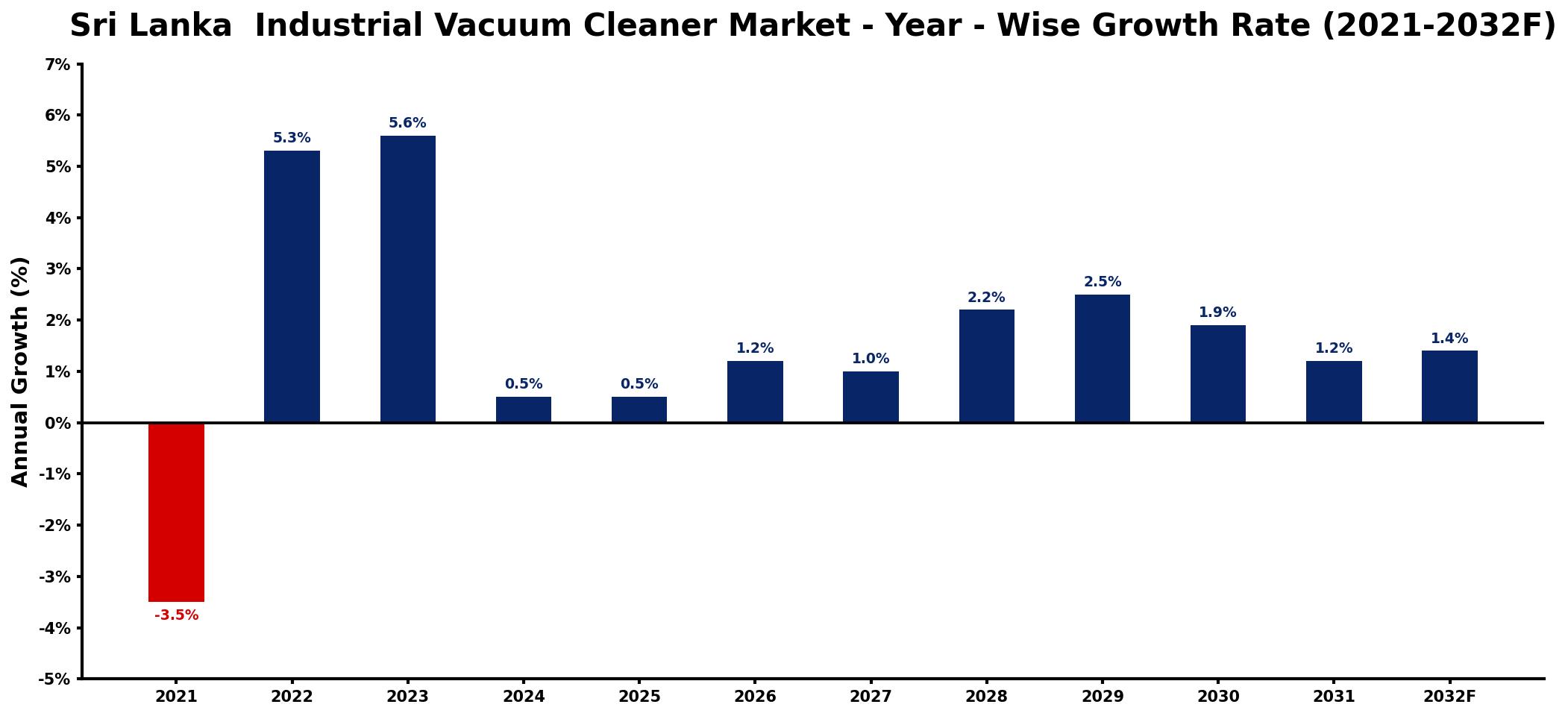
The table below presents the year‑wise growth rates along with the key drivers influencing the market
| Year | Growth Rate | Major Drivers |
| 2021 | -3.5% | decreased manufacturing output levels |
| 2022 | 5.3% | increased demand from construction sector |
| 2023 | 5.6% | growing focus on environmental regulations |
| 2024 | 0.5% | expansion of logistics and warehousing |
| 2025 | 0.5% | rising investments in automation technologies |
| 2026 | 1.2% | enhanced awareness of workplace hygiene |
| 2027 | 1.0% | growth in food processing industries |
| 2028 | 2.2% | surge in healthcare facility upgrades |
| 2029 | 2.5% | development of smart city initiatives |
| 2030 | 1.9% | increased export opportunities in Asia |
| 2031 | 1.2% | strengthened supply chain management |
| 2032 | 1.4% | growing trend of sustainability practices |
Note: Market size estimations and growth projections presented in this report are based on 6Wresearch's proprietary forecasting methodology, utilizing the latest available industry data, government publications, and primary research inputs.
Sri Lanka Industrial Vacuum Cleaner Market Synopsis
In recent years, the Sri Lanka industrial vacuum cleaner market has seen momentum driven by rising hygiene standards across various sectors. However, the road ahead is characterized by both opportunities and challenges, primarily stemming from the high costs associated with imported cleaning solutions. A growing awareness of workplace safety and enhanced product functionalities are steering market dynamics toward a more favorable outlook.
Despite the promising growth, the market faces obstacles due to limited local manufacturing capabilities and high import tariffs that hinder widespread adoption. Nevertheless, these hurdles may also act as catalysts for local innovations and initiatives aimed at establishing domestic production. As industries adapt, the future looks more encouraging for the industrial vacuum cleaner market in Sri Lanka.
Sri Lanka Industrial Vacuum Cleaner Market Key Takeaways
- Increasing industrial hygiene standards are fueling demand for efficient vacuum cleaning solutions.
- Technological advancements in vacuum cleaners are improving performance and reducing operational costs.
- High import tariffs and lack of local manufacturing are key challenges for market accessibility.
- Government initiatives are promoting local production and adherence to quality control standards.
- The market presents opportunities for investments in innovative, energy-efficient cleaning technologies.
Evaluation of Restraints in Sri Lanka Industrial Vacuum Cleaner Market
The Sri Lanka industrial vacuum cleaner market is significantly restrained by high import tariffs that elevate product costs, making it challenging for local businesses to access effective cleaning solutions. The lack of domestic manufacturing capabilities further exacerbates this issue, as reliance on imports hampers market growth and increases vulnerability to international price fluctuations. Additionally, limited awareness of the benefits of industrial vacuum cleaners means many businesses remain hesitant to invest in such technologies, resulting in slower adoption rates and restricted market expansion.
Sri Lanka Industrial Vacuum Cleaner Market Trends
Several trends are shaping the Sri Lanka industrial vacuum cleaner market, notably the shift towards energy-efficient and environmentally-friendly cleaning solutions. The increasing incorporation of advanced technologies, such as IoT and automation, is enhancing vacuum cleaner functionalities, thereby enabling real-time monitoring and efficient operation. Moreover, an uptick in customization options for different industrial applications is making these machines more appealing to a broader range of sectors, driving demand in tandem.
Sri Lanka Industrial Vacuum Cleaner Market Opportunities
The market presents significant growth and investment opportunities in areas such as local manufacturing and product innovation. There is a pressing need for cost-effective solutions that meet international standards, which can incentivize the establishment of domestic production facilities. Additionally, businesses that invest in research and development of advanced industrial cleaning technologies could position themselves favorably in a market that is gradually recognizing the value of quality maintenance and hygiene.
Government Initiatives in the Sri Lanka Industrial Vacuum Cleaner Market
The Sri Lankan government is actively promoting local production in the industrial vacuum cleaner market through various initiatives and incentives. Policies aimed at supporting research and development in manufacturing technologies are encouraging innovation, while stringent quality control regulations ensure that products meet safety and operational standards. Additionally, there is a focus on fostering energy-efficient and environmentally-friendly products, aligning with global sustainability trends and enhancing the competitive edge of local manufacturers.
Future Insights of the Sri Lanka Industrial Vacuum Cleaner Market
Looking ahead to 2026-2032, the Sri Lanka industrial vacuum cleaner market is poised for gradual growth driven by increasing awareness of workplace hygiene and safety. As industries continue to evolve, demand for advanced cleaning solutions tailored to specific needs will likely rise, creating openings for innovation. Coupled with favorable government policies aimed at boosting local manufacturing, the market may witness an upsurge in competitive offerings that enhance accessibility for businesses of all sizes.
Sri Lanka Industrial Vacuum Cleaner Market Latest Developments (2025 - 2026)
Recent developments in the Sri Lanka industrial vacuum cleaner market indicate a strategic focus on enhancing product efficiency and sustainability. Companies are increasingly prioritizing research and development to align with emerging market demands, particularly in terms of energy efficiency and user-friendliness. Additionally, local stakeholders are exploring partnerships aimed at reducing reliance on imports, thus signaling a shift toward fostering a more self-sustaining market environment.
Sri Lanka Industrial Vacuum Cleaner Market - Key Attractiveness of the Report
- 10 Years of Market Numbers
- Historical Data Starting from 2022 to 2025
- Base Year: 2025
- Forecast Data until 2032
- Key Performance Indicators Impacting the Market
- Major Upcoming Developments and Projects
Key Highlights of the Report:
- Sri Lanka Industrial Vacuum Cleaner Market Outlook
- Market Size of Sri Lanka Industrial Vacuum Cleaner Market, 2025
- Forecast of Sri Lanka Industrial Vacuum Cleaner Market, 2032
- Historical Data and Forecast of Sri Lanka Industrial Vacuum Cleaner Revenues & Volume for the Period 2022-2032F
- Sri Lanka Industrial Vacuum Cleaner Market Trend Evolution
- Sri Lanka Industrial Vacuum Cleaner Market Drivers and Challenges
- Sri Lanka Industrial Vacuum Cleaner Price Trends
- Sri Lanka Industrial Vacuum Cleaner Porter's Five Forces
- Sri Lanka Industrial Vacuum Cleaner Industry Life Cycle
- Historical Data and Forecast of Sri Lanka Industrial Vacuum Cleaner Market Revenues & Volume By Type for the Period 2022-2032F
- Historical Data and Forecast of Sri Lanka Industrial Vacuum Cleaner Market Revenues & Volume By Dry for the Period 2022-2032F
- Historical Data and Forecast of Sri Lanka Industrial Vacuum Cleaner Market Revenues & Volume By Wet & Dry for the Period 2022-2032F
- Historical Data and Forecast of Sri Lanka Industrial Vacuum Cleaner Market Revenues & Volume By Power Source for the Period 2022-2032F
- Historical Data and Forecast of Sri Lanka Industrial Vacuum Cleaner Market Revenues & Volume By Electric for the Period 2022-2032F
- Historical Data and Forecast of Sri Lanka Industrial Vacuum Cleaner Market Revenues & Volume By Pneumatic for the Period 2022-2032F
- Historical Data and Forecast of Sri Lanka Industrial Vacuum Cleaner Market Revenues & Volume By Industry for the Period 2022-2032F
- Historical Data and Forecast of Sri Lanka Industrial Vacuum Cleaner Market Revenues & Volume By Food & Beverages for the Period 2022-2032F
- Historical Data and Forecast of Sri Lanka Industrial Vacuum Cleaner Market Revenues & Volume By Metalworking for the Period 2022-2032F
- Historical Data and Forecast of Sri Lanka Industrial Vacuum Cleaner Market Revenues & Volume By Pharmaceuticals for the Period 2022-2032F
- Historical Data and Forecast of Sri Lanka Industrial Vacuum Cleaner Market Revenues & Volume By Manufacturing for the Period 2022-2032F
- Historical Data and Forecast of Sri Lanka Industrial Vacuum Cleaner Market Revenues & Volume By Building & Construction for the Period 2022-2032F
- Historical Data and Forecast of Sri Lanka Industrial Vacuum Cleaner Market Revenues & Volume By Others for the Period 2022-2032F
- Sri Lanka Industrial Vacuum Cleaner Import Export Trade Statistics
- Market Opportunity Assessment By Type
- Market Opportunity Assessment By Power Source
- Market Opportunity Assessment By Industry
- Sri Lanka Industrial Vacuum Cleaner Top Companies Market Share
- Sri Lanka Industrial Vacuum Cleaner Competitive Benchmarking By Technical and Operational Parameters
- Sri Lanka Industrial Vacuum Cleaner Company Profiles
- Sri Lanka Industrial Vacuum Cleaner Key Strategic Recommendations






































