Sri Lanka Insecticide Market Size, Share & Growth Rate
The Sri Lanka Insecticide Market was estimated at USD 442 Million in 2025 and is projected to reach USD 601 Million by 2032, growing at a CAGR of 4.5% from 2026 to 2032. This growth trajectory is primarily driven by the agricultural sector's increasing reliance on effective pest control measures to ensure crop yield and food security. Additionally, the ongoing shift towards integrated pest management and the adoption of sustainable agricultural practices are fuelling the demand for both chemical and biological insecticides in the market.
Sri Lanka Insecticide Market Year-wise Growth Rate and Key Drivers
This graph highlights how the Sri Lanka Insecticide Market has steadily grown over the years, supported by major growth factors.
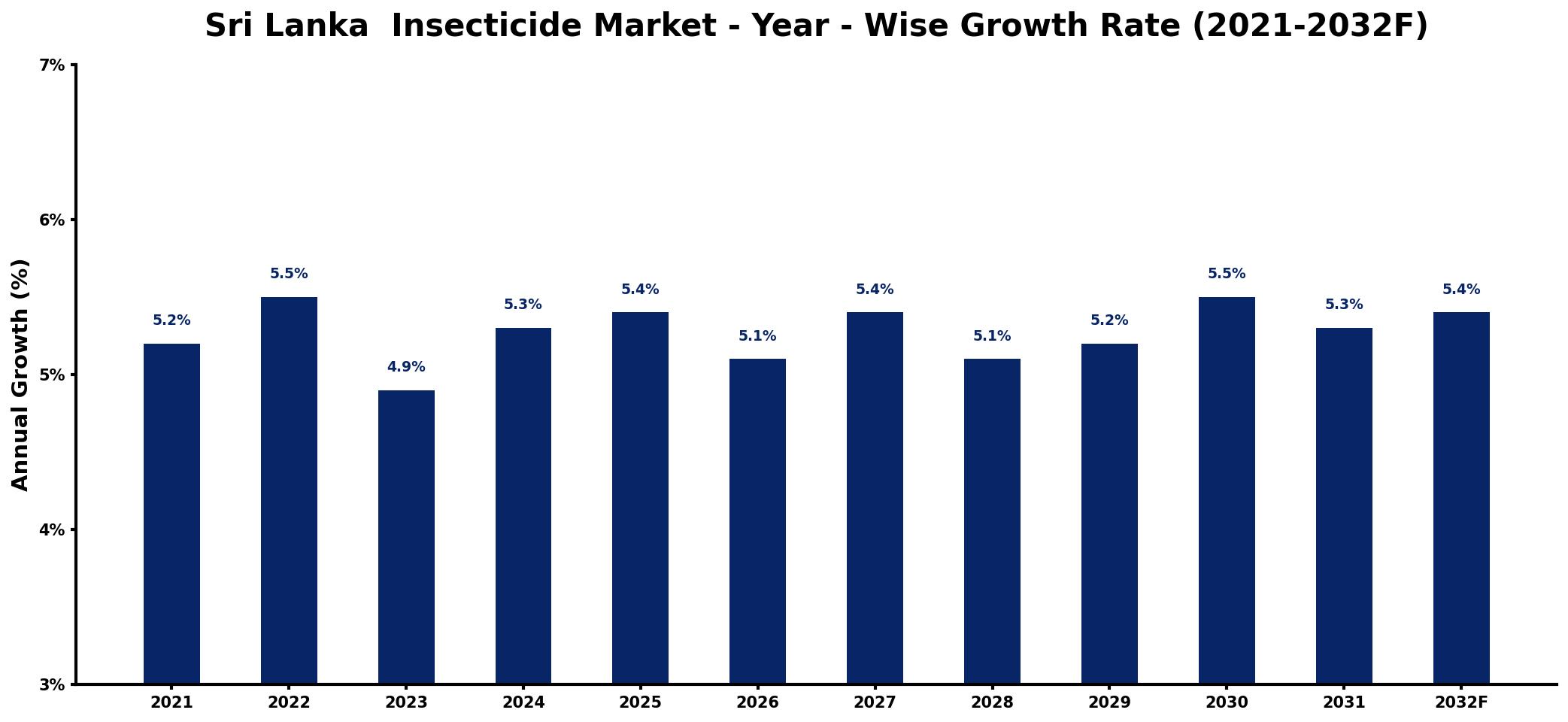
The table below presents the year‑wise growth rates along with the key drivers influencing the market
| Year | Growth Rate | Major Drivers |
| 2021 | 5.2% | Rising agricultural sector investments |
| 2022 | 5.5% | Increased pest resistance awareness |
| 2023 | 4.9% | Growing urban gardening initiatives |
| 2024 | 5.3% | Expanding organic farming practices |
| 2025 | 5.4% | Strengthened environmental regulations enacted |
| 2026 | 5.1% | Boosted crop yield expectations |
| 2027 | 5.4% | Growing demand for sustainable solutions |
| 2028 | 5.1% | Emerging biopesticide market opportunities |
| 2029 | 5.2% | Enhanced distribution network efficiency |
| 2030 | 5.5% | Growing focus on food security |
| 2031 | 5.3% | Increased agricultural technology adoption |
| 2032 | 5.4% | Rising consumer health consciousness |
Note: Market size estimations and growth projections presented in this report are based on 6Wresearch's proprietary forecasting methodology, utilizing the latest available industry data, government publications, and primary research inputs.
Sri Lanka Insecticide Market Synopsis
Currently, Sri Lanka's insecticide market is adapting to a dual challenge: meeting the demand for effective pest control while adhering to stringent environmental regulations. The growing trend towards organic farming is shaping consumer preferences, leading to a notable rise in the demand for biopesticides and eco-friendly solutions.
The local market landscape reflects a blend of traditional insecticide use and innovative, sustainable alternatives. As farmers increasingly adopt integrated pest management strategies, they seek solutions that not only protect their crops but also align with global sustainability goals.
Sri Lanka Insecticide Market Key Takeaways
- The market is supported by rising food security concerns and an expanding agricultural sector.
- There is a significant transition towards eco-friendly and biopesticide products due to consumer demand.
- Government initiatives are promoting sustainable agriculture practices and influencing insecticide development.
- Resistance to conventional insecticides poses a challenge but also drives innovation in pest control solutions.
- The market is seeing increased investment in research and development for environmentally sustainable products.
Evaluation of Restraints in Sri Lanka Insecticide Market
Despite the positive outlook for the Sri Lanka insecticide market, several constraints hinder its growth. The regulatory environment is increasingly stringent, necessitating compliance with rigorous safety and efficacy standards. This can escalate operational costs for manufacturers. Furthermore, the rising consumer preference for organic products is pressuring traditional insecticide firms to adapt their offerings. Lastly, the occurrence of pest resistance against widely used insecticides presents a challenge, compelling the industry to innovate continuously and explore alternative pest control strategies.
Sri Lanka Insecticide Market Trends
A notable trend in the Sri Lanka insecticide market is the growing adoption of integrated pest management (IPM) approaches among farmers. This method emphasizes the use of biological controls and environmentally friendly products alongside traditional insecticides. There is also an increasing focus on research and development, with companies investing in the formulation of innovative products that minimize environmental impact. Additionally, the rise in consumer awareness regarding food safety and sustainability is driving demand for organic and biobased insecticides.
Sri Lanka Insecticide Market Opportunities
The Sri Lanka insecticide market presents significant growth opportunities, particularly in the realm of biopesticides and sustainable pest management solutions. Companies can capitalize on the increasing acceptance of organic farming practices and the governments push for environmentally friendly agricultural methods. There is also a ripe avenue for investment in educational programs that empower farmers with knowledge about integrated pest management and the effective use of new technologies. Collaborations with agricultural research institutions can further facilitate product development tailored to local agricultural challenges.
Government Initiatives in the Sri Lanka Insecticide Market
The Sri Lankan government has implemented a range of initiatives aimed at promoting sustainable agriculture, which directly impacts the insecticide market. These include stricter regulations for chemical insecticides, promoting biopesticides through incentives, and funding for research and development in eco-friendly agricultural practices. Policies encouraging the adoption of integrated pest management techniques are also contributing to a more sustainable approach in the agriculture sector, thereby influencing insecticide usage and development.
Future Insights of the Sri Lanka Insecticide Market
Looking ahead to the period between 2026 and 2032, the Sri Lanka insecticide market is expected to evolve significantly. The combination of increasing food production demands and the shift towards environmentally sustainable practices will create a dynamic market environment. Innovations in biopesticides and advanced formulations will likely play a pivotal role in this evolution. Furthermore, as resistance to traditional chemical pest control methods grows, the demand for novel solutions will drive further research and technological advancements.
Sri Lanka Insecticide Market Latest Developments (2025 - 2026)
Recent developments in the Sri Lanka insecticide market reflect a growing commitment to sustainability and innovation. Industry stakeholders are increasingly focusing on the development of biopesticides and eco-friendly products in response to regulatory pressures and consumer demand. Furthermore, partnerships between government bodies and agricultural organizations are fostering research initiatives aimed at promoting integrated pest management. This collaborative approach is expected to lead to new product offerings and improved pest control practices across the agricultural sector.
Sri Lanka Insecticide Market - Key Attractiveness of the Report
- 10 Years of Market Numbers
- Historical Data Starting from 2022 to 2025
- Base Year: 2025
- Forecast Data until 2032
- Key Performance Indicators Impacting the Market
- Major Upcoming Developments and Projects
Key Highlights of the Report:
- Sri Lanka Insecticide Market Outlook
- Market Size of Sri Lanka Insecticide Market, 2025
- Forecast of Sri Lanka Insecticide Market, 2032
- Historical Data and Forecast of Sri Lanka Insecticide Revenues & Volume for the Period 2022-2032F
- Sri Lanka Insecticide Market Trend Evolution
- Sri Lanka Insecticide Market Drivers and Challenges
- Sri Lanka Insecticide Price Trends
- Sri Lanka Insecticide Porter's Five Forces
- Sri Lanka Insecticide Industry Life Cycle
- Historical Data and Forecast of Sri Lanka Insecticide Market Revenues & Volume By Type for the Period 2022-2032F
- Historical Data and Forecast of Sri Lanka Insecticide Market Revenues & Volume By Pyrethroids for the Period 2022-2032F
- Historical Data and Forecast of Sri Lanka Insecticide Market Revenues & Volume By Organophosphorus for the Period 2022-2032F
- Historical Data and Forecast of Sri Lanka Insecticide Market Revenues & Volume By Carbamates for the Period 2022-2032F
- Historical Data and Forecast of Sri Lanka Insecticide Market Revenues & Volume By Organochlorine for the Period 2022-2032F
- Historical Data and Forecast of Sri Lanka Insecticide Market Revenues & Volume By Botanicals for the Period 2022-2032F
- Historical Data and Forecast of Sri Lanka Insecticide Market Revenues & Volume By Other Types for the Period 2022-2032F
- Historical Data and Forecast of Sri Lanka Insecticide Market Revenues & Volume By Crop Type for the Period 2022-2032F
- Historical Data and Forecast of Sri Lanka Insecticide Market Revenues & Volume By Cereals & Grains for the Period 2022-2032F
- Historical Data and Forecast of Sri Lanka Insecticide Market Revenues & Volume By Oilseeds & Pulses for the Period 2022-2032F
- Historical Data and Forecast of Sri Lanka Insecticide Market Revenues & Volume By Fruits & Vegetables for the Period 2022-2032F
- Historical Data and Forecast of Sri Lanka Insecticide Market Revenues & Volume By Other Crop Types for the Period 2022-2032F
- Historical Data and Forecast of Sri Lanka Insecticide Market Revenues & Volume By Formulation for the Period 2022-2032F
- Historical Data and Forecast of Sri Lanka Insecticide Market Revenues & Volume By Wettable Powder for the Period 2022-2032F
- Historical Data and Forecast of Sri Lanka Insecticide Market Revenues & Volume By Emulsifiable Concentrate for the Period 2022-2032F
- Historical Data and Forecast of Sri Lanka Insecticide Market Revenues & Volume By Suspension Concentrate for the Period 2022-2032F
- Historical Data and Forecast of Sri Lanka Insecticide Market Revenues & Volume By Oil Emulsion In Water for the Period 2022-2032F
- Historical Data and Forecast of Sri Lanka Insecticide Market Revenues & Volume By Microencapsulated Suspension for the Period 2022-2032F
- Historical Data and Forecast of Sri Lanka Insecticide Market Revenues & Volume By Granules for the Period 2022-2032F
- Historical Data and Forecast of Sri Lanka Insecticide Market Revenues & Volume By Other Formulations for the Period 2022-2032F
- Historical Data and Forecast of Sri Lanka Insecticide Market Revenues & Volume By Form for the Period 2022-2032F
- Historical Data and Forecast of Sri Lanka Insecticide Market Revenues & Volume By Sprays for the Period 2022-2032F
- Historical Data and Forecast of Sri Lanka Insecticide Market Revenues & Volume By Baits for the Period 2022-2032F
- Historical Data and Forecast of Sri Lanka Insecticide Market Revenues & Volume By Strips for the Period 2022-2032F
- Sri Lanka Insecticide Import Export Trade Statistics
- Market Opportunity Assessment By Type
- Market Opportunity Assessment By Crop Type
- Market Opportunity Assessment By Formulation
- Market Opportunity Assessment By Form
- Sri Lanka Insecticide Top Companies Market Share
- Sri Lanka Insecticide Competitive Benchmarking By Technical and Operational Parameters
- Sri Lanka Insecticide Company Profiles
- Sri Lanka Insecticide Key Strategic Recommendations






































