Sri Lanka Letterpress Printing Machinery Market Size, Share & Growth Rate
The Sri Lanka Letterpress Printing Machinery Market was estimated at USD 948 Million in 2025 and is projected to reach USD 1372 Million by 2032, growing at a CAGR of 5.4% from 2026 to 2032. This growth trajectory is significantly influenced by rising demand for quality printing services across the packaging, publishing, and advertising sectors. Additionally, technological advancements and an increasing focus on sustainable practices are further propelling the market forward, ensuring that businesses remain competitive in a dynamic landscape.
Sri Lanka Letterpress Printing Machinery Market Year-wise Growth Rate and Key Drivers
This graph highlights how the Sri Lanka Letterpress Printing Machinery Market has steadily grown over the years, supported by major growth factors.
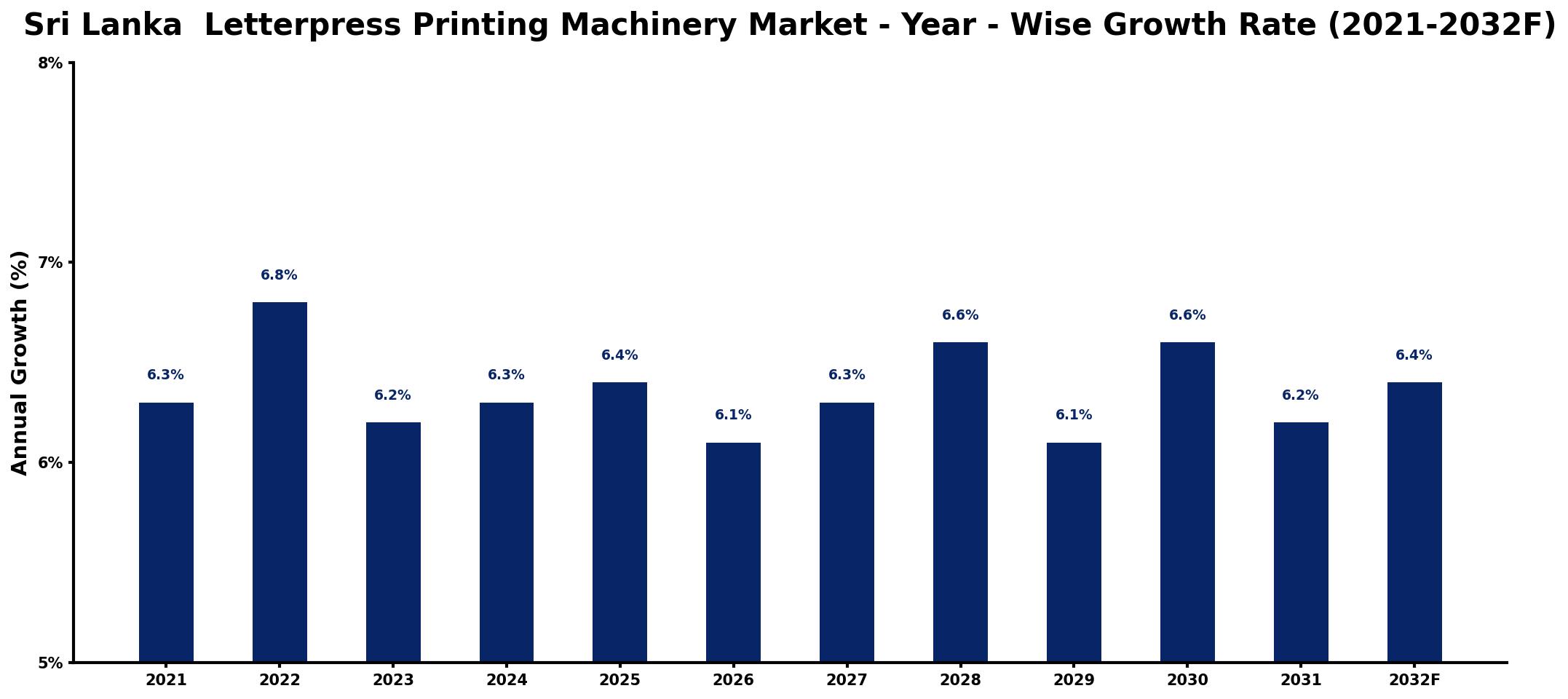
The table below presents the year‑wise growth rates along with the key drivers influencing the market
| Year | Growth Rate | Major Drivers |
| 2021 | 6.3% | Rising demand for quality packaging |
| 2022 | 6.8% | Growth in eco-friendly materials usage |
| 2023 | 6.2% | Increase in local manufacturing investments |
| 2024 | 6.3% | Expansion of e-commerce platforms |
| 2025 | 6.4% | Surge in customized product offerings |
| 2026 | 6.1% | Strengthening of export markets |
| 2027 | 6.3% | Innovations in sustainable production |
| 2028 | 6.6% | growing downstream application demand |
| 2029 | 6.1% | Rising trends in personalized items |
| 2030 | 6.6% | Increased focus on automation technologies |
| 2031 | 6.2% | Expansion in advertising sectors |
| 2032 | 6.4% | Higher demand for niche applications |
Note: Market size estimations and growth projections presented in this report are based on 6Wresearch's proprietary forecasting methodology, utilizing the latest available industry data, government publications, and primary research inputs.
Sri Lanka Letterpress Printing Machinery Market Synopsis
The landscape of the Sri Lanka Letterpress Printing Machinery Market is evolving rapidly, marked by a robust push towards quality and efficiency. As industries increasingly seek innovative printing solutions, traditional letterpress methods are being revitalized with modern technology, allowing for both customization and eco-friendly practices.
Local businesses are adapting to this shift by investing in advanced machinery that caters to the growing demand for bespoke printing products. Coupled with government initiatives aimed at enhancing the printing sector, the market demonstrates a strong potential for expansion and innovation in the coming years.
Sri Lanka Letterpress Printing Machinery Market Key Takeaways
- The market is on a growth path, projected to reach USD 1372 Million by 2032.
- Technological advancements are reshaping production processes in letterpress printing.
- Customization and eco-friendliness are driving new business models and solutions.
- Government initiatives are fostering an environment conducive to market growth.
- Investment opportunities abound in training, machinery, and maintenance services.
Evaluation of Restraints in Sri Lanka Letterpress Printing Machinery Market
Despite its promising outlook, the Sri Lanka Letterpress Printing Machinery Market faces significant challenges that hinder its full potential. A primary restraint is the increasing competition from digital printing technology, which has captured a considerable share of the market due to its cost-effectiveness and efficiency. This shift in consumer preference places pressure on traditional letterpress methods, which may struggle to demonstrate similar advantages.
Furthermore, the high initial investment required to set up and maintain letterpress machinery poses a barrier, particularly for small and medium-sized enterprises. The scarcity of skilled professionals proficient in operating letterpress equipment also presents an ongoing challenge. Addressing these constraints through innovative strategies and value-added services will be crucial for sustaining growth in the market.
Sri Lanka Letterpress Printing Machinery Market Trends
One notable trend is the ongoing shift towards digital integration within the letterpress manufacturing process. Companies are increasingly adopting technologies such as computer-to-plate systems, which enhance efficiency and reduce production times. Additionally, a growing emphasis on sustainability is prompting businesses to utilize eco-friendly inks and papers, aligning with consumer preferences for greener products.
Customization is another pivotal trend, with demand surging for unique and personalized printing solutions. As clients seek differentiated products, businesses are responding by leveraging advanced machinery that caters to these specific needs, thereby redefining the competitive landscape.
Sri Lanka Letterpress Printing Machinery Market Opportunities
The Sri Lanka Letterpress Printing Machinery Market holds significant investment potential, particularly in light of the rising demand for efficient printing solutions. Opportunities abound in the development and distribution of modern letterpress equipment, coupled with maintenance and repair services that enhance operational efficiency. Furthermore, the market presents avenues for investors to create training and educational programs aimed at upskilling operators, thus addressing the skills gap and boosting productivity.
Government Initiatives in the Sri Lanka Letterpress Printing Machinery Market
Government policies supporting the Sri Lanka Letterpress Printing Machinery Market are geared towards encouraging local manufacturing and enhancing the overall growth of the printing sector. Through initiatives that promote technology transfer and provide incentives for domestic production, the government aims to create a balanced ecosystem that benefits both local and international players. Additionally, regulations focused on environmental sustainability and safety standards further guide market practices and ensure compliance among industry participants.
Future Insights of the Sri Lanka Letterpress Printing Machinery Market
The outlook for the Sri Lanka Letterpress Printing Machinery Market is optimistic, with growth expected to continue through 2032. The anticipated rise in demand for high-quality, customizable printing solutions across various sectors will likely drive further investment in advanced machinery. As businesses increasingly adopt sustainable practices, the adoption of letterpress printing methods integrated with digital capabilities is expected to flourish. In summary, the market is well-positioned for expansion, fueled by innovation, quality, and a commitment to meeting evolving consumer demands.
Sri Lanka Letterpress Printing Machinery Market Latest Developments (2025 - 2026)
Recent developments in the Sri Lanka Letterpress Printing Machinery Market indicate a strong pivot towards modernization, with many companies embracing cutting-edge technologies to enhance production capabilities. Additionally, there has been a noticeable uptick in collaborations and partnerships aimed at fostering innovation within the industry. As the market adapts to changes in consumer preferences, businesses are increasingly focused on developing sustainable practices and solutions to meet the demands of environmentally conscious customers.
Sri Lanka Letterpress Printing Machinery Market - Key Attractiveness of the Report
- 10 Years of Market Numbers
- Historical Data Starting from 2022 to 2025
- Base Year: 2025
- Forecast Data until 2032
- Key Performance Indicators Impacting the Market
- Major Upcoming Developments and Projects
Key Highlights of the Report:
- Sri Lanka Letterpress Printing Machinery Market Outlook
- Market Size of Sri Lanka Letterpress Printing Machinery Market, 2025
- Forecast of Sri Lanka Letterpress Printing Machinery Market, 2032
- Historical Data and Forecast of Sri Lanka Letterpress Printing Machinery Revenues & Volume for the Period 2022-2032F
- Sri Lanka Letterpress Printing Machinery Market Trend Evolution
- Sri Lanka Letterpress Printing Machinery Market Drivers and Challenges
- Sri Lanka Letterpress Printing Machinery Price Trends
- Sri Lanka Letterpress Printing Machinery Porter's Five Forces
- Sri Lanka Letterpress Printing Machinery Industry Life Cycle
- Historical Data and Forecast of Sri Lanka Letterpress Printing Machinery Market Revenues & Volume By Type for the Period 2022-2032F
- Historical Data and Forecast of Sri Lanka Letterpress Printing Machinery Market Revenues & Volume By Rotary Letterpress Machine for the Period 2022-2032F
- Historical Data and Forecast of Sri Lanka Letterpress Printing Machinery Market Revenues & Volume By Other for the Period 2022-2032F
- Historical Data and Forecast of Sri Lanka Letterpress Printing Machinery Market Revenues & Volume By Application for the Period 2022-2032F
- Historical Data and Forecast of Sri Lanka Letterpress Printing Machinery Market Revenues & Volume By Securities for the Period 2022-2032F
- Historical Data and Forecast of Sri Lanka Letterpress Printing Machinery Market Revenues & Volume By Invitation Card for the Period 2022-2032F
- Historical Data and Forecast of Sri Lanka Letterpress Printing Machinery Market Revenues & Volume By Other for the Period 2022-2032F
- Sri Lanka Letterpress Printing Machinery Import Export Trade Statistics
- Market Opportunity Assessment By Type
- Market Opportunity Assessment By Application
- Sri Lanka Letterpress Printing Machinery Top Companies Market Share
- Sri Lanka Letterpress Printing Machinery Competitive Benchmarking By Technical and Operational Parameters
- Sri Lanka Letterpress Printing Machinery Company Profiles
- Sri Lanka Letterpress Printing Machinery Key Strategic Recommendations






































