Sri Lanka Lithium Market Size Growth Rate
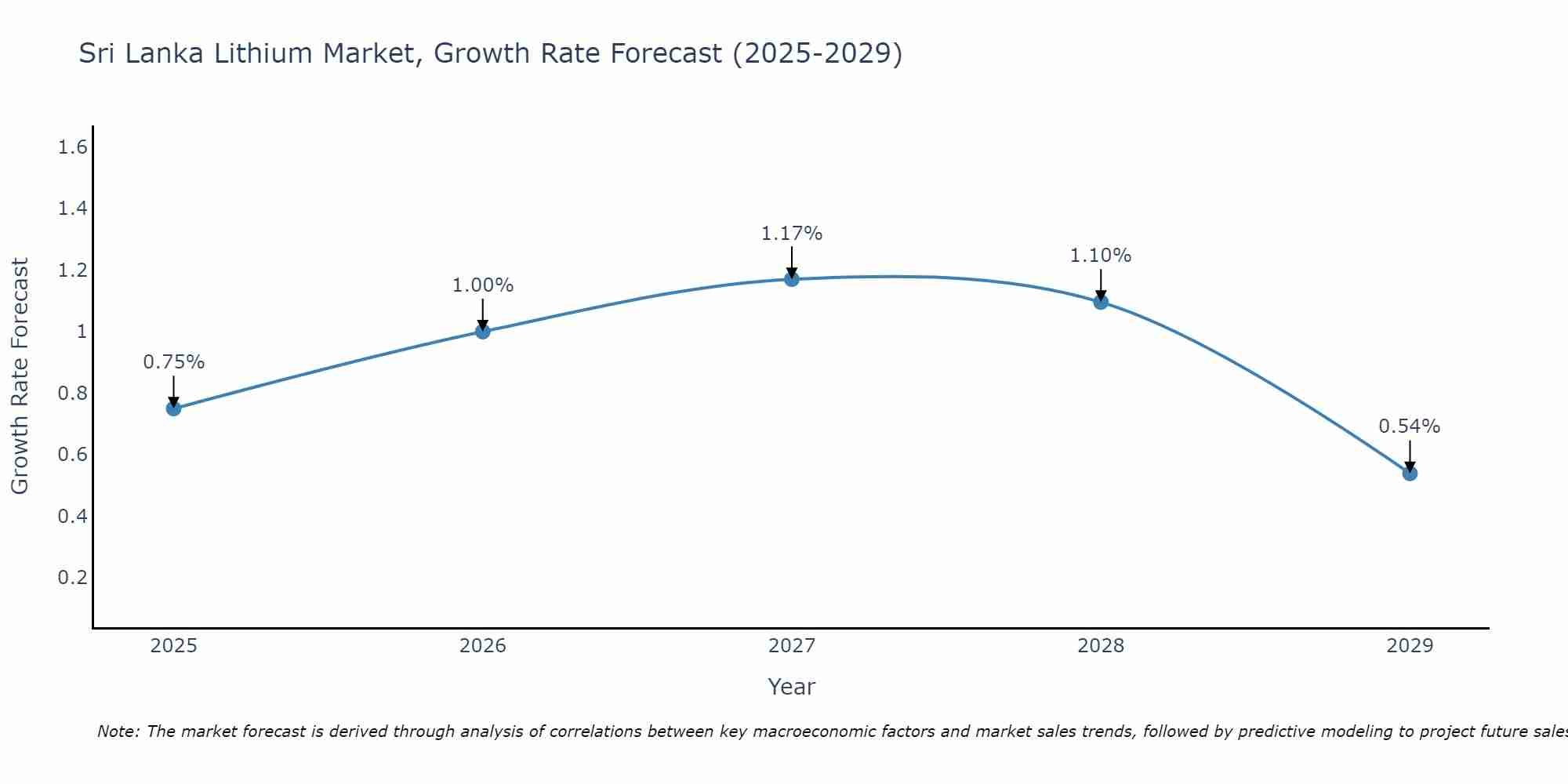
The Sri Lanka Lithium Market is projected to witness mixed growth rate patterns during 2025 to 2029. Growth accelerates to 1.17% in 2027, following an initial rate of 0.75%, before easing to 0.54% at the end of the period.
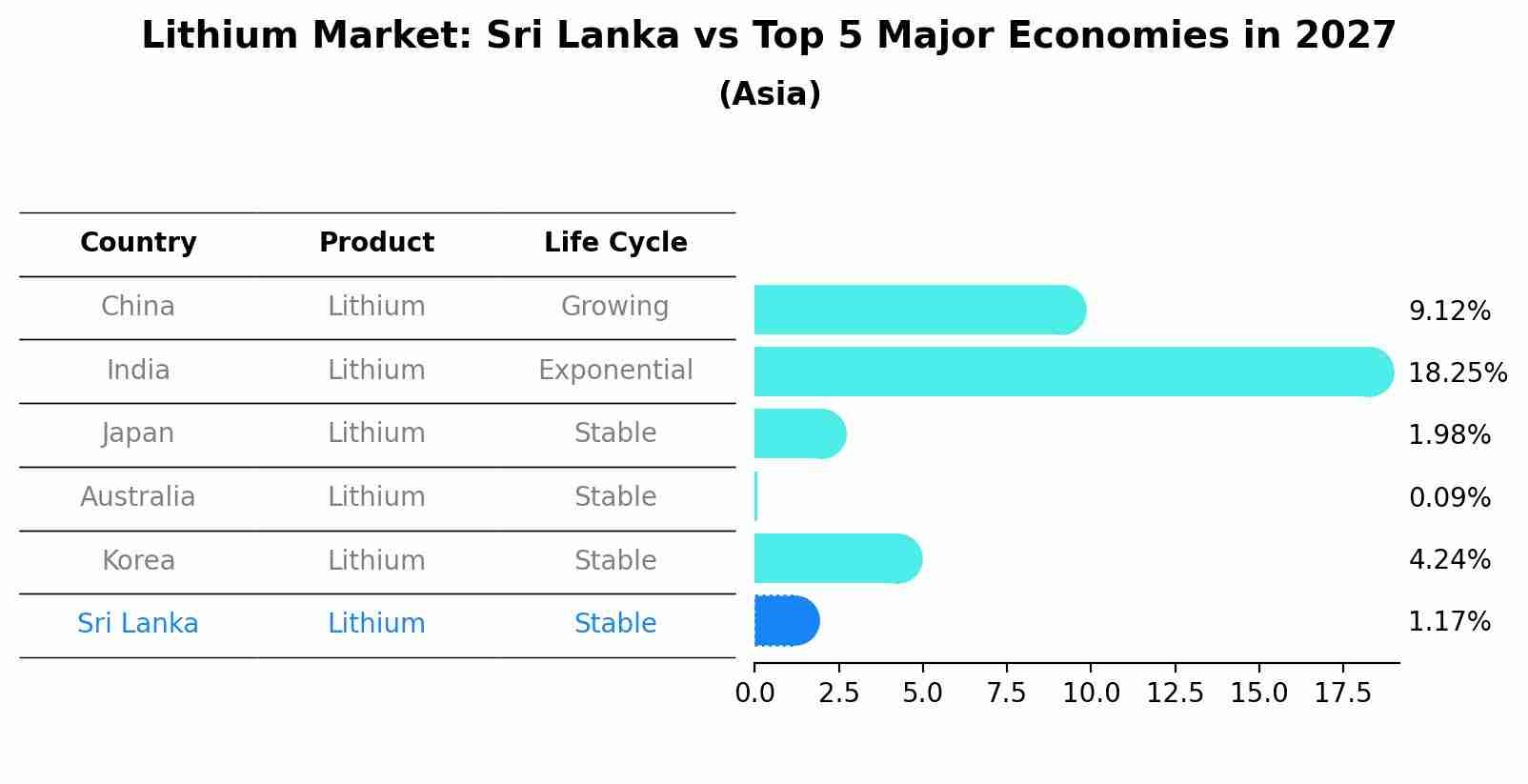
Lithium Market: Sri Lanka vs Top 5 Major Economies in 2027 (Asia)
The Lithium market in Sri Lanka is projected to grow at a stable growth rate of 1.17% by 2027, within the Asia region led by China, along with other countries like India, Japan, Australia and South Korea, collectively shaping a dynamic and evolving market environment driven by innovation and increasing adoption of emerging technologies.
Sri Lanka Lithium Market Overview
The overall lithium market in Sri Lanka is developing as the country recognizes the strategic importance of lithium in the global energy transition. Lithium is a critical element for battery technology, which is essential for renewable energy storage and electric mobility. The market growth is driven by the increasing global demand for lithium and the potential for local resource development.
Drivers of the market
The lithium market in Sri Lanka is driven by the growing demand for lithium in various industrial applications, including batteries, ceramics, and pharmaceuticals. The emphasis on sustainable energy and the shift towards electric vehicles are significantly boosting the demand for lithium. Additionally, the increasing investment in lithium extraction and processing technologies and the development of new lithium-based products are contributing to market growth.
Challenges of the market
The overall lithium market in Sri Lanka is constrained by high production and processing costs, as well as limited availability of high-quality lithium ore. There is significant competition from global producers with more advanced extraction technologies. The market faces regulatory challenges related to mining and environmental sustainability. Additionally, fluctuations in global lithium prices and varying demand from the battery and electronics industries impact market stability. Limited local expertise in lithium extraction and processing further hampers growth.
Government Policy of the market
The Sri Lankan government has implemented policies to develop the lithium market, which is crucial for the battery industry. These policies include providing tax incentives for exploration and mining of lithium resources and funding for research into efficient extraction and processing technologies. The government also promotes the development of local manufacturing capabilities and supports the establishment of a robust supply chain for lithium products through industry partnerships and infrastructure development.
Key Highlights of the Report:
- Sri Lanka Lithium Market Outlook
- Market Size of Sri Lanka Lithium Market, 2021
- Forecast of Sri Lanka Lithium Market, 2028
- Historical Data and Forecast of Sri Lanka Lithium Revenues & Volume for the Period 2018 - 2028
- Sri Lanka Lithium Market Trend Evolution
- Sri Lanka Lithium Market Drivers and Challenges
- Sri Lanka Lithium Price Trends
- Sri Lanka Lithium Porter's Five Forces
- Sri Lanka Lithium Industry Life Cycle
- Historical Data and Forecast of Sri Lanka Lithium Market Revenues & Volume By Product for the Period 2018 - 2028
- Historical Data and Forecast of Sri Lanka Lithium Market Revenues & Volume By Carbonates for the Period 2018 - 2028
- Historical Data and Forecast of Sri Lanka Lithium Market Revenues & Volume By Hydroxide for the Period 2018 - 2028
- Historical Data and Forecast of Sri Lanka Lithium Market Revenues & Volume By Others for the Period 2018 - 2028
- Historical Data and Forecast of Sri Lanka Lithium Market Revenues & Volume By Application for the Period 2018 - 2028
- Historical Data and Forecast of Sri Lanka Lithium Market Revenues & Volume By Automotive for the Period 2018 - 2028
- Historical Data and Forecast of Sri Lanka Lithium Market Revenues & Volume By Consumer Electronics for the Period 2018 - 2028
- Historical Data and Forecast of Sri Lanka Lithium Market Revenues & Volume By Grid Storage for the Period 2018 - 2028
- Historical Data and Forecast of Sri Lanka Lithium Market Revenues & Volume By Glass & Ceramics for the Period 2018 - 2028
- Historical Data and Forecast of Sri Lanka Lithium Market Revenues & Volume By Others for the Period 2018 - 2028
- Sri Lanka Lithium Import Export Trade Statistics
- Market Opportunity Assessment By Product
- Market Opportunity Assessment By Application
- Sri Lanka Lithium Top Companies Market Share
- Sri Lanka Lithium Competitive Benchmarking By Technical and Operational Parameters
- Sri Lanka Lithium Company Profiles
- Sri Lanka Lithium Key Strategic Recommendations






































