Sri Lanka Medical Tubing Market Size, Share & Growth Rate
The Sri Lanka Medical Tubing Market was estimated at USD 161 Million in 2025 and is projected to reach USD 225 Million by 2032, growing at a CAGR of 4.9% from 2026 to 2032. This growth trajectory is supported by the increasing demand for sophisticated medical devices driven by the aging population and a higher prevalence of chronic diseases. Furthermore, ongoing advancements in medical technology coupled with enhanced healthcare infrastructure development within the country are solidifying the market's expansion.
Sri Lanka Medical Tubing Market Year-wise Growth Rate and Key Drivers
This graph highlights how the Sri Lanka Medical Tubing Market has steadily grown over the years, supported by major growth factors.
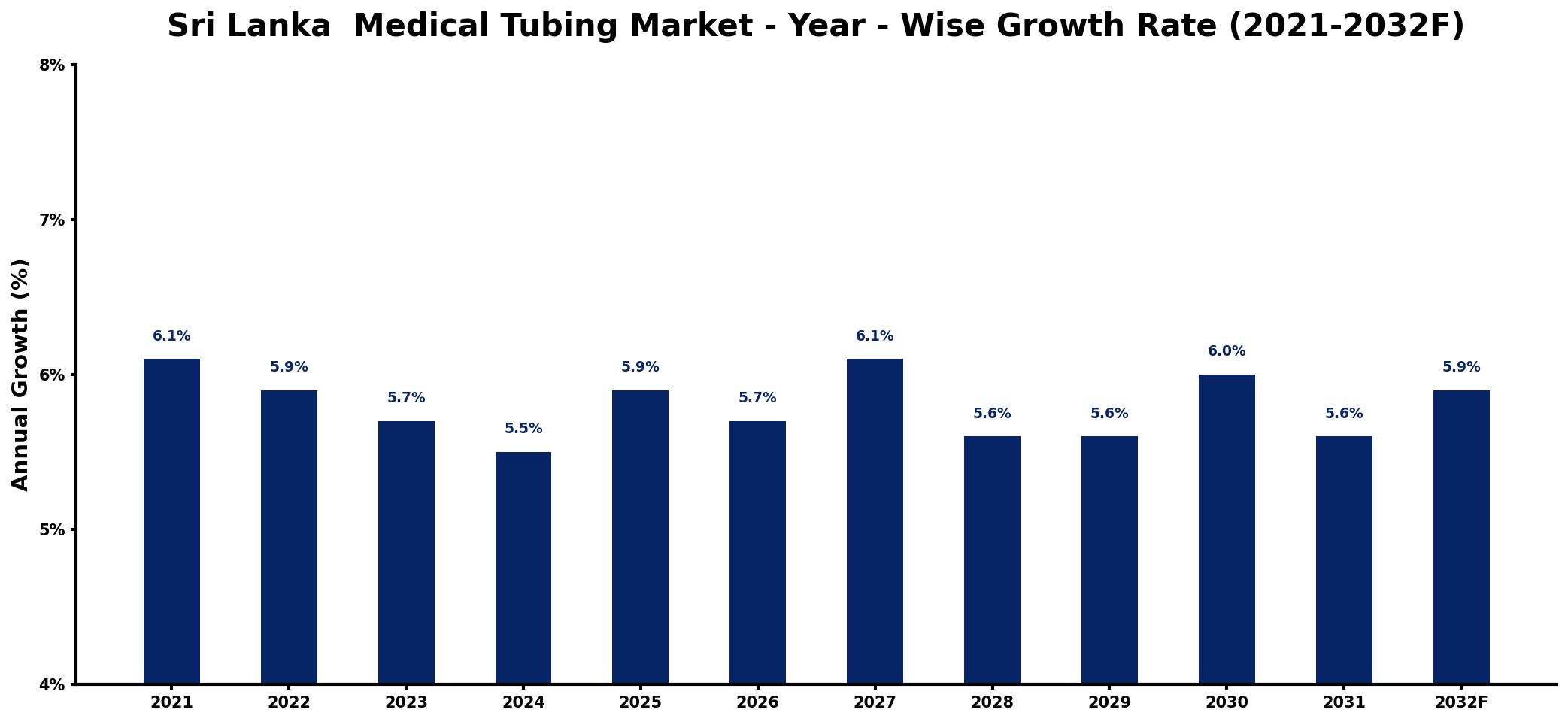
The table below presents the year‑wise growth rates along with the key drivers influencing the market
| Year | Growth Rate | Major Drivers |
| 2021 | 6.1% | Increased healthcare infrastructure investments |
| 2022 | 5.9% | rising procurement volume requirements |
| 2023 | 5.7% | Expansion of healthcare facilities |
| 2024 | 5.5% | Rising awareness of health standards |
| 2025 | 5.9% | Surge in chronic disease prevalence |
| 2026 | 5.7% | Technological advancements in healthcare |
| 2027 | 6.1% | Higher government healthcare spending |
| 2028 | 5.6% | Increased focus on preventive care |
| 2029 | 5.6% | Growth in home healthcare solutions |
| 2030 | 6.0% | Rising population health consciousness |
| 2031 | 5.6% | rising end-use demand growth |
| 2032 | 5.9% | Increased investments in biotechnology |
Note: Market size estimations and growth projections presented in this report are based on 6Wresearch's proprietary forecasting methodology, utilizing the latest available industry data, government publications, and primary research inputs.
Sri Lanka Medical Tubing Market Synopsis
The Sri Lanka Medical Tubing Market has seen positive momentum in recent years, primarily attributed to the growing healthcare sector and innovations in medical technology. As the demand for specialized medical devices intensifies, the market is poised for further growth with an increasing emphasis on quality and biocompatible materials.
Looking ahead, the market is expected to continue expanding, driven by rising healthcare expenditures and the necessity for high-quality medical tubing solutions. As healthcare providers increasingly prioritize safety and efficacy, manufacturers are responding with advanced products tailored to meet these emerging needs.
Sri Lanka Medical Tubing Market Key Takeaways
- The market is driven by the growing demand for medical devices due to an aging population and rising chronic disease prevalence.
- Innovations in material science, particularly biocompatible polymers, are shaping product development in the medical tubing sector.
- The government's focus on enhancing healthcare infrastructure significantly supports market growth.
- Investment opportunities exist in manufacturing and distribution channels catering to local and export markets.
- Compliance with international quality and safety standards is critical for local manufacturers aiming to compete effectively.
Evaluation of Restraints in Sri Lanka Medical Tubing Market
Despite the optimistic outlook, several restraints are curbing the potential growth of the Sri Lanka Medical Tubing Market. One of the primary challenges is the limited availability of high-quality raw materials, which directly impacts the quality of finished products. Additionally, local manufacturers face stiff competition from imported medical tubing, often at lower prices due to economies of scale enjoyed by foreign companies. The technological gap in local manufacturing capabilities further inhibits innovation, complicating the development of specialized products tailored to the healthcare industrys specific needs.
Sri Lanka Medical Tubing Market Trends
The Sri Lanka Medical Tubing Market is witnessing several transformative trends. A prominent shift towards advanced materials, such as silicone and thermoplastic elastomers, reflects the industry's demand for biocompatibility and flexibility. These materials are increasingly utilized in various applications, including catheters and IV tubes, enhancing patient safety and comfort. Moreover, antimicrobial tubing is gaining traction as healthcare providers prioritize infection prevention in clinical settings.
Sustainability is also emerging as a key focus area. Manufacturers are exploring eco-friendly materials and green production processes, driven by both regulatory pressures and the healthcare industry's commitment to reducing its environmental footprint. As these trends evolve, they represent not only a response to market needs but also a proactive approach to future-proofing businesses against changing regulatory landscapes.
Sri Lanka Medical Tubing Market Opportunities
Investment opportunities in the Sri Lanka Medical Tubing Market are abundant, particularly in light of the increasing demand for high-quality medical devices. The healthcare sector's ongoing expansion, fueled by government initiatives and private sector investments, creates a favorable environment for new entrants and existing players alike. Partnerships with local healthcare providers can enhance distribution capabilities and market reach, ensuring that innovative tubing solutions are readily available to meet clinical needs. Additionally, the strategic geographic location of Sri Lanka offers export potential to neighboring markets, enhancing profitability for manufacturers and distributors.
Government Initiatives in the Sri Lanka Medical Tubing Market
The Sri Lankan government has taken significant steps to regulate and promote the Medical Tubing Market, emphasizing product quality and patient safety. The Medical Devices Act of 2015 mandates that all medical devices, including tubing, be registered with the National Medical Device Regulatory Authority (NMDRA). This ensures that products meet necessary safety and quality standards before entering the market. Additionally, the establishment of guidelines for Good Manufacturing Practices (GMP) supports manufacturers in maintaining high production standards, thus fostering trust and reliability within the healthcare sector.
Future Insights of the Sri Lanka Medical Tubing Market
The future of the Sri Lanka Medical Tubing Market appears bright, with anticipated steady growth through 2026-2032. Increasing healthcare expenditure, coupled with a heightened focus on chronic disease management, is expected to drive demand further. As healthcare facilities continue to expand and modernize, manufacturers are likely to innovate continuously, introducing advanced products that cater to the evolving landscape of medical needs. However, industry players must navigate regulatory complexities and competitive pressures effectively to capitalize on emerging opportunities.
Sri Lanka Medical Tubing Market Latest Developments (2025 - 2026)
In the period from & to June 2026, the Sri Lanka Medical Tubing Market has observed significant developments, particularly in the adoption of new technologies and materials. There has been a marked increase in the launch of antimicrobial tubing solutions, reflecting the urgent need for enhanced infection control within healthcare settings. Additionally, partnerships between local manufacturers and international firms have started to emerge, aiming to leverage technological expertise while ensuring compliance with local regulations. These collaborations are expected to stimulate innovation and bolster the market's overall growth.
Sri Lanka Medical Tubing Market - Key Attractiveness of the Report
- 10 Years of Market Numbers
- Historical Data Starting from 2022 to 2025
- Base Year: 2025
- Forecast Data until 2032
- Key Performance Indicators Impacting the Market
- Major Upcoming Developments and Projects
Key Highlights of the Report:
- Sri Lanka Medical Tubing Market Outlook
- Market Size of Sri Lanka Medical Tubing Market, 2025
- Forecast of Sri Lanka Medical Tubing Market, 2032
- Historical Data and Forecast of Sri Lanka Medical Tubing Revenues & Volume for the Period 2022-2032F
- Sri Lanka Medical Tubing Market Trend Evolution
- Sri Lanka Medical Tubing Market Drivers and Challenges
- Sri Lanka Medical Tubing Price Trends
- Sri Lanka Medical Tubing Porter's Five Forces
- Sri Lanka Medical Tubing Industry Life Cycle
- Historical Data and Forecast of Sri Lanka Medical Tubing Market Revenues & Volume By Material for the Period 2022-2032F
- Historical Data and Forecast of Sri Lanka Medical Tubing Market Revenues & Volume By Plastics for the Period 2022-2032F
- Historical Data and Forecast of Sri Lanka Medical Tubing Market Revenues & Volume By Rubbers for the Period 2022-2032F
- Historical Data and Forecast of Sri Lanka Medical Tubing Market Revenues & Volume By Specialty Polymers for the Period 2022-2032F
- Historical Data and Forecast of Sri Lanka Medical Tubing Market Revenues & Volume By Structure for the Period 2022-2032F
- Historical Data and Forecast of Sri Lanka Medical Tubing Market Revenues & Volume By Single-lumen for the Period 2022-2032F
- Historical Data and Forecast of Sri Lanka Medical Tubing Market Revenues & Volume By Co-extruded for the Period 2022-2032F
- Historical Data and Forecast of Sri Lanka Medical Tubing Market Revenues & Volume By Multi-lumen for the Period 2022-2032F
- Historical Data and Forecast of Sri Lanka Medical Tubing Market Revenues & Volume By Tapered Or Bump Tubing for the Period 2022-2032F
- Historical Data and Forecast of Sri Lanka Medical Tubing Market Revenues & Volume By Braided Tubing for the Period 2022-2032F
- Historical Data and Forecast of Sri Lanka Medical Tubing Market Revenues & Volume By Application for the Period 2022-2032F
- Historical Data and Forecast of Sri Lanka Medical Tubing Market Revenues & Volume By Bulk Disposable Tubing for the Period 2022-2032F
- Historical Data and Forecast of Sri Lanka Medical Tubing Market Revenues & Volume By Catheters & Cannulas for the Period 2022-2032F
- Historical Data and Forecast of Sri Lanka Medical Tubing Market Revenues & Volume By Drug Delivery System for the Period 2022-2032F
- Historical Data and Forecast of Sri Lanka Medical Tubing Market Revenues & Volume By Special Applications for the Period 2022-2032F
- Sri Lanka Medical Tubing Import Export Trade Statistics
- Market Opportunity Assessment By Material
- Market Opportunity Assessment By Structure
- Market Opportunity Assessment By Application
- Sri Lanka Medical Tubing Top Companies Market Share
- Sri Lanka Medical Tubing Competitive Benchmarking By Technical and Operational Parameters
- Sri Lanka Medical Tubing Company Profiles
- Sri Lanka Medical Tubing Key Strategic Recommendations






































