Sri Lanka Microphone Market: Import Trend Analysis
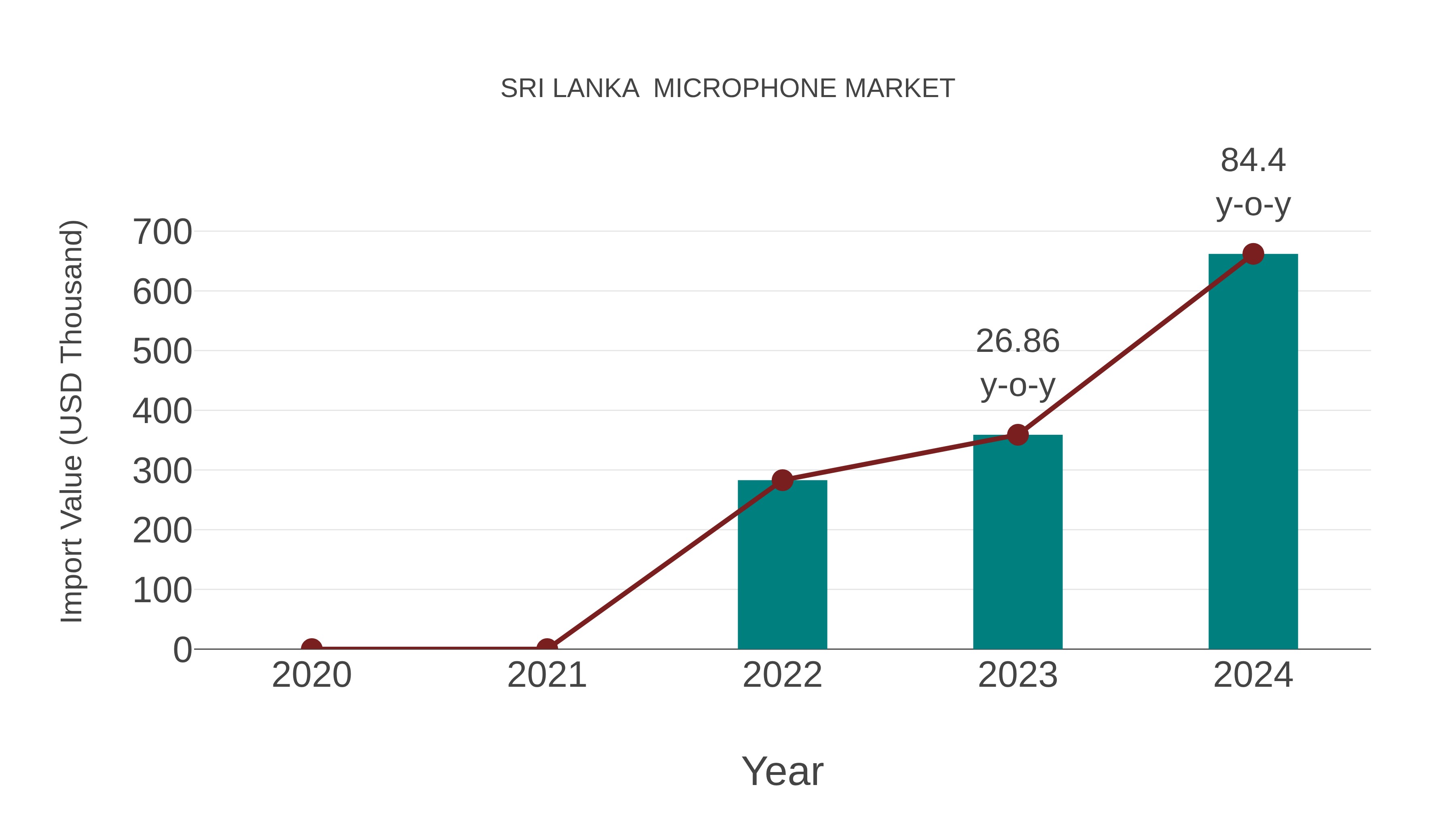
Sri Lanka import trend for the microphone market saw significant growth from 2023 to 2024, with an 84.4% increase. The compound annual growth rate (CAGR) for the period 2020-2024 stood at 52.95%. This surge can be attributed to increasing demand for advanced audio equipment in various sectors.
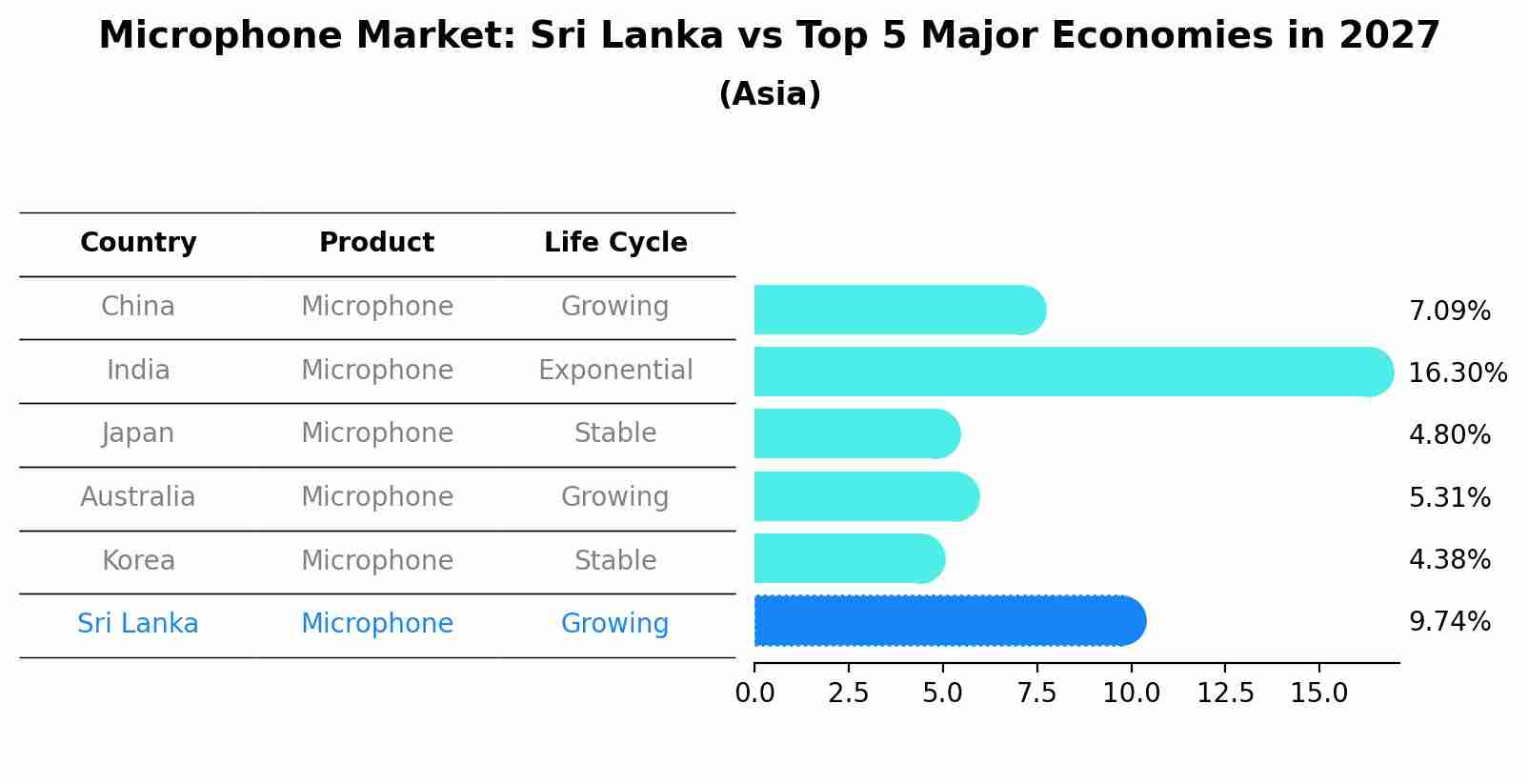
Microphone Market: Sri Lanka vs Top 5 Major Economies in 2027 (Asia)
The Microphone market in Sri Lanka is projected to grow at a growing growth rate of 9.74% by 2027, highlighting the country's increasing focus on advanced technologies within the Asia region, where China holds the dominant position, followed closely by India, Japan, Australia and South Korea, shaping overall regional demand.
Sri Lanka Microphone Market Overview
The microphone market in Sri Lanka is expanding due to the growing demand for audio recording and communication devices. This market includes various types of microphones used in applications like broadcasting, public speaking, and consumer electronics. The rise of content creation, podcasting, and telecommunication advancements are key drivers of this market.
Drivers of the market
The microphone market in Sri Lanka is driven by the increasing demand for high-quality audio input devices in applications such as consumer electronics, telecommunications, and professional audio. Microphones are essential for capturing sound in various devices, including smartphones, laptops, and audio recording equipment. The growth of these end-use industries, along with the increasing focus on sound quality and user experience, supports the market. Additionally, advancements in microphone technologies, such as noise-cancellation and voice recognition, further enhance the performance and application potential of microphones, propelling market growth.
Challenges of the market
Challenges in the microphone market include sound quality, durability, and market competition. Businesses must produce microphones that deliver high sound quality and durability for diverse applications, including consumer electronics, professional audio, and telecommunications. Moreover, competing with established brands and maintaining cost competitiveness pose significant hurdles. Investing in advanced acoustic technologies, ensuring robust product designs, and implementing strategic marketing initiatives are crucial to overcoming these challenges.
Government Policy of the market
The Sri Lankan government supports the microphone market by promoting local manufacturing and technological advancement. Policies include providing incentives for research and development in audio technologies, supporting industry collaborations, and ensuring regulatory compliance with international quality standards.
Key Highlights of the Report:
- Sri Lanka Microphone Market Outlook
- Market Size of Sri Lanka Microphone Market, 2019
- Forecast of Sri Lanka Microphone Market, 2026
- Historical Data and Forecast of Sri Lanka Microphone Revenues & Volume for the Period 2016 - 2026
- Sri Lanka Microphone Market Trend Evolution
- Sri Lanka Microphone Market Drivers and Challenges
- Sri Lanka Microphone Price Trends
- Sri Lanka Microphone Porter's Five Forces
- Sri Lanka Microphone Industry Life Cycle
- Historical Data and Forecast of Sri Lanka Microphone Market Revenues & Volume By MEMS Type for the Period 2016 - 2026
- Historical Data and Forecast of Sri Lanka Microphone Market Revenues & Volume By Analog for the Period 2016 - 2026
- Historical Data and Forecast of Sri Lanka Microphone Market Revenues & Volume By Digital for the Period 2016 - 2026
- Historical Data and Forecast of Sri Lanka Microphone Market Revenues & Volume By Technology for the Period 2016 - 2026
- Historical Data and Forecast of Sri Lanka Microphone Market Revenues & Volume By Electret for the Period 2016 - 2026
- Historical Data and Forecast of Sri Lanka Microphone Market Revenues & Volume By MEMS for the Period 2016 - 2026
- Historical Data and Forecast of Sri Lanka Microphone Market Revenues & Volume By Others for the Period 2016 - 2026
- Historical Data and Forecast of Sri Lanka Microphone Market Revenues & Volume By Communication Technology for the Period 2016 - 2026
- Historical Data and Forecast of Sri Lanka Microphone Market Revenues & Volume By Wired for the Period 2016 - 2026
- Historical Data and Forecast of Sri Lanka Microphone Market Revenues & Volume By Wireless for the Period 2016 - 2026
- Historical Data and Forecast of Sri Lanka Microphone Market Revenues & Volume By Applications for the Period 2016 - 2026
- Historical Data and Forecast of Sri Lanka Microphone Market Revenues & Volume By Automotive for the Period 2016 - 2026
- Historical Data and Forecast of Sri Lanka Microphone Market Revenues & Volume By Commercial Security & Surveillance for the Period 2016 - 2026
- Historical Data and Forecast of Sri Lanka Microphone Market Revenues & Volume By Consumer Electronics for the Period 2016 - 2026
- Historical Data and Forecast of Sri Lanka Microphone Market Revenues & Volume By Industrial for the Period 2016 - 2026
- Historical Data and Forecast of Sri Lanka Microphone Market Revenues & Volume By Medical for the Period 2016 - 2026
- Historical Data and Forecast of Sri Lanka Microphone Market Revenues & Volume By Noise Monitoring & Sensing for the Period 2016 - 2026
- Sri Lanka Microphone Import Export Trade Statistics
- Market Opportunity Assessment By MEMS Type
- Market Opportunity Assessment By Technology
- Market Opportunity Assessment By Communication Technology
- Market Opportunity Assessment By Applications
- Sri Lanka Microphone Top Companies Market Share
- Sri Lanka Microphone Competitive Benchmarking By Technical and Operational Parameters
- Sri Lanka Microphone Company Profiles
- Sri Lanka Microphone Key Strategic Recommendations






































