Sri Lanka Modular Kitchen Market Size, Share & Growth Rate
The Sri Lanka Modular Kitchen Market was estimated at USD 459 Million in 2025 and is projected to reach USD 603 Million by 2032, growing at a CAGR of 4.0% from 2026 to 2032. This growth trajectory is propelled by a notable increase in urban housing developments and a shift in consumer preferences towards efficient and aesthetically pleasing kitchen designs. Moreover, as disposable incomes rise, more homeowners are investing in renovations and modern kitchen solutions that offer both functionality and style.
Sri Lanka Modular Kitchen Market Year-wise Growth Rate and Key Drivers
This graph highlights how the Sri Lanka Modular Kitchen Market has steadily grown over the years, supported by major growth factors.
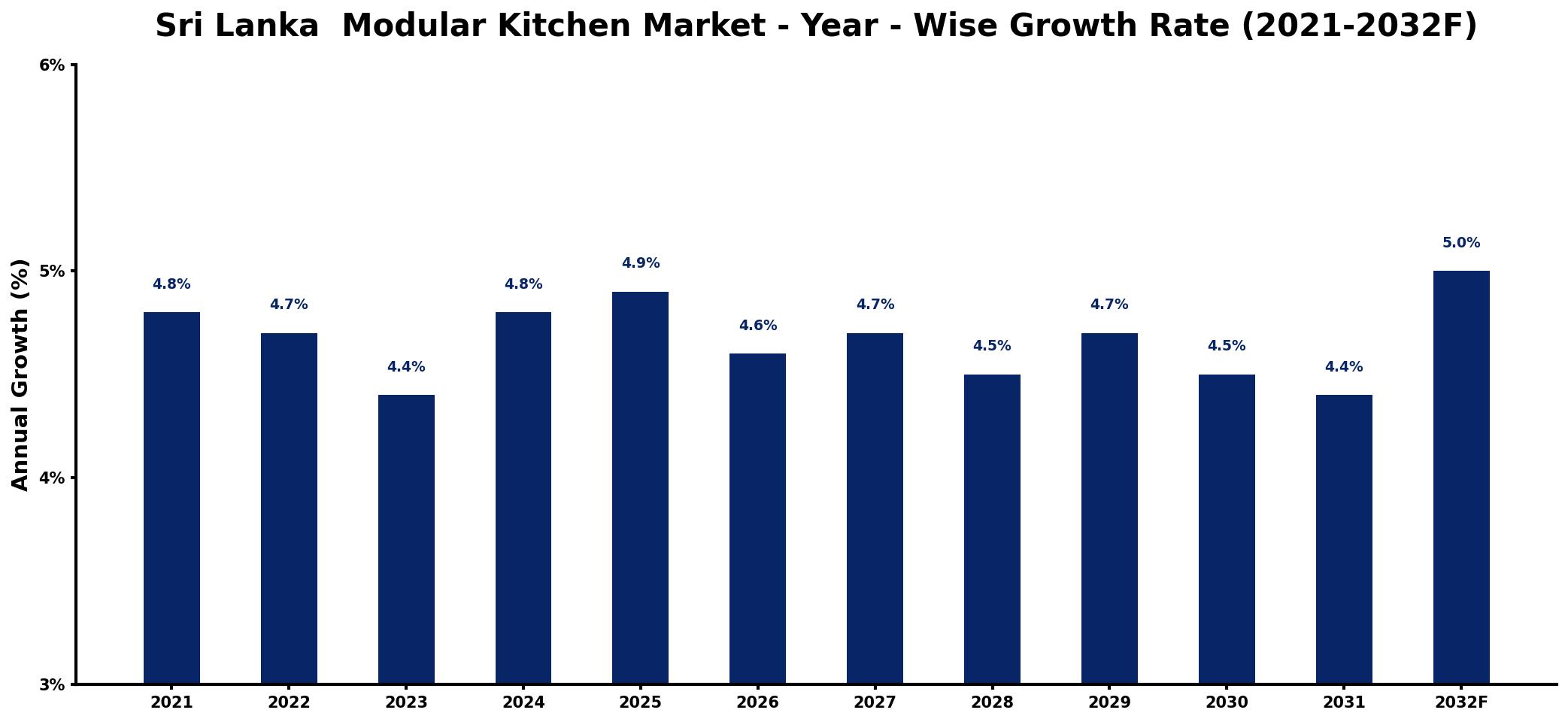
The table below presents the year‑wise growth rates along with the key drivers influencing the market
| Year | Growth Rate | Major Drivers |
| 2021 | 4.8% | Rising urban population increases demand |
| 2022 | 4.7% | Growing disposable income stimulates spending |
| 2023 | 4.4% | Expansion of real estate projects |
| 2024 | 4.8% | Emerging trends in home renovations |
| 2025 | 4.9% | Increased focus on sustainable materials |
| 2026 | 4.6% | Technological advancements improve designs |
| 2027 | 4.7% | Shifts towards open concept layouts |
| 2028 | 4.5% | Government incentives for home improvements |
| 2029 | 4.7% | Growing popularity of interior design |
| 2030 | 4.5% | Increased consumer awareness of aesthetics |
| 2031 | 4.4% | Rising demand for customized solutions |
| 2032 | 5.0% | Innovations in smart home technologies |
Note: Market size estimations and growth projections presented in this report are based on 6Wresearch's proprietary forecasting methodology, utilizing the latest available industry data, government publications, and primary research inputs.
Sri Lanka Modular Kitchen Market Synopsis
In recent years, the Sri Lanka modular kitchen market has experienced significant momentum, driven by urbanization and a growing appetite for customizable home solutions. However, as the market matures, it's transitioning towards a more competitive landscape where affordability and customization are paramount.
Looking ahead, the market is poised for further expansion, supported by favorable government policies and increasing investments in residential construction. The combination of technological advancements in design and materials will likely further enhance consumer experiences and expectations in the years to come.
Sri Lanka Modular Kitchen Market Key Takeaways
- The market's growth is strongly supported by urbanization and rising disposable incomes.
- Consumer demand for modern, efficient designs is leading to innovative offerings from manufacturers.
- Customization remains a key driver, though affordability poses challenges.
- Government initiatives are fostering a supportive environment for local manufacturers.
- Technological advancements are enhancing the overall quality and appeal of modular kitchen solutions.
Evaluation of Restraints in Sri Lanka Modular Kitchen Market
Despite the positive outlook for the Sri Lanka modular kitchen market, several restraints impact its growth potential. A primary concern is the complexity of providing tailored solutions that cater to diverse consumer preferences without compromising affordability. The intricate balance between high-quality materials, compliance with safety standards, and cost-effectiveness presents challenges for manufacturers. Additionally, the competitive landscape demands continual innovation, necessitating significant investment in R&D, which can strain resources for smaller players.
Sri Lanka Modular Kitchen Market Trends
As consumer preferences evolve, several key trends are emerging in the Sri Lanka modular kitchen market. One notable trend is the increasing demand for sustainable and eco-friendly materials, as environmentally conscious consumers seek kitchens that reflect their values. Additionally, smart technology integration is gaining traction, with homeowners looking for kitchens that offer modern conveniences like automated systems and energy-efficient appliances. This convergence of technology and design is likely to redefine how kitchens are utilized in contemporary homes.
Sri Lanka Modular Kitchen Market Opportunities
The modular kitchen market in Sri Lanka presents numerous opportunities for growth and investment. With urbanization continuing at a rapid pace, new residential developments are expected to fuel demand for modern kitchen solutions. Moreover, as more consumers opt for home renovations, businesses can capitalize on this trend by offering customizable solutions that cater to specific aesthetic and functional needs. Additionally, tapping into the rising interest in sustainability could create a niche market for eco-friendly kitchen designs.
Government Initiatives in the Sri Lanka Modular Kitchen Market
Government policies in Sri Lanka are increasingly supportive of the modular kitchen market, aimed at enhancing local manufacturing capabilities and promoting modern home solutions. Initiatives include providing financial incentives for local production and adoption of modular systems, alongside investments in research focused on innovative kitchen design and manufacturing technologies. Ensuring regulatory compliance with quality and safety standards also remains a priority, fostering a trustworthy environment for consumers.
Future Insights of the Sri Lanka Modular Kitchen Market
Looking forward to 2026-2032, the Sri Lanka modular kitchen market is expected to witness robust growth, driven by a combination of rising urban housing demands and evolving consumer preferences for high-quality, customized kitchen solutions. The anticipated technological advancements in materials and designs will further enhance the appeal of modular kitchens, making them increasingly accessible to a broader audience. As the market landscape evolves, businesses that can effectively balance innovation with affordability will be best positioned to thrive.
Sri Lanka Modular Kitchen Market Latest Developments (2025 - 2026)
Recent developments in the Sri Lanka modular kitchen market highlight a shift towards digitalization, with more companies embracing online platforms for design consultations and customer engagement. Manufacturers are also increasingly incorporating smart technology into their offerings, catering to the growing consumer demand for integrated home solutions. Furthermore, collaborations between local designers and international brands are emerging, promoting innovative design concepts that blend global trends with local tastes.
Sri Lanka Modular Kitchen Market - Key Attractiveness of the Report
- 10 Years of Market Numbers
- Historical Data Starting from 2022 to 2025
- Base Year: 2025
- Forecast Data until 2032
- Key Performance Indicators Impacting the Market
- Major Upcoming Developments and Projects
Key Highlights of the Report:
- Sri Lanka Modular Kitchen Market Outlook
- Market Size of Sri Lanka Modular Kitchen Market, 2025
- Forecast of Sri Lanka Modular Kitchen Market, 2032
- Historical Data and Forecast of Sri Lanka Modular Kitchen Revenues & Volume for the Period 2022-2032F
- Sri Lanka Modular Kitchen Market Trend Evolution
- Sri Lanka Modular Kitchen Market Drivers and Challenges
- Sri Lanka Modular Kitchen Price Trends
- Sri Lanka Modular Kitchen Porter's Five Forces
- Sri Lanka Modular Kitchen Industry Life Cycle
- Historical Data and Forecast of Sri Lanka Modular Kitchen Market Revenues & Volume By Product for the Period 2022-2032F
- Historical Data and Forecast of Sri Lanka Modular Kitchen Market Revenues & Volume By Floor Cabinet & Wall Cabinets for the Period 2022-2032F
- Historical Data and Forecast of Sri Lanka Modular Kitchen Market Revenues & Volume By Tall Storage Cabinets for the Period 2022-2032F
- Historical Data and Forecast of Sri Lanka Modular Kitchen Market Revenues & Volume By Others for the Period 2022-2032F
- Historical Data and Forecast of Sri Lanka Modular Kitchen Market Revenues & Volume By End-User for the Period 2022-2032F
- Historical Data and Forecast of Sri Lanka Modular Kitchen Market Revenues & Volume By Residential for the Period 2022-2032F
- Historical Data and Forecast of Sri Lanka Modular Kitchen Market Revenues & Volume By Commercial for the Period 2022-2032F
- Historical Data and Forecast of Sri Lanka Modular Kitchen Market Revenues & Volume By Distribution Channel for the Period 2022-2032F
- Historical Data and Forecast of Sri Lanka Modular Kitchen Market Revenues & Volume By Offline (Contractors, Builders, and Others) for the Period 2022-2032F
- Historical Data and Forecast of Sri Lanka Modular Kitchen Market Revenues & Volume By Online for the Period 2022-2032F
- Sri Lanka Modular Kitchen Import Export Trade Statistics
- Market Opportunity Assessment By Product
- Market Opportunity Assessment By End-User
- Market Opportunity Assessment By Distribution Channel
- Sri Lanka Modular Kitchen Top Companies Market Share
- Sri Lanka Modular Kitchen Competitive Benchmarking By Technical and Operational Parameters
- Sri Lanka Modular Kitchen Company Profiles
- Sri Lanka Modular Kitchen Key Strategic Recommendations






































