Sri Lanka Nuts Market Size, Share & Growth Rate
The Sri Lanka Nuts Market was estimated at USD 414 Million in 2025 and is projected to reach USD 546 Million by 2032, growing at a CAGR of 4.0% from 2026 to 2032. This growth is being propelled by a significant increase in consumer awareness regarding the health benefits of nuts and a rising demand for protein-rich snack options. Furthermore, the popularity of organic and sustainably sourced nuts is enhancing market attractiveness and driving consumer preferences.
Sri Lanka Nuts Market Year-wise Growth Rate and Key Drivers
This graph highlights how the Sri Lanka Nuts Market has steadily grown over the years, supported by major growth factors.
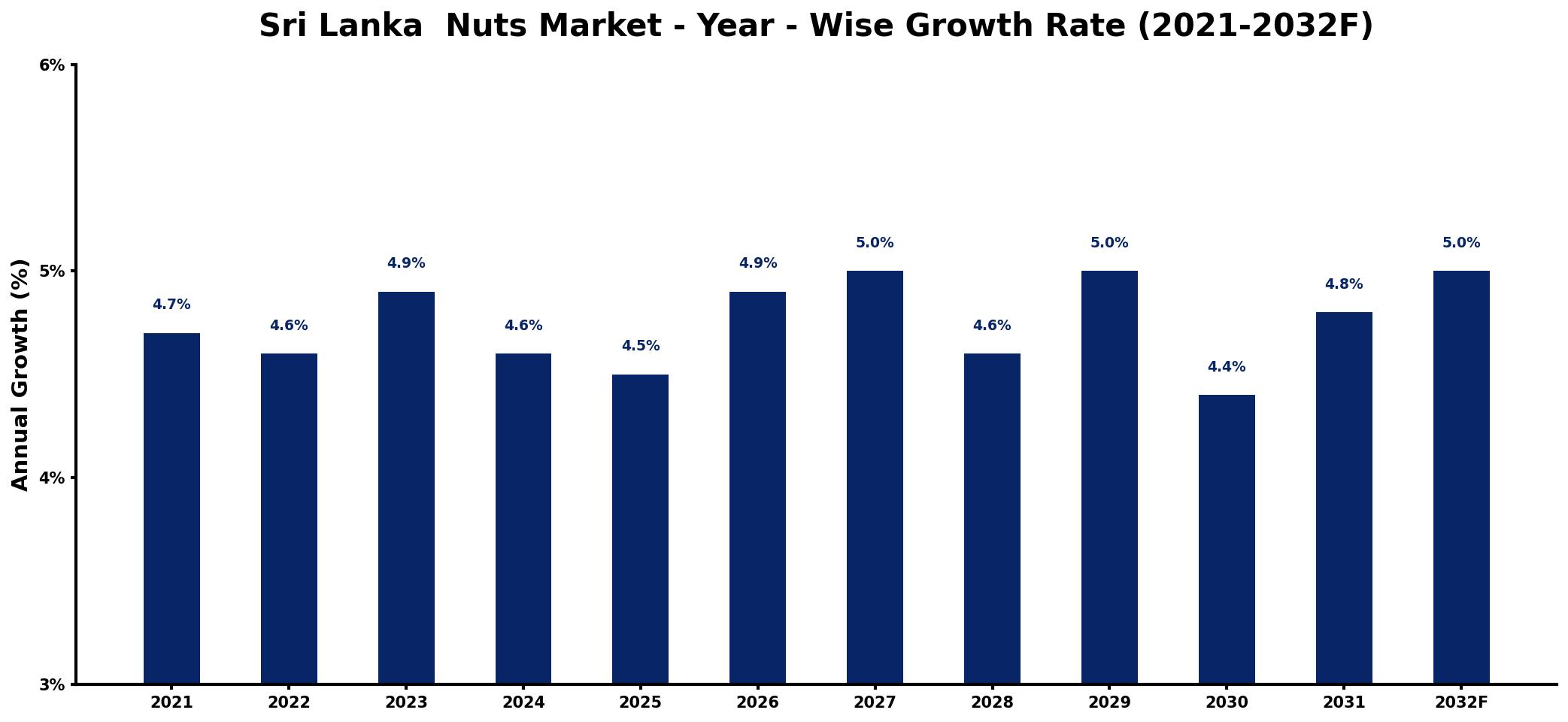
The table below presents the year‑wise growth rates along with the key drivers influencing the market
| Year | Growth Rate | Major Drivers |
| 2021 | 4.7% | Rising health consciousness among consumers |
| 2022 | 4.6% | Increased demand for plant-based snacks |
| 2023 | 4.9% | Expansion of export markets globally |
| 2024 | 4.6% | Growth in organic food sector |
| 2025 | 4.5% | Surge in online retail sales |
| 2026 | 4.9% | Investment in sustainable farming practices |
| 2027 | 5.0% | Growing popularity of gourmet products |
| 2028 | 4.6% | Increase in dietary supplement usage |
| 2029 | 5.0% | rising export shipment volumes |
| 2030 | 4.4% | growing automotive sector requirements |
| 2031 | 4.8% | Development of innovative packaging solutions |
| 2032 | 5.0% | growing downstream application demand |
Note: Market size estimations and growth projections presented in this report are based on 6Wresearch's proprietary forecasting methodology, utilizing the latest available industry data, government publications, and primary research inputs.
Sri Lanka Nuts Market Synopsis
The demand for nuts in Sri Lanka is steadily increasing as consumers seek healthier snack alternatives. Almonds, walnuts, and cashews are gaining traction, being recognized for their nutritional value and versatility in a variety of dishes. The popularity of flavored nuts is also contributing to a broader selection available in the market, catering to diverse taste preferences.
Moreover, the market is seeing an influx of both domestic and international nut producers, providing consumers with a wide range of choices through various distribution channels. These include supermarkets, specialty stores, and online platforms, which enhance accessibility and convenience for the health-conscious consumer.
Sri Lanka Nuts Market Key Takeaways
- The market is experiencing growth due to increased consumer demand for health-centric snack options.
- There is a notable shift towards organic and premium nuts as consumers are willing to invest in quality.
- The rise of flavored nuts is diversifying product offerings and appealing to various consumer segments.
- Domestic and international competition is fostering innovation and improved product quality.
- Distribution channels are expanding, making nuts more accessible to a broader audience.
Evaluation of Restraints in Sri Lanka Nuts Market
The Sri Lanka nuts market faces several substantial challenges that could impede growth. Primarily, fluctuations in weather conditions adversely affect nut production, leading to variability in supply and quality. This unpredictability necessitates a keen focus on sustainable farming practices. Additionally, competition from imported nuts can drive down prices, impacting the profitability of local producers. Issues related to inadequate storage and transportation infrastructure further exacerbate these challenges, hindering efficiency and increasing costs. Ensuring that local products consistently meet international food safety standards remains crucial for expanding market access globally.
Sri Lanka Nuts Market Trends
Current trends in the Sri Lanka nuts market reflect a significant movement towards healthier eating habits. With consumers seeking natural, nutrient-dense options, the demand for nuts as a convenient snack is on the rise. The burgeoning interest in plant-based diets is also driving up demand for nuts as a key protein source. Additionally, the trend of premiumization is evident, as consumers show a willingness to pay more for organic and high-quality nut products. Innovations in flavoring and packaging are also emerging as strategies to entice consumers looking for unique snacking experiences.
Sri Lanka Nuts Market Opportunities
Investment opportunities in the Sri Lanka nuts market are abundant, particularly in the realm of organic nut production. As awareness grows around health and wellness, there is a lucrative niche for organic varieties of cashews, almonds, and walnuts. The rising adoption of plant-based diets is another area ripe for investment. Furthermore, advancements in processing technology and packaging solutions can enhance the value chain, improving product quality and extending market reach both locally and internationally. These prospects present a promising landscape for stakeholders looking to capitalize on growing consumer demand.
Government Initiatives in the Sri Lanka Nuts Market
The Sri Lankan government has implemented various supportive policies to bolster the nuts market. Financial incentives and subsidies have been introduced to encourage farmers to increase nut production. Additionally, there is a concerted effort to promote sustainable farming practices, ensuring the longevity of the industry. The government is also investing in research and development aimed at enhancing the quality of nuts, while facilitating better market access for exports through trade agreements and support for marketing efforts.
Future Insights of the Sri Lanka Nuts Market
Looking ahead to the years 2026-2032, the Sri Lanka nuts market is set for sustained growth. Factors such as an increasing awareness of the health benefits of nut consumption, rising disposable incomes, and a trend towards healthy snacking will significantly contribute to market expansion. However, stakeholders must remain vigilant about challenges like price fluctuations in raw materials and competition from imports. To thrive, market participants will likely focus on product innovation, ensuring quality, and adopting sustainable sourcing practices to secure a competitive advantage.
Sri Lanka Nuts Market Latest Developments (2025 - 2026)
Recent developments in the Sri Lanka nuts market indicate a positive shift towards sustainability and innovation. Producers are increasingly exploring organic cultivation methods, responding to consumer demand for eco-friendly products. Additionally, new marketing strategies are emerging that emphasize the health benefits of nuts, potentially widening consumer interest. Collaborations and partnerships among stakeholders are being forged to enhance supply chain efficiency, thereby improving the overall market structure.
Sri Lanka Nuts Market - Key Attractiveness of the Report
- 10 Years of Market Numbers
- Historical Data Starting from 2022 to 2025
- Base Year: 2025
- Forecast Data until 2032
- Key Performance Indicators Impacting the Market
- Major Upcoming Developments and Projects
Key Highlights of the Report:
- Sri Lanka Nuts Market Outlook
- Market Size of Sri Lanka Nuts Market, 2025
- Forecast of Sri Lanka Nuts Market, 2032
- Historical Data and Forecast of Sri Lanka Nuts Revenues & Volume for the Period 2022-2032F
- Sri Lanka Nuts Market Trend Evolution
- Sri Lanka Nuts Market Drivers and Challenges
- Sri Lanka Nuts Price Trends
- Sri Lanka Nuts Porter's Five Forces
- Sri Lanka Nuts Industry Life Cycle
- Historical Data and Forecast of Sri Lanka Nuts Market Revenues & Volume By Product for the Period 2022-2032F
- Historical Data and Forecast of Sri Lanka Nuts Market Revenues & Volume By Almonds for the Period 2022-2032F
- Historical Data and Forecast of Sri Lanka Nuts Market Revenues & Volume By Peanuts for the Period 2022-2032F
- Historical Data and Forecast of Sri Lanka Nuts Market Revenues & Volume By Cashew for the Period 2022-2032F
- Historical Data and Forecast of Sri Lanka Nuts Market Revenues & Volume By Walnuts for the Period 2022-2032F
- Historical Data and Forecast of Sri Lanka Nuts Market Revenues & Volume By Hazelnuts for the Period 2022-2032F
- Historical Data and Forecast of Sri Lanka Nuts Market Revenues & Volume By Pistachios for the Period 2022-2032F
- Historical Data and Forecast of Sri Lanka Nuts Market Revenues & Volume By Others for the Period 2022-2032F
- Historical Data and Forecast of Sri Lanka Nuts Market Revenues & Volume By Distribution Channel for the Period 2022-2032F
- Historical Data and Forecast of Sri Lanka Nuts Market Revenues & Volume By Offline for the Period 2022-2032F
- Historical Data and Forecast of Sri Lanka Nuts Market Revenues & Volume By Online for the Period 2022-2032F
- Sri Lanka Nuts Import Export Trade Statistics
- Market Opportunity Assessment By Product
- Market Opportunity Assessment By Distribution Channel
- Sri Lanka Nuts Top Companies Market Share
- Sri Lanka Nuts Competitive Benchmarking By Technical and Operational Parameters
- Sri Lanka Nuts Company Profiles
- Sri Lanka Nuts Key Strategic Recommendations






































