Sri Lanka Off Road Motorcycle Market Size, Share & Growth Rate
The Sri Lanka Off Road Motorcycle Market was estimated at USD 197 Million in 2025 and is projected to reach USD 275 Million by 2032, growing at a CAGR of 4.9% from 2026 to 2032. This growth trajectory is largely fueled by a surge in adventure tourism and recreational activities, especially among the country's youth. As disposable incomes rise and outdoor sports gain traction, more consumers are seeking high-performance motorcycles tailored for both leisure and competition.
Sri Lanka Off Road Motorcycle Market Year-wise Growth Rate and Key Drivers
This graph highlights how the Sri Lanka Off Road Motorcycle Market has steadily grown over the years, supported by major growth factors.
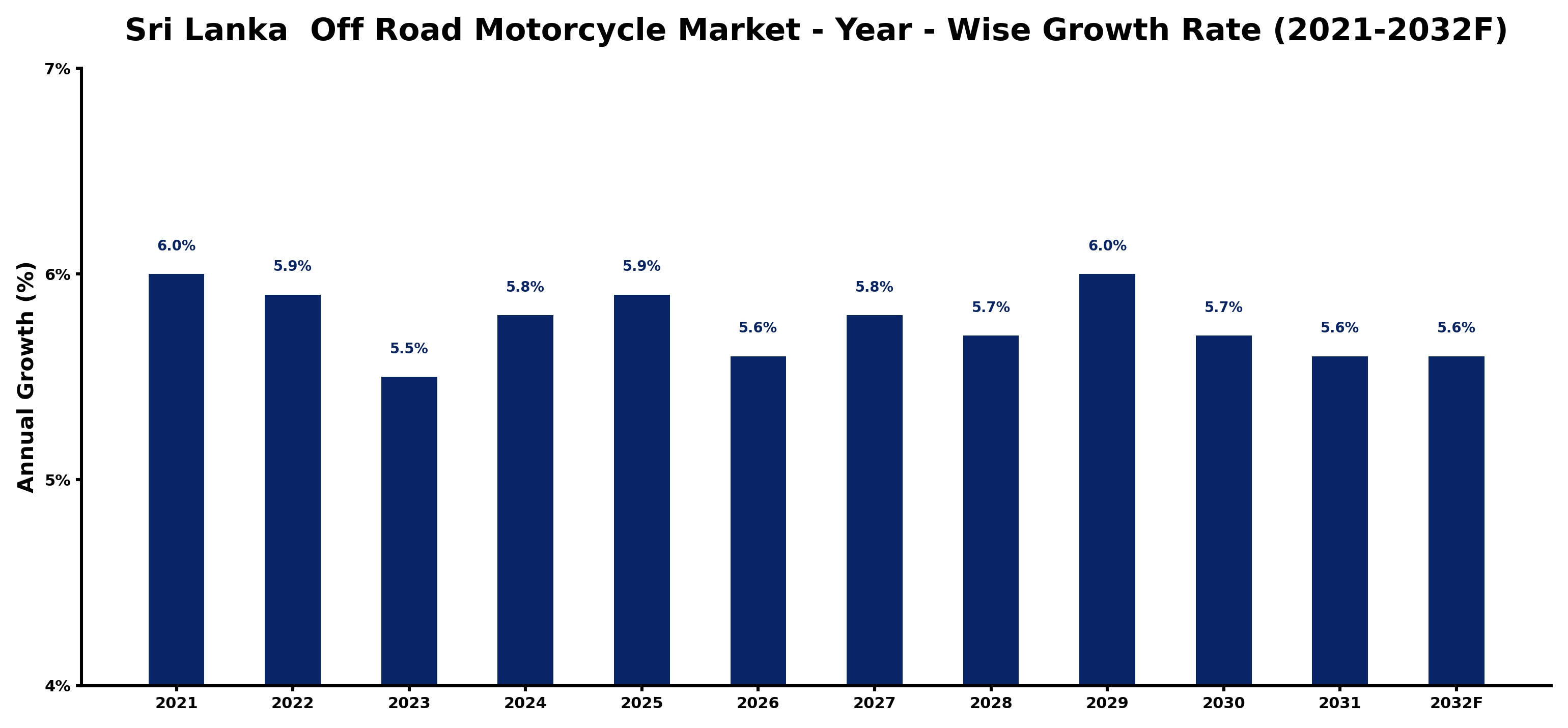
The table below presents the year‑wise growth rates along with the key drivers influencing the market
| Year | Growth Rate | Major Drivers |
| 2021 | 6.0% | Increased adventure tourism demand |
| 2022 | 5.9% | Rising disposable income levels |
| 2023 | 5.5% | Youth interest in off-roading |
| 2024 | 5.8% | Enhanced road infrastructure development |
| 2025 | 5.9% | Growing motorcycle clubs participation |
| 2026 | 5.6% | Technological advancements in motorcycles |
| 2027 | 5.8% | Expansion of off-road events |
| 2028 | 5.7% | Improved financing options available |
| 2029 | 6.0% | Rising popularity of outdoor activities |
| 2030 | 5.7% | Increased social media influence |
| 2031 | 5.6% | Enhanced safety gear adoption |
| 2032 | 5.6% | Growing environmental awareness initiatives |
Note - Market size estimations and growth projections presented in this report are based on 6Wresearch’s advanced forecasting approach, validated with industry datasets as of June 2026.
Sri Lanka Off Road Motorcycle Market Synopsis
The most significant force shaping the Sri Lankan off-road motorcycle market today is the increasing interest in adventure sports among the younger demographic. This demographic shift is inspiring more individuals to engage in recreational biking activities, thus expanding the consumer base. Furthermore, the growing popularity of organized off-road racing events is further stimulating demand for specialized motorcycles designed to perform in rugged conditions.
Additionally, the market is seeing a notable trend toward more versatile off-road motorcycles that cater to both adventurous outings and everyday commuting. This dual-purpose functionality is appealing to a broader audience, including those who prioritize practicality alongside recreational enjoyment.
Sri Lanka Off Road Motorcycle Market Key Takeaways
- The demand for off-road motorcycles is driven by rising disposable incomes and a growing interest in outdoor activities.
- Technological advancements are leading to the introduction of more powerful and durable motorcycles.
- Environmental sustainability concerns are increasing interest in electric off-road motorcycles.
- Adventure tourism and off-road events are becoming key components of market growth.
- Versatility in motorcycle design is becoming increasingly important to consumers.
Evaluation of Restraints in Sri Lanka Off Road Motorcycle Market
Despite the promising growth, several constraints are hindering the full potential of the Sri Lankan off-road motorcycle market. The lack of adequate infrastructure for off-road riding poses a significant challenge, limiting opportunities for enthusiasts to engage in their passion safely. Additionally, high import taxes and tariffs can make off-road motorcycles less accessible to consumers. The environmental implications of off-road riding are prompting more stringent regulations, which could further limit access to riding areas and affect market growth. Furthermore, limited servicing facilities in remote areas can deter potential buyers, impacting overall market expansion.
Sri Lanka Off Road Motorcycle Market Trends
Current trends in the Sri Lankan off-road motorcycle market indicate a rising preference for motorcycles equipped with larger engine capacities and enhanced safety features. As performance expectations increase, manufacturers are responding with models that integrate advanced suspension systems and improved durability. Additionally, the interest in electric off-road motorcycles is gaining momentum, driven by a growing consumer awareness of environmental sustainability. This shift in consumer preference is likely to encourage innovation and diversification in motorcycle offerings.
Sri Lanka Off Road Motorcycle Market Opportunities
The Sri Lankan off-road motorcycle market presents lucrative investment opportunities, particularly in segments catering to adventure tourism and recreational riding. Investors can consider importing high-quality motorcycles from established international brands or establishing off-road biking tracks and training facilities. Guided tours and biking events also represent avenues for growth, capitalizing on the increasing enthusiasm for outdoor recreational activities. By aligning marketing strategies with the trend towards adventure sports, stakeholders can effectively position themselves within this expanding market.
Government Initiatives in the Sri Lanka Off Road Motorcycle Market
The Sri Lankan government has introduced several initiatives to regulate the off-road motorcycle market, emphasizing safety and environmental protection. These regulations include mandatory registration and licensing for off-road motorcycles, alongside strict safety standards such as helmet usage. Moreover, emission standards have been enforced to curb pollution and promote eco-friendly practices among riders. Import regulations are in place to ensure the quality of motorcycles entering the market, fostering a responsible off-road riding culture while protecting natural habitats.
Future Insights of the Sri Lanka Off Road Motorcycle Market
Looking ahead to 2026-2032, the Sri Lanka Off Road Motorcycle Market is expected to sustain its growth momentum, driven by a continual rise in interest for outdoor recreational activities and adventure tourism. The evolving landscape of off-road biking events and the introduction of more durable and powerful motorcycle models are likely to attract a wider audience. As technology advances, the integration of eco-friendly features is expected to resonate with consumers, paving the way for a dynamic and diversified market that meets modern demands.
Sri Lanka Off Road Motorcycle Market Latest Developments (May 2025 - June 2026)
Recent developments in the Sri Lankan off-road motorcycle market showcase a growing emphasis on innovation and sustainability. With more manufacturers focusing on the introduction of electric models, there is a notable shift towards environmentally friendly options. Additionally, various organizations are beginning to host off-road competitions that promote the sport, thus increasing public interest. These developments are laying the groundwork for the future expansion of the market.
Sri Lanka Off Road Motorcycle Market - Key Attractiveness of the Report
- 10 Years of Market Numbers
- Historical Data Starting from 2022 to 2025
- Base Year: 2025
- Forecast Data until 2032
- Key Performance Indicators Impacting the Market
- Major Upcoming Developments and Projects
Key Highlights of the Report:
- Sri Lanka Off Road Motorcycle Market Outlook
- Market Size of Sri Lanka Off Road Motorcycle Market, 2025
- Forecast of Sri Lanka Off Road Motorcycle Market, 2032
- Historical Data and Forecast of Sri Lanka Off Road Motorcycle Revenues & Volume for the Period 2022-2032F
- Sri Lanka Off Road Motorcycle Market Trend Evolution
- Sri Lanka Off Road Motorcycle Market Drivers and Challenges
- Sri Lanka Off Road Motorcycle Price Trends
- Sri Lanka Off Road Motorcycle Porter's Five Forces
- Sri Lanka Off Road Motorcycle Industry Life Cycle
- Historical Data and Forecast of Sri Lanka Off Road Motorcycle Market Revenues & Volume By Type for the Period 2022-2032F
- Historical Data and Forecast of Sri Lanka Off Road Motorcycle Market Revenues & Volume By Dual-Sports for the Period 2022-2032F
- Historical Data and Forecast of Sri Lanka Off Road Motorcycle Market Revenues & Volume By Adventure Bikes for the Period 2022-2032F
- Historical Data and Forecast of Sri Lanka Off Road Motorcycle Market Revenues & Volume By Raid Bikes for the Period 2022-2032F
- Historical Data and Forecast of Sri Lanka Off Road Motorcycle Market Revenues & Volume By Motocross for the Period 2022-2032F
- Historical Data and Forecast of Sri Lanka Off Road Motorcycle Market Revenues & Volume By Trial Bikes for the Period 2022-2032F
- Historical Data and Forecast of Sri Lanka Off Road Motorcycle Market Revenues & Volume By Others for the Period 2022-2032F
- Historical Data and Forecast of Sri Lanka Off Road Motorcycle Market Revenues & Volume By DistributionChannel for the Period 2022-2032F
- Historical Data and Forecast of Sri Lanka Off Road Motorcycle Market Revenues & Volume By OEM for the Period 2022-2032F
- Historical Data and Forecast of Sri Lanka Off Road Motorcycle Market Revenues & Volume By Aftermarket for the Period 2022-2032F
- Historical Data and Forecast of Sri Lanka Off Road Motorcycle Market Revenues & Volume By Application for the Period 2022-2032F
- Historical Data and Forecast of Sri Lanka Off Road Motorcycle Market Revenues & Volume By Recreation for the Period 2022-2032F
- Historical Data and Forecast of Sri Lanka Off Road Motorcycle Market Revenues & Volume By Defense for the Period 2022-2032F
- Sri Lanka Off Road Motorcycle Import Export Trade Statistics
- Market Opportunity Assessment By Type
- Market Opportunity Assessment By DistributionChannel
- Market Opportunity Assessment By Application
- Sri Lanka Off Road Motorcycle Top Companies Market Share
- Sri Lanka Off Road Motorcycle Competitive Benchmarking By Technical and Operational Parameters
- Sri Lanka Off Road Motorcycle Company Profiles
- Sri Lanka Off Road Motorcycle Key Strategic Recommendations






































