Sri Lanka Optical Projector Market Size, Share & Growth Rate
The Sri Lanka Optical Projector Market was estimated at USD 273 Million in 2025 and is projected to reach USD 367 Million by 2032, growing at a CAGR of 4.3% from 2026 to 2032. This growth is fundamentally driven by the increasing demand for high-quality visual displays across educational, corporate, and entertainment sectors. The advent of more affordable and advanced projector technology is enabling wider accessibility, further propelling the adoption of optical projectors in various applications.
Sri Lanka Optical Projector Market Year-wise Growth Rate and Key Drivers
This graph highlights how the Sri Lanka Optical Projector Market has steadily grown over the years, supported by major growth factors.
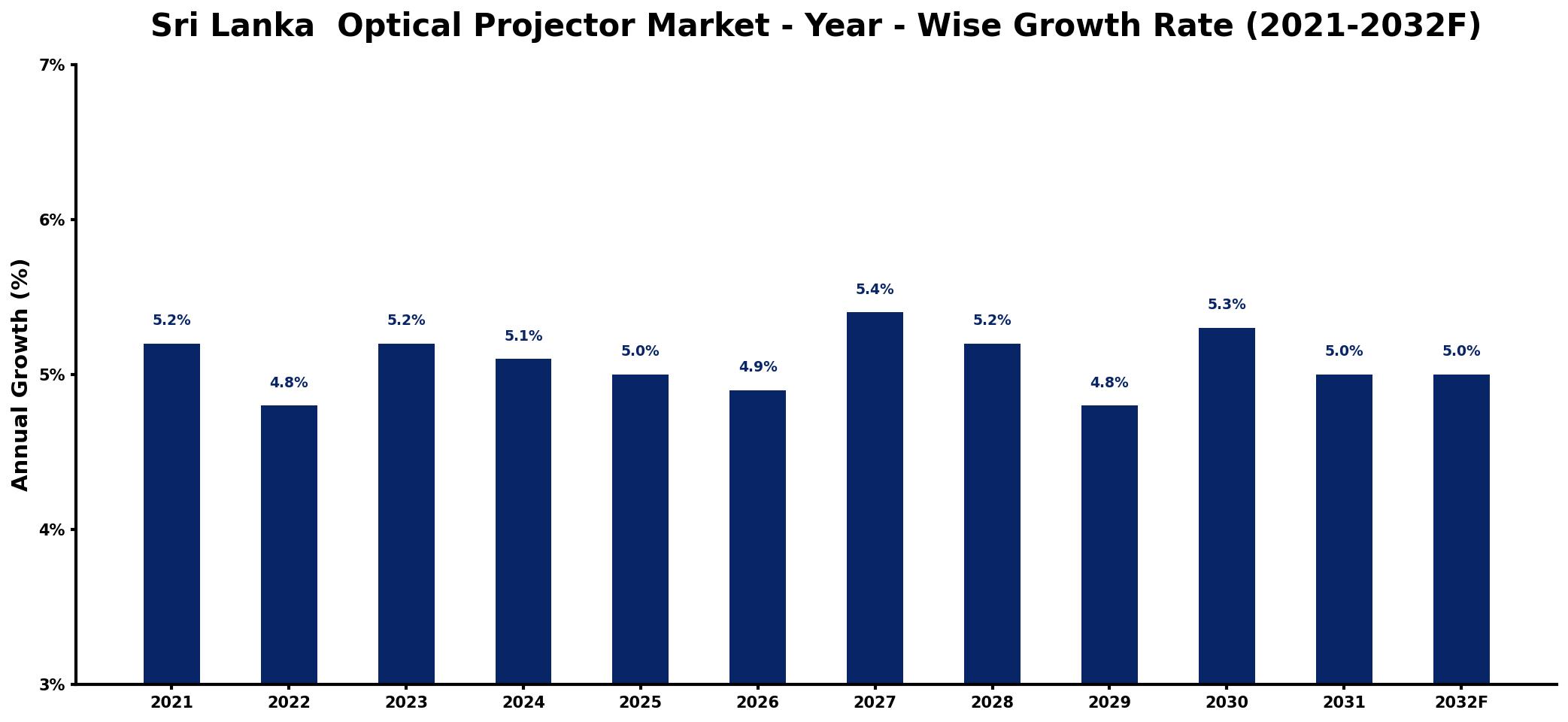
The table below presents the year‑wise growth rates along with the key drivers influencing the market
| Year | Growth Rate | Major Drivers |
| 2021 | 5.2% | Increased demand for home entertainment |
| 2022 | 4.8% | Growth in education sector investments |
| 2023 | 5.2% | Rise in corporate training programs |
| 2024 | 5.1% | Expansion of event management services |
| 2025 | 5.0% | Boom in digital marketing initiatives |
| 2026 | 4.9% | Adoption of remote learning technologies |
| 2027 | 5.4% | Surge in live entertainment events |
| 2028 | 5.2% | enhanced product quality standards |
| 2029 | 4.8% | Increase in public display installations |
| 2030 | 5.3% | Demand for interactive learning tools |
| 2031 | 5.0% | strengthening international trade flows |
| 2032 | 5.0% | expanding manufacturing base activity |
Note: Market size estimations and growth projections presented in this report are based on 6Wresearch's proprietary forecasting methodology, utilizing the latest available industry data, government publications, and primary research inputs.
Sri Lanka Optical Projector Market Synopsis
The strongest force currently shaping the Sri Lanka Optical Projector Market is the surge in digital learning initiatives across educational institutions. As schools and universities prioritize interactive learning environments, the integration of projectors becomes essential for effective teaching and engagement.
Corporate upgrades in meeting room technologies are also pivotal, as businesses seek innovative solutions for presentations and collaboration. This shift towards more versatile and high-resolution projectors reflects a broader trend towards modernization in workplaces throughout the country.
Sri Lanka Optical Projector Market Key Takeaways
- The market is fueled by growing digital learning and corporate upgrade initiatives.
- High-resolution imaging and portability are increasingly becoming essential for various applications.
- Integration of smart features and wireless connectivity enhances projector functionality.
- The affordability of projectors is expanding access across sectors in Sri Lanka.
- Ongoing innovations from manufacturers continue to cater to evolving consumer preferences.
Evaluation of Restraints in Sri Lanka Optical Projector Market
Despite the promising growth trajectory, the Sri Lanka Optical Projector Market faces several restraints. High costs associated with advanced projector technologies limit widespread adoption, particularly in smaller businesses and educational institutions. Additionally, the reliance on imported projectors creates vulnerabilities linked to international trade policies and price variations. Furthermore, a shortage of skilled professionals for installation and maintenance poses challenges in optimizing projector systems effectively. Lastly, limited awareness regarding the practical benefits of optical projectors among potential users continues to hinder broader acceptance and utilization.
Sri Lanka Optical Projector Market Trends
Current trends indicate a marked preference for compact and feature-rich projectors that boast superior image quality and energy efficiency. Moreover, the rise of portable projectors reflects a growing demand for flexible viewing options, catering to both on-the-go professionals and home entertainment enthusiasts. As the integration of smart technology becomes increasingly prominent, consumers are looking for projectors that offer seamless connectivity and intuitive operation.
Sri Lanka Optical Projector Market Opportunities
The Sri Lanka Optical Projector Market is ripe with opportunities, particularly in the realm of education. With ongoing government efforts to enhance educational infrastructure, projector manufacturers can benefit from partnerships aimed at supplying educational institutions. Additionally, as businesses continually seek to upgrade their technological capabilities, there exists a lucrative market for innovative AV solutions tailored to corporate environments. The increasing demand for home theater systems also presents a growth avenue for manufacturers focusing on high-quality, affordable projectors.
Government Initiatives in the Sri Lanka Optical Projector Market
The Sri Lankan government is actively fostering a conducive environment for the optical projector market through various initiatives. Policies aimed at promoting technological innovation and educational infrastructure are at the forefront. Incentives for the production and adoption of optical projectors, coupled with support for research and development in projection technologies, are paving the way for a more robust market landscape. Furthermore, the government ensures regulatory compliance with international standards, enhancing the overall credibility of locally available products.
Future Insights of the Sri Lanka Optical Projector Market
Looking forward to 2026-2032, the Sri Lanka Optical Projector Market is expected to experience sustained growth driven by continuous advancements in projection technology. As consumer preferences shift towards more interactive and high-definition experiences, manufacturers will need to prioritize innovation and adaptability. The integration of emerging technologies such as augmented reality could redefine application possibilities for optical projectors, thereby expanding their use across diverse sectors beyond education and business.
Sri Lanka Optical Projector Market Latest Developments (2025 - 2026)
Recent developments in the optical projector industry have focused on enhancing the user experience through innovative design and features. Manufacturers are increasingly launching projectors that combine portability with high-quality performance, catering to both professional and personal use. Additionally, advancements in wireless connectivity options are becoming standard, allowing users more flexibility in how they connect and present information.
Sri Lanka Optical Projector Market - Key Attractiveness of the Report
- 10 Years of Market Numbers
- Historical Data Starting from 2022 to 2025
- Base Year: 2025
- Forecast Data until 2032
- Key Performance Indicators Impacting the Market
- Major Upcoming Developments and Projects
Key Highlights of the Report:
- Sri Lanka Optical Projector Market Outlook
- Market Size of Sri Lanka Optical Projector Market, 2025
- Forecast of Sri Lanka Optical Projector Market, 2032
- Historical Data and Forecast of Sri Lanka Optical Projector Revenues & Volume for the Period 2022-2032F
- Sri Lanka Optical Projector Market Trend Evolution
- Sri Lanka Optical Projector Market Drivers and Challenges
- Sri Lanka Optical Projector Price Trends
- Sri Lanka Optical Projector Porter's Five Forces
- Sri Lanka Optical Projector Industry Life Cycle
- Historical Data and Forecast of Sri Lanka Optical Projector Market Revenues & Volume By Type for the Period 2022-2032F
- Historical Data and Forecast of Sri Lanka Optical Projector Market Revenues & Volume By Digital Light Processing (DLP) for the Period 2022-2032F
- Historical Data and Forecast of Sri Lanka Optical Projector Market Revenues & Volume By Liquid Crystal Display (LCD) for the Period 2022-2032F
- Historical Data and Forecast of Sri Lanka Optical Projector Market Revenues & Volume By Liquid Crystal on Silicon (LCoS) for the Period 2022-2032F
- Historical Data and Forecast of Sri Lanka Optical Projector Market Revenues & Volume By Application for the Period 2022-2032F
- Historical Data and Forecast of Sri Lanka Optical Projector Market Revenues & Volume By Residential for the Period 2022-2032F
- Historical Data and Forecast of Sri Lanka Optical Projector Market Revenues & Volume By Commercial for the Period 2022-2032F
- Historical Data and Forecast of Sri Lanka Optical Projector Market Revenues & Volume By Industrial for the Period 2022-2032F
- Sri Lanka Optical Projector Import Export Trade Statistics
- Market Opportunity Assessment By Type
- Market Opportunity Assessment By Application
- Sri Lanka Optical Projector Top Companies Market Share
- Sri Lanka Optical Projector Competitive Benchmarking By Technical and Operational Parameters
- Sri Lanka Optical Projector Company Profiles
- Sri Lanka Optical Projector Key Strategic Recommendations






































