Sri Lanka Organic Beverages Market (2026-2032) | Trends, Segmentation, Forecast, Value, Share, Outlook, Competitive Landscape, Companies, Industry, Analysis, Size & Revenue, Growth
Market Forecast By Product Type (Alcoholic, Non-Alcoholic), By Distribution Channel (Supermarkets/Hypermarkets, Convenience Stores, Specialist Retailers, Online Retailers, Other Distribution Channels) And Competitive Landscape
| Product Code: ETC9474822 | Publication Date: Sep 2024 | Updated Date: Mar 2026 | Product Type: Market Research Report | |
| Publisher: 6Wresearch | Author: Shubham Padhi | No. of Pages: 75 | No. of Figures: 35 | No. of Tables: 20 |
Sri Lanka Organic Beverages Market: Import Trend Analysis
From 2023 to 2024, Sri Lanka import trend for organic beverages experienced a growth rate of 45.08%. The compound annual growth rate (CAGR) for the period 2020-2024 stood at 16.68%. This significant increase can be attributed to the growing consumer preference for healthier and sustainable beverage options in the market.
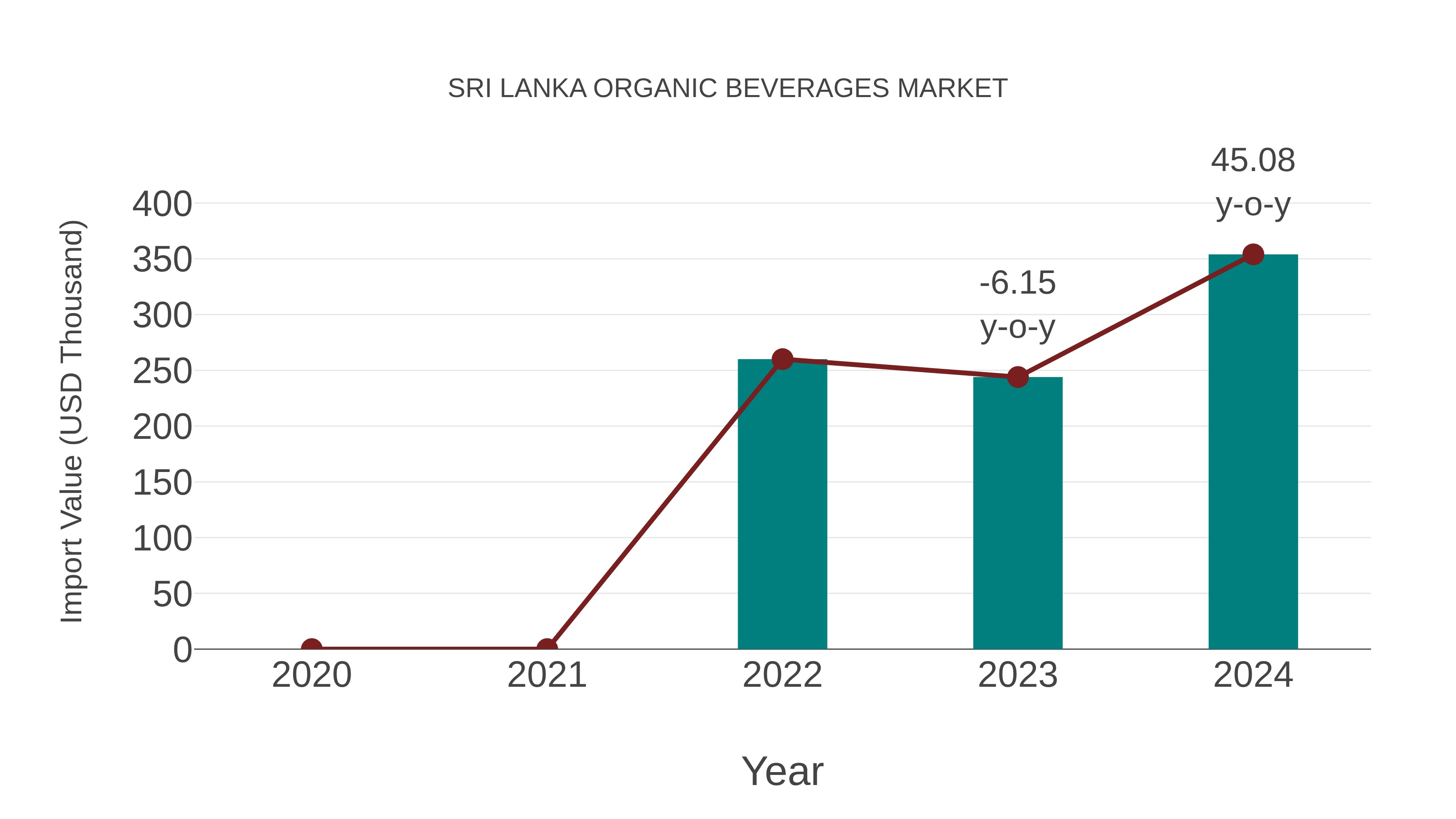
Sri Lanka Organic Beverages Market Growth Rate
According to 6Wresearch internal database and industry insights, the Sri Lanka Organic Beverages Market is projected to grow at a compound annual growth rate (CAGR) of 8.4% during the forecast period (2026-2032).
Topics Covered in the Sri Lanka Organic Beverages Market Report
The Sri Lanka Organic Beverages Market report thoroughly covers the market by product type and distribution channel. The report provides an unbiased and detailed analysis of ongoing market trends, opportunities/high-growth areas, and market dynamics, assisting stakeholders in aligning their strategies.
Sri Lanka Organic Beverages Market Highlights
| Report Name | Sri Lanka Organic Beverages Market |
| Forecast Period | 2026-2032 |
| CAGR | 8.4% |
| Growing Sector | Retail |
Sri Lanka Organic Beverages Market Synopsis
The Sri Lanka Organic Beverages Market is experiencing major growth, which is spurred by the increasing demand for healthier and more sustainable beverage options. Additional factors that are supporting the growth of the market are the evolving consumer awareness about the benefits of organic and natural products. Along with this, the growing preference for wellness and lifestyle beverages, such as organic fruit juices and plant-based milks is boosting the expansion of the market.
Evaluation of Growth Drivers in the Sri Lanka Organic Beverages Market
Below mentioned are some prominent growth drivers and their influence on market dynamics:
| Drivers | Primary Segments Affected | Why it Matters (Evidence) |
| Health & Wellness Trends | All Segments | Growing preference for healthier and natural products is boosting demand. |
| Rising Purchasing Power | All Segments | Increasing purchasing power among the middle class enables more consumption of premium organic beverages. |
| E-commerce Growth | Distribution Channels, All Segments | E-commerce platforms are increasing the availability of the product in the market. |
| Urbanization | All Segments | The growing urban population is influencing the demand for convenience-driven organic beverage options. |
| Consumer Trust in Organic Products | All Segments | Rising trust in the health benefits of organic beverages is influencing increased sales. |
The Sri Lanka Organic Beverages Market is expected to experience significant growth at a compound annual growth rate (CAGR) of 8.4% during the forecast period (2026-2032). This growth is largely influenced by many major factors, mainly the evolving shift in consumer preferences towards health-conscious consumption. As awareness around the importance of maintaining a healthy lifestyle continues to rise, many consumers are choosing organic beverages, which are seen as a healthier, more natural substitute for conventional soft drinks and alcoholic beverages. This trend is especially noticeable among consumers seeking to a steer clear of artificial additives and sugars typically present in conventional beverages.
Evaluation of Restraints in the Sri Lanka Organic Beverages Market
Below mentioned are some major restraints and their influence on market dynamics:
| Restraints | Primary Segments Affected | What This Means (Evidence) |
| High Product Pricing | All Segments | Higher costs of organic beverages compared to conventional options may limit consumption in price-sensitive consumer segments. |
| Limited Awareness in Rural Areas | Distribution Channels, All Segments | Lack of awareness in rural areas may slow down the market penetration in these regions. |
| Availability of Non-Organic Alternatives | All Segments | Availability of non-organic alternatives could slow down the expansion of the market. |
| Supply Chain Challenges | All Segments | Natural disasters within the organic supply chain could disrupt the availability of beverages. |
| Limited Product Variety | All Segments | A lack of diverse product offerings may hinder the appeal of organic beverages to a broader range of consumers. |
Sri Lanka Organic Beverages Market Challenges
At the same time, The Sri Lanka Organic Beverages Market’s share can be affected due to the major challenges. One of the major obstacles is the higher cost of organic beverages compared to conventional options, which may restrict consumption among budget-conscious consumers, particularly in remote regions. Along with this, lack of understanding regarding the benefits of organic products in some regions could slow down the expansion of the market.
Sri Lanka Organic Beverages Market Trends
The following trends are shaping the growth of the market:
- Innovation in Organic Beverage Flavors: New flavors and ingredients in organic beverages are attracting health-conscious consumers.
- Growth of Organic Beverages in E-commerce: Growth of e-commerce platforms has enabled consumers to buy a variety of organic beverage products and this is driving the growth of the market.
- Plant based beverages becoming popular: The growing vegan movement is increasing the popularity of plant based organic beverages such as organic fruit juices and herbal teas.
- Demand for sustainable products: More consumers are focused on sustainability thus increasing the demand for organic and sustainable beverages.
Investment Opportunities in the Sri Lanka Organic Beverages Market
The following investment opportunities are anticipated to fuel the expansion of the market:
- Expansion of E-commerce Channels: Investment in online retailing platforms could enhance market reach and visibility for organic beverages.
- Product Innovation: Product development of organic beverages to cater to a variety of tastes and dietary preferences can tap into new markets.
- Sustainability and Packaging Innovations: Increasing Investment in green packaging can cater to the environmentally friendly consumer.
- Brand Partnerships and Retail Expansion: Collaboration with retail chains, supermarkets, and convenience stores will enhance product visibility and availability.
Top 5 Leading Players in the Sri Lanka Organic Beverages Market
Below is a comprehensive list of leading players operating in the Sri Lanka Organic Beverages Market:
1. Dilmah Ceylon Tea Company PLC
| Company Name | Dilmah Ceylon Tea Company PLC |
| Established Year | 1988 |
| Headquarters | Peliyagoda, Sri Lanka |
| Official Website | Click Here |
Market Position: The most globally recognized Sri Lankan tea brand. Dilmah has a dedicated organic range certified by international bodies (USDA, EU Organic). They lead in "value-added" beverages, including organic RTD (Ready-To-Drink) iced teas and premium herbal infusions.
2. Renuka Foods PLC (Renuka Teas Ceylon)
| Company Name | Renuka Foods PLC (Renuka Teas Ceylon) |
| Established Year | 1866 |
| Headquarters | Colombo, Sri Lanka |
| Official Website | Click Here |
Market Position: A powerhouse in the organic sector. They are one of the world's leading exporters of organic coconut-based beverages (coconut water and milk) and have a massive footprint in organic tea and superfood infusions under their Renuté brand.
3. Bogawantalawa Tea Ceylon (Pvt) Ltd
| Company Name | Bogawantalawa Tea Ceylon (Pvt) Ltd |
| Established Year | 1869 |
| Headquarters | Welisara, Sri Lanka |
| Official Website | Click Here |
Market Position: Known as the "Golden Valley of Ceylon Tea," they were pioneers in creating Climate Positive tea. Their Apurva and organic lines are major players in the high-end organic infusion market, focusing heavily on sustainability and traceability.
4. Bio Foods (Pvt) Ltd
| Company Name | Bio Foods (Pvt) Ltd |
| Established Year | 1993 |
| Headquarters | Kandy, Sri Lanka |
| Official Website | Click Here |
Market Position: A leader in the Fairtrade and Organic niche. Unlike the larger conglomerates, Bio Foods specializes almost exclusively in organic-certified products, including organic teas, spices used in beverages, and traditional herbal drinks (Ayurvedic blends).
5. Bev Ceylon (Pvt) Ltd
| Company Name | Bev Ceylon (Pvt) Ltd |
| Established Year | 2017 |
| Headquarters | Colombo, Sri Lanka |
| Official Website | Click Here |
Market Position: A modern, fast-growing player focused on Organic King Coconut Water and fruit-based functional drinks. They have successfully positioned "endemic" Sri Lankan ingredients in the global health-beverage market, using no preservatives or added sugars.
Government Regulations Introduced in the Sri Lanka Organic Beverages Market
According to Sri Lankan government data, many policies have been adopted to ensure the safety and quality of organic beverages in the country. For example, the Ministry of Agriculture and the Sri Lanka Standards Institution have defined standards for the certification, production and labeling of organic beverages to guarantee their authenticity. The regulations are aiming to make sure that organic foods are of good quality and are free from any harmful chemical and artificial substances.
Future Insights of the Sri Lanka Organic Beverages Market
Sri Lanka Organic Beverages Market revenue will be quickly expanding in the next few years, which is driven by several key factors that are in line with the changing consumer preferences and the broader global trends. A definite part of this growth is the increasing health consciousness of Sri Lankan consumers. As people’s awareness of the long-term health benefits from natural and organic products grows, several consumers are choosing beverages that promote their health and well-being.
Market Segmentation Analysis
This report provides an inclusive study of the following market segments and their leading categories:
By Product Type – Non-Alcoholic to Lead
According to Sarthi, Senior Research Analyst, 6wresearch, non-alcoholic beverages are expected to lead the Sri Lanka Organic Beverages Market due to the increasing demand for healthy, functional beverages such as organic fruit juices, plant-based milks and herbal teas.
By Distribution Channel – Supermarkets and Hypermarkets to Lead
Supermarkets and hypermarkets are expected to dominate the Sri Lanka Organic Beverages Market due to their broad reach and extensive product offerings. These retail stores offer consumers easy access to a broad selection of organic beverages, frequently at competitive prices.
Key Attractiveness of the Report
- 10 Years of Market Numbers
- Historical Data Starting from 2022 to 2025
- Base Year: 2025
- Forecast Data until 2032
- Key Performance Indicators Impacting the Market
- Major Upcoming Developments and Projects
Key Highlights of the Report:
- Sri Lanka Organic Beverages Market Outlook
- Market Size of Sri Lanka Organic Beverages Market, 2025
- Forecast of Sri Lanka Organic Beverages Market, 2032
- Historical Data and Forecast of Sri Lanka Organic Beverages Revenues & Volume for the Period 2022-2032
- Sri Lanka Organic Beverages Market Trend Evolution
- Sri Lanka Organic Beverages Market Drivers and Challenges
- Sri Lanka Organic Beverages Price Trends
- Sri Lanka Organic Beverages Porter's Five Forces
- Sri Lanka Organic Beverages Industry Life Cycle
- Historical Data and Forecast of Sri Lanka Organic Beverages Market Revenues & Volume By Product Type for the Period 2022-2032
- Historical Data and Forecast of Sri Lanka Organic Beverages Market Revenues & Volume By Alcoholic for the Period 2022-2032
- Historical Data and Forecast of Sri Lanka Organic Beverages Market Revenues & Volume By Non-Alcoholic for the Period 2022-2032
- Historical Data and Forecast of Sri Lanka Organic Beverages Market Revenues & Volume By Distribution Channel for the Period 2022-2032
- Historical Data and Forecast of Sri Lanka Organic Beverages Market Revenues & Volume By Supermarkets/Hypermarkets for the Period 2022-2032
- Historical Data and Forecast of Sri Lanka Organic Beverages Market Revenues & Volume By Convenience Stores for the Period 2022-2032
- Historical Data and Forecast of Sri Lanka Organic Beverages Market Revenues & Volume By Specialist Retailers for the Period 2022-2032
- Historical Data and Forecast of Sri Lanka Organic Beverages Market Revenues & Volume By Online Retailers for the Period 2022-2032
- Historical Data and Forecast of Sri Lanka Organic Beverages Market Revenues & Volume By Other Distribution Channels for the Period 2022-2032
- Sri Lanka Organic Beverages Import Export Trade Statistics
- Market Opportunity Assessment By Product Type
- Market Opportunity Assessment By Distribution Channel
- Sri Lanka Organic Beverages Top Companies Market Share
- Sri Lanka Organic Beverages Competitive Benchmarking By Technical and Operational Parameters
- Sri Lanka Organic Beverages Company Profiles
- Sri Lanka Organic Beverages Key Strategic Recommendations
Markets Covered
The market report for the Sri Lanka Organic Beverages Market has been segmented and sub-segmented into the following categories:
By Product Type
- Alcoholic
- Non-Alcoholic
By Distribution Channel
- Supermarkets/Hypermarkets Convenience Stores
- Specialist Retailers
- Online Retailers
- Other Distribution Channels
Sri Lanka Organic Beverages Market (2026-2032): FAQs
The Sri Lanka Organic Beverages Market is projected to grow at a CAGR of 8.4% during the forecast period (2026-2032).
Non-alcoholic beverages are estimated to dominate the Sri Lanka Organic Beverages market, driven by the rising demand for healthy, functional beverages.
Major opportunities include the increasing distribution channels, investments in e-commerce and innovations in organic beverage formulations.
Supermarkets and hypermarkets are anticipated to dominate the Sri Lanka Organic Beverages market due to their broad convenience and widespread organic beverage offerings.
6Wresearch actively monitors the Sri Lanka Organic Beverages Market and publishes its comprehensive annual report, highlighting emerging trends, growth drivers, revenue analysis, and forecast outlook. Our insights help businesses to make data-backed strategic decisions with ongoing market dynamics. Our analysts track relevent industries related to the Sri Lanka Organic Beverages Market, allowing our clients with actionable intelligence and reliable forecasts tailored to emerging regional needs.
Yes, we provide customisation as per your requirements. To learn more, feel free to contact us on sales@6wresearch.com
|
1 Executive Summary |
|
2 Introduction |
|
2.1 Key Highlights of the Report |
|
2.2 Report Description |
|
2.3 Market Scope & Segmentation |
|
2.4 Research Methodology |
|
2.5 Assumptions |
|
3 Sri Lanka Organic Beverages Market Overview |
|
3.1 Sri Lanka Country Macro Economic Indicators |
|
3.2 Sri Lanka Organic Beverages Market Revenues & Volume, 2022 & 2032F |
|
3.3 Sri Lanka Organic Beverages Market - Industry Life Cycle |
|
3.4 Sri Lanka Organic Beverages Market - Porter's Five Forces |
|
3.5 Sri Lanka Organic Beverages Market Revenues & Volume Share, By Product Type, 2022 & 2032F |
|
3.6 Sri Lanka Organic Beverages Market Revenues & Volume Share, By Distribution Channel, 2022 & 2032F |
|
4 Sri Lanka Organic Beverages Market Dynamics |
|
4.1 Impact Analysis |
|
4.2 Market Drivers |
|
4.2.1 Increasing health consciousness and awareness among consumers |
|
4.2.2 Growing demand for natural and organic products |
|
4.2.3 Rise in disposable income leading to higher spending on premium beverages |
|
4.2.4 Supportive government regulations and initiatives promoting organic agriculture |
|
4.2.5 Expansion of distribution channels and availability of organic beverages in retail outlets |
|
4.3 Market Restraints |
|
4.3.1 High prices of organic beverages compared to conventional options |
|
4.3.2 Limited awareness and understanding of organic beverages among the general population |
|
4.3.3 Challenges in consistent supply chain management for organic ingredients |
|
4.3.4 Competition from established non-organic beverage brands |
|
4.3.5 Lack of standardization in organic certification processes leading to consumer skepticism |
|
5 Sri Lanka Organic Beverages Market Trends |
|
6 Sri Lanka Organic Beverages Market, By Types |
|
6.1 Sri Lanka Organic Beverages Market, By Product Type |
|
6.1.1 Overview and Analysis |
|
6.1.2 Sri Lanka Organic Beverages Market Revenues & Volume, By Product Type, 2022-2032F |
|
6.1.3 Sri Lanka Organic Beverages Market Revenues & Volume, By Alcoholic, 2022-2032F |
|
6.1.4 Sri Lanka Organic Beverages Market Revenues & Volume, By Non-Alcoholic, 2022-2032F |
|
6.2 Sri Lanka Organic Beverages Market, By Distribution Channel |
|
6.2.1 Overview and Analysis |
|
6.2.2 Sri Lanka Organic Beverages Market Revenues & Volume, By Supermarkets/Hypermarkets, 2022-2032F |
|
6.2.3 Sri Lanka Organic Beverages Market Revenues & Volume, By Convenience Stores, 2022-2032F |
|
6.2.4 Sri Lanka Organic Beverages Market Revenues & Volume, By Specialist Retailers, 2022-2032F |
|
6.2.5 Sri Lanka Organic Beverages Market Revenues & Volume, By Online Retailers, 2022-2032F |
|
6.2.6 Sri Lanka Organic Beverages Market Revenues & Volume, By Other Distribution Channels, 2022-2032F |
|
7 Sri Lanka Organic Beverages Market Import-Export Trade Statistics |
|
7.1 Sri Lanka Organic Beverages Market Export to Major Countries |
|
7.2 Sri Lanka Organic Beverages Market Imports from Major Countries |
|
8 Sri Lanka Organic Beverages Market Key Performance Indicators |
|
8.1 Number of organic beverage brand offerings in the market |
|
8.2 Percentage increase in organic beverage consumption in Sri Lanka annually |
|
8.3 Growth rate of organic agriculture in Sri Lanka |
|
8.4 Number of organic beverage retail outlets and distribution points |
|
8.5 Consumer perception and acceptance of organic beverages in the market |
|
9 Sri Lanka Organic Beverages Market - Opportunity Assessment |
|
9.1 Sri Lanka Organic Beverages Market Opportunity Assessment, By Product Type, 2022 & 2032F |
|
9.2 Sri Lanka Organic Beverages Market Opportunity Assessment, By Distribution Channel, 2022 & 2032F |
|
10 Sri Lanka Organic Beverages Market - Competitive Landscape |
|
10.1 Sri Lanka Organic Beverages Market Revenue Share, By Companies, 2025 |
|
10.2 Sri Lanka Organic Beverages Market Competitive Benchmarking, By Operating and Technical Parameters |
|
11 Company Profiles |
|
12 Recommendations |
|
13 Disclaimer |
Global Go To Market Strategy - 2030
Export potential enables firms to identify high-growth global markets with greater confidence by combining advanced trade intelligence with a structured quantitative methodology. The framework analyzes emerging demand trends and country-level import patterns while integrating macroeconomic and trade datasets such as GDP and population forecasts, bilateral import–export flows, tariff structures, elasticity differentials between developed and developing economies, geographic distance, and import demand projections. Using weighted trade values from 2020–2024 as the base period to project country-to-country export potential for 2030, these inputs are operationalized through calculated drivers such as gravity model parameters, tariff impact factors, and projected GDP per-capita growth. Through an analysis of hidden potentials, demand hotspots, and market conditions that are most favorable to success, this method enables firms to focus on target countries, maximize returns, and global expansion with data, backed by accuracy.
By factoring in the projected importer demand gap that is currently unmet and could be potential opportunity, it identifies the potential for the Exporter (Country) among 190 countries, against the general trade analysis, which identifies the biggest importer or exporter.
To discover high-growth global markets and optimize your business strategy:
Click Here
Pricing
- Single User License$ 1,995
- Department License$ 2,400
- Site License$ 3,120
- Global License$ 3,795

Leadership Perspectives from Industry Events
Search
Thought Leadership and Analyst Meet





Our Clients








6WResearch In News
- Doha a strategic location for EV manufacturing hub: IPA Qatar
- Demand for luxury TVs surging in the GCC, says Samsung
- Empowering Growth: The Thriving Journey of Bangladesh’s Cable Industry
- Demand for luxury TVs surging in the GCC, says Samsung
- Video call with a traditional healer? Once unthinkable, it’s now common in South Africa
- Intelligent Buildings To Smooth GCC’s Path To Net Zero
Latest Reports
- Taiwan Airport Wireless Infrastructure Market (2026-2032)
- Vietnam Airport Wireless Infrastructure Market (2026-2032)
- Thailand Airport Wireless Infrastructure Market (2026-2032)
- South Korea Airport Wireless Infrastructure Market (2026-2032)
- Romania Airport Wireless Infrastructure Market (2026-2032)
- Qatar Airport Wireless Infrastructure Market (2026-2032)
- Philippines Airport Wireless Infrastructure Market (2026-2032)
- Japan Airport Wireless Infrastructure Market (2026-2032)
- Taiwan Airport Winter Services Market (2026-2032)
- Vietnam Airport Winter Services Market (2026-2032)
Industry Events and Analyst Meet

HIMTEX 2026

India Refining Summit 2026

India EV Show 2026

EV tech India Expo 2026

Auto Tech Asia 2026
Whitepaper
- Middle East & Africa Commercial Security Market Click here to view more.
- Middle East & Africa Fire Safety Systems & Equipment Market Click here to view more.
- GCC Drone Market Click here to view more.
- Middle East Lighting Fixture Market Click here to view more.
- GCC Physical & Perimeter Security Market Click here to view more.


