Sri Lanka Pest Control Market Size Growth Rate
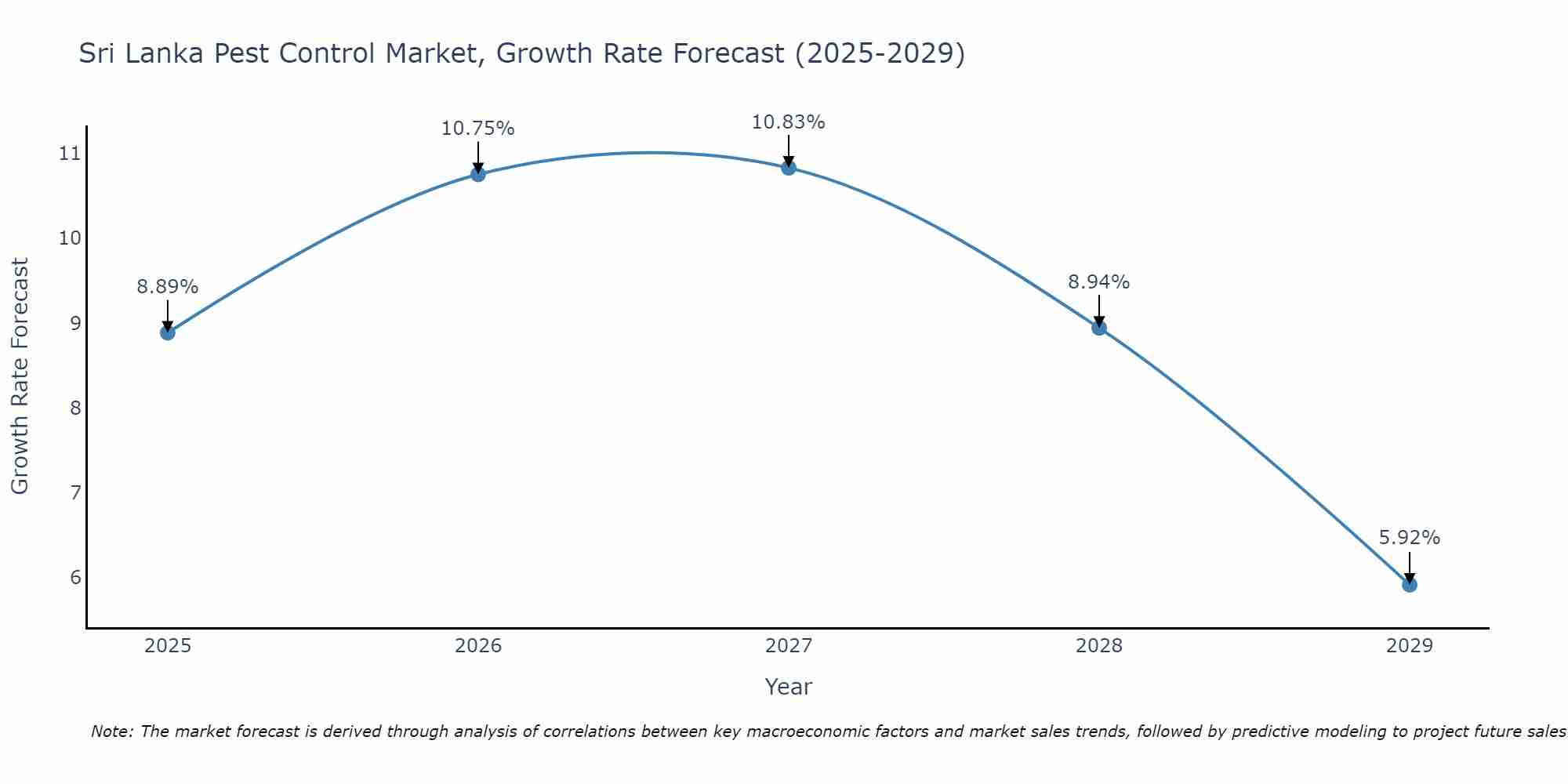
The Sri Lanka Pest Control Market is projected to witness mixed growth rate patterns during 2025 to 2029. Growth accelerates to 10.83% in 2027, following an initial rate of 8.89%, before easing to 5.92% at the end of the period.
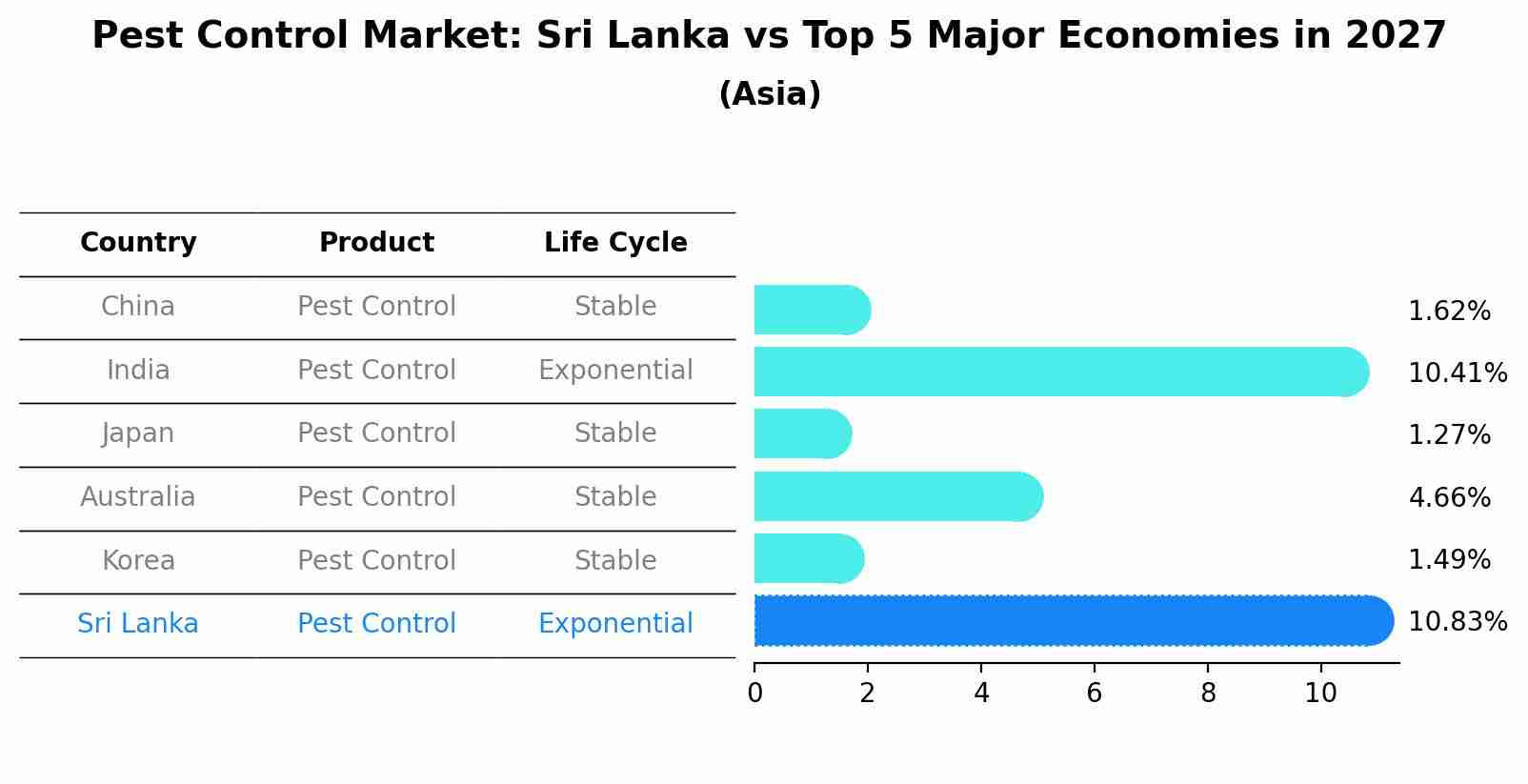
Pest Control Market: Sri Lanka vs Top 5 Major Economies in 2027 (Asia)
In the Asia region, the Pest Control market in Sri Lanka is projected to expand at a high growth rate of 10.83% by 2027. The largest economy is China, followed by India, Japan, Australia and South Korea.
Sri Lanka Pest Control Market Synopsis
The Pest Control Market in Sri Lanka is witnessing steady growth driven by increasing awareness about health and hygiene, stringent regulations, and growing urbanization. Key players in the market offer a range of services including termite control, rodent control, fumigation, and insect control to residential, commercial, and industrial sectors. The market is characterized by the use of both chemical and non-chemical methods, with a growing preference for eco-friendly and sustainable solutions. Factors such as rising incidences of vector-borne diseases, expanding hospitality industry, and the emphasis on food safety standards are contributing to the market`s expansion. Moreover, the government`s initiatives to control the spread of diseases like dengue and malaria are further propelling the demand for pest control services in Sri Lanka.
Sri Lanka Pest Control Market Trends
The Pest Control Market in Sri Lanka is experiencing a growing demand for eco-friendly and non-toxic pest control solutions as consumers are becoming increasingly aware of environmental sustainability. Integrated Pest Management (IPM) practices are gaining popularity, focusing on prevention and minimizing chemical usage. The market is also witnessing a rise in demand for professional pest control services in residential, commercial, and industrial sectors due to the increasing awareness of health risks associated with pests. Technological advancements, such as the use of digital tools for pest monitoring and control, are also shaping the industry. Additionally, stringent regulations and standards set by government authorities are driving the adoption of safer and more sustainable pest control methods in the Sri Lankan market.
Sri Lanka Pest Control Market Challenges
In the Sri Lanka pest control market, some key challenges include increasing competition among service providers leading to price wars, lack of awareness among consumers about the importance of professional pest control services, and the presence of unlicensed and unregulated operators offering substandard services. Additionally, issues such as limited access to advanced pest control technologies and products, inadequate government regulations to monitor the industry, and difficulty in sourcing skilled labor are prevalent in the market. Addressing these challenges will require industry players to invest in marketing and education initiatives, promote industry standards and certifications, collaborate with government agencies to enforce regulations, and focus on innovation and training to improve service quality and customer trust.
Sri Lanka Pest Control Market Investment Opportunities
The Sri Lanka Pest Control Market presents promising investment opportunities due to the increasing awareness about the importance of pest management in agriculture, food processing, and residential sectors. With a growing population and urbanization, the demand for pest control services is on the rise, creating a favorable environment for investments in this sector. Integrated pest management solutions, eco-friendly products, and innovative technologies are areas that offer potential for growth and differentiation in the market. Additionally, the government`s initiatives to promote sustainable agriculture practices and food safety regulations further support the expansion of the pest control industry in Sri Lanka. Investing in established pest control companies, research and development of new products, and strategic partnerships with key stakeholders can lead to profitable returns in this growing market.
Sri Lanka Pest Control Market Future Outlook
The future outlook for the Sri Lanka Pest Control Market appears promising, driven by factors such as increasing awareness of the importance of pest control for health and safety, growing urbanization leading to higher demand for pest management services in residential and commercial properties, and stricter regulations on pest control practices. Additionally, the rising prevalence of vector-borne diseases and the expansion of industries such as agriculture, hospitality, and healthcare are expected to further fuel market growth. Technology advancements, such as the adoption of eco-friendly and sustainable pest control solutions, are likely to shape the industry`s future landscape. Overall, the Sri Lanka Pest Control Market is anticipated to experience steady growth and present opportunities for market players to innovate and expand their services.
Key Highlights of the Report:
- Sri Lanka Pest Control Market Outlook
- Market Size of Sri Lanka Pest Control Market, 2021
- Forecast of Sri Lanka Pest Control Market, 2031
- Historical Data and Forecast of Sri Lanka Pest Control Revenues & Volume for the Period 2018 - 2031
- Sri Lanka Pest Control Market Trend Evolution
- Sri Lanka Pest Control Market Drivers and Challenges
- Sri Lanka Pest Control Price Trends
- Sri Lanka Pest Control Porter's Five Forces
- Sri Lanka Pest Control Industry Life Cycle
- Historical Data and Forecast of Sri Lanka Pest Control Market Revenues & Volume By Pest Type for the Period 2018 - 2031
- Historical Data and Forecast of Sri Lanka Pest Control Market Revenues & Volume By Insects for the Period 2018 - 2031
- Historical Data and Forecast of Sri Lanka Pest Control Market Revenues & Volume By Termites for the Period 2018 - 2031
- Historical Data and Forecast of Sri Lanka Pest Control Market Revenues & Volume By Rodents for the Period 2018 - 2031
- Historical Data and Forecast of Sri Lanka Pest Control Market Revenues & Volume By Wildlife for the Period 2018 - 2031
- Historical Data and Forecast of Sri Lanka Pest Control Market Revenues & Volume By Other pest types (birds, reptiles, and mollusks) for the Period 2018 - 2031
- Historical Data and Forecast of Sri Lanka Pest Control Market Revenues & Volume By Control Method for the Period 2018 - 2031
- Historical Data and Forecast of Sri Lanka Pest Control Market Revenues & Volume By Chemical for the Period 2018 - 2031
- Historical Data and Forecast of Sri Lanka Pest Control Market Revenues & Volume By Biological for the Period 2018 - 2031
- Historical Data and Forecast of Sri Lanka Pest Control Market Revenues & Volume By Mechanical for the Period 2018 - 2031
- Historical Data and Forecast of Sri Lanka Pest Control Market Revenues & Volume By Software & services for the Period 2018 - 2031
- Historical Data and Forecast of Sri Lanka Pest Control Market Revenues & Volume By Mode of Application for the Period 2018 - 2031
- Historical Data and Forecast of Sri Lanka Pest Control Market Revenues & Volume By Powder for the Period 2018 - 2031
- Historical Data and Forecast of Sri Lanka Pest Control Market Revenues & Volume By Sprays for the Period 2018 - 2031
- Historical Data and Forecast of Sri Lanka Pest Control Market Revenues & Volume By Pellets for the Period 2018 - 2031
- Historical Data and Forecast of Sri Lanka Pest Control Market Revenues & Volume By Traps for the Period 2018 - 2031
- Historical Data and Forecast of Sri Lanka Pest Control Market Revenues & Volume By Baits for the Period 2018 - 2031
- Historical Data and Forecast of Sri Lanka Pest Control Market Revenues & Volume By Application: for the Period 2018 - 2031
- Historical Data and Forecast of Sri Lanka Pest Control Market Revenues & Volume By Residential for the Period 2018 - 2031
- Historical Data and Forecast of Sri Lanka Pest Control Market Revenues & Volume By Commercial for the Period 2018 - 2031
- Historical Data and Forecast of Sri Lanka Pest Control Market Revenues & Volume By Livestock for the Period 2018 - 2031
- Historical Data and Forecast of Sri Lanka Pest Control Market Revenues & Volume By Industrial for the Period 2018 - 2031
- Historical Data and Forecast of Sri Lanka Pest Control Market Revenues & Volume By Other applications (non-commercial institutions, storage & transport facilities, and public landscapes) for the Period 2018 - 2031
- Sri Lanka Pest Control Import Export Trade Statistics
- Market Opportunity Assessment By Pest Type
- Market Opportunity Assessment By Control Method
- Market Opportunity Assessment By Mode of Application
- Market Opportunity Assessment By Application:
- Sri Lanka Pest Control Top Companies Market Share
- Sri Lanka Pest Control Competitive Benchmarking By Technical and Operational Parameters
- Sri Lanka Pest Control Company Profiles
- Sri Lanka Pest Control Key Strategic Recommendations






































