Sri Lanka Pest Control Products Market Summary
The sri lanka pest control products market was estimated at USD 499 Million in 2025 and is projected to reach USD 679 Million by 2032, growing at a CAGR of 5.2% from 2026 to 2032.
Sri Lanka Pest Control Products Market Year-wise Growth Rate and Key Drivers
This graph highlights how the Sri Lanka Pest Control Products Market has steadily grown over the past five years, supported by major growth factors.
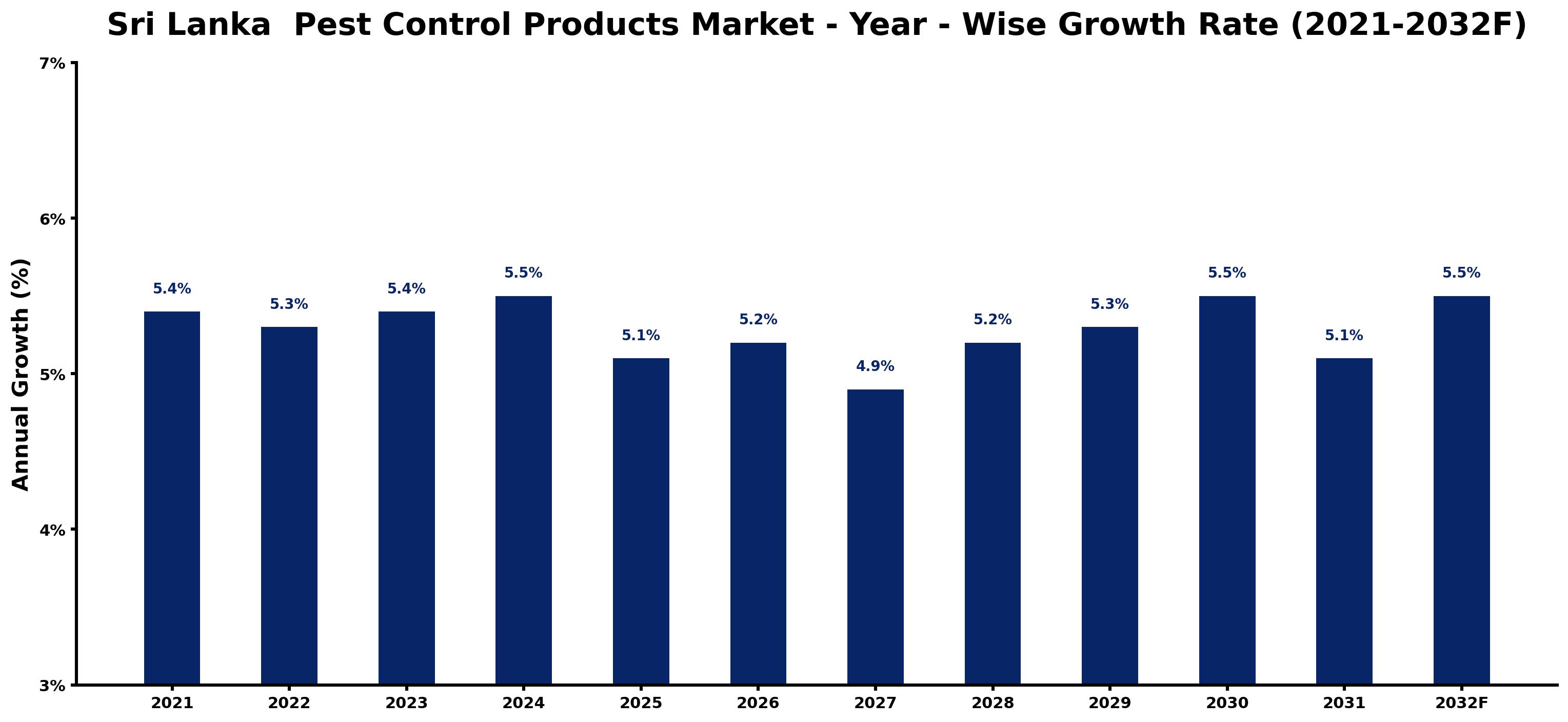
The table below presents the year wise growth rates along with the key drivers influencing the market
| Year | Growth Rate | Major Drivers |
| 2021 | 5.4% | Consumer awareness about pest-related health issues enhances the need for effective solutions. |
| 2022 | 5.3% | Urbanization prompts pest infestations in metropolitan areas, increasing product usage significantly. |
| 2023 | 5.4% | E-commerce platforms expand distribution channels, making pest control products more accessible. |
| 2024 | 5.5% | Environmental concerns steer households towards eco-friendly pest control solutions. |
| 2025 | 5.1% | Agricultural sector growth drives demand for pest management in crop protection strategies. |
| 2026 | 5.2% | Technological innovations in pest control enhance efficacy and customer satisfaction rates. |
| 2027 | 4.9% | Increased tourism brings pests to hospitality sectors, necessitating regular pest control services. |
| 2028 | 5.2% | Collaboration with local governments encourages community awareness programs on pest prevention. |
| 2029 | 5.3% | Rising disposable incomes allow families to invest in professional pest control services. |
| 2030 | 5.5% | Climate change alters pest behavior, fostering a need for adaptive control measures. |
| 2031 | 5.1% | Integration of smart technologies in pest control creates new market opportunities for growth. |
| 2032 | 5.5% | Shift towards sustainable practices in agriculture influences pest control product innovation. |
Note - Market size estimations and growth projections presented in this report are based on 6Wresearch's advanced forecasting approach, validated with industry datasets as of June 2026.
Sri Lanka Pest Control Products Market Synopsis
The Sri Lanka Pest Control Products Market is projected to reach 5.2% and witness significant growth during the forecast period (2026-2032). The anticipated compound annual growth rate (CAGR) of 6.1% during this period reflects a dynamic landscape in which consumer awareness around pest management is dramatically evolving. This growth is propelled by various factors, including an increasing demand for professionally managed pest control services and the utilization of advanced chemical solutions and biological methodologies across diverse sectors such as residential areas, healthcare facilities, and food establishments.
Sri Lanka Pest Control Products Market Growth Drivers
Several key drivers are fostering the growth of the Sri Lanka pest control products market. Firstly, the rising consumer awareness concerning the detrimental effects of pest infestations is compelling homeowners and businesses alike to seek effective pest management solutions. Additionally, the escalating urbanization in Sri Lanka is contributing to a greater incidence of pest-related issues, further bolstering demand. Technological advancements also play a pivotal role; the adoption of geo-mapping software and remote sensing devices is revolutionizing pest control strategies and enhancing the efficiency of pest management services. Moreover, an influx of government initiatives aimed at controlling vector-borne diseases, especially those related to mosquitoes, is set to create numerous opportunities for service providers in this sector. Lastly, with a burgeoning food and hospitality industry, there is an undeniable necessity for stringent pest control measures, thus driving the market.
Sri Lanka Pest Control Products Market Trends and Opportunities
The Sri Lanka pest control products market is witnessing several trends that present new opportunities for stakeholders. The growing inclination towards environmentally friendly and sustainable pest control methods is becoming increasingly prevalent among consumers. This shift is encouraging the development and utilization of biological pest control products, which are perceived as safer alternatives to traditional chemicals. Furthermore, the integration of digital technologies, including mobile applications for pest monitoring and management, is reshaping how services are delivered, providing efficiency and real-time solutions. The market is also seeing a burgeoning interest in integrated pest management (IPM) practices, which combine multiple strategies for effective pest control. Moreover, the increased collaboration between public health entities and pest control services is paving the way for more comprehensive pest management programs, especially in urban areas.
Sri Lanka Pest Control Products Market Challenges and Restraints
Despite the positive growth trajectory, the Sri Lanka pest control products market faces several challenges and restraints. One of the primary concerns is the regulatory landscape surrounding pest control products; stringent regulations may pose barriers to market entry for new products. Additionally, there is a growing concern regarding the resistance of pests to certain chemical treatments, which necessitates continuous innovation and the development of novel solutions. Moreover, the challenge of public perception regarding chemical pest control products, due to health and environmental concerns, can hinder adoption rates. The seasonal nature of pest activity also presents fluctuations in demand, making it difficult for service providers to maintain consistent revenue streams. Lastly, competition among service providers can lead to price wars, potentially compromising service quality and profitability.
Sri Lanka Pest Control Products Market Government Investment and Initiatives
The Sri Lankan government is actively investing in initiatives aimed at enhancing public health standards, particularly concerning pest management. Various government programs target vector control, especially those focused on combating diseases transmitted by mosquitoes, such as dengue fever. Public awareness campaigns are being launched to educate citizens on the risks associated with pests and the importance of pest control. Additionally, the government is providing subsidies and financial assistance to promote the adoption of environmentally friendly pest control products, encouraging businesses to transition towards more sustainable practices. Collaborative efforts between public health institutions and private pest control service providers are being fostered to facilitate more effective pest management strategies nationwide. Ongoing research and development initiatives are also supported by government funding, focusing on the innovation of new pest control technologies and methods to better address emerging pest issues.
Sri Lanka Pest Control Products Market Latest Developments (May 2025 - June 2026)
In the period from May 2025 to June 2026, the Sri Lanka pest control products market has witnessed several notable developments. The increasing incidence of vector-borne diseases prompted heightened governmental focus on pest control measures, leading to health campaigns aimed at reducing mosquito populations. Additionally, advancements in pest control technologies, including the introduction of IoT-enabled devices for monitoring pest activity, have gained traction among service providers, enhancing the effectiveness of pest monitoring and management. The emergence of new biodegradable pest control products reflects a growing consumer preference for eco-friendly solutions. Furthermore, there has been a noticeable shift towards integrated pest management approaches, combining chemical treatments with biological solutions to ensure long-term pest control efficacy. Lastly, collaborative partnerships between public and private sectors have been emphasized to bolster pest control initiatives, contributing to an overall improvement in public health.
Sri Lanka Pest Control Products Market - Key Attractiveness of the Report
- 10 Years of Market Numbers
- Historical Data Starting from 2022 to 2025
- Base Year: 2025
- Forecast Data until 2032
- Key Performance Indicators Impacting the Market
- Major Upcoming Developments and Projects
- What factors are driving growth in the Sri Lanka pest control products market?
- How is government policy influencing pest control in Sri Lanka?
- What technological advancements are impacting pest control strategies in Sri Lanka?
- What challenges does the Sri Lanka pest control products market face?
Key Highlights of the Report:
- Sri Lanka Pest Control Products Market Outlook
- Market Size of Sri Lanka Pest Control Products Market, 2025
- Forecast of Sri Lanka Pest Control Products Market, 2032F
- Historical Data and Forecast of Sri Lanka Pest Control Products Revenues & Volume for the Period 2022-2032F
- Sri Lanka Pest Control Products Market Trend Evolution
- Sri Lanka Pest Control Products Market Drivers and Challenges
- Sri Lanka Pest Control Products Price Trends
- Sri Lanka Pest Control Products Porter's Five Forces
- Sri Lanka Pest Control Products Industry Life Cycle
- Historical Data and Forecast of Sri Lanka Pest Control Products Market Revenues & Volume By Type for the Period 2022-2032F
- Historical Data and Forecast of Sri Lanka Pest Control Products Market Revenues & Volume By Chemical for the Period 2022-2032F
- Historical Data and Forecast of Sri Lanka Pest Control Products Market Revenues & Volume By Mechanical for the Period 2022-2032F
- Historical Data and Forecast of Sri Lanka Pest Control Products Market Revenues & Volume By Biological for the Period 2022-2032F
- Historical Data and Forecast of Sri Lanka Pest Control Products Market Revenues & Volume By Others for the Period 2022-2032F
- Historical Data and Forecast of Sri Lanka Pest Control Products Market Revenues & Volume By Pest type for the Period 2022-2032F
- Historical Data and Forecast of Sri Lanka Pest Control Products Market Revenues & Volume By Insects for the Period 2022-2032F
- Historical Data and Forecast of Sri Lanka Pest Control Products Market Revenues & Volume By Termites for the Period 2022-2032F
- Historical Data and Forecast of Sri Lanka Pest Control Products Market Revenues & Volume By Rodents for the Period 2022-2032F
- Historical Data and Forecast of Sri Lanka Pest Control Products Market Revenues & Volume By Others for the Period 2022-2032F
- Historical Data and Forecast of Sri Lanka Pest Control Products Market Revenues & Volume By Application for the Period 2022-2032F
- Historical Data and Forecast of Sri Lanka Pest Control Products Market Revenues & Volume By Commercial for the Period 2022-2032F
- Historical Data and Forecast of Sri Lanka Pest Control Products Market Revenues & Volume By Residential for the Period 2022-2032F
- Historical Data and Forecast of Sri Lanka Pest Control Products Market Revenues & Volume By Agriculture for the Period 2022-2032F
- Historical Data and Forecast of Sri Lanka Pest Control Products Market Revenues & Volume By Industrial for the Period 2022-2032F
- Historical Data and Forecast of Sri Lanka Pest Control Products Market Revenues & Volume By Others for the Period 2022-2032F
- Sri Lanka Pest Control Products Import Export Trade Statistics
- Market Opportunity Assessment By Type
- Market Opportunity Assessment By Pest type
- Market Opportunity Assessment By Application
- Sri Lanka Pest Control Products Top Companies Market Share
- Sri Lanka Pest Control Products Competitive Benchmarking By Technical and Operational Parameters
- Sri Lanka Pest Control Products Company Profiles
- Sri Lanka Pest Control Products Key Strategic Recommendations






































