Sri Lanka Photosensitive Semiconductor Device Market Size, Share & Growth Rate
The Sri Lanka Photosensitive Semiconductor Device Market was estimated at USD 710 Million in 2025 and is projected to reach USD 1171 Million by 2032, growing at a CAGR of 7.4% from 2026 to 2032. This robust growth is primarily fueled by the rising demand for advanced consumer electronics, automotive safety applications, and industrial automation. Moreover, the increasing integration of IoT, artificial intelligence, and automation technologies is stimulating the market, reflecting the nation's commitment to digital transformation.
Sri Lanka Photosensitive Semiconductor Device Market Year-wise Growth Rate and Key Drivers
This graph highlights how the Sri Lanka Photosensitive Semiconductor Device Market has steadily grown over the years, supported by major growth factors.
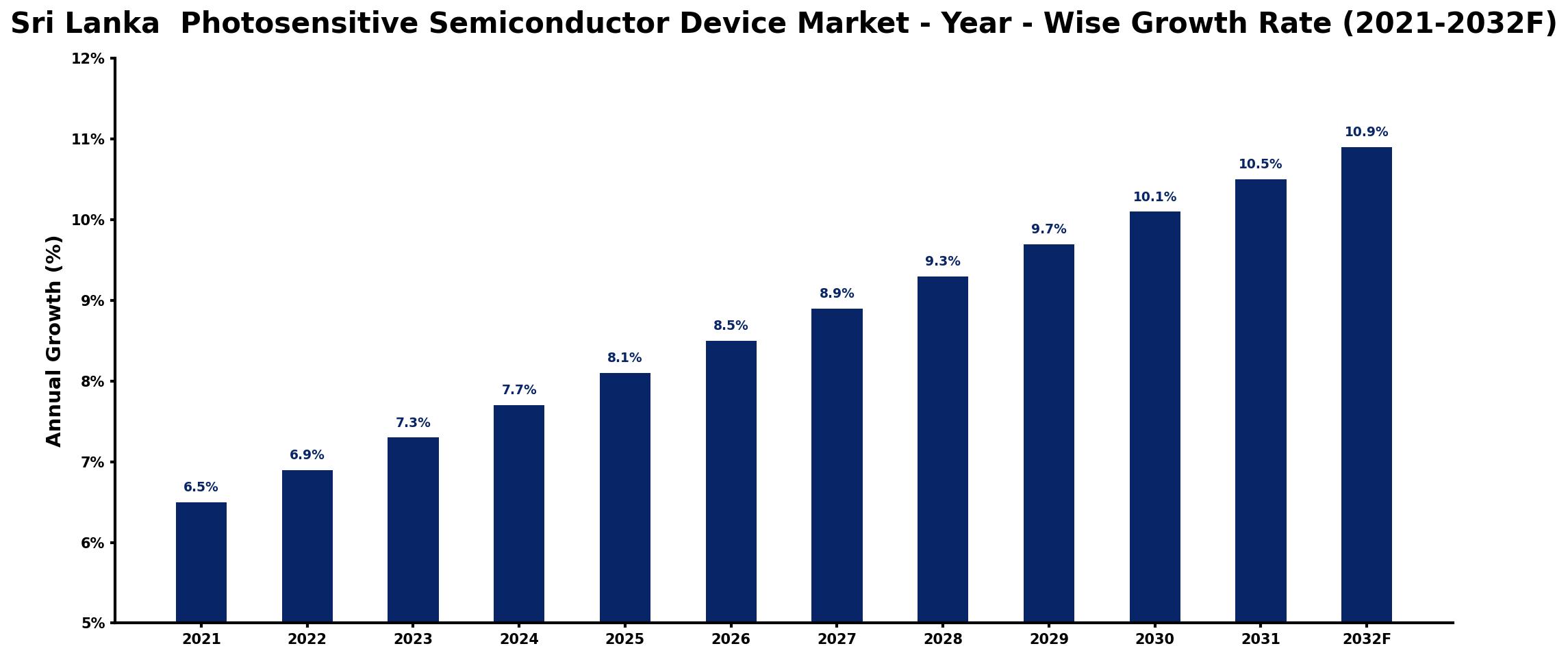
The table below presents the year‑wise growth rates along with the key drivers influencing the market
| Year | Growth Rate | Major Drivers |
| 2021 | 6.5% | Rising demand for renewable energy |
| 2022 | 6.9% | Increased investment in technology |
| 2023 | 7.3% | Growth in automotive electronics sector |
| 2024 | 7.7% | Expansion of smart home applications |
| 2025 | 8.1% | Surge in consumer electronics production |
| 2026 | 8.5% | Development of new industrial applications |
| 2027 | 8.9% | increased pharmaceutical industry usage |
| 2028 | 9.3% | Advancements in healthcare monitoring systems |
| 2029 | 9.7% | Boost in renewable energy projects |
| 2030 | 10.1% | Emergence of sustainable manufacturing practices |
| 2031 | 10.5% | Increased focus on energy efficiency |
| 2032 | 10.9% | Rising adoption of smart grids |
Note: Market size estimations and growth projections presented in this report are based on 6Wresearch's proprietary forecasting methodology, utilizing the latest available industry data, government publications, and primary research inputs.
Sri Lanka Photosensitive Semiconductor Device Market Synopsis
Recently, the Sri Lanka photosensitive semiconductor device market has gained momentum, driven by significant growth in consumer electronics and automotive sectors. Looking ahead, the market is expected to continue expanding as industries increasingly adopt advanced technologies and automation solutions.
This upward trajectory presents an exciting landscape, particularly with innovations in imaging and sensing technologies. However, the market still faces hurdles such as technical complexities and awareness gaps that need to be addressed for sustainable growth.
Sri Lanka Photosensitive Semiconductor Device Market Key Takeaways
- The market is set to grow from USD 710 Million in 2025 to USD 1171 Million by 2032.
- Demand is primarily driven by consumer electronics, automotive, and industrial automation sectors.
- Advanced technologies like IoT and AI are significantly influencing market growth.
- Investment in research and development is essential for enhancing device performance.
- Government initiatives play a crucial role in fostering a competitive environment.
Evaluation of Restraints in Sri Lanka Photosensitive Semiconductor Device Market
Despite the promising outlook, several real constraints are holding back the Sri Lanka photosensitive semiconductor device market. One of the primary challenges is the limited consumer awareness of photosensitive technologies, which restricts adoption rates across various sectors. Additionally, there is a notable shortage of skilled professionals required for research and development, which hampers innovation. Import restrictions and elevated tariffs on semiconductor components further complicate the situation by raising production costs. Moreover, the lack of established infrastructure for semiconductor manufacturing in Sri Lanka limits operational efficiency and scalability for industry players.
Sri Lanka Photosensitive Semiconductor Device Market Trends
Several current and emerging trends are shaping the Sri Lanka photosensitive semiconductor device market. The growing adoption of high-performance sensors for security systems and smart devices is one of the most notable trends. Furthermore, as industries increasingly pivot towards automation and IoT solutions, the demand for innovative photosensitive devices like photodiodes and image sensors is surging. Additionally, the rising interest in renewable energy solutions is prompting a shift towards energy-efficient lighting applications, further boosting the market's prospects. These trends underscore a landscape ripe for innovation and investment.
Sri Lanka Photosensitive Semiconductor Device Market Opportunities
The Sri Lanka photosensitive semiconductor device market is brimming with genuine growth and investment opportunities. The escalating demand for advanced imaging technologies, coupled with the growing shift towards smart devices and autonomous vehicles, presents ample chances for investors. Companies focused on developing cutting-edge sensors, phototransistors, and innovative applications stand to gain significantly in this evolving market. Furthermore, with the government actively promoting technology and innovation, strategic investments in R&D can yield high returns as the market matures.
Government Initiatives in the Sri Lanka Photosensitive Semiconductor Device Market
The Sri Lankan government has taken substantial steps to enhance the photosensitive semiconductor device market through various initiatives. These include implementing regulatory frameworks for imports, setting quality standards, and establishing licensing requirements to ensure product safety and reliability. Furthermore, the government offers incentives such as tax breaks and subsidies to bolster domestic production and innovation within the semiconductor industry. Environmental regulations aimed at managing electronic waste disposal are also in place, demonstrating the governments commitment to sustainable market practices.
Future Insights of the Sri Lanka Photosensitive Semiconductor Device Market
The future outlook for the Sri Lanka photosensitive semiconductor device market appears optimistic, propelled by escalating demand in electronics, automotive applications, and surveillance systems. Innovations in sensor technology are expected to drive growth, particularly with advancements in performance and efficiency. As consumer awareness increases and technology adoption expands, the market is likely to witness enhanced demand for these devices. Government support for the electronics sector further underlines a bright future for manufacturers and investors within the market, positioning it for steady growth through 2032.
Sri Lanka Photosensitive Semiconductor Device Market Latest Developments (2025 - 2026)
In the latest industry developments, companies are increasingly focusing on enhancing their product portfolios through advanced R&D initiatives. Collaboration between industry stakeholders and academic institutions is gaining traction as a means to bridge the skills gap and foster innovation. The governments continuous promotion of technology and digitalization is also catalyzing investment in local manufacturing capabilities. As the market evolves, several initiatives aimed at improving infrastructure for semiconductor manufacturing and testing are being explored, reflecting a proactive approach to address existing challenges.
Sri Lanka Photosensitive Semiconductor Device Market - Key Attractiveness of the Report
- 10 Years of Market Numbers
- Historical Data Starting from 2022 to 2025
- Base Year: 2025
- Forecast Data until 2032
- Key Performance Indicators Impacting the Market
- Major Upcoming Developments and Projects
Key Highlights of the Report:
- Sri Lanka Photosensitive Semiconductor Device Market Outlook
- Market Size of Sri Lanka Photosensitive Semiconductor Device Market, 2025
- Forecast of Sri Lanka Photosensitive Semiconductor Device Market, 2032
- Historical Data and Forecast of Sri Lanka Photosensitive Semiconductor Device Revenues & Volume for the Period 2022-2032F
- Sri Lanka Photosensitive Semiconductor Device Market Trend Evolution
- Sri Lanka Photosensitive Semiconductor Device Market Drivers and Challenges
- Sri Lanka Photosensitive Semiconductor Device Price Trends
- Sri Lanka Photosensitive Semiconductor Device Porter's Five Forces
- Sri Lanka Photosensitive Semiconductor Device Industry Life Cycle
- Historical Data and Forecast of Sri Lanka Photosensitive Semiconductor Device Market Revenues & Volume By Device for the Period 2022-2032F
- Historical Data and Forecast of Sri Lanka Photosensitive Semiconductor Device Market Revenues & Volume By Photocell for the Period 2022-2032F
- Historical Data and Forecast of Sri Lanka Photosensitive Semiconductor Device Market Revenues & Volume By Photodiode for the Period 2022-2032F
- Historical Data and Forecast of Sri Lanka Photosensitive Semiconductor Device Market Revenues & Volume By Phototransistor for the Period 2022-2032F
- Historical Data and Forecast of Sri Lanka Photosensitive Semiconductor Device Market Revenues & Volume By Photoresistor for the Period 2022-2032F
- Historical Data and Forecast of Sri Lanka Photosensitive Semiconductor Device Market Revenues & Volume By Photo IC for the Period 2022-2032F
- Historical Data and Forecast of Sri Lanka Photosensitive Semiconductor Device Market Revenues & Volume By End User for the Period 2022-2032F
- Historical Data and Forecast of Sri Lanka Photosensitive Semiconductor Device Market Revenues & Volume By Automotive and Transportation for the Period 2022-2032F
- Historical Data and Forecast of Sri Lanka Photosensitive Semiconductor Device Market Revenues & Volume By Consumer Electronics for the Period 2022-2032F
- Historical Data and Forecast of Sri Lanka Photosensitive Semiconductor Device Market Revenues & Volume By Aerospace and Defence for the Period 2022-2032F
- Historical Data and Forecast of Sri Lanka Photosensitive Semiconductor Device Market Revenues & Volume By Healthcare for the Period 2022-2032F
- Historical Data and Forecast of Sri Lanka Photosensitive Semiconductor Device Market Revenues & Volume By Industrial for the Period 2022-2032F
- Historical Data and Forecast of Sri Lanka Photosensitive Semiconductor Device Market Revenues & Volume By Security and Survelliance for the Period 2022-2032F
- Sri Lanka Photosensitive Semiconductor Device Import Export Trade Statistics
- Market Opportunity Assessment By Device
- Market Opportunity Assessment By End User
- Sri Lanka Photosensitive Semiconductor Device Top Companies Market Share
- Sri Lanka Photosensitive Semiconductor Device Competitive Benchmarking By Technical and Operational Parameters
- Sri Lanka Photosensitive Semiconductor Device Company Profiles
- Sri Lanka Photosensitive Semiconductor Device Key Strategic Recommendations






































