Sri Lanka Ploughing and Cultivating Machinery Market Size, Share & Growth Rate
The Sri Lanka Ploughing and Cultivating Machinery Market was estimated at USD 1338 Million in 2025 and is projected to reach USD 1974 Million by 2032, growing at a CAGR of 5.7% from 2026 to 2032. This growth trajectory is primarily driven by a significant push towards mechanization in the agricultural sector, as farmers increasingly prioritize efficiency and higher yields. Additionally, government initiatives aimed at enhancing agricultural productivity further bolster the demand for modern ploughing and cultivating machinery.
Sri Lanka Ploughing and Cultivating Machinery Market Year-wise Growth Rate and Key Drivers
This graph highlights how the Sri Lanka Ploughing and Cultivating Machinery Market has steadily grown over the years, supported by major growth factors.
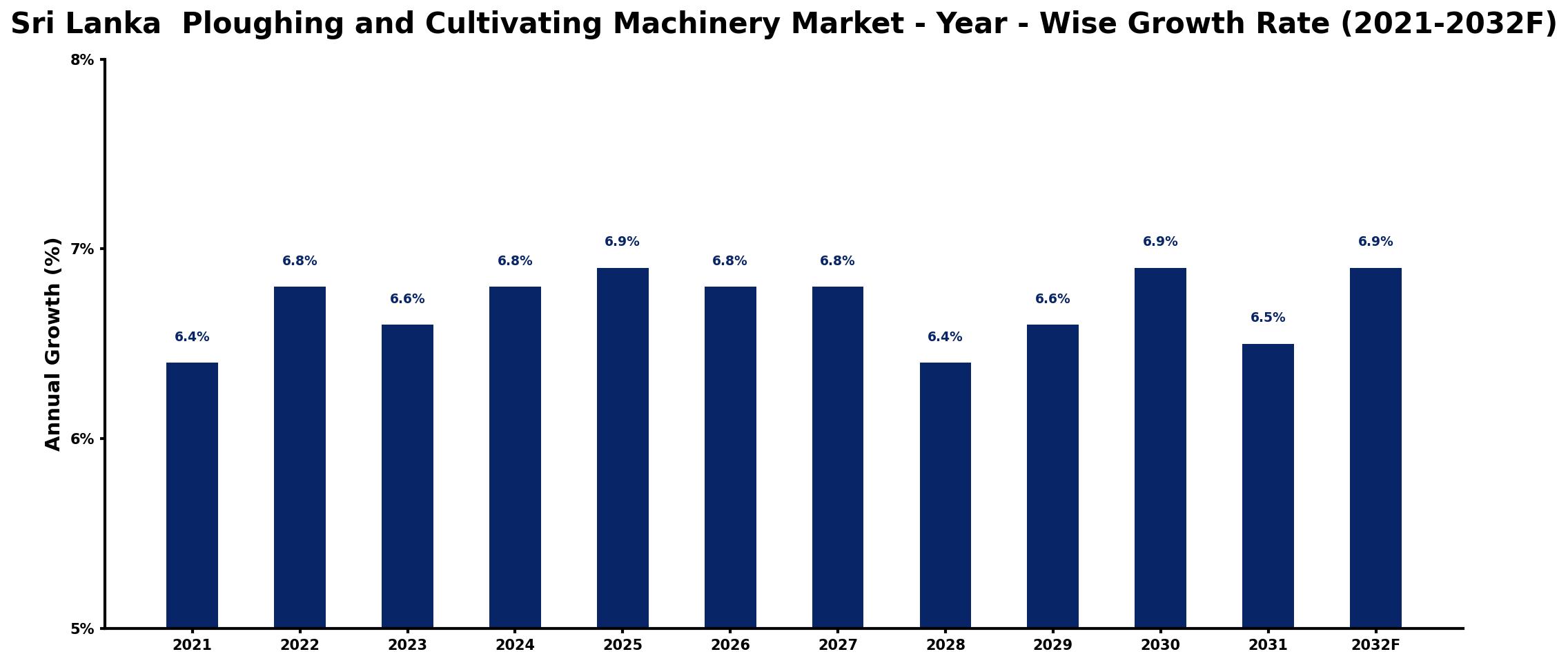
The table below presents the year‑wise growth rates along with the key drivers influencing the market
| Year | Growth Rate | Major Drivers |
| 2021 | 6.4% | Rising agricultural investment levels |
| 2022 | 6.8% | Increased demand for automation |
| 2023 | 6.6% | Expansion of export markets |
| 2024 | 6.8% | Growing focus on sustainability |
| 2025 | 6.9% | Technological advancements in agriculture |
| 2026 | 6.8% | Higher crop yield expectations |
| 2027 | 6.8% | Enhanced farmer education programs |
| 2028 | 6.4% | Government incentives for modernization |
| 2029 | 6.6% | Diversification of agricultural practices |
| 2030 | 6.9% | Strengthened rural infrastructure projects |
| 2031 | 6.5% | Boost in cooperative farming initiatives |
| 2032 | 6.9% | Emerging agro-tech startups growth |
Note: Market size estimations and growth projections presented in this report are based on 6Wresearch's proprietary forecasting methodology, utilizing the latest available industry data, government publications, and primary research inputs.
Sri Lanka Ploughing and Cultivating Machinery Market Synopsis
The strongest force currently shaping the Sri Lanka Ploughing and Cultivating Machinery Market is the growing mechanization trend among local farmers. This shift is a direct response to rising labor costs and an increasing need to enhance productivity in light of the country's agricultural demands.
Furthermore, government efforts to promote mechanized farming have paved the way for more farmers to adopt advanced machinery. These initiatives, combined with a rising population and growing food demand, are propelling the market towards significant expansion.
Sri Lanka Ploughing and Cultivating Machinery Market Key Takeaways
- The market is experiencing steady growth driven by increasing mechanization in agriculture.
- Government initiatives are encouraging the adoption of modern farming equipment.
- There is a notable shift towards environmentally friendly and energy-efficient machinery.
- Compact and versatile machinery is becoming increasingly popular among small-scale farmers.
- Technological advancements, including precision farming, are redefining agricultural practices.
Evaluation of Restraints in Sri Lanka Ploughing and Cultivating Machinery Market
The Sri Lanka Ploughing and Cultivating Machinery Market faces several key constraints that hinder its potential growth. A prevalent lack of awareness among farmers regarding modern agricultural practices inhibits wider adoption of mechanization. Additionally, limited access to financing options for small-scale farmers creates barriers to investment in advanced machinery. Inadequate infrastructure in rural areas further complicates the distribution and servicing of machinery, and the high cost of equipment presents affordability issues. Addressing these obstacles will be crucial for unlocking the market's full potential.
Sri Lanka Ploughing and Cultivating Machinery Market Trends
In recent years, the demand for mechanized equipment in Sri Lanka has surged, reflecting a broader trend toward modern agricultural practices. Farmers are increasingly inclined to adopt advanced ploughing and cultivating machinery to enhance operational efficiency. Noteworthy trends include a growing interest in sustainable and energy-efficient machinery, which aligns with global agricultural practices. Additionally, precision farming technologies are gaining traction, promising optimized outputs and resource utilization for farmers. This evolving landscape is also characterized by a demand for compact and versatile equipment suitable for the needs of small-scale operations.
Sri Lanka Ploughing and Cultivating Machinery Market Opportunities
The Sri Lanka Ploughing and Cultivating Machinery Market presents substantial investment opportunities due to the country's robust agricultural sector. With an increasing emphasis on mechanization and productivity enhancements, there is a rising demand for innovative machinery solutions tailored to local farmers' needs. Investors can capitalize on this trend by introducing advanced technology and forging strategic partnerships with local distributors. Government support through subsidies and incentives for mechanization further enhances the market's appeal, creating a favorable environment for new entrants and existing players alike.
Government Initiatives in the Sri Lanka Ploughing and Cultivating Machinery Market
The Sri Lankan government has put in place various initiatives to bolster the Ploughing and Cultivating Machinery Market. These include import tariffs designed to encourage the purchase of locally manufactured equipment. Additionally, the government provides financial assistance and subsidies to farmers to facilitate the adoption of modern machinery. Regulatory measures are also enforced to maintain quality and safety standards for machinery produced or imported into the country. Overall, these policies aim to enhance agricultural productivity and reduce reliance on manual labor in the farming sector.
Future Insights of the Sri Lanka Ploughing and Cultivating Machinery Market
Looking ahead, the future of the Sri Lanka Ploughing and Cultivating Machinery Market appears promising. The growing emphasis on agricultural modernization, driven by both government initiatives and increasing farmer adoption of advanced techniques, is expected to sustain demand for ploughing and cultivating machinery. Additionally, addressing labor shortages through mechanization will continue to fuel market growth. Advancements in technology, particularly in areas such as IoT and AI, are likely to revolutionize machinery functionality, offering even greater efficiency and productivity. However, challenges related to financing and high initial costs may temper growth rates in certain segments of the market.
Sri Lanka Ploughing and Cultivating Machinery Market Latest Developments (2025 - 2026)
Recent developments in the Sri Lanka Ploughing and Cultivating Machinery Market indicate a strong shift towards sustainable practices and advanced technologies. More manufacturers are focusing on creating environmentally friendly machinery that reduces soil erosion and resource waste. Alongside this, strategic partnerships between technology firms and agricultural machinery manufacturers are becoming more common, fostering innovation and enhancing product offerings in the local market. The trend towards smart farming, integrating IoT and AI technologies, is also beginning to take shape, promising to enhance agricultural efficiency significantly.
Sri Lanka Ploughing and Cultivating Machinery Market - Key Attractiveness of the Report
- 10 Years of Market Numbers
- Historical Data Starting from 2022 to 2025
- Base Year: 2025
- Forecast Data until 2032
- Key Performance Indicators Impacting the Market
- Major Upcoming Developments and Projects
Key Highlights of the Report:
- Sri Lanka Ploughing and Cultivating Machinery Market Outlook
- Market Size of Sri Lanka Ploughing and Cultivating Machinery Market, 2025
- Forecast of Sri Lanka Ploughing and Cultivating Machinery Market, 2032
- Historical Data and Forecast of Sri Lanka Ploughing and Cultivating Machinery Revenues & Volume for the Period 2022-2032F
- Sri Lanka Ploughing and Cultivating Machinery Market Trend Evolution
- Sri Lanka Ploughing and Cultivating Machinery Market Drivers and Challenges
- Sri Lanka Ploughing and Cultivating Machinery Price Trends
- Sri Lanka Ploughing and Cultivating Machinery Porter's Five Forces
- Sri Lanka Ploughing and Cultivating Machinery Industry Life Cycle
- Historical Data and Forecast of Sri Lanka Ploughing and Cultivating Machinery Market Revenues & Volume By Type for the Period 2022-2032F
- Historical Data and Forecast of Sri Lanka Ploughing and Cultivating Machinery Market Revenues & Volume By Ploughs for the Period 2022-2032F
- Historical Data and Forecast of Sri Lanka Ploughing and Cultivating Machinery Market Revenues & Volume By Harrows for the Period 2022-2032F
- Historical Data and Forecast of Sri Lanka Ploughing and Cultivating Machinery Market Revenues & Volume By Others for the Period 2022-2032F
- Historical Data and Forecast of Sri Lanka Ploughing and Cultivating Machinery Market Revenues & Volume By Application for the Period 2022-2032F
- Historical Data and Forecast of Sri Lanka Ploughing and Cultivating Machinery Market Revenues & Volume By Soil Loosening for the Period 2022-2032F
- Historical Data and Forecast of Sri Lanka Ploughing and Cultivating Machinery Market Revenues & Volume By Clod Size Reduction for the Period 2022-2032F
- Historical Data and Forecast of Sri Lanka Ploughing and Cultivating Machinery Market Revenues & Volume By Clod Sorting for the Period 2022-2032F
- Historical Data and Forecast of Sri Lanka Ploughing and Cultivating Machinery Market Revenues & Volume By Others for the Period 2022-2032F
- Sri Lanka Ploughing and Cultivating Machinery Import Export Trade Statistics
- Market Opportunity Assessment By Type
- Market Opportunity Assessment By Application
- Sri Lanka Ploughing and Cultivating Machinery Top Companies Market Share
- Sri Lanka Ploughing and Cultivating Machinery Competitive Benchmarking By Technical and Operational Parameters
- Sri Lanka Ploughing and Cultivating Machinery Company Profiles
- Sri Lanka Ploughing and Cultivating Machinery Key Strategic Recommendations






































