Sri Lanka Plywood Market Size Growth Rate
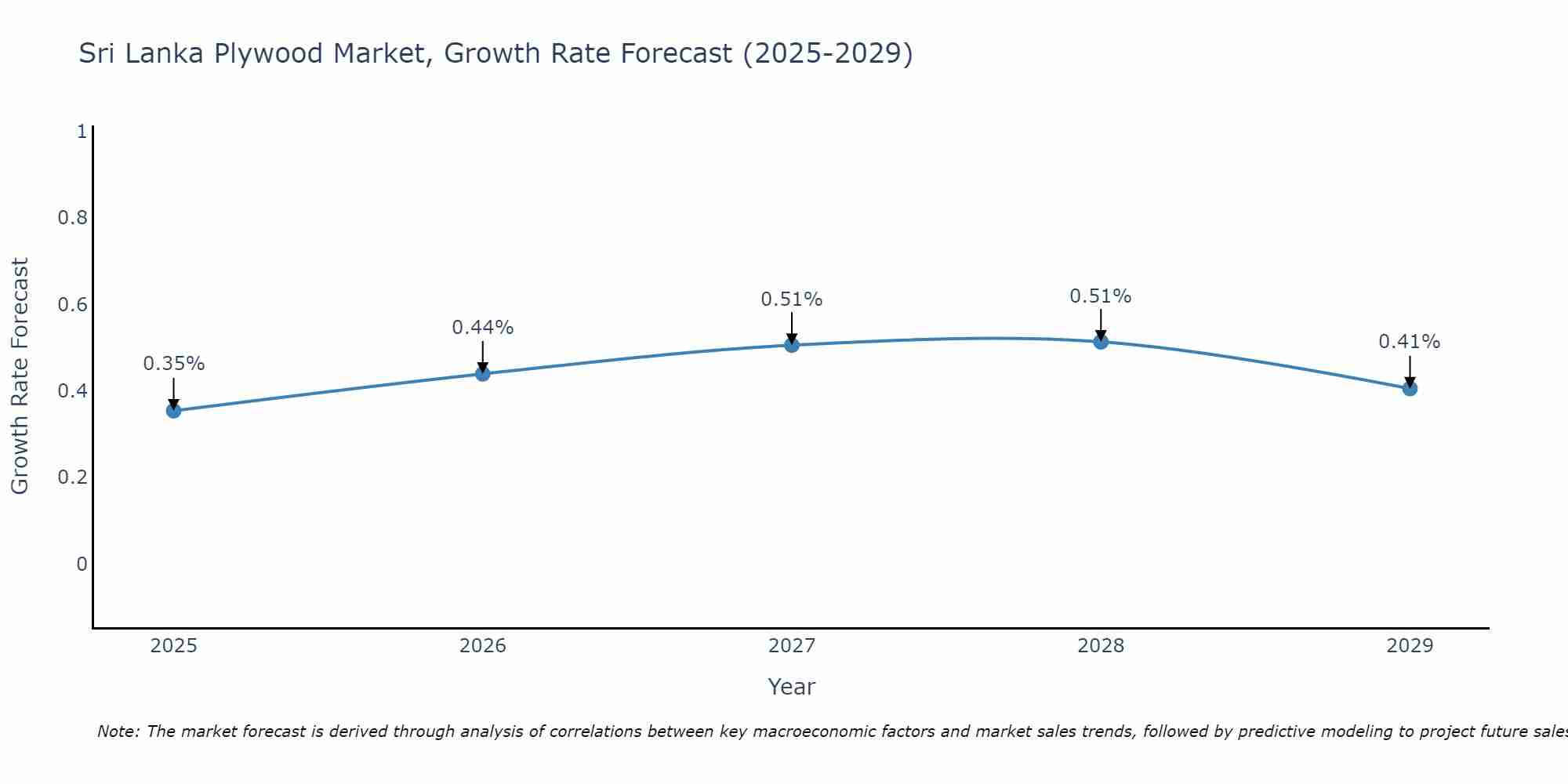
The Sri Lanka Plywood Market is projected to witness mixed growth rate patterns during 2025 to 2029. Starting at 0.35% in 2025, the market peaks at 0.51% in 2028, and settles at 0.41% by 2029.
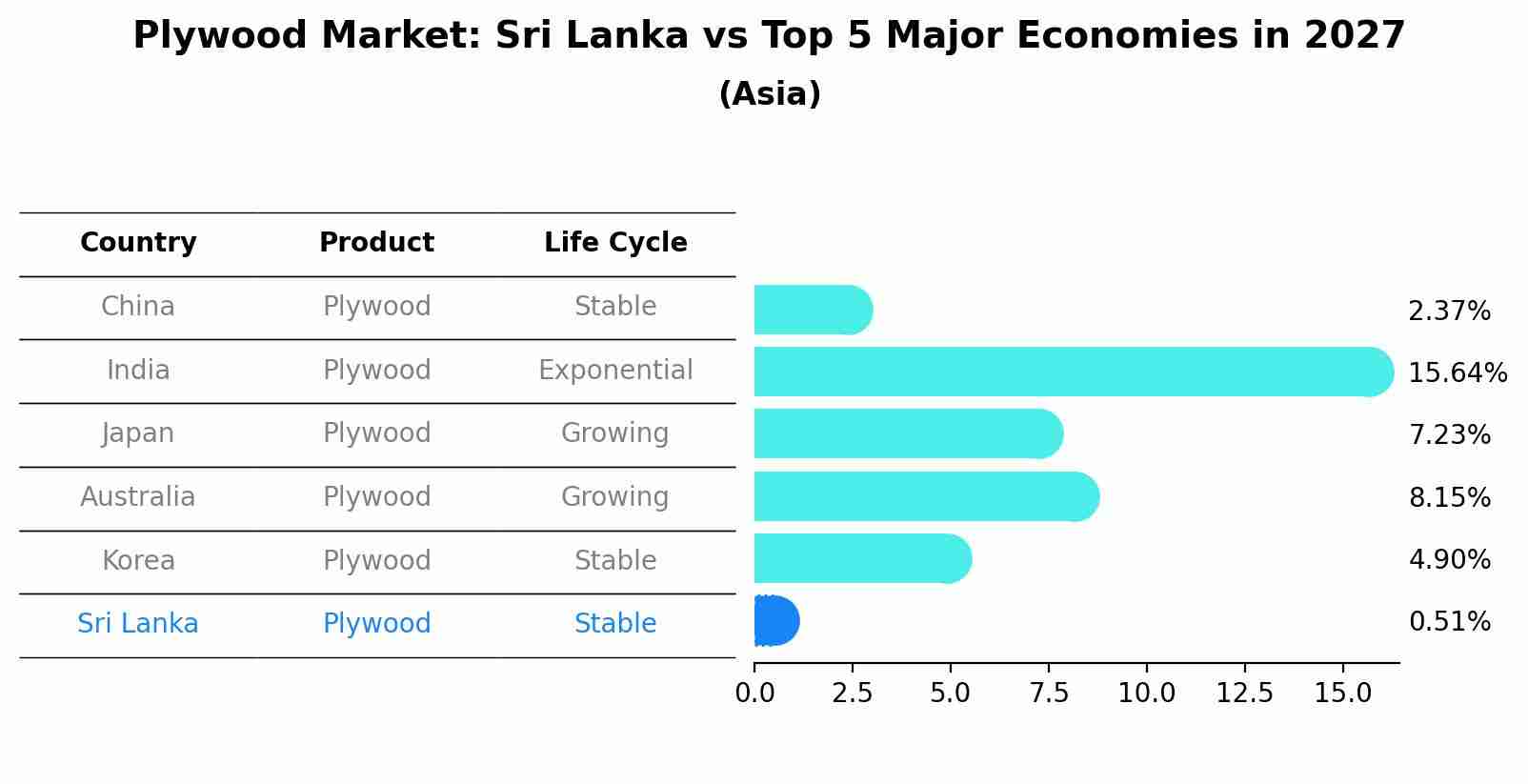
Plywood Market: Sri Lanka vs Top 5 Major Economies in 2027 (Asia)
In the Asia region, the Plywood market in Sri Lanka is projected to expand at a stable growth rate of 0.51% by 2027. The largest economy is China, followed by India, Japan, Australia and South Korea.
Sri Lanka Plywood Market Synopsis
The Sri Lanka plywood market is witnessing steady growth driven by increasing construction activities, furniture manufacturing, and the expanding interior design industry in the country. With a focus on sustainable and eco-friendly materials, there is a rising demand for high-quality plywood products that offer durability and aesthetic appeal. The market is characterized by the presence of both domestic manufacturers and imported plywood brands, providing customers with a wide range of options in terms of price points and quality. Government initiatives to promote affordable housing and infrastructure development projects further contribute to the market`s growth. As the construction sector continues to expand, the Sri Lanka plywood market is expected to see continued demand, particularly for products that meet international standards of quality and sustainability.
Sri Lanka Plywood Market Trends
The Sri Lanka Plywood Market is experiencing several key trends. One significant trend is the growing demand for sustainable and eco-friendly plywood products. Consumers are increasingly looking for plywood that is sourced from responsibly managed forests and manufactured using environmentally friendly processes. Another trend is the rise of innovative plywood products that offer enhanced durability, moisture resistance, and fire-retardant properties, catering to the construction and furniture industries` evolving needs. Additionally, digitalization is playing a crucial role in the market, with online platforms facilitating easier access to a wide range of plywood products and enabling seamless transactions. Overall, the Sri Lanka Plywood Market is witnessing a shift towards sustainability, innovation, and digitalization to meet the changing preferences and requirements of consumers and industries.
Sri Lanka Plywood Market Challenges
In the Sri Lanka Plywood Market, challenges include competition from alternative building materials such as steel and concrete, fluctuating raw material prices, inadequate infrastructure for timber logging and processing, and the impact of environmental regulations on sustainable sourcing of wood. Additionally, the market faces issues with quality control and standardization, as well as limited awareness among consumers about the benefits of plywood compared to other materials. These challenges hinder the growth of the plywood industry in Sri Lanka and require strategic solutions such as investment in technology for efficient production, collaborations with sustainable forestry initiatives, and marketing efforts to educate consumers about the advantages of plywood in construction and furniture manufacturing.
Sri Lanka Plywood Market Investment Opportunities
In the Sri Lanka plywood market, there are several investment opportunities worth considering. With the construction industry experiencing growth due to infrastructure development projects and increasing demand for housing, investing in plywood manufacturing companies or distribution businesses could be lucrative. Additionally, the furniture industry in Sri Lanka is also expanding, creating a demand for high-quality plywood products. Investing in technology and innovation within the plywood sector to enhance production processes and product quality could provide a competitive edge. Furthermore, sustainable and eco-friendly plywood options are gaining popularity globally, presenting an opportunity for investors to focus on environmentally conscious plywood manufacturing practices. Overall, the Sri Lanka plywood market offers diverse investment possibilities for those looking to capitalize on the country`s growing construction and furniture industries.
Sri Lanka Plywood Market Future Outlook
The Sri Lanka plywood market is anticipated to experience steady growth in the coming years due to increasing construction activities, particularly in the residential and commercial sectors. The demand for plywood is expected to rise as the country continues to invest in infrastructure development projects and urbanization efforts. Additionally, the growing trend towards sustainable and eco-friendly construction materials is likely to drive the market further. However, challenges such as fluctuating raw material prices and competition from alternative materials may impact market growth. Overall, with a positive economic outlook and rising construction projects, the Sri Lanka plywood market is poised for expansion in the foreseeable future.
Key Highlights of the Report:
- Sri Lanka Plywood Market Outlook
- Market Size of Sri Lanka Plywood Market, 2021
- Forecast of Sri Lanka Plywood Market, 2031
- Historical Data and Forecast of Sri Lanka Plywood Revenues & Volume for the Period 2018 - 2031
- Sri Lanka Plywood Market Trend Evolution
- Sri Lanka Plywood Market Drivers and Challenges
- Sri Lanka Plywood Price Trends
- Sri Lanka Plywood Porter's Five Forces
- Sri Lanka Plywood Industry Life Cycle
- Historical Data and Forecast of Sri Lanka Plywood Market Revenues & Volume By Size for the Period 2018 - 2031
- Historical Data and Forecast of Sri Lanka Plywood Market Revenues & Volume By 4 x 8 Plywood for the Period 2018 - 2031
- Historical Data and Forecast of Sri Lanka Plywood Market Revenues & Volume By 4 x 6 Plywood for the Period 2018 - 2031
- Historical Data and Forecast of Sri Lanka Plywood Market Revenues & Volume By 4 x 10 Plywood for the Period 2018 - 2031
- Historical Data and Forecast of Sri Lanka Plywood Market Revenues & Volume By 3 x 6 Plywood for the Period 2018 - 2031
- Historical Data and Forecast of Sri Lanka Plywood Market Revenues & Volume By Others for the Period 2018 - 2031
- Historical Data and Forecast of Sri Lanka Plywood Market Revenues & Volume By Thickness for the Period 2018 - 2031
- Historical Data and Forecast of Sri Lanka Plywood Market Revenues & Volume By < 8mm Plywood for the Period 2018 - 2031
- Historical Data and Forecast of Sri Lanka Plywood Market Revenues & Volume By 8mm 18mm Plywood for the Period 2018 - 2031
- Historical Data and Forecast of Sri Lanka Plywood Market Revenues & Volume By > 18mm Plywood for the Period 2018 - 2031
- Historical Data and Forecast of Sri Lanka Plywood Market Revenues & Volume By Grade for the Period 2018 - 2031
- Historical Data and Forecast of Sri Lanka Plywood Market Revenues & Volume By MR Grade Plywood for the Period 2018 - 2031
- Historical Data and Forecast of Sri Lanka Plywood Market Revenues & Volume By BWR Grade Plywood for the Period 2018 - 2031
- Historical Data and Forecast of Sri Lanka Plywood Market Revenues & Volume By Fire Resistant Grade Plywood for the Period 2018 - 2031
- Historical Data and Forecast of Sri Lanka Plywood Market Revenues & Volume By BWP Grade Plywood for the Period 2018 - 2031
- Historical Data and Forecast of Sri Lanka Plywood Market Revenues & Volume By Structural Grade Plywood for the Period 2018 - 2031
- Historical Data and Forecast of Sri Lanka Plywood Market Revenues & Volume By Wood Type for the Period 2018 - 2031
- Historical Data and Forecast of Sri Lanka Plywood Market Revenues & Volume By Softwood for the Period 2018 - 2031
- Historical Data and Forecast of Sri Lanka Plywood Market Revenues & Volume By Hardwood for the Period 2018 - 2031
- Historical Data and Forecast of Sri Lanka Plywood Market Revenues & Volume By Number of Ply for the Period 2018 - 2031
- Historical Data and Forecast of Sri Lanka Plywood Market Revenues & Volume By 3 Ply for the Period 2018 - 2031
- Historical Data and Forecast of Sri Lanka Plywood Market Revenues & Volume By 5 Ply for the Period 2018 - 2031
- Historical Data and Forecast of Sri Lanka Plywood Market Revenues & Volume By 7 ply and More for the Period 2018 - 2031
- Historical Data and Forecast of Sri Lanka Plywood Market Revenues & Volume By Sales Channel for the Period 2018 - 2031
- Historical Data and Forecast of Sri Lanka Plywood Market Revenues & Volume By Direct Sales for the Period 2018 - 2031
- Historical Data and Forecast of Sri Lanka Plywood Market Revenues & Volume By Distributors/Retailers for the Period 2018 - 2031
- Historical Data and Forecast of Sri Lanka Plywood Market Revenues & Volume By Application for the Period 2018 - 2031
- Historical Data and Forecast of Sri Lanka Plywood Market Revenues & Volume By Plywood for Furniture for the Period 2018 - 2031
- Historical Data and Forecast of Sri Lanka Plywood Market Revenues & Volume By Plywood for Flooring & Construction for the Period 2018 - 2031
- Historical Data and Forecast of Sri Lanka Plywood Market Revenues & Volume By Plywood for Automotive Interiors for the Period 2018 - 2031
- Historical Data and Forecast of Sri Lanka Plywood Market Revenues & Volume By Plywood for Packaging for the Period 2018 - 2031
- Historical Data and Forecast of Sri Lanka Plywood Market Revenues & Volume By Plywood for Marine Use for the Period 2018 - 2031
- Historical Data and Forecast of Sri Lanka Plywood Market Revenues & Volume By Others for the Period 2018 - 2031
- Sri Lanka Plywood Import Export Trade Statistics
- Market Opportunity Assessment By Size
- Market Opportunity Assessment By Thickness
- Market Opportunity Assessment By Grade
- Market Opportunity Assessment By Wood Type
- Market Opportunity Assessment By Number of Ply
- Market Opportunity Assessment By Sales Channel
- Market Opportunity Assessment By Application
- Sri Lanka Plywood Top Companies Market Share
- Sri Lanka Plywood Competitive Benchmarking By Technical and Operational Parameters
- Sri Lanka Plywood Company Profiles
- Sri Lanka Plywood Key Strategic Recommendations






































