Sri Lanka Polio Vaccine Market Size, Share & Growth Rate
The Sri Lanka Polio Vaccine Market was estimated at USD 274 Million in 2025 and is projected to reach USD 386 Million by 2032, growing at a CAGR of 5.0% from 2026 to 2032. This growth trajectory is underpinned by robust national immunization efforts aimed at sustaining polio-free status and curtailing the potential resurgence of poliovirus. The strategic collaboration among public health agencies, vaccine manufacturers, and international organizations further bolsters the market by enhancing vaccine accessibility and public awareness.
Sri Lanka Polio Vaccine Market Year-wise Growth Rate and Key Drivers
This graph highlights how the Sri Lanka Polio Vaccine Market has steadily grown over the years, supported by major growth factors.
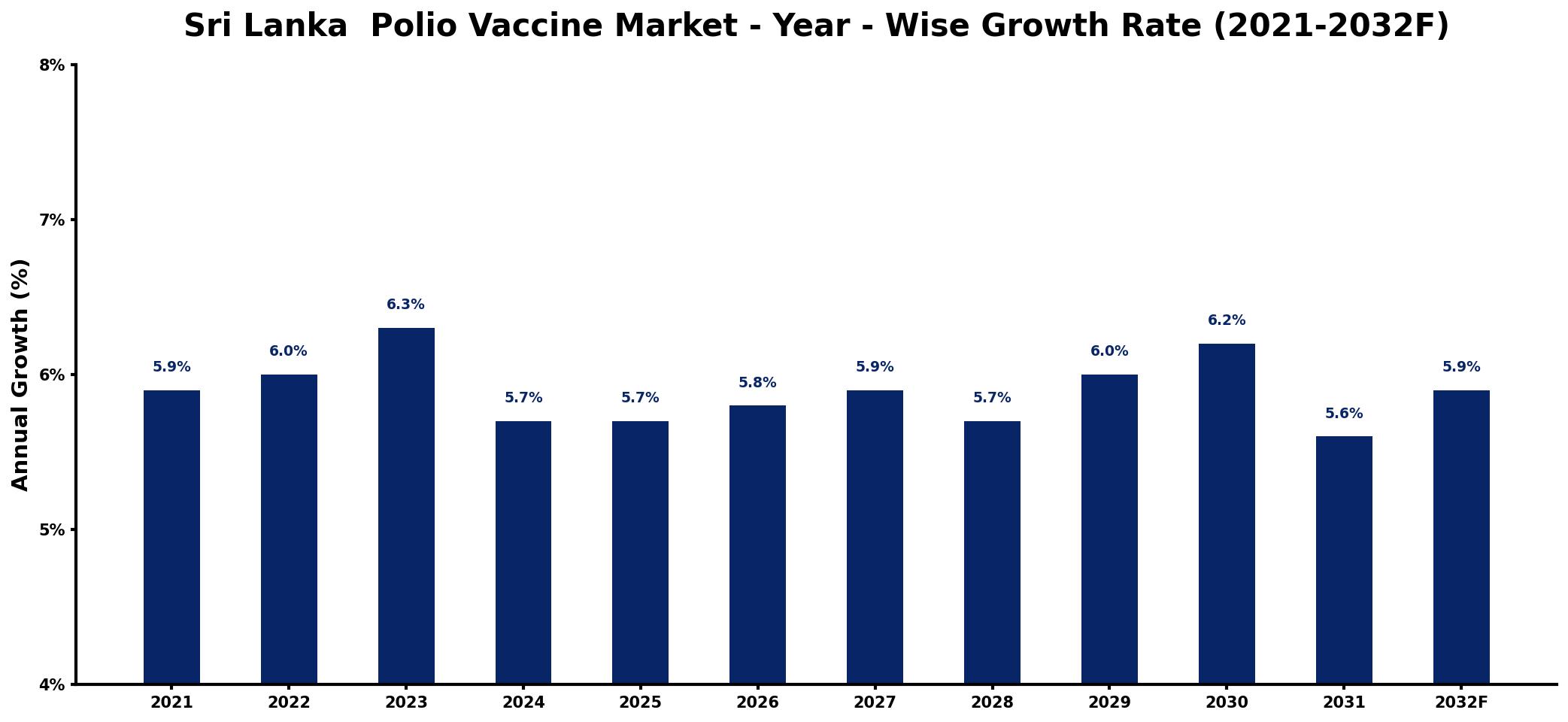
The table below presents the year‑wise growth rates along with the key drivers influencing the market
| Year | Growth Rate | Major Drivers |
| 2021 | 5.9% | Increased public health awareness |
| 2022 | 6.0% | Government investment in healthcare |
| 2023 | 6.3% | Rising demand for immunization programs |
| 2024 | 5.7% | Expansion of healthcare infrastructure |
| 2025 | 5.7% | Growth in healthcare funding initiatives |
| 2026 | 5.8% | Enhanced disease prevention campaigns |
| 2027 | 5.9% | Collaboration with international organizations |
| 2028 | 5.7% | Strengthening of healthcare policies |
| 2029 | 6.0% | improved processing technologies adoption |
| 2030 | 6.2% | expanding manufacturing base activity |
| 2031 | 5.6% | Advancements in healthcare technology |
| 2032 | 5.9% | Growing emphasis on community health |
Note: Market size estimations and growth projections presented in this report are based on 6Wresearch's proprietary forecasting methodology, utilizing the latest available industry data, government publications, and primary research inputs.
Sri Lanka Polio Vaccine Market Synopsis
Recently, Sri Lanka has made commendable strides in its polio vaccination initiatives, achieving significant coverage rates. However, as the landscape of public health evolves, the market must adapt to face emerging challenges, particularly those stemming from supply chain vulnerabilities and public perception issues regarding vaccination.
While the nation celebrates its success in maintaining polio-free status, the need for continual immunization and public education campaigns is crucial. A focus on improving logistical frameworks and vaccine formulation advancements will play a pivotal role in ensuring that Sri Lanka not only retains its achievements but also expands its reach in underserved regions.
Sri Lanka Polio Vaccine Market Key Takeaways
- The market is projected to witness steady growth due to ongoing immunization campaigns and global health initiatives.
- Collaborative efforts among healthcare agencies and vaccine manufacturers are essential to sustain vaccination coverage.
- Public awareness campaigns are vital for increasing vaccine acceptance and understanding of polio's risks.
- Investment in cold chain logistics and storage solutions is critical for effective vaccine distribution.
- Challenges in local manufacturing capacity and reliance on imports continue to impact the market dynamics.
Evaluation of Restraints in Sri Lanka Polio Vaccine Market
Several key restraints are hampering the growth of the polio vaccine market in Sri Lanka. The high costs associated with the production and distribution of vaccines represent a significant barrier, particularly due to the limited local manufacturing capabilities. This reliance on imported vaccines creates vulnerabilities subject to international trade policies and price volatility. Moreover, compliance with rigorous regulatory standards poses challenges for both manufacturers and distributors, further complicating market dynamics. A lack of comprehensive public understanding regarding the benefits of vaccination also dampens demand, necessitating targeted educational initiatives to foster greater community engagement.
Sri Lanka Polio Vaccine Market Trends
Current trends in the Sri Lanka polio vaccine market are characterized by advancements in vaccine formulations, including improved efficacy and safety profiles. Innovations in delivery mechanisms and storage solutions are enhancing the logistical frameworks needed for effective vaccination campaigns. Furthermore, a growing emphasis on public health education is emerging, aimed at increasing awareness of polios risks and the importance of maintaining high vaccination coverage. Digital technology integration into public health strategies is also gaining traction, facilitating better data collection and outreach efforts.
Sri Lanka Polio Vaccine Market Opportunities
The Sri Lanka polio vaccine market presents several promising opportunities for growth and investment. First and foremost, enhancing local manufacturing capabilities could decrease reliance on imports and stabilize supply chains. Additionally, there exists potential for partnerships with international organizations focused on vaccine development, enabling innovative solutions tailored to local needs. The expansion of educational campaigns addressing vaccine misinformation can foster greater community trust and engagement. Furthermore, investment in cold chain logistics will facilitate more efficient distribution of vaccines, particularly in remote regions.
Government Initiatives in the Sri Lanka Polio Vaccine Market
The government of Sri Lanka has shown a strong commitment to polio eradication through various public health initiatives. Policies enacted include financial incentives for the production and distribution of vaccines, ensuring robust immunization campaigns are rolled out across the country. Support for research and development in vaccine innovation remains a priority, alongside adherence to strict regulatory compliance with health and safety standards. These initiatives aim to boost vaccination coverage and maintain the nations polio-free status.
Future Insights of the Sri Lanka Polio Vaccine Market
Looking ahead to 2026-2032, the Sri Lanka polio vaccine market is poised for significant advancements. As the country continues to prioritize immunization and public health education, we can expect further enhancements in vaccine accessibility and community engagement. Additionally, technological advancements in vaccine delivery and distribution will play a crucial role in shaping market dynamics. Continuous collaboration among stakeholders will be essential to address emerging challenges and sustain the polio-free status that Sri Lanka has diligently achieved.
Sri Lanka Polio Vaccine Market Latest Developments (2025 - 2026)
In the recent period, the Sri Lanka polio vaccine market has seen several important developments. Public health campaigns have been ramped up to enhance community awareness surrounding vaccination. Collaboration between local health authorities and international organizations has led to the introduction of new logistic solutions aimed at strengthening vaccine distribution. Additionally, the emphasis on research and local manufacturing capabilities is gaining momentum, with ongoing discussions surrounding partnerships that could bolster domestic production efforts.
Sri Lanka Polio Vaccine Market - Key Attractiveness of the Report
- 10 Years of Market Numbers
- Historical Data Starting from 2022 to 2025
- Base Year: 2025
- Forecast Data until 2032
- Key Performance Indicators Impacting the Market
- Major Upcoming Developments and Projects
Key Highlights of the Report:
- Sri Lanka Polio Vaccine Market Outlook
- Market Size of Sri Lanka Polio Vaccine Market, 2025
- Forecast of Sri Lanka Polio Vaccine Market, 2032
- Historical Data and Forecast of Sri Lanka Polio Vaccine Revenues & Volume for the Period 2022-2032F
- Sri Lanka Polio Vaccine Market Trend Evolution
- Sri Lanka Polio Vaccine Market Drivers and Challenges
- Sri Lanka Polio Vaccine Price Trends
- Sri Lanka Polio Vaccine Porter's Five Forces
- Sri Lanka Polio Vaccine Industry Life Cycle
- Historical Data and Forecast of Sri Lanka Polio Vaccine Market Revenues & Volume By Type for the Period 2022-2032F
- Historical Data and Forecast of Sri Lanka Polio Vaccine Market Revenues & Volume By Oral Polio Vaccine (OPV) for the Period 2022-2032F
- Historical Data and Forecast of Sri Lanka Polio Vaccine Market Revenues & Volume By Inactivated Poliomyelitis Vaccine (IPV) for the Period 2022-2032F
- Historical Data and Forecast of Sri Lanka Polio Vaccine Market Revenues & Volume By Application for the Period 2022-2032F
- Historical Data and Forecast of Sri Lanka Polio Vaccine Market Revenues & Volume By Public for the Period 2022-2032F
- Historical Data and Forecast of Sri Lanka Polio Vaccine Market Revenues & Volume By Private for the Period 2022-2032F
- Sri Lanka Polio Vaccine Import Export Trade Statistics
- Market Opportunity Assessment By Type
- Market Opportunity Assessment By Application
- Sri Lanka Polio Vaccine Top Companies Market Share
- Sri Lanka Polio Vaccine Competitive Benchmarking By Technical and Operational Parameters
- Sri Lanka Polio Vaccine Company Profiles
- Sri Lanka Polio Vaccine Key Strategic Recommendations






































