Sri Lanka Potassium chlorate Market Size, Share & Growth Rate
The Sri Lanka Potassium chlorate Market was estimated at USD 458 Million in 2025 and is projected to reach USD 614 Million by 2032, growing at a CAGR of 4.3% from 2026 to 2032. This upward trajectory is largely driven by increasing applications of potassium chlorate as an oxidizing agent, particularly within the fireworks and agricultural sectors. The growing demand for fireworks in cultural celebrations and the rising use of potassium chlorate as a herbicide present robust opportunities for market expansion.
Sri Lanka Potassium chlorate Market Year-wise Growth Rate and Key Drivers
This graph highlights how the Sri Lanka Potassium chlorate Market has steadily grown over the years, supported by major growth factors.
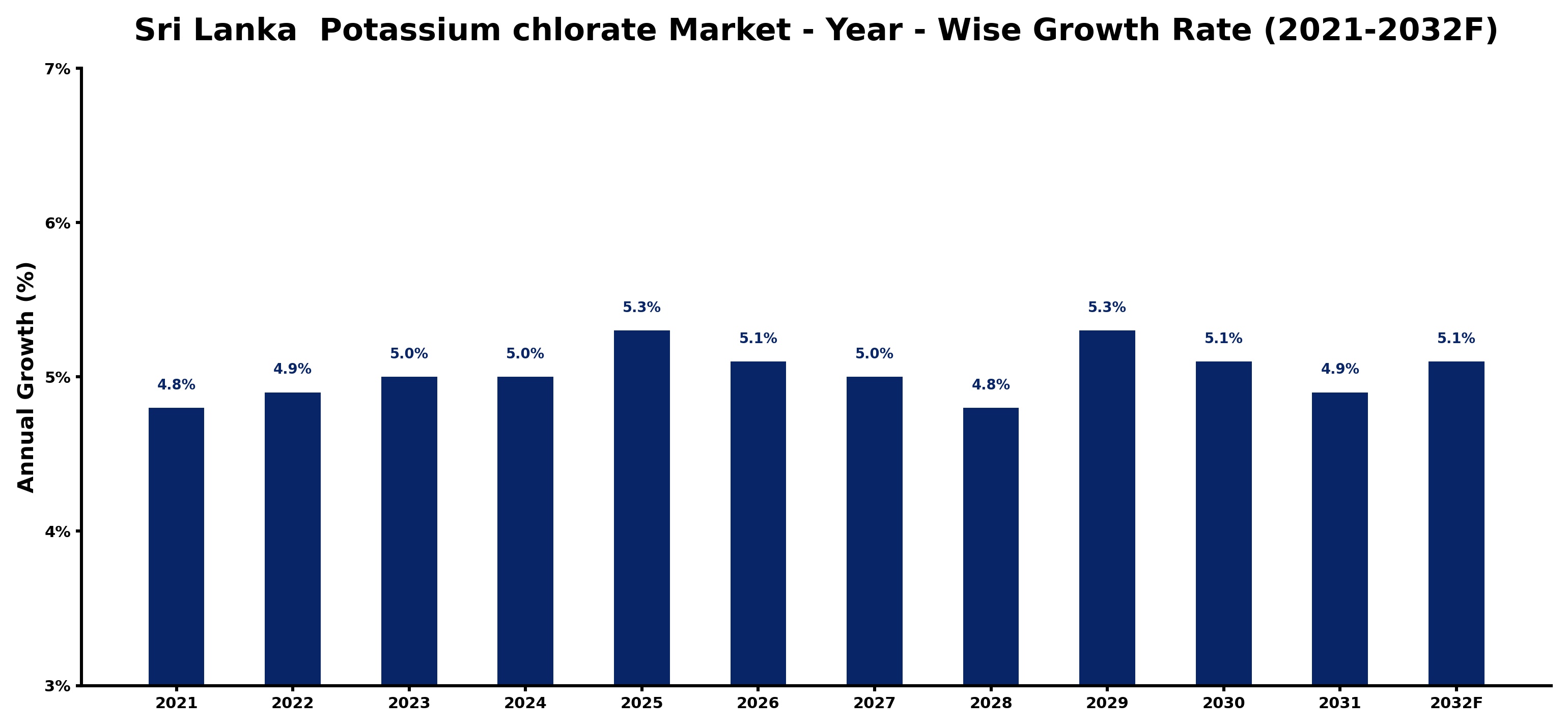
The table below presents the year‑wise growth rates along with the key drivers influencing the market
| Year | Growth Rate | Major Drivers |
| 2021 | 4.8% | New fertilizer plants boost potassium chlorate production capacity significantly |
| 2022 | 4.9% | Technological upgrades in chemical processes boost potassium chlorate yield |
| 2023 | 5.0% | Local textile manufacturers boost potassium chlorate demand for dyeing processes |
| 2024 | 5.0% | Increased fertilizer production demand drives potassium chlorate manufacturing capacity |
| 2025 | 5.3% | Local chemical plants boost potassium chlorate production capabilities significantly |
| 2026 | 5.1% | Higher export orders prompted potassium chlorate production capacity boosts |
| 2027 | 5.0% | Improved plant efficiency boosted potassium chlorate production capacity |
| 2028 | 4.8% | Domestic chemical plants upgrade processes to boost potassium chlorate production |
| 2029 | 5.3% | New facilities boost local potassium chlorate production capacity significantly |
| 2030 | 5.1% | Innovative chemical processing technologies boost potassium chlorate production efficiency |
| 2031 | 4.9% | Improved export opportunities bolstered domestic potassium chlorate production capacity |
| 2032 | 5.1% | Improved manufacturing capabilities boosted potassium chlorate export opportunities |
Note - Market size estimations and growth projections presented in this report are based on 6Wresearch's advanced forecasting approach, validated with industry datasets as of June 2026.
Sri Lanka Potassium chlorate Market Synopsis
The Sri Lanka Potassium chlorate market is currently experiencing steady momentum, fueled by a resurgence in demand from key sectors. However, the landscape is evolving as regulatory frameworks tighten, introducing complexities that could affect future growth. This dynamic creates both challenges and opportunities for stakeholders in the market.
As industries adapt to stricter guidelines, there's potential for innovation in production processes and application methods. Manufacturers who embrace these changes can position themselves advantageously as the market continues to evolve. Thus, while the market is poised for growth, navigating these new terrains will be crucial for sustained success.
Sri Lanka Potassium chlorate Market Key Takeaways
- Steady growth driven by diverse applications across fireworks and agriculture sectors.
- Government regulations present both challenges and opportunities for market stakeholders.
- Innovative production methods are emerging to meet safety and quality standards.
- Investment potential exists in herbicide applications as agricultural demands rise.
- Market dynamics are shaped by both local manufacturing and international supply influences.
Evaluation of Restraints in Sri Lanka Potassium chlorate Market
The Sri Lanka Potassium chlorate market faces several significant restraints that hinder its potential growth. Among these, stringent government regulations are a primary concern, as the handling and transportation of potassium chlorate are closely monitored due to the chemical's hazardous nature. These regulations, while essential for public safety, can complicate production processes and limit operational flexibility.
Additionally, competition from alternative compounds poses a challenge, forcing potassium chlorate manufacturers to defend market share amidst price fluctuations. Limited awareness among end-users about the benefits of potassium chlorate further impacts overall demand, indicating a need for targeted educational initiatives to highlight its applications and advantages.
Sri Lanka Potassium chlorate Market Trends
Recent trends indicate a consistent rise in the demand for potassium chlorate, particularly in the pyrotechnics and agricultural sectors. The cultural significance of fireworks during festivals is driving production growth, while agricultural practices increasingly incorporate potassium chlorate as an effective herbicide. Furthermore, manufacturers are prioritizing the development of safer production techniques and enhanced product quality in response to regulatory requirements.
Technological advancements are also influencing the market, with innovations aimed at improving the efficiency and safety of potassium chlorate manufacturing processes. This reflects a broader trend of sustainability and compliance within the industry, as stakeholders recognize the importance of adhering to environmental standards and community expectations.
Sri Lanka Potassium chlorate Market Opportunities
Investment opportunities in the Sri Lanka Potassium chlorate market are particularly pronounced in the agricultural and fireworks sectors. As the agricultural landscape evolves, the demand for potassium chlorate as a key ingredient in herbicides is expected to grow, creating avenues for innovative product development and distribution strategies. Moreover, the fireworks industry continues to thrive, presenting a reliable market for potassium chlorate as a critical component in pyrotechnics.
Investors looking to enter this market should conduct thorough assessments of regulatory frameworks and sustainability practices. By aligning business strategies with environmental standards, companies can capitalize on the growing demand while fostering responsible production methodologies.
Government Initiatives in the Sri Lanka Potassium chlorate Market
Government policies surrounding the Sri Lanka Potassium chlorate market focus on establishing stringent safety regulations for production and distribution. The Ministry of Industry and Commerce plays a vital role in monitoring compliance among manufacturers, ensuring adherence to safety standards. Additionally, the Department of Explosives oversees the secure storage and transportation of potassium chlorate, mitigating risks associated with its use.
Such regulatory frameworks aim not only to safeguard public welfare but also to promote responsible business practices within the market. By fostering transparency and compliance, these initiatives contribute to a more stable environment for investment and innovation.
Future Insights of the Sri Lanka Potassium chlorate Market
Looking ahead to 2026-2032, the Sri Lanka Potassium chlorate market is set to experience further growth, driven by the expansion of agricultural practices and the fireworks industry. The increasing utilization of potassium chlorate as a herbicide will likely be complemented by rising consumer demand for celebratory fireworks, particularly during cultural events. However, as regulations continue to evolve, companies will need to adapt strategically to meet compliance standards while maximizing production capabilities.
Sustainability will also play a pivotal role in shaping future developments within the market. As environmental concerns grow, companies committed to eco-friendly practices will find themselves better positioned to capture emerging opportunities. Thus, the Sri Lanka Potassium chlorate market appears well-positioned for a positive trajectory in the coming years, assuming proactive engagement with regulatory and sustainability challenges.
Sri Lanka Potassium chlorate Market Latest Developments (May 2025 - June 2026)
In the past year, the Sri Lanka Potassium chlorate market has seen significant activity geared towards enhancing safety protocols in manufacturing and distribution. Companies are investing in training programs for staff to ensure compliance with the latest regulations, while research initiatives focus on improving product quality and safety features. Additionally, there's been a noticeable uptick in collaborations between local manufacturers and international suppliers aimed at streamlining the supply chain and fostering technological advancements.
Sri Lanka Potassium chlorate Market - Key Attractiveness of the Report
- 10 Years of Market Numbers
- Historical Data Starting from 2022 to 2025
- Base Year: 2025
- Forecast Data until 2032
- Key Performance Indicators Impacting the Market
- Major Upcoming Developments and Projects
Key Highlights of the Report:
- Sri Lanka Potassium chlorate Market Outlook
- Market Size of Sri Lanka Potassium chlorate Market, 2025
- Forecast of Sri Lanka Potassium chlorate Market, 2032
- Historical Data and Forecast of Sri Lanka Potassium chlorate Revenues & Volume for the Period 2022-2032F
- Sri Lanka Potassium chlorate Market Trend Evolution
- Sri Lanka Potassium chlorate Market Drivers and Challenges
- Sri Lanka Potassium chlorate Price Trends
- Sri Lanka Potassium chlorate Porter's Five Forces
- Sri Lanka Potassium chlorate Industry Life Cycle
- Historical Data and Forecast of Sri Lanka Potassium chlorate Market Revenues & Volume By Product type for the Period 2022-2032F
- Historical Data and Forecast of Sri Lanka Potassium chlorate Market Revenues & Volume By Pharmaceutical Grade for the Period 2022-2032F
- Historical Data and Forecast of Sri Lanka Potassium chlorate Market Revenues & Volume By Chemical Grade for the Period 2022-2032F
- Historical Data and Forecast of Sri Lanka Potassium chlorate Market Revenues & Volume By End-use for the Period 2022-2032F
- Historical Data and Forecast of Sri Lanka Potassium chlorate Market Revenues & Volume By Explosives for the Period 2022-2032F
- Historical Data and Forecast of Sri Lanka Potassium chlorate Market Revenues & Volume By Matches for the Period 2022-2032F
- Historical Data and Forecast of Sri Lanka Potassium chlorate Market Revenues & Volume By Disinfectants for the Period 2022-2032F
- Historical Data and Forecast of Sri Lanka Potassium chlorate Market Revenues & Volume By Bleaches for the Period 2022-2032F
- Historical Data and Forecast of Sri Lanka Potassium chlorate Market Revenues & Volume By Medical for the Period 2022-2032F
- Sri Lanka Potassium chlorate Import Export Trade Statistics
- Market Opportunity Assessment By Product type
- Market Opportunity Assessment By End-use
- Sri Lanka Potassium chlorate Top Companies Market Share
- Sri Lanka Potassium chlorate Competitive Benchmarking By Technical and Operational Parameters
- Sri Lanka Potassium chlorate Company Profiles
- Sri Lanka Potassium chlorate Key Strategic Recommendations






































