Sri Lanka Prepaid Cards Market Size, Share & Growth Rate
The Sri Lanka Prepaid Cards Market was estimated at USD 1092 Million in 2025 and is projected to reach USD 1913 Million by 2032, growing at a CAGR of 8.3% from 2026 to 2032. This robust growth trajectory is primarily fueled by the country's increasing shift towards cashless transactions, a significant driver in a market traditionally reliant on cash. Alongside this, government initiatives aimed at promoting financial inclusion and a surge in e-commerce adoption are further propelling demand for prepaid card solutions.
Sri Lanka Prepaid Cards Market Year-wise Growth Rate and Key Drivers
This graph highlights how the Sri Lanka Prepaid Cards Market has steadily grown over the years, supported by major growth factors.
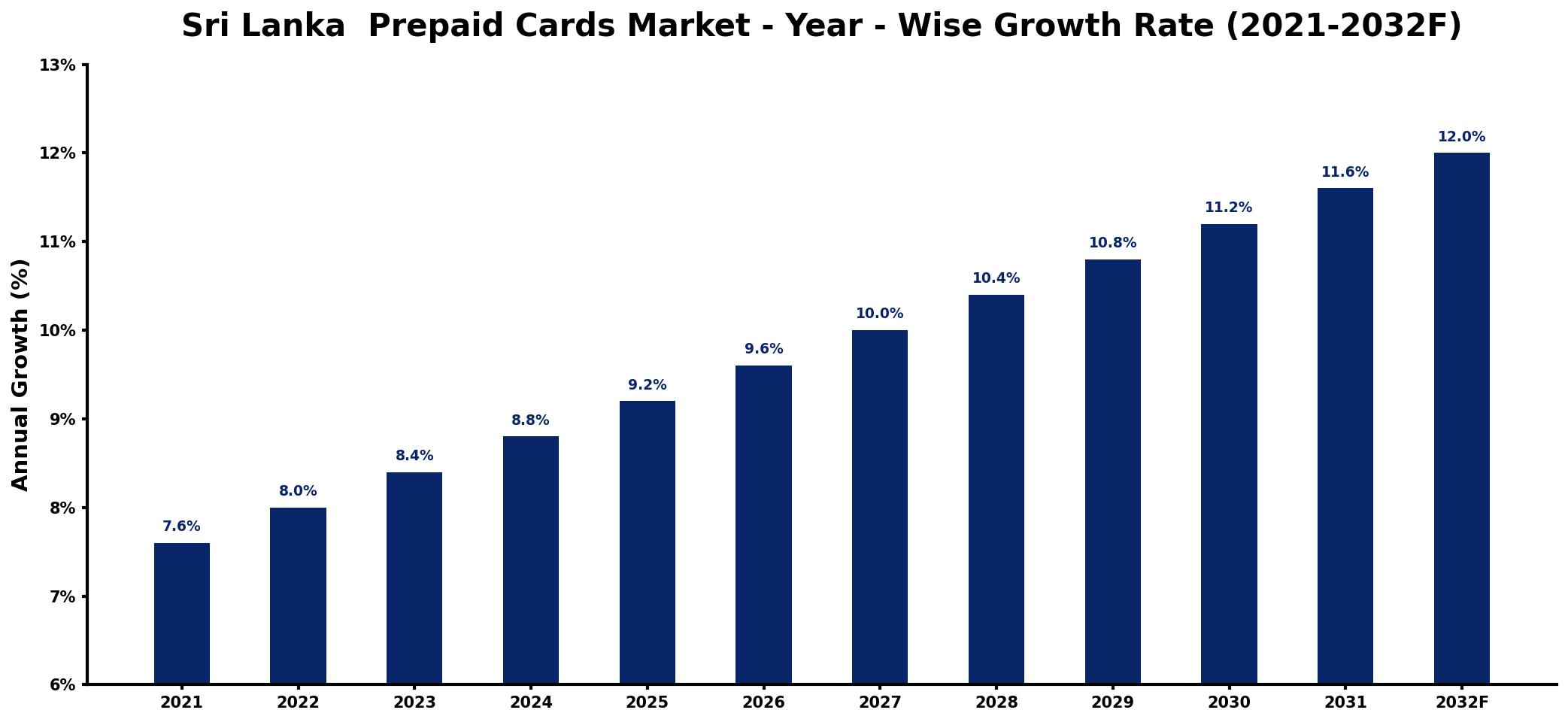
The table below presents the year‑wise growth rates along with the key drivers influencing the market
| Year | Growth Rate | Major Drivers |
| 2021 | 7.6% | Rise in digital payment adoption |
| 2022 | 8.0% | Increased consumer spending trends |
| 2023 | 8.4% | Growing e-commerce market expansion |
| 2024 | 8.8% | Enhanced mobile wallet integration |
| 2025 | 9.2% | Shift towards cashless transactions |
| 2026 | 9.6% | Rising financial inclusion initiatives |
| 2027 | 10.0% | Expansion of fintech innovations |
| 2028 | 10.4% | Increase in cross-border transactions |
| 2029 | 10.8% | Growth in online service subscriptions |
| 2030 | 11.2% | Surge in loyalty program participation |
| 2031 | 11.6% | Development of new financial technologies |
| 2032 | 12.0% | Boost in youth market engagement |
Note: Market size estimations and growth projections presented in this report are based on 6Wresearch's proprietary forecasting methodology, utilizing the latest available industry data, government publications, and primary research inputs.
Sri Lanka Prepaid Cards Market Synopsis
In recent years, the Sri Lanka prepaid cards market has gained momentum, showcasing a rising acceptance of cashless payments among consumers. However, as the market matures, it is expected to evolve significantly with the integration of advanced technologies and customer-centric offerings. This evolution will likely position the prepaid card sector as a critical facilitator of financial inclusion and digital engagement.
As the market looks ahead, the landscape is expected to shift towards greater collaboration among fintech companies, banks, and retailers. This synergy will enhance cardholder benefits, streamline payment experiences, and expand the acceptance of prepaid cards in various retail and online platforms, ensuring robust growth in the coming years.
Sri Lanka Prepaid Cards Market Key Takeaways
- The prepaid cards market in Sri Lanka is driven by the increasing digital payments landscape.
- Government efforts to promote financial inclusion are expanding the user base for prepaid cards.
- Integration with mobile wallets and virtual card offerings are on the rise.
- Consumer awareness and education will be crucial for increasing acceptance and usage.
- Collaborations among industry stakeholders are enhancing the overall customer experience.
Evaluation of Restraints in Sri Lanka Prepaid Cards Market
Despite the promising growth outlook for prepaid cards in Sri Lanka, the market faces several restraints that could hinder its full potential. High operational costs associated with imported technologies create financial burdens for providers and affect pricing strategies. Furthermore, limited acceptance at merchant locations constrains usability, diminishing the appeal of prepaid cards among consumers. Moreover, consumer awareness levels about the advantages of prepaid solutions remain low, necessitating substantial investments in education and marketing. The competitive landscape, which includes various alternative payment methods, further complicates growth as continuous innovation becomes paramount to maintain relevance and consumer trust.
Sri Lanka Prepaid Cards Market Trends
Current trends in the Sri Lanka prepaid cards market highlight a significant shift towards digital solutions. The integration of prepaid cards with mobile wallets is becoming increasingly common, enabling seamless transactions for tech-savvy consumers. Additionally, there is a growing popularity of virtual prepaid cards for online shopping, catering to the rising number of online consumers. As partnerships between card issuers and retailers expand, there is also an emphasis on enhancing cardholder benefits through rewards and loyalty programs, aligning with the modern consumer's expectations of added value.
Sri Lanka Prepaid Cards Market Opportunities
Genuine growth opportunities in the Sri Lanka prepaid cards market lie in the untapped segments of the population that remain outside of the formal banking system. With financial inclusion initiatives at the forefront, targeting underserved demographics presents a lucrative avenue for expansion. Moreover, as smartphone penetration continues to rise, tapping into mobile wallet integrations and digital banking solutions can significantly boost prepaid card adoption. Additionally, investing in consumer education and awareness campaigns can play a pivotal role in unlocking the markets full potential.
Government Initiatives in the Sri Lanka Prepaid Cards Market
The Sri Lankan government has actively implemented policies aimed at fostering the adoption of digital payment solutions, including prepaid cards. Initiatives such as financial incentives for technology developers and support for innovative payment solutions highlight the commitment to enhancing the digital economy. Regulatory frameworks are being developed to ensure a secure environment for electronic payments, which will further support growth in the prepaid cards sector. These government efforts demonstrate a clear understanding of the importance of financial inclusion and digital transformation in driving economic progress.
Future Insights of the Sri Lanka Prepaid Cards Market
Looking ahead to 2026-2032, the Sri Lanka prepaid cards market is poised for transformative growth, driven by technology advancements and evolving consumer preferences. As digital literacy improves and the acceptance of cashless transactions increases, prepaid cards will become a more integral part of everyday financial activities. The ongoing collaborations between various stakeholders will likely lead to enhanced products tailored to consumer needs, fostering greater market penetration. Overall, this period will be characterized by innovation, convenience, and a heightened focus on customer experience, solidifying the position of prepaid cards as a mainstay in Sri Lankas financial ecosystem.
Sri Lanka Prepaid Cards Market Latest Developments (2025 - 2026)
The recent trajectory of the prepaid cards market in Sri Lanka has witnessed significant developments as industry stakeholders ramp up efforts to broaden their service offerings. Collaborations are emerging between fintech companies and banks to enhance the functionality and appeal of prepaid card products. Notable advancements include the introduction of innovative features aimed at improving user experience and security. Additionally, marketing campaigns focused on educating consumers about the benefits of prepaid cards are gaining traction, further promoting adoption across various demographic segments.
Sri Lanka Prepaid Cards Market - Key Attractiveness of the Report
- 10 Years of Market Numbers
- Historical Data Starting from 2022 to 2025
- Base Year: 2025
- Forecast Data until 2032
- Key Performance Indicators Impacting the Market
- Major Upcoming Developments and Projects
Key Highlights of the Report:
- Sri Lanka Prepaid Cards Market Outlook
- Market Size of Sri Lanka Prepaid Cards Market, 2025
- Forecast of Sri Lanka Prepaid Cards Market, 2032
- Historical Data and Forecast of Sri Lanka Prepaid Cards Revenues & Volume for the Period 2022-2032F
- Sri Lanka Prepaid Cards Market Trend Evolution
- Sri Lanka Prepaid Cards Market Drivers and Challenges
- Sri Lanka Prepaid Cards Price Trends
- Sri Lanka Prepaid Cards Porter's Five Forces
- Sri Lanka Prepaid Cards Industry Life Cycle
- Historical Data and Forecast of Sri Lanka Prepaid Cards Market Revenues & Volume By Offering for the Period 2022-2032F
- Historical Data and Forecast of Sri Lanka Prepaid Cards Market Revenues & Volume By General Purpose Card for the Period 2022-2032F
- Historical Data and Forecast of Sri Lanka Prepaid Cards Market Revenues & Volume By Gift Card for the Period 2022-2032F
- Historical Data and Forecast of Sri Lanka Prepaid Cards Market Revenues & Volume By Government Benefit/Disbursement Card for the Period 2022-2032F
- Historical Data and Forecast of Sri Lanka Prepaid Cards Market Revenues & Volume By Incentive/Payroll Card for the Period 2022-2032F
- Historical Data and Forecast of Sri Lanka Prepaid Cards Market Revenues & Volume By Others for the Period 2022-2032F
- Historical Data and Forecast of Sri Lanka Prepaid Cards Market Revenues & Volume By Card Type for the Period 2022-2032F
- Historical Data and Forecast of Sri Lanka Prepaid Cards Market Revenues & Volume By Closed Loop Card for the Period 2022-2032F
- Historical Data and Forecast of Sri Lanka Prepaid Cards Market Revenues & Volume By Open Loop Card for the Period 2022-2032F
- Historical Data and Forecast of Sri Lanka Prepaid Cards Market Revenues & Volume By End User for the Period 2022-2032F
- Historical Data and Forecast of Sri Lanka Prepaid Cards Market Revenues & Volume By Retail for the Period 2022-2032F
- Historical Data and Forecast of Sri Lanka Prepaid Cards Market Revenues & Volume By Corporate for the Period 2022-2032F
- Historical Data and Forecast of Sri Lanka Prepaid Cards Market Revenues & Volume By Government/Public Sector for the Period 2022-2032F
- Sri Lanka Prepaid Cards Import Export Trade Statistics
- Market Opportunity Assessment By Offering
- Market Opportunity Assessment By Card Type
- Market Opportunity Assessment By End User
- Sri Lanka Prepaid Cards Top Companies Market Share
- Sri Lanka Prepaid Cards Competitive Benchmarking By Technical and Operational Parameters
- Sri Lanka Prepaid Cards Company Profiles
- Sri Lanka Prepaid Cards Key Strategic Recommendations






































