Sri Lanka Print Label Market: Import Trend Analysis
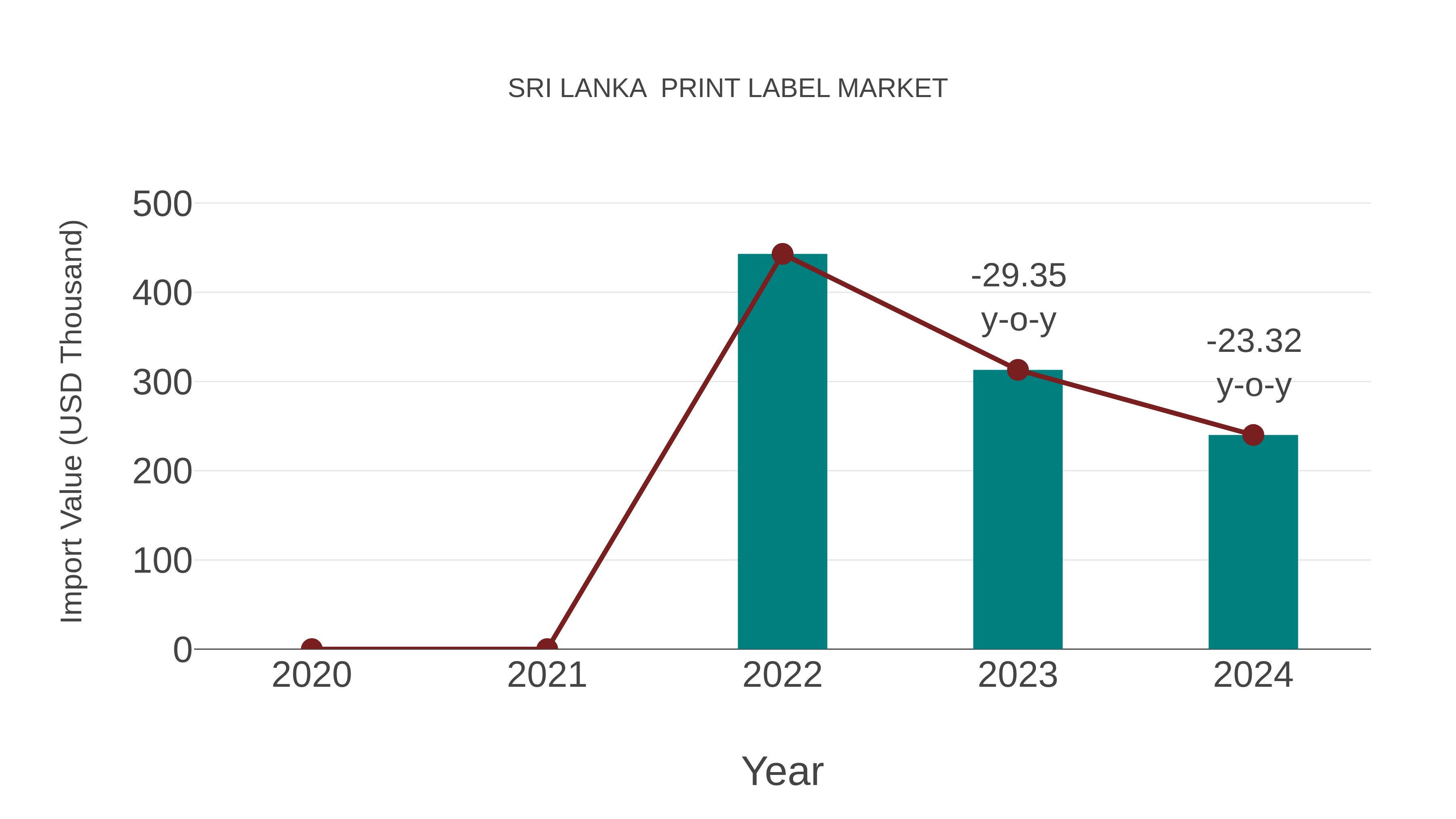
Sri Lanka import trend for the print label market experienced a decline, with a growth rate of -23.32% from 2023 to 2024 and a CAGR of -26.4% for 2020-2024. This decline could be attributed to shifts in consumer preferences or disruptions in global trade dynamics.
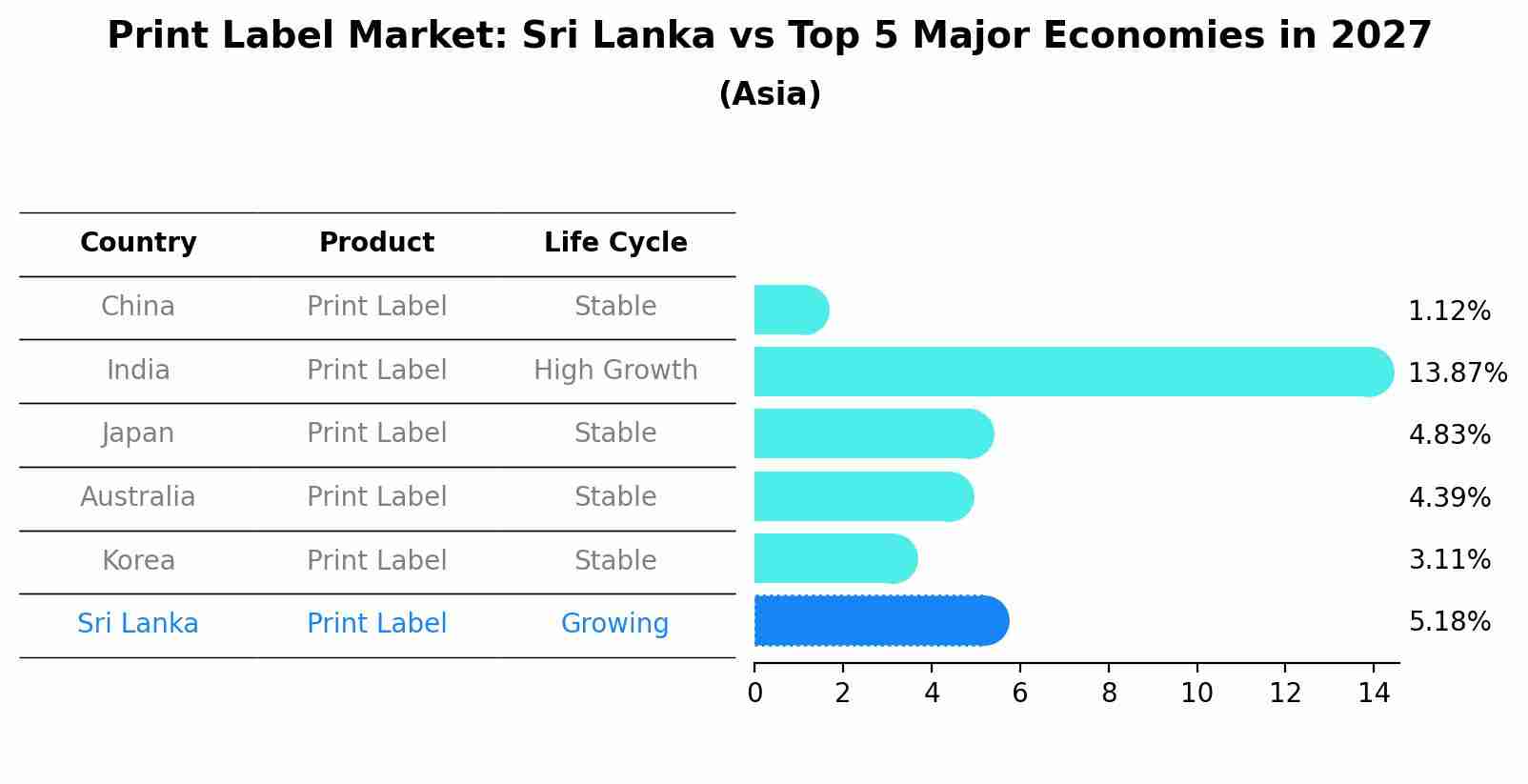
Print Label Market: Sri Lanka vs Top 5 Major Economies in 2027 (Asia)
In the Asia region, the Print Label market in Sri Lanka is projected to expand at a growing growth rate of 5.18% by 2027. The largest economy is China, followed by India, Japan, Australia and South Korea.
Sri Lanka Print Label Market Overview
The Sri Lanka print label market is experiencing steady growth driven by increasing demand from various industries such as food and beverage, pharmaceuticals, cosmetics, and retail. The market is characterized by a wide range of label types including pressure-sensitive labels, in-mold labels, and sleeve labels, catering to diverse packaging needs. The growing trend towards product customization and branding efforts by companies further fuels the demand for high-quality print labels. Technological advancements in printing processes, such as digital printing and RFID integration, are also contributing to market growth. Additionally, stringent regulations regarding product labeling and packaging are pushing companies to invest in innovative labeling solutions. Overall, the Sri Lanka print label market is poised for continued expansion with a focus on sustainability and efficiency in label production processes.
Sri Lanka Print Label Market Trends
The Sri Lanka Print Label Market is experiencing growth due to increasing demand from various sectors such as food and beverage, pharmaceuticals, and consumer goods. The market is witnessing a shift towards more sustainable and eco-friendly labeling solutions to address environmental concerns. Digital printing technology is gaining popularity in the Sri Lanka Print Label Market, as it offers flexibility, cost-effectiveness, and customization options. Additionally, there is a growing preference for labels with security features to combat counterfeiting and ensure product authenticity. Companies in Sri Lanka are focusing on enhancing their labeling designs and incorporating innovative techniques to attract consumer attention and differentiate their products in the competitive market landscape.
Sri Lanka Print Label Market Challenges
The Sri Lanka Print Label Market faces several challenges such as increasing competition from international players, fluctuating raw material prices, and the need for constant innovation to meet changing consumer preferences. Additionally, the industry also grapples with issues related to counterfeit products and regulatory compliance. The market is also impacted by economic fluctuations and political instability, which can affect consumer spending patterns and overall demand for print labels. To stay competitive, companies in the Sri Lanka Print Label Market need to focus on enhancing product quality, investing in technology and automation, and building strong relationships with clients to secure long-term contracts. Adapting to changing market dynamics and implementing sustainable practices are key strategies for overcoming these challenges and ensuring long-term growth in the industry.
Sri Lanka Print Label Market Investment Opportunities
The Sri Lanka Print Label Market offers promising investment opportunities due to the country`s growing packaging industry and increasing demand for customized labeling solutions. With a focus on sectors such as food and beverage, pharmaceuticals, and personal care, the market for print labels is expanding rapidly. Investing in state-of-the-art printing technologies, innovative label designs, and sustainable materials can help companies capitalize on this growth trend. Additionally, partnering with local businesses to provide cost-effective labeling solutions and leveraging e-commerce channels for distribution can further enhance investment prospects in the Sri Lanka Print Label Market. Overall, the market presents a compelling opportunity for investors looking to tap into the country`s evolving packaging landscape and consumer preferences.
Sri Lanka Print Label Market Government Policy
The Sri Lanka Print Label Market is governed by policies aimed at regulating the industry and ensuring consumer protection. The government has implemented labeling regulations that mandate clear and accurate information on products to prevent misleading claims and protect public health. The government also encourages the use of eco-friendly materials and sustainable practices in print label production to promote environmental conservation. Additionally, there are measures in place to monitor and enforce compliance with labeling standards to maintain market transparency and fair competition. Overall, government policies in Sri Lanka`s Print Label Market focus on promoting quality, safety, and sustainability while safeguarding consumer interests.
Sri Lanka Print Label Market Future Outlook
The Sri Lanka Print Label Market is expected to witness steady growth in the coming years, driven by increasing demand from various sectors such as food and beverage, pharmaceuticals, and retail. The market is likely to benefit from the growing trend of product customization and branding, as well as the need for secure and informative labeling solutions. The adoption of advanced printing technologies and materials is also anticipated to fuel market growth, as companies seek more efficient and sustainable labeling options. However, challenges such as fluctuating raw material prices and increasing competition may pose a threat to market players. Overall, the Sri Lanka Print Label Market is projected to expand as industries continue to prioritize high-quality and innovative labeling solutions to enhance product visibility and consumer engagement.
Key Highlights of the Report:
- Sri Lanka Print Label Market Outlook
- Market Size of Sri Lanka Print Label Market, 2021
- Forecast of Sri Lanka Print Label Market, 2031
- Historical Data and Forecast of Sri Lanka Print Label Revenues & Volume for the Period 2018 - 2031
- Sri Lanka Print Label Market Trend Evolution
- Sri Lanka Print Label Market Drivers and Challenges
- Sri Lanka Print Label Price Trends
- Sri Lanka Print Label Porter's Five Forces
- Sri Lanka Print Label Industry Life Cycle
- Historical Data and Forecast of Sri Lanka Print Label Market Revenues & Volume By Print Process for the Period 2018 - 2031
- Historical Data and Forecast of Sri Lanka Print Label Market Revenues & Volume By Offset lithography for the Period 2018 - 2031
- Historical Data and Forecast of Sri Lanka Print Label Market Revenues & Volume By Gravure for the Period 2018 - 2031
- Historical Data and Forecast of Sri Lanka Print Label Market Revenues & Volume By Flexography for the Period 2018 - 2031
- Historical Data and Forecast of Sri Lanka Print Label Market Revenues & Volume By Screen for the Period 2018 - 2031
- Historical Data and Forecast of Sri Lanka Print Label Market Revenues & Volume By Letterpress for the Period 2018 - 2031
- Historical Data and Forecast of Sri Lanka Print Label Market Revenues & Volume By Electrophotography for the Period 2018 - 2031
- Historical Data and Forecast of Sri Lanka Print Label Market Revenues & Volume By Inkjet for the Period 2018 - 2031
- Historical Data and Forecast of Sri Lanka Print Label Market Revenues & Volume By Label Format for the Period 2018 - 2031
- Historical Data and Forecast of Sri Lanka Print Label Market Revenues & Volume By Wet-glue labels for the Period 2018 - 2031
- Historical Data and Forecast of Sri Lanka Print Label Market Revenues & Volume By Pressure-sensitive labels for the Period 2018 - 2031
- Historical Data and Forecast of Sri Lanka Print Label Market Revenues & Volume By Linerless labels for the Period 2018 - 2031
- Historical Data and Forecast of Sri Lanka Print Label Market Revenues & Volume By Multi-part tracking labels for the Period 2018 - 2031
- Historical Data and Forecast of Sri Lanka Print Label Market Revenues & Volume By In-mold labels for the Period 2018 - 2031
- Historical Data and Forecast of Sri Lanka Print Label Market Revenues & Volume By Sleeves for the Period 2018 - 2031
- Historical Data and Forecast of Sri Lanka Print Label Market Revenues & Volume By End-User for the Period 2018 - 2031
- Historical Data and Forecast of Sri Lanka Print Label Market Revenues & Volume By Food for the Period 2018 - 2031
- Historical Data and Forecast of Sri Lanka Print Label Market Revenues & Volume By Beverage for the Period 2018 - 2031
- Historical Data and Forecast of Sri Lanka Print Label Market Revenues & Volume By Healthcare for the Period 2018 - 2031
- Historical Data and Forecast of Sri Lanka Print Label Market Revenues & Volume By Cosmetics for the Period 2018 - 2031
- Historical Data and Forecast of Sri Lanka Print Label Market Revenues & Volume By Household for the Period 2018 - 2031
- Historical Data and Forecast of Sri Lanka Print Label Market Revenues & Volume By Industrial for the Period 2018 - 2031
- Historical Data and Forecast of Sri Lanka Print Label Market Revenues & Volume By Logistics for the Period 2018 - 2031
- Historical Data and Forecast of Sri Lanka Print Label Market Revenues & Volume By Other for the Period 2018 - 2031
- Sri Lanka Print Label Import Export Trade Statistics
- Market Opportunity Assessment By Print Process
- Market Opportunity Assessment By Label Format
- Market Opportunity Assessment By End-User
- Sri Lanka Print Label Top Companies Market Share
- Sri Lanka Print Label Competitive Benchmarking By Technical and Operational Parameters
- Sri Lanka Print Label Company Profiles
- Sri Lanka Print Label Key Strategic Recommendations






































