Sri Lanka Radioactive Waste Management Market Size, Share & Growth Rate
The Sri Lanka Radioactive Waste Management Market was estimated at USD 980 Million in 2025 and is projected to reach USD 1400 Million by 2032, growing at a CAGR of 5.2% from 2026 to 2032. This growth trajectory is largely driven by advancements in nuclear medicine, particularly in cancer treatment, as well as the increasing adoption of nuclear energy research within the country. Regulatory compliance and enhanced safety measures also fuel investments in waste management technologies and infrastructure, essential for mitigating environmental impact and ensuring public health safety.
Sri Lanka Radioactive Waste Management Market Year-wise Growth Rate and Key Drivers
This graph highlights how the Sri Lanka Radioactive Waste Management Market has steadily grown over the years, supported by major growth factors.
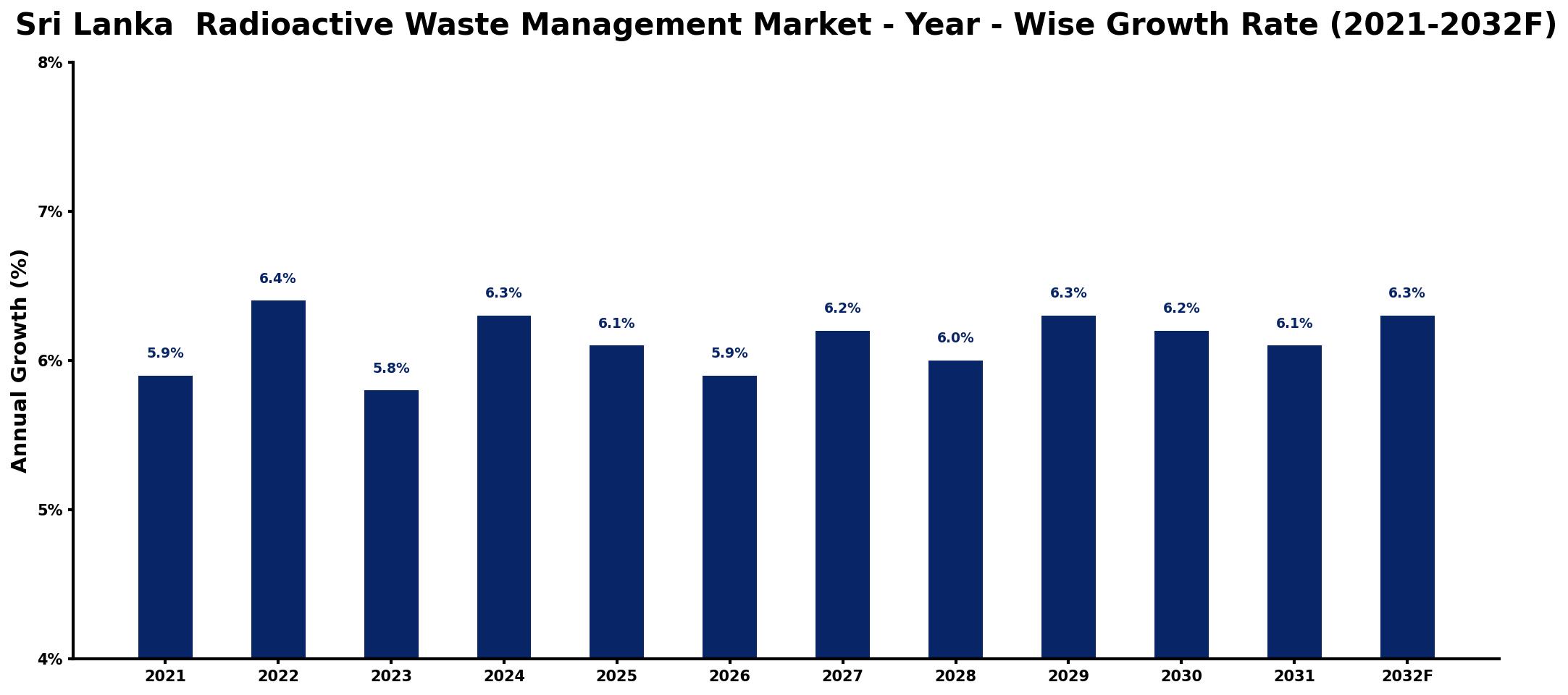
The table below presents the year‑wise growth rates along with the key drivers influencing the market
| Year | Growth Rate | Major Drivers |
| 2021 | 5.9% | Rising energy sector investments |
| 2022 | 6.4% | Increased regulatory compliance requirements |
| 2023 | 5.8% | Growing public health awareness initiatives |
| 2024 | 6.3% | Expansion of nuclear facilities planned |
| 2025 | 6.1% | Emerging technologies in disposal methods |
| 2026 | 5.9% | Strengthening international collaboration efforts |
| 2027 | 6.2% | Heightened focus on sustainability practices |
| 2028 | 6.0% | Growing demand for environmental safety |
| 2029 | 6.3% | Increased funding for research projects |
| 2030 | 6.2% | Enhanced training programs for personnel |
| 2031 | 6.1% | Development of innovative disposal solutions |
| 2032 | 6.3% | Strengthening public-private partnerships initiatives |
Note: Market size estimations and growth projections presented in this report are based on 6Wresearch's proprietary forecasting methodology, utilizing the latest available industry data, government publications, and primary research inputs.
Sri Lanka Radioactive Waste Management Market Synopsis
The growing use of radioactive materials in healthcare and industrial applications has led to an increased demand for effective waste management solutions in Sri Lanka. The market is characterized by a need for advanced disposal techniques and stringent safety protocols to protect both the environment and public health.
Stakeholders across the sector, including nuclear facilities and healthcare institutions, are actively collaborating with regulatory authorities to enhance waste management practices. This collaboration is crucial for developing a robust infrastructure capable of safely handling the expected rise in radioactive waste volumes.
Sri Lanka Radioactive Waste Management Market Key Takeaways
- Investment in radioactive waste treatment technologies is surging to meet regulatory compliance demands.
- Collaboration with regulatory authorities is pivotal for enhancing waste management infrastructure.
- The rising focus on nuclear medicine is driving the need for more efficient disposal methods.
- Healthcare institutions are increasingly adopting advanced waste containment systems for public safety.
- Stringent environmental regulations are reshaping the landscape of radioactive waste management practices.
Evaluation of Restraints in Sri Lanka Radioactive Waste Management Market
The Sri Lanka radioactive waste management market faces significant restraints, notably the high costs associated with acquiring advanced technology and infrastructure. Much of the required equipment is imported, exposing the market to price fluctuations and impacting overall investment viability. Additionally, the shortage of skilled professionals capable of managing sophisticated waste treatment systems hinders growth. Strict regulatory compliance adds complexity, requiring companies to navigate a rigorous framework that can slow down implementation and innovation.
Sri Lanka Radioactive Waste Management Market Trends
Current trends in the Sri Lanka radioactive waste management market include an increasing shift towards sustainable waste management solutions. Technologies such as plasma arc disposal and advanced radiation shielding are gaining traction, enhancing safety while minimizing environmental impact. Furthermore, growing public awareness regarding radiation safety is prompting healthcare institutions to adopt more transparent waste management practices, driving innovation in the sector.
Sri Lanka Radioactive Waste Management Market Opportunities
Significant growth opportunities are emerging within the Sri Lanka radioactive waste management market, particularly in the healthcare sector. The expansion of cancer treatment facilities and the demand for medical isotopes are creating a robust need for advanced waste handling systems. Additionally, with a global trend towards green technologies, there is an opportunity for local firms to develop cost-effective, environmentally friendly solutions for waste treatment.
Government Initiatives in the Sri Lanka Radioactive Waste Management Market
The Sri Lankan government is committed to enhancing radioactive waste management through various policies aimed at ensuring environmental safety and compliance with international standards. These initiatives include licensing requirements for waste management facilities, routine monitoring of radiation levels, and public awareness campaigns on radiation safety. Moreover, public spending is increasingly directed towards building the necessary infrastructure to support effective waste disposal and treatment systems.
Future Insights of the Sri Lanka Radioactive Waste Management Market
Looking ahead to 2026-2032, the Sri Lanka radioactive waste management market is poised for substantial growth. Increasing investments in nuclear energy and medical technology, coupled with ongoing regulatory enhancements, are expected to shape the future landscape. The emphasis on sustainable practices will likely drive innovation in waste management solutions, positioning Sri Lanka as a regional leader in safe radioactive waste disposal and management.
Sri Lanka Radioactive Waste Management Market Latest Developments (2025 - 2026)
Recent developments in the Sri Lanka radioactive waste management market indicate a push towards integrating advanced technology for waste treatment. There is a noticeable trend of healthcare institutions collaborating with research bodies to develop more efficient disposal methods. Moreover, government initiatives to bolster regulatory frameworks have resulted in greater engagement among stakeholders, fostering a proactive approach to radiation safety and waste management.
Sri Lanka Radioactive Waste Management Market - Key Attractiveness of the Report
- 10 Years of Market Numbers
- Historical Data Starting from 2022 to 2025
- Base Year: 2025
- Forecast Data until 2032
- Key Performance Indicators Impacting the Market
- Major Upcoming Developments and Projects
Key Highlights of the Report:
- Sri Lanka Radioactive Waste Management Market Outlook
- Market Size of Sri Lanka Radioactive Waste Management Market, 2025
- Forecast of Sri Lanka Radioactive Waste Management Market, 2032
- Historical Data and Forecast of Sri Lanka Radioactive Waste Management Revenues & Volume for the Period 2022-2032F
- Sri Lanka Radioactive Waste Management Market Trend Evolution
- Sri Lanka Radioactive Waste Management Market Drivers and Challenges
- Sri Lanka Radioactive Waste Management Price Trends
- Sri Lanka Radioactive Waste Management Porter's Five Forces
- Sri Lanka Radioactive Waste Management Industry Life Cycle
- Historical Data and Forecast of Sri Lanka Radioactive Waste Management Market Revenues & Volume By Type for the Period 2022-2032F
- Historical Data and Forecast of Sri Lanka Radioactive Waste Management Market Revenues & Volume By Exempt Waste and Very Low-Level Waste(VLLW) for the Period 2022-2032F
- Historical Data and Forecast of Sri Lanka Radioactive Waste Management Market Revenues & Volume By Low-Level Waste(LLW) for the Period 2022-2032F
- Historical Data and Forecast of Sri Lanka Radioactive Waste Management Market Revenues & Volume By Intermediate-Level Waste(ILW) for the Period 2022-2032F
- Historical Data and Forecast of Sri Lanka Radioactive Waste Management Market Revenues & Volume By High-Level Waste(HLW) for the Period 2022-2032F
- Historical Data and Forecast of Sri Lanka Radioactive Waste Management Market Revenues & Volume By Application for the Period 2022-2032F
- Historical Data and Forecast of Sri Lanka Radioactive Waste Management Market Revenues & Volume By Industrial for the Period 2022-2032F
- Historical Data and Forecast of Sri Lanka Radioactive Waste Management Market Revenues & Volume By Utility for the Period 2022-2032F
- Sri Lanka Radioactive Waste Management Import Export Trade Statistics
- Market Opportunity Assessment By Type
- Market Opportunity Assessment By Application
- Sri Lanka Radioactive Waste Management Top Companies Market Share
- Sri Lanka Radioactive Waste Management Competitive Benchmarking By Technical and Operational Parameters
- Sri Lanka Radioactive Waste Management Company Profiles
- Sri Lanka Radioactive Waste Management Key Strategic Recommendations






































