Sri Lanka RegTech Market Size & Growth Rate (2026-2032)
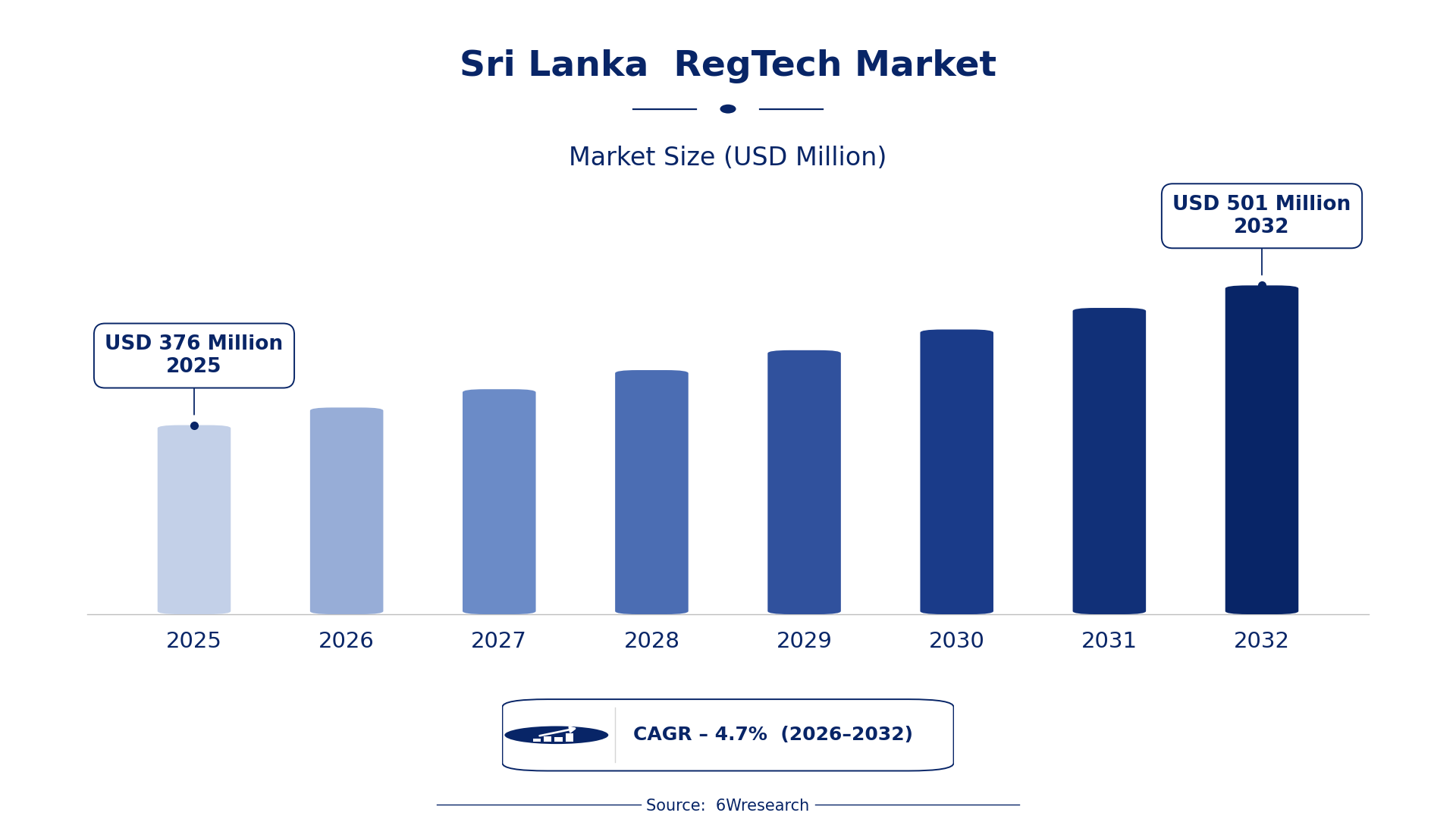
The Sri Lanka RegTech Market was estimated at USD 376 Million in 2025 and is projected to reach USD 501 Million by 2032, growing at a CAGR of 4.7% from 2026 to 2032.
Sri Lanka RegTech Market Synopsis
The driving force behind the Sri Lanka RegTech market is the increasing regulatory requirements across various sectors, particularly in banking and financial services. As organizations face mounting pressure to comply with local and international regulations, they are turning to RegTech solutions that enhance compliance efficiency and streamline processes.
In response, businesses are increasingly integrating advanced technologies such as artificial intelligence and blockchain to tackle complex regulatory challenges. This shift not only aids compliance but also strengthens data security, creating a compelling case for the adoption of RegTech solutions within Sri Lanka's evolving regulatory environment.
Sri Lanka RegTech Market Year-wise Growth Rate and Key Drivers
This graph illustrates the annual growth rates of the Sri Lanka RegTech Market from 2021 to 2032, highlighting a steady upward trajectory and projected expansion over the forecast period.
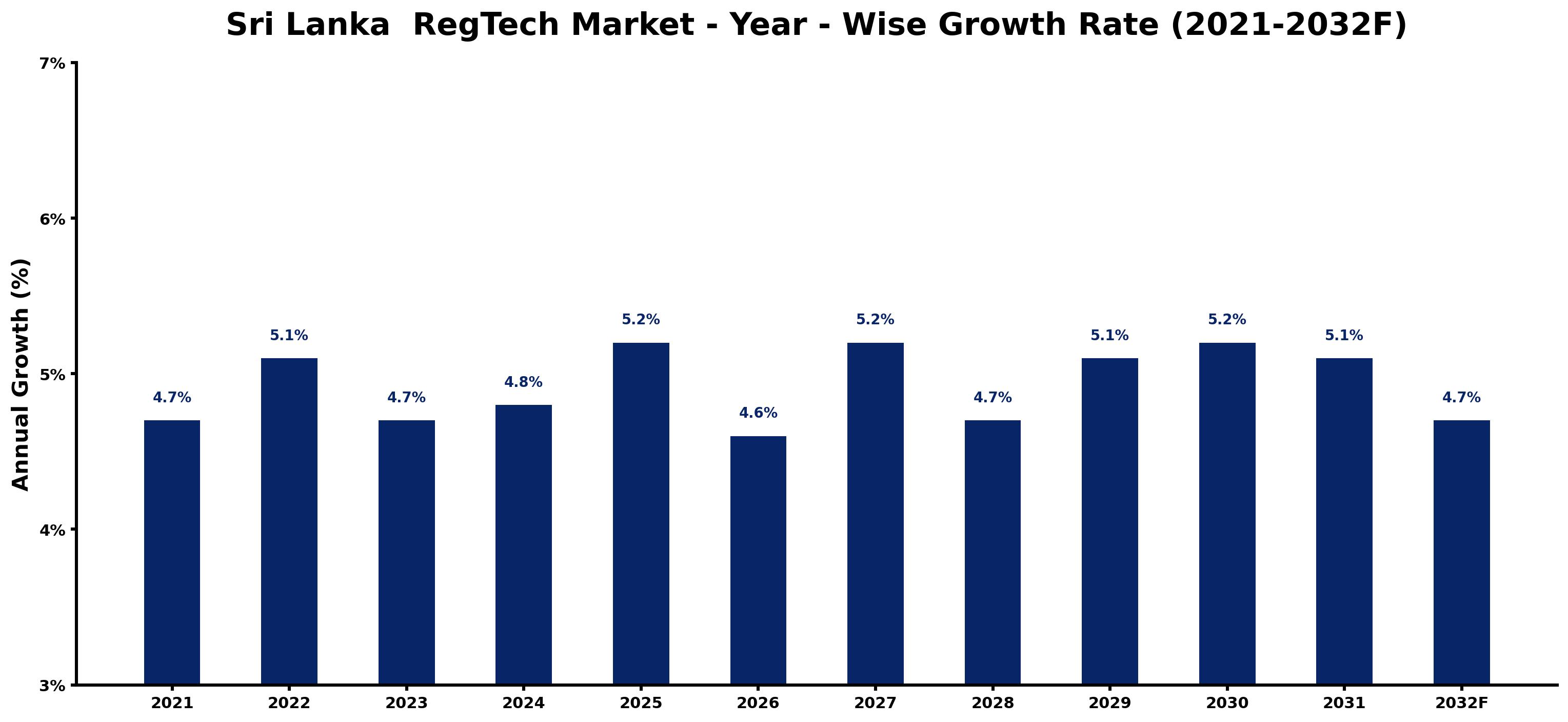
The table below presents the year‑wise growth rates along with the key drivers influencing the market
| Year | Growth Rate | Major Drivers |
| 2021 | 4.7% | Central Bank regulations promoting digital KYC solutions. |
| 2022 | 5.1% | Increased fraud detection needs after significant cyber incidents. |
| 2023 | 4.7% | Government push for financial inclusion through RegTech adoption. |
| 2024 | 4.8% | Emergence of local RegTech startups optimizing compliance processes. |
| 2025 | 5.2% | Enhanced data protection laws driving digital identity solutions. |
| 2026 | 4.6% | Investment in fintech competency enhancing compliance technology demand. |
| 2027 | 5.2% | Demand for AML solutions due to stricter local laws. |
| 2028 | 4.7% | Rising awareness of financial crimes increasing RegTech services uptake. |
| 2029 | 5.1% | Growing cross-border trade requiring robust compliance frameworks. |
| 2030 | 5.2% | Financial literacy campaigns boosting demand for compliance tools. |
| 2031 | 5.1% | Adoption of cloud solutions enhancing RegTech service efficiency. |
| 2032 | 4.7% | Regulatory partnerships stimulating innovation in compliance technologies. |
Note: Market size estimations and growth projections presented in this report are based on 6Wresearch's proprietary forecasting methodology, utilizing the latest available industry data, government publications, and primary research inputs.
Sri Lanka RegTech Market Key Takeaways
Below are some of the specific key takeaways from the market, including:
- The adoption of AI and machine learning is transforming regulatory reporting processes.
- Blockchain technology is gaining traction for secure data management in compliance efforts.
- Automated compliance tools are increasingly being utilized to enhance operational efficiency.
- Regulatory bodies are actively promoting RegTech solutions to combat financial crimes.
- Investment opportunities are burgeoning as local and international firms seek innovative compliance solutions.
Evaluation of Restraints in Sri Lanka RegTech Market
Despite the promising growth potential, the Sri Lanka RegTech market faces notable challenges. Limited awareness and understanding of RegTech solutions among businesses and regulatory bodies hinder widespread adoption. The absence of a comprehensive regulatory framework specific to these technologies adds further complexity, creating uncertainties for both providers and users. Additionally, a shortage of skilled professionals with expertise in regulatory compliance and technology exacerbates the situation, restricting the market's growth.
Sri Lanka RegTech Market Trends
The RegTech market in Sri Lanka is currently influenced by several key trends. Firstly, there is a strong shift towards the use of artificial intelligence for more accurate regulatory reporting and compliance monitoring. Secondly, businesses are adopting blockchain solutions for secure transactions and to ensure data integrity. on top of that, there is a growing demand for automated compliance tools that enhance efficiency while reducing the risk of human error. This confluence of technological advancements is shaping the future of compliance practices in Sri Lanka.
Sri Lanka RegTech Market Opportunities
Investment prospects in the Sri Lanka RegTech market are robust, driven by increasing regulatory demands across sectors. Companies that provide innovative regulatory technology solutions focused on streamlining compliance and improving risk management are in high demand. on top of that, the government's push for digital transformation and regulatory reforms creates fertile ground for growth. Investors who support RegTech firms that tailor their offerings to local needs stand to gain significantly as these companies help enhance compliance standards across the country.
Government Initiatives in the Sri Lanka RegTech Market
The Sri Lankan government is actively working to enhance the adoption of regulatory technology in the financial sector. Recognizing the need for improved compliance and risk management processes, policymakers have introduced several initiatives aimed at fostering a supportive environment for RegTech innovation. This includes collaboration between regulators and industry stakeholders to ensure that new technologies align with compliance needs and enhance overall market integrity.
- A regulatory framework introduced in 2025 to promote the adoption of RegTech solutions among financial institutions.
- An ongoing initiative aimed at increasing collaboration between the Central Bank of Sri Lanka and technology providers to enhance compliance mechanisms.
- A planned public-private partnership expected to launch in 2026, focusing on developing a national digital infrastructure to support RegTech applications.
- Current efforts to implement guidelines for data security and privacy compliance that align with emerging RegTech solutions.
- Recent workshops conducted to raise awareness about the benefits of RegTech among local businesses and regulatory bodies.
Future Insights of the Sri Lanka RegTech Market
Looking ahead to 2026-2032, the Sri Lanka RegTech market is set to expand significantly as regulatory compliance needs intensify. Organizations are likely to increasingly seek advanced solutions that not only meet compliance requirements but also enhance operational efficiency and risk management capabilities. With ongoing government support for regulatory reforms and digital transformation, the market presents considerable growth opportunities for both local and international RegTech providers. The adoption of cutting-edge technologies will further position the Sri Lanka RegTech market at the forefront of compliance innovation.
Sri Lanka RegTech Market Latest Developments
In the past year, the Sri Lanka RegTech market has witnessed significant developments as organizations ramp up their compliance efforts. Many businesses are focusing on integrating advanced technologies into their operations to streamline compliance processes and reduce risks associated with regulatory failures. The trend towards digitalization continues to gain momentum, driven by both regulatory pressures and the need for operational efficiency.
- A major technology vendor launched a new AI-driven compliance management platform in Q1 2025, designed to simplify regulatory reporting.
- In mid-2025, a collaborative initiative began between local banks and tech firms to develop blockchain-based solutions for transaction security.
- A regulatory sandbox was established in late 2025, allowing startups to test innovative RegTech solutions under real-world conditions.
- Currently ongoing is a national campaign to educate businesses about the advantages of adopting RegTech solutions, expected to run through the end of 2026.
- Upcoming is a government-sponsored initiative set to begin in 2027, aimed at enhancing data security standards in alignment with international best practices.
Sri Lanka RegTech Market - Key Attractiveness of the Report
- 10 Years of Market Numbers
- Historical Data Starting from 2022 to 2025
- Base Year: 2025
- Forecast Data until 2032
- Key Performance Indicators Impacting the Market
- Major Upcoming Developments and Projects
Key Highlights of the Report:
- Sri Lanka RegTech Market Outlook
- Market Size of Sri Lanka RegTech Market, 2025
- Forecast of Sri Lanka RegTech Market, 2032
- Historical Data and Forecast of Sri Lanka RegTech Revenues & Volume for the Period 2022-2032F
- Sri Lanka RegTech Market Trend Evolution
- Sri Lanka RegTech Market Drivers and Challenges
- Sri Lanka RegTech Price Trends
- Sri Lanka RegTech Porter's Five Forces
- Sri Lanka RegTech Industry Life Cycle
- Historical Data and Forecast of Sri Lanka RegTech Market Revenues & Volume By Component for the Period 2022-2032F
- Historical Data and Forecast of Sri Lanka RegTech Market Revenues & Volume By Solutions for the Period 2022-2032F
- Historical Data and Forecast of Sri Lanka RegTech Market Revenues & Volume By Services for the Period 2022-2032F
- Historical Data and Forecast of Sri Lanka RegTech Market Revenues & Volume By Application for the Period 2022-2032F
- Historical Data and Forecast of Sri Lanka RegTech Market Revenues & Volume By Risk & Compliance Management for the Period 2022-2032F
- Historical Data and Forecast of Sri Lanka RegTech Market Revenues & Volume By Identity Management for the Period 2022-2032F
- Historical Data and Forecast of Sri Lanka RegTech Market Revenues & Volume By Regulatory Reporting for the Period 2022-2032F
- Historical Data and Forecast of Sri Lanka RegTech Market Revenues & Volume By AML and Fraud Management for the Period 2022-2032F
- Historical Data and Forecast of Sri Lanka RegTech Market Revenues & Volume By Regulatory Intelligence for the Period 2022-2032F
- Historical Data and Forecast of Sri Lanka RegTech Market Revenues & Volume By Organization Size for the Period 2022-2032F
- Historical Data and Forecast of Sri Lanka RegTech Market Revenues & Volume By SMEs for the Period 2022-2032F
- Historical Data and Forecast of Sri Lanka RegTech Market Revenues & Volume By Large Enterprises for the Period 2022-2032F
- Historical Data and Forecast of Sri Lanka RegTech Market Revenues & Volume By Deployment Mode for the Period 2022-2032F
- Historical Data and Forecast of Sri Lanka RegTech Market Revenues & Volume By On-Premises for the Period 2022-2032F
- Historical Data and Forecast of Sri Lanka RegTech Market Revenues & Volume By Cloud for the Period 2022-2032F
- Historical Data and Forecast of Sri Lanka RegTech Market Revenues & Volume By Vertical for the Period 2022-2032F
- Historical Data and Forecast of Sri Lanka RegTech Market Revenues & Volume By Banking for the Period 2022-2032F
- Historical Data and Forecast of Sri Lanka RegTech Market Revenues & Volume By Insurance for the Period 2022-2032F
- Historical Data and Forecast of Sri Lanka RegTech Market Revenues & Volume By Non-Financial for the Period 2022-2032F
- Sri Lanka RegTech Import Export Trade Statistics
- Market Opportunity Assessment By Component
- Market Opportunity Assessment By Application
- Market Opportunity Assessment By Organization Size
- Market Opportunity Assessment By Deployment Mode
- Market Opportunity Assessment By Vertical
- Sri Lanka RegTech Top Companies Market Share
- Sri Lanka RegTech Competitive Benchmarking By Technical and Operational Parameters
- Sri Lanka RegTech Company Profiles
- Sri Lanka RegTech Key Strategic Recommendations






































