Sri Lanka Risk Analytics Market Size & Growth Rate (2026-2032)
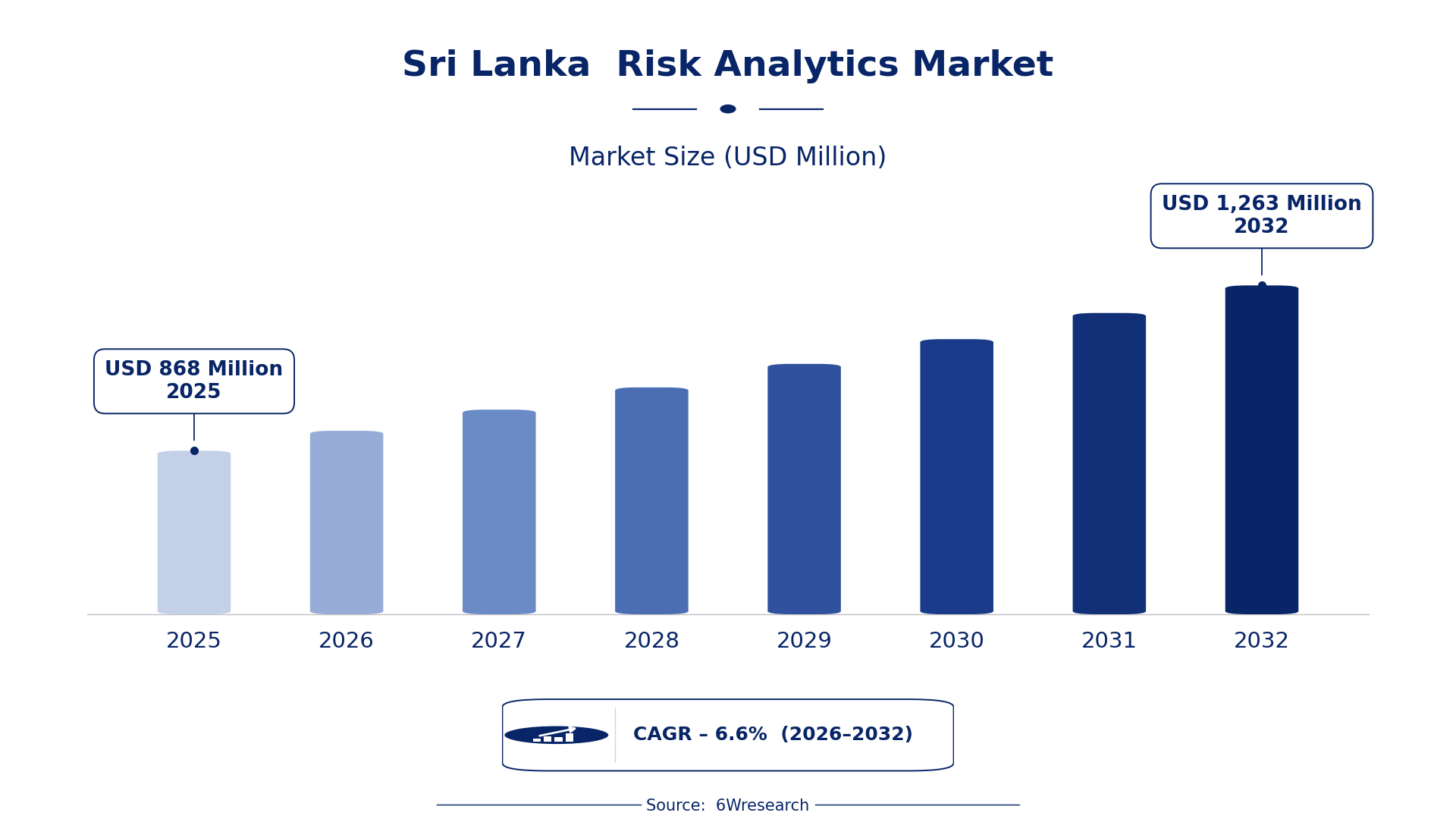
The Sri Lanka Risk Analytics Market was estimated at USD 868 Million in 2025 and is projected to reach USD 1263 Million by 2032, growing at a CAGR of 6.6% from 2026 to 2032.
Sri Lanka Risk Analytics Market Synopsis
The demand for risk analytics in Sri Lanka is being significantly propelled by an increasing awareness of the necessity for effective risk management strategies among organizations. Businesses across various sectors are recognizing the critical role that data-driven insights play in identifying, assessing, and mitigating risks, particularly in a climate marked by rising cyber threats.
With a growing regulatory framework, companies are compelled to integrate robust risk analytics tools to ensure compliance and safeguard their operations. This shift is creating a fertile ground for innovations in technology, where artificial intelligence and machine learning are being leveraged to enhance risk assessment capabilities.
Sri Lanka Risk Analytics Market Year-wise Growth Rate and Key Drivers
This graph illustrates the annual growth rates of the Sri Lanka Risk Analytics Market from 2021 to 2032, highlighting a steady upward trajectory and projected expansion over the forecast period.
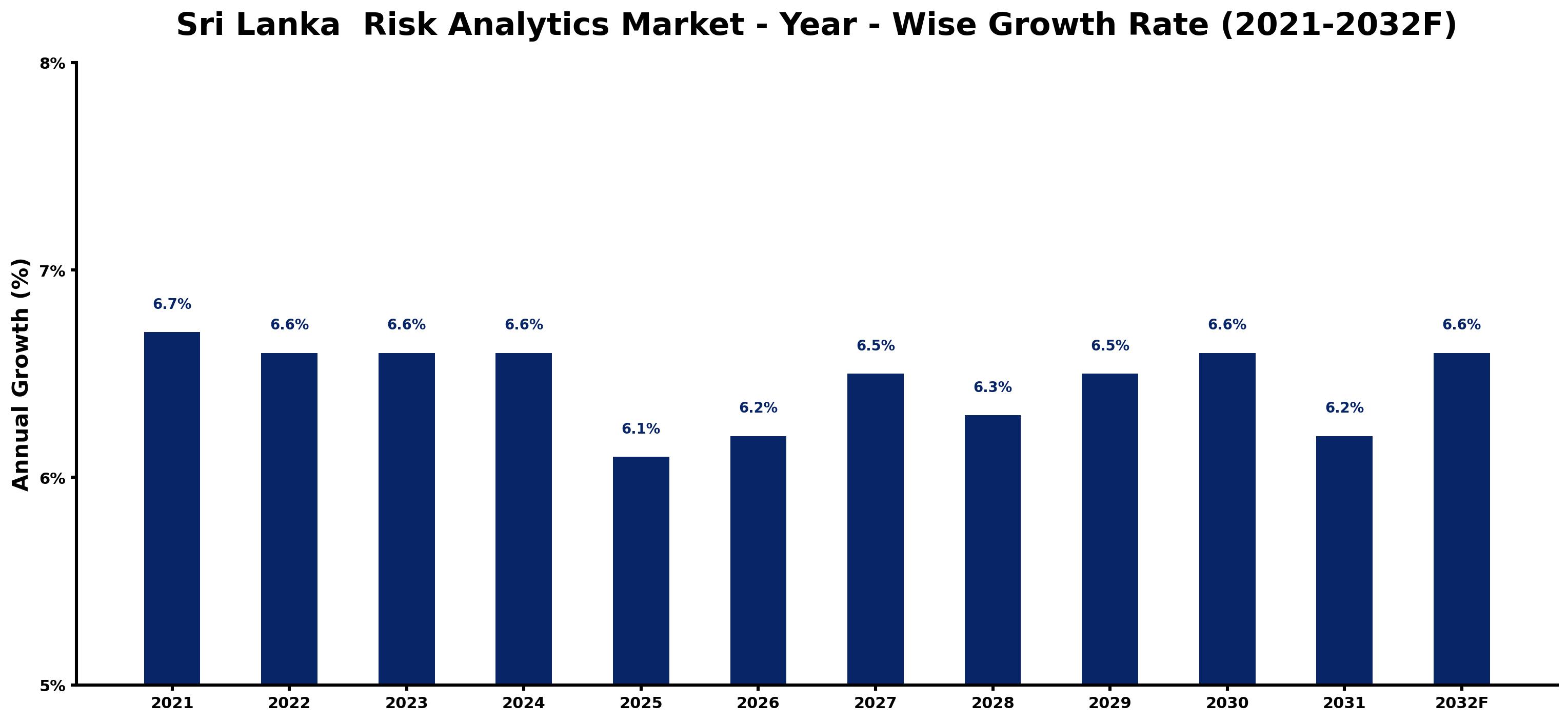
The table below presents the year‑wise growth rates along with the key drivers influencing the market
| Year | Growth Rate | Major Drivers |
| 2021 | 6.7% | Increased regulatory scrutiny from the Central Bank of Sri Lanka. |
| 2022 | 6.6% | Adoption of new analytics technologies by local banks. |
| 2023 | 6.6% | Government initiatives promoting investment in financial technologies. |
| 2024 | 6.6% | Rising incidence of natural disasters boosting risk assessments. |
| 2025 | 6.1% | Enhanced demand for cybersecurity measures in financial services. |
| 2026 | 6.2% | Growth in microfinance driving comprehensive risk analysis needs. |
| 2027 | 6.5% | Regulatory mandates requiring improved credit risk evaluations. |
| 2028 | 6.3% | Increase in foreign investments necessitating robust risk strategies. |
| 2029 | 6.5% | Emergence of fintech companies demanding sophisticated analytics solutions. |
| 2030 | 6.6% | Legislative reforms fostering transparency in financial risk management. |
| 2031 | 6.2% | Local startups focusing on tech-driven risk mitigation strategies. |
| 2032 | 6.6% | Continued emphasis on sustainable business practices enhancing risk forecasting. |
Note: Market size estimations and growth projections presented in this report are based on 6Wresearch's proprietary forecasting methodology, utilizing the latest available industry data, government publications, and primary research inputs.
Sri Lanka Risk Analytics Market Key Takeaways
Below are some of the specific key takeaways from the market, including:
- The market is undergoing a transformation as organizations adopt advanced technologies for risk management.
- There is a notable shift towards cloud-based solutions, enhancing scalability and data accessibility.
- Regulatory compliance remains a key driver, pushing businesses to invest in sophisticated risk analytics tools.
- Cybersecurity concerns are leading to increased investments in fraud detection and mitigation technologies.
- The market's growth is fueled by the need for data-driven decision-making across industries.
Evaluation of Restraints in Sri Lanka Risk Analytics Market
Despite the promising growth trajectory, the Sri Lanka Risk Analytics Market faces several constraints that hinder its full potential. A major limitation is the scarcity of comprehensive and up-to-date data, which complicates effective risk assessment. on top of that, limited access to advanced analytics technologies restricts organizations from fully capitalizing on risk management opportunities.
Additionally, the shortage of skilled professionals in data analytics is a pressing challenge. Organizations struggle to find talent capable of utilizing advanced analytics tools effectively. Budget constraints also play a role, as many companies are hesitant to allocate sufficient resources towards robust risk analytics solutions, impacting their ability to manage risks proactively.
Sri Lanka Risk Analytics Market Trends
The Sri Lanka Risk Analytics Market is witnessing a shift towards advanced technologies, particularly artificial intelligence and machine learning. These innovations are becoming integral in enhancing risk identification and mitigation processes. The emphasis on real-time data analysis and predictive modeling is increasing, enabling organizations to anticipate potential risks and make informed decisions.
on top of that, the adoption of cloud-based risk analytics solutions is on the rise, driven by the need for scalable and accessible tools. Industries such as banking, insurance, and healthcare are particularly focused on compliance and cybersecurity, thus fueling demand for comprehensive risk analytics capabilities.
Sri Lanka Risk Analytics Market Opportunities
Investment opportunities abound within the Sri Lanka Risk Analytics Market, especially for firms specializing in data analytics and risk management. With the rising demand for advanced risk assessment strategies, there is a significant market for innovative risk analysis tools, predictive modeling software, and tailored consulting services.
Companies can benefit by aligning their offerings with the increasing focus on regulatory compliance and risk governance. The current momentum towards adopting sophisticated risk analytics solutions presents a unique chance for investors looking to establish a foothold in this expanding market.
Government Initiatives in the Sri Lanka Risk Analytics Market
The Sri Lankan government is actively shaping the Risk Analytics Market through various policies focused on data protection and cybersecurity. The implementation of the Data Protection Act mandates strict compliance with data handling standards, compelling organizations to enhance their risk management capabilities. Additionally, initiatives such as the establishment of the Sri Lanka Computer Emergency Readiness Team (SLCERT) are crucial for addressing cybersecurity threats, thereby fostering a supportive environment for the growth of risk analytics solutions.
- A regulatory framework was introduced in 2025 mandating data protection compliance for all organizations.
- The Sri Lanka Computer Emergency Readiness Team (SLCERT) has been launched to provide guidance on mitigating cybersecurity risks, enhancing organizational resilience.
- A national cybersecurity strategy is currently underway, focusing on public-private partnerships to strengthen cybersecurity infrastructure.
- Planned initiatives aim to promote data literacy and skill development in data analytics, enhancing the talent pool in the coming years.
Future Insights of the Sri Lanka Risk Analytics Market
Looking ahead to 2026-2032, the Sri Lanka Risk Analytics Market is positioned for steady growth, driven by an increasing emphasis on risk management across industries. The surge in data volumes, coupled with a rise in cyber threats and a stringent regulatory environment, will amplify the demand for advanced risk analytics solutions.
Companies are becoming more proactive in identifying and managing risks, recognizing that robust analytics capabilities are essential for maintaining operational integrity and competitive advantage. The integration of artificial intelligence and machine learning is expected to enhance predictive capabilities, further shaping the future of risk analytics in Sri Lanka.
Sri Lanka Risk Analytics Market Latest Developments
Recent activity in the Sri Lanka Risk Analytics Market reflects a growing commitment to enhancing risk management capabilities among organizations. Over the past 12-14 months, there has been a notable uptick in the adoption of technology-driven solutions aimed at improving risk assessment and compliance.
- A major technology vendor initiated a rollout of an advanced risk analytics platform in early 2025, enhancing real-time data processing capabilities.
- An ongoing partnership between local financial institutions and analytics firms aims to develop customized fraud detection solutions, currently underway since mid-2025.
- A new cloud-based risk management solution is planned for launch in early 2026, targeting small to medium enterprises in Sri Lanka.
- In late 2024, a leading regional operator upgraded its analytics tools to incorporate machine learning for better predictive modeling.
Sri Lanka Risk Analytics Market - Key Attractiveness of the Report
- 10 Years of Market Numbers
- Historical Data Starting from 2022 to 2025
- Base Year: 2025
- Forecast Data until 2032
- Key Performance Indicators Impacting the Market
- Major Upcoming Developments and Projects
Key Highlights of the Report:
- Sri Lanka Risk Analytics Market Outlook
- Market Size of Sri Lanka Risk Analytics Market, 2025
- Forecast of Sri Lanka Risk Analytics Market, 2032
- Historical Data and Forecast of Sri Lanka Risk Analytics Revenues & Volume for the Period 2022-2032F
- Sri Lanka Risk Analytics Market Trend Evolution
- Sri Lanka Risk Analytics Market Drivers and Challenges
- Sri Lanka Risk Analytics Price Trends
- Sri Lanka Risk Analytics Porter's Five Forces
- Sri Lanka Risk Analytics Industry Life Cycle
- Historical Data and Forecast of Sri Lanka Risk Analytics Market Revenues & Volume By Component for the Period 2022-2032F
- Historical Data and Forecast of Sri Lanka Risk Analytics Market Revenues & Volume By Software (ETL Tools, Risk Calculation Engines, GRC Software) for the Period 2022-2032F
- Historical Data and Forecast of Sri Lanka Risk Analytics Market Revenues & Volume By Services for the Period 2022-2032F
- Historical Data and Forecast of Sri Lanka Risk Analytics Market Revenues & Volume By Risk Type for the Period 2022-2032F
- Historical Data and Forecast of Sri Lanka Risk Analytics Market Revenues & Volume By Strategic Risk for the Period 2022-2032F
- Historical Data and Forecast of Sri Lanka Risk Analytics Market Revenues & Volume By Operational Risk for the Period 2022-2032F
- Historical Data and Forecast of Sri Lanka Risk Analytics Market Revenues & Volume By Financial Risk for the Period 2022-2032F
- Historical Data and Forecast of Sri Lanka Risk Analytics Market Revenues & Volume By Deployment Mode for the Period 2022-2032F
- Historical Data and Forecast of Sri Lanka Risk Analytics Market Revenues & Volume By Cloud for the Period 2022-2032F
- Historical Data and Forecast of Sri Lanka Risk Analytics Market Revenues & Volume By On-premises for the Period 2022-2032F
- Historical Data and Forecast of Sri Lanka Risk Analytics Market Revenues & Volume By Organization Size for the Period 2022-2032F
- Historical Data and Forecast of Sri Lanka Risk Analytics Market Revenues & Volume By Large enterprises for the Period 2022-2032F
- Historical Data and Forecast of Sri Lanka Risk Analytics Market Revenues & Volume By Small and medium-sized enterprises (SMEs) for the Period 2022-2032F
- Historical Data and Forecast of Sri Lanka Risk Analytics Market Revenues & Volume By Vertical for the Period 2022-2032F
- Historical Data and Forecast of Sri Lanka Risk Analytics Market Revenues & Volume By Banking and Financial Services for the Period 2022-2032F
- Historical Data and Forecast of Sri Lanka Risk Analytics Market Revenues & Volume By Insurance for the Period 2022-2032F
- Historical Data and Forecast of Sri Lanka Risk Analytics Market Revenues & Volume By Manufacturing for the Period 2022-2032F
- Historical Data and Forecast of Sri Lanka Risk Analytics Market Revenues & Volume By Transportation and Logistics for the Period 2022-2032F
- Historical Data and Forecast of Sri Lanka Risk Analytics Market Revenues & Volume By Retail and Consumer Goods for the Period 2022-2032F
- Historical Data and Forecast of Sri Lanka Risk Analytics Market Revenues & Volume By IT and Telecom for the Period 2022-2032F
- Historical Data and Forecast of Sri Lanka Risk Analytics Market Revenues & Volume By Government and Defense for the Period 2022-2032F
- Historical Data and Forecast of Sri Lanka Risk Analytics Market Revenues & Volume By Healthcare and Life Sciences for the Period 2022-2032F
- Sri Lanka Risk Analytics Import Export Trade Statistics
- Market Opportunity Assessment By Component
- Market Opportunity Assessment By Risk Type
- Market Opportunity Assessment By Deployment Mode
- Market Opportunity Assessment By Organization Size
- Market Opportunity Assessment By Vertical
- Sri Lanka Risk Analytics Top Companies Market Share
- Sri Lanka Risk Analytics Competitive Benchmarking By Technical and Operational Parameters
- Sri Lanka Risk Analytics Company Profiles
- Sri Lanka Risk Analytics Key Strategic Recommendations






































