Sri Lanka Sail Canvas Market Size, Share & Growth Rate
The Sri Lanka Sail Canvas Market was estimated at USD 643 Million in 2025 and is projected to reach USD 1084 Million by 2032, growing at a CAGR of 7.7% from 2026 to 2032. This robust growth trajectory is fueled by the country's expanding maritime activities and a burgeoning tourism sector, which increasingly embraces sailing and boating experiences. The rising demand for high-performance marine fabrics, combined with a renewed interest in traditional sailmaking craftsmanship, enhances the market's vibrancy and potential for long-term prosperity.
Sri Lanka Sail Canvas Market Year-wise Growth Rate and Key Drivers
This graph highlights how the Sri Lanka Sail Canvas Market has steadily grown over the years, supported by major growth factors.
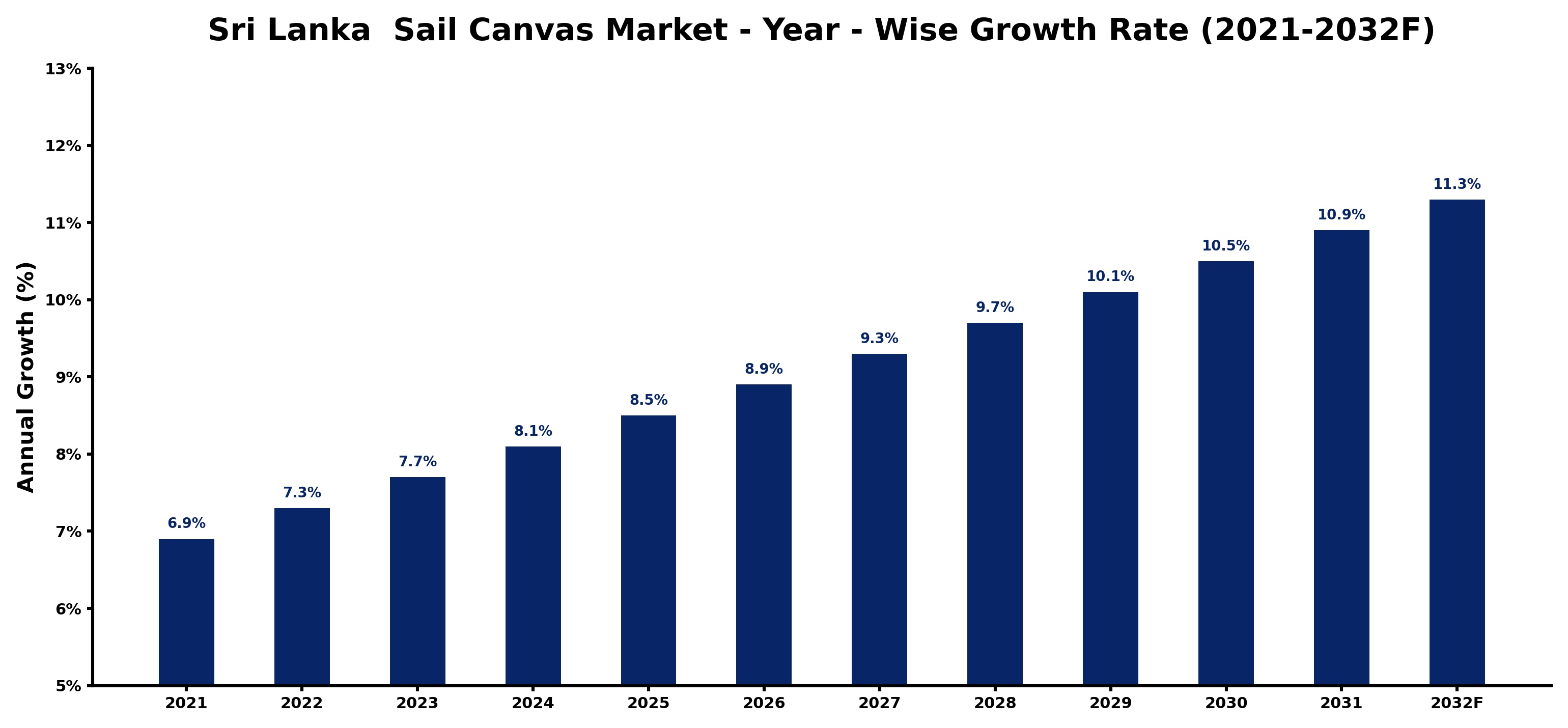
The table below presents the year‑wise growth rates along with the key drivers influencing the market
| Year | Growth Rate | Major Drivers |
| 2021 | 6.9% | Export driven tourism revival boosts demand for sail canvas production |
| 2022 | 7.3% | Technology adoption in sail manufacturing enhanced production efficiency significantly |
| 2023 | 7.7% | Local manufacturers invest in sustainable materials for sail canvas production |
| 2024 | 8.1% | Sail canvas production scale up boosted local textile sector efficiency |
| 2025 | 8.5% | Sail canvas production upgrades improved quality for export markets |
| 2026 | 8.9% | Local manufacturers adopt advanced textiles technology to boost sail durability |
| 2027 | 9.3% | Strategic partnerships with local textile firms boosted canvas production efficiency |
| 2028 | 9.7% | Local manufacturers invest in advanced machinery for sail production |
| 2029 | 10.1% | Local boat manufacturers adopt advanced sewing technology for sail production |
| 2030 | 10.5% | Digital fabrication tools boosted precision in sail canvas production |
| 2031 | 10.9% | Export orders for sail canvas surged, boosting local manufacturing capacity |
| 2032 | 11.3% | Advanced textile technologies enhance sail canvas manufacturing efficiency |
Note - Market size estimations and growth projections presented in this report are based on 6Wresearch’s advanced forecasting approach, validated with industry datasets as of June 2026.
Sri Lanka Sail Canvas Market Synopsis
In recent years, the Sri Lanka Sail Canvas Market has seen momentum driven by a growing interest in water sports and leisure boating activities. However, as the market evolves, challenges surrounding durability, weather resistance, and the integration of sustainable practices are reshaping its future landscape. The balance of tradition and innovation is critical for growth moving forward.
Looking ahead, the market is expected to witness increased competition, particularly from synthetic materials that offer alternative advantages. Manufacturers must adapt and innovate to maintain their share, focusing on technical enhancements that align with both performance standards and environmental regulations.
Sri Lanka Sail Canvas Market Key Takeaways
- Strong market growth projected at a CAGR of 7.7% from 2026 to 2032, indicating a thriving demand for sail canvas.
- Increased interest in sailing activities boosts the market, driven by tourism and leisure sectors.
- Challenges in durability and performance standards require ongoing innovation from manufacturers.
- Competition from synthetic and composite materials pressures traditional canvas makers to diversify their offerings.
- Government policies favoring sustainability are influencing manufacturing practices and market dynamics.
Evaluation of Restraints in Sri Lanka Sail Canvas Market
Despite its promising outlook, the Sri Lanka Sail Canvas Market faces significant restraints. The need for high-quality, durable materials in sail production places pressure on manufacturers to continuously improve their product offerings. Weather resistance remains a key area of focus, as the market must contend with the effects of harsh marine environments. Additionally, the cost implications of adhering to stringent environmental regulations present a challenge for many producers, potentially limiting their ability to compete effectively with synthetic alternatives that may not face the same level of scrutiny.
Sri Lanka Sail Canvas Market Trends
Emerging trends in the Sri Lanka Sail Canvas Market include a shift towards eco-friendly materials and processes as manufacturers seek to meet both consumer demand and regulatory expectations. Innovative techniques in fabric weave and dyeing processes are gaining traction to ensure uniformity and performance. Additionally, the rise of digital technologies in sail design and manufacturing is revolutionizing traditional practices, facilitating customization and enhancing the overall quality of sails.
Sri Lanka Sail Canvas Market Opportunities
Opportunities within the Sri Lanka Sail Canvas Market are abundant, particularly in the realm of product diversification. Manufacturers can capitalize on the growing interest in sustainable boating practices by investing in environmentally friendly materials and production methods. The tourism sector's expansion offers a direct channel for growth, as sailing becomes an increasingly popular activity among visitors. Collaborative ventures with local tourism businesses could further enhance market penetration and brand visibility.
Government Initiatives in the Sri Lanka Sail Canvas Market
The Sri Lankan government actively supports the sail canvas market through regulations that promote high-quality standards and sustainability in production. There are also incentives for manufacturers adopting eco-friendly practices aimed at reducing the environmental impact of their operations. Such policies not only help ensure product quality but also encourage investment in innovative technologies that align with global sustainability efforts.
Future Insights of the Sri Lanka Sail Canvas Market
As we look towards 2026-2032, the Sri Lanka Sail Canvas Market is expected to navigate a landscape shaped by innovation and sustainability. With an increasing push for eco-conscious production methods and a deeper integration of technology in manufacturing, the sector is set for transformative change. The emphasis on high-performance materials, driven by consumer expectations and regulatory standards, will further define the market's trajectory, fostering a competitive environment ripe for investment and growth.
Sri Lanka Sail Canvas Market Latest Developments (May 2025 - June 2026)
In the past year, the Sri Lanka Sail Canvas Market has witnessed noteworthy shifts. Manufacturers are increasingly focusing on sustainable practices, responding to both consumer preferences and regulatory pressures. Advances in textile technology have enabled the development of more resilient and high-performance sail canvas options, appealing to a broader range of maritime activities. Additionally, collaborations between manufacturers and tourism stakeholders are on the rise, enhancing market opportunities as sailing gains popularity as a leisure activity.
Sri Lanka Sail Canvas Market - Key Attractiveness of the Report
- 10 Years of Market Numbers
- Historical Data Starting from 2022 to 2025
- Base Year: 2025
- Forecast Data until 2032
- Key Performance Indicators Impacting the Market
- Major Upcoming Developments and Projects
Key Highlights of the Report:
- Sri Lanka Sail Canvas Market Outlook
- Market Size of Sri Lanka Sail Canvas Market, 2025
- Forecast of Sri Lanka Sail Canvas Market, 2032
- Historical Data and Forecast of Sri Lanka Sail Canvas Revenues & Volume for the Period 2022-2032F
- Sri Lanka Sail Canvas Market Trend Evolution
- Sri Lanka Sail Canvas Market Drivers and Challenges
- Sri Lanka Sail Canvas Price Trends
- Sri Lanka Sail Canvas Porter's Five Forces
- Sri Lanka Sail Canvas Industry Life Cycle
- Historical Data and Forecast of Sri Lanka Sail Canvas Market Revenues & Volume By Type for the Period 2022-2032F
- Historical Data and Forecast of Sri Lanka Sail Canvas Market Revenues & Volume By 8 Ann Canvas for the Period 2022-2032F
- Historical Data and Forecast of Sri Lanka Sail Canvas Market Revenues & Volume By 12 Ann Canvas for the Period 2022-2032F
- Historical Data and Forecast of Sri Lanka Sail Canvas Market Revenues & Volume By Polyester Canvas for the Period 2022-2032F
- Historical Data and Forecast of Sri Lanka Sail Canvas Market Revenues & Volume By Others for the Period 2022-2032F
- Historical Data and Forecast of Sri Lanka Sail Canvas Market Revenues & Volume By Application for the Period 2022-2032F
- Historical Data and Forecast of Sri Lanka Sail Canvas Market Revenues & Volume By Sailing for the Period 2022-2032F
- Historical Data and Forecast of Sri Lanka Sail Canvas Market Revenues & Volume By Yacht for the Period 2022-2032F
- Historical Data and Forecast of Sri Lanka Sail Canvas Market Revenues & Volume By Others for the Period 2022-2032F
- Sri Lanka Sail Canvas Import Export Trade Statistics
- Market Opportunity Assessment By Type
- Market Opportunity Assessment By Application
- Sri Lanka Sail Canvas Top Companies Market Share
- Sri Lanka Sail Canvas Competitive Benchmarking By Technical and Operational Parameters
- Sri Lanka Sail Canvas Company Profiles
- Sri Lanka Sail Canvas Key Strategic Recommendations






































