Sri Lanka Smart Locks Market Size, Share & Growth Rate
The Sri Lanka Smart Locks Market was estimated at USD 1417 Million in 2025 and is projected to reach USD 2679 Million by 2032, growing at a CAGR of 9.5% from 2026 to 2032. This upward trajectory is largely fueled by a significant shift in consumer preferences towards smart home technologies and heightened awareness about home security. Increasing disposable incomes, urbanization, and a burgeoning middle-class population further contribute to this robust market growth.
Sri Lanka Smart Locks Market Year-wise Growth Rate and Key Drivers
This graph highlights how the Sri Lanka Smart Locks Market has steadily grown over the years, supported by major growth factors.
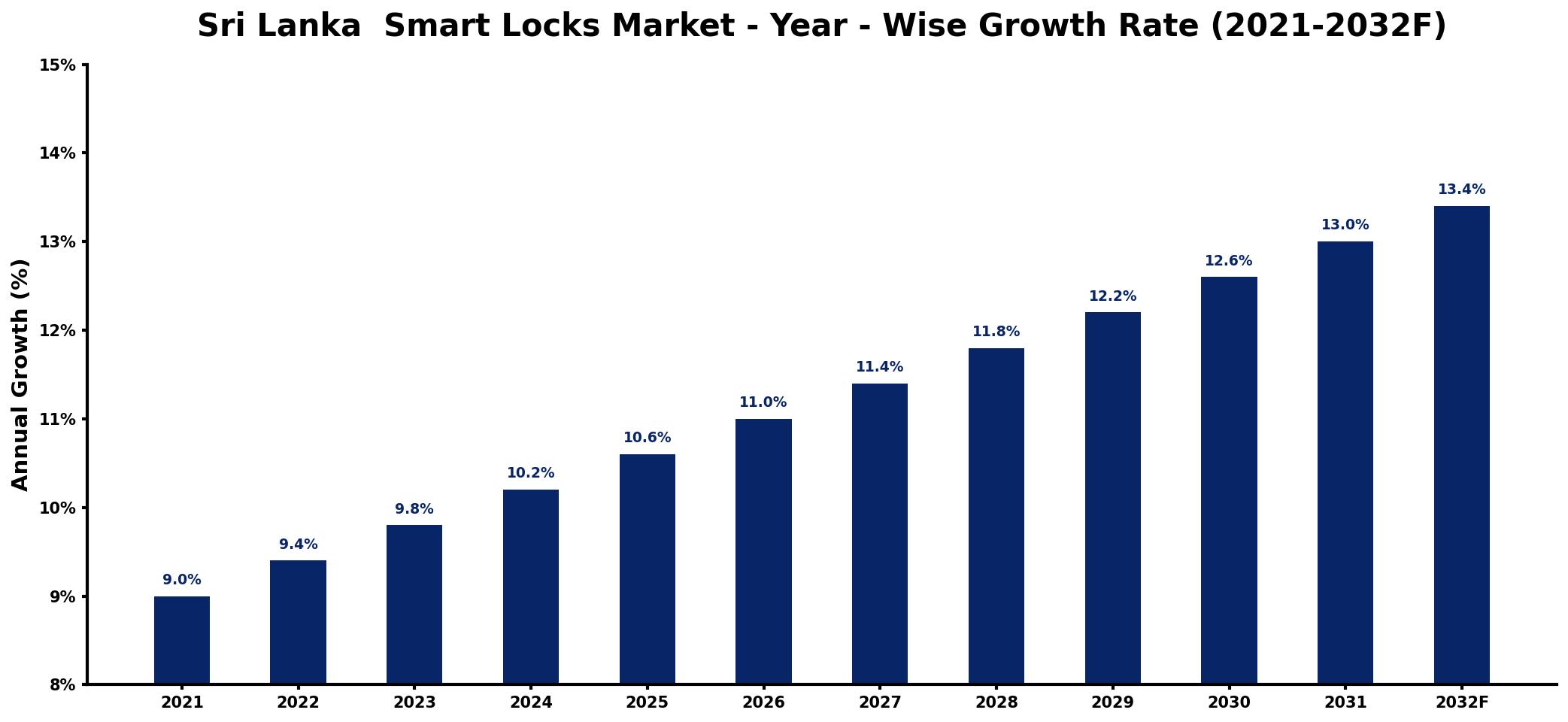
The table below presents the year‑wise growth rates along with the key drivers influencing the market
| Year | Growth Rate | Major Drivers |
| 2021 | 9.0% | Rising demand for home automation |
| 2022 | 9.4% | Increased focus on security solutions |
| 2023 | 9.8% | Growing urbanization and infrastructure development |
| 2024 | 10.2% | Expansion of e-commerce platforms |
| 2025 | 10.6% | Surge in construction activities |
| 2026 | 11.0% | Technological advancements in security |
| 2027 | 11.4% | Higher disposable income levels |
| 2028 | 11.8% | Increased awareness of security threats |
| 2029 | 12.2% | Growth in rental property market |
| 2030 | 12.6% | Rising consumer preference for convenience |
| 2031 | 13.0% | growing emerging market penetration |
| 2032 | 13.4% | Enhanced government regulations on security |
Note: Market size estimations and growth projections presented in this report are based on 6Wresearch's proprietary forecasting methodology, utilizing the latest available industry data, government publications, and primary research inputs.
Sri Lanka Smart Locks Market Synopsis
The primary force currently shaping the Sri Lanka Smart Locks Market is the growing demand for enhanced security solutions. As consumers seek to protect their homes and businesses, the convenience and advanced features offered by smart locks have begun to replace traditional locking systems. This transition is particularly notable in urban areas where smart home technologies are gaining traction.
Additionally, innovations in product offerings, such as biometric recognition and seamless mobile app integration, are fostering increased adoption. The integration of smart locks within larger smart home ecosystems is becoming a decisive factor, further propelling the market in residential and commercial sectors alike.
Sri Lanka Smart Locks Market Key Takeaways
- The market is poised for substantial growth due to rising security concerns and increasing technology adoption.
- Urbanization and a growing middle-class demographic are crucial drivers of smart lock demand.
- Innovations such as keyless entry and mobile connectivity are attracting consumers.
- Awareness and education around smart lock functionalities remain vital for market penetration.
- Investors are presented with significant opportunities amid evolving infrastructure and digital transformation initiatives.
Evaluation of Restraints in Sri Lanka Smart Locks Market
Despite the promising outlook, the Sri Lanka Smart Locks Market faces several restraints hindering its growth. A major concern is the consumer's limited understanding of smart locks compared to traditional alternatives, which can lead to hesitation in adoption. Additionally, issues surrounding data privacy and security of smart technology can deter potential buyers. The price sensitivity of the market, particularly among lower-income households, also poses a challenge, as smart locks generally come with higher initial costs. Lastly, the need for stable internet connectivity can be a significant barrier in regions with less reliable infrastructure, limiting market penetration.
Sri Lanka Smart Locks Market Trends
Current trends in the Sri Lanka Smart Locks Market indicate a substantial move towards advanced security features, emphasizing convenience and connectivity. Keyless entry systems and mobile app functionalities are becoming standard, allowing users to monitor and control access remotely. The rise of biometric smart locks is also notable, as consumers seek higher levels of security. Moreover, the increasing trend towards smart cities and connected homes is anticipated to further bolster the market as infrastructure develops to support these technologies.
Sri Lanka Smart Locks Market Opportunities
Investment opportunities in the Sri Lanka Smart Locks Market are plentiful, with urbanization and rising home security awareness acting as catalysts for growth. Investors can look to capitalize on the expanding middle-class demographic's demand for advanced locking solutions. The increasing penetration of IoT devices and smartphones creates a fertile ground for product innovation. Furthermore, as the government focuses on enhancing digital infrastructure, stakeholders are encouraged to develop and distribute smart lock technologies to meet the emerging needs of consumers.
Government Initiatives in the Sri Lanka Smart Locks Market
While there are no specific policies directly aimed at the Smart Locks Market, the Sri Lankan government is fostering a broader environment conducive to technological advancement. Initiatives aimed at improving digital infrastructure and encouraging innovation contribute positively to the market landscape. The government's emphasis on cybersecurity also plays a pivotal role, ensuring that advancements in smart technology can be adopted with greater confidence.
Future Insights of the Sri Lanka Smart Locks Market
Looking ahead to 2026-2032, the Sri Lanka Smart Locks Market is set to flourish, spurred by continuous urbanization and rising disposable incomes. As consumer awareness around smart home technologies grows, the demand for smart locks is expected to escalate. Technological advancements, particularly in terms of connectivity and user interface, will further enhance product appeal. The increasing integration of smart locks within home automation systems signals a favorable environment for sustained market growth.
Sri Lanka Smart Locks Market Latest Developments (2025 - 2026)
Recent developments in the Sri Lanka Smart Locks Market highlight an increased focus on product innovation, particularly in smart lock design and functionality. Companies are investing in user-friendly interfaces and enhanced connectivity options. Furthermore, there is a notable rise in strategic partnerships aimed at integrating smart locks with broader home automation systems. These trends indicate a proactive approach to adapting to consumer preferences and technological advancements in the market.
Sri Lanka Smart Locks Market - Key Attractiveness of the Report
- 10 Years of Market Numbers
- Historical Data Starting from 2022 to 2025
- Base Year: 2025
- Forecast Data until 2032
- Key Performance Indicators Impacting the Market
- Major Upcoming Developments and Projects
Key Highlights of the Report:
- Sri Lanka Smart Locks Market Outlook
- Market Size of Sri Lanka Smart Locks Market, 2025
- Forecast of Sri Lanka Smart Locks Market, 2032
- Historical Data and Forecast of Sri Lanka Smart Locks Revenues & Volume for the Period 2022-2032F
- Sri Lanka Smart Locks Market Trend Evolution
- Sri Lanka Smart Locks Market Drivers and Challenges
- Sri Lanka Smart Locks Price Trends
- Sri Lanka Smart Locks Porter's Five Forces
- Sri Lanka Smart Locks Industry Life Cycle
- Historical Data and Forecast of Sri Lanka Smart Locks Market Revenues & Volume By Product for the Period 2022-2032F
- Historical Data and Forecast of Sri Lanka Smart Locks Market Revenues & Volume By Deadbolts for the Period 2022-2032F
- Historical Data and Forecast of Sri Lanka Smart Locks Market Revenues & Volume By Lever Handles for the Period 2022-2032F
- Historical Data and Forecast of Sri Lanka Smart Locks Market Revenues & Volume By Padlocks for the Period 2022-2032F
- Historical Data and Forecast of Sri Lanka Smart Locks Market Revenues & Volume By Others for the Period 2022-2032F
- Historical Data and Forecast of Sri Lanka Smart Locks Market Revenues & Volume By Technology for the Period 2022-2032F
- Historical Data and Forecast of Sri Lanka Smart Locks Market Revenues & Volume By Bluetooth for the Period 2022-2032F
- Historical Data and Forecast of Sri Lanka Smart Locks Market Revenues & Volume By Wi-Fi for the Period 2022-2032F
- Historical Data and Forecast of Sri Lanka Smart Locks Market Revenues & Volume By End User for the Period 2022-2032F
- Historical Data and Forecast of Sri Lanka Smart Locks Market Revenues & Volume By Residential for the Period 2022-2032F
- Historical Data and Forecast of Sri Lanka Smart Locks Market Revenues & Volume By Commercial for the Period 2022-2032F
- Sri Lanka Smart Locks Import Export Trade Statistics
- Market Opportunity Assessment By Product
- Market Opportunity Assessment By Technology
- Market Opportunity Assessment By End User
- Sri Lanka Smart Locks Top Companies Market Share
- Sri Lanka Smart Locks Competitive Benchmarking By Technical and Operational Parameters
- Sri Lanka Smart Locks Company Profiles
- Sri Lanka Smart Locks Key Strategic Recommendations






































