Sri Lanka Smart Toilet Market Size, Share & Growth Rate
The Sri Lanka Smart Toilet Market was estimated at USD 384 Million in 2025 and is projected to reach USD 699 Million by 2032, growing at a CAGR of 8.9% from 2026 to 2032. This growth trajectory is fueled by rapid urbanization, where more households are seeking modern amenities to improve their living standards. Increased disposable income coupled with a heightened focus on hygiene is driving the demand for sophisticated toilet solutions that incorporate advanced technology.
Sri Lanka Smart Toilet Market Year-wise Growth Rate and Key Drivers
This graph highlights how the Sri Lanka Smart Toilet Market has steadily grown over the years, supported by major growth factors.
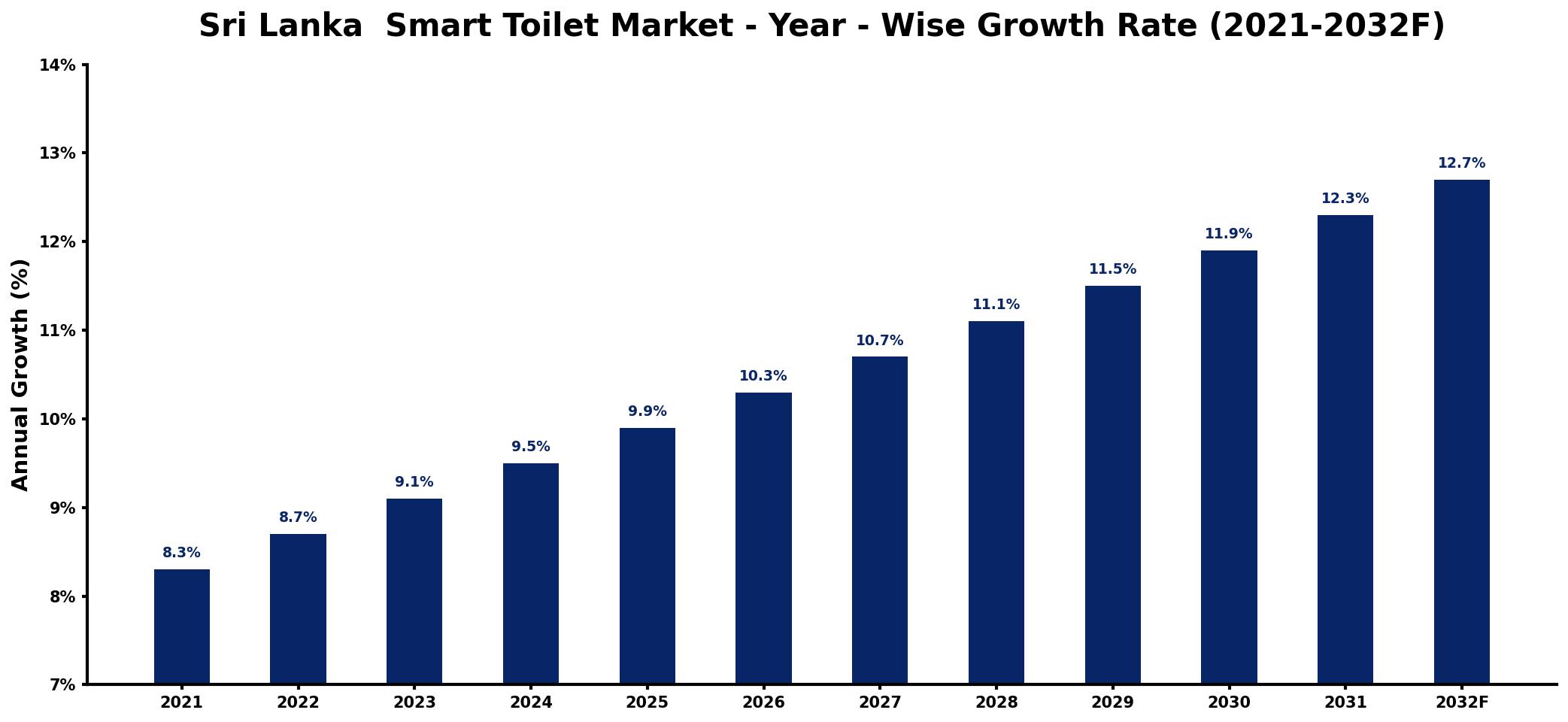
The table below presents the year‑wise growth rates along with the key drivers influencing the market
| Year | Growth Rate | Major Drivers |
| 2021 | 8.3% | Rising urban population driving demand |
| 2022 | 8.7% | Increased focus on hygiene standards |
| 2023 | 9.1% | Technological advancements in sanitation |
| 2024 | 9.5% | Growing awareness of water conservation |
| 2025 | 9.9% | Surge in eco-friendly initiatives |
| 2026 | 10.3% | Expansion of real estate projects |
| 2027 | 10.7% | Investment in modern infrastructure |
| 2028 | 11.1% | Enhanced consumer disposable income |
| 2029 | 11.5% | Government support for innovations |
| 2030 | 11.9% | Shift towards automated solutions |
| 2031 | 12.3% | Growing health consciousness among consumers |
| 2032 | 12.7% | Rising demand for luxury amenities |
Note: Market size estimations and growth projections presented in this report are based on 6Wresearch's proprietary forecasting methodology, utilizing the latest available industry data, government publications, and primary research inputs.
Sri Lanka Smart Toilet Market Synopsis
In Sri Lanka, the smart toilet market is gaining momentum as consumers become more health-conscious and environmentally aware. The appeal of smart toilets lies not only in their comfort but also in their advanced hygiene features, which resonate with the evolving urban lifestyle.
Contemporary households are increasingly adopting features such as automated cleaning systems and bidet functionalities, positioning smart toilets as a desirable investment. As the nation focuses on enhancing sanitation infrastructure, these innovative solutions are expected to play a vital role in meeting modern hygiene standards.
Sri Lanka Smart Toilet Market Key Takeaways
- Urbanization and rising incomes are pivotal drivers of market growth.
- Consumers are leaning towards products that offer both luxury and hygiene enhancements.
- Government initiatives are promoting investment and development in sanitation technologies.
- Awareness of environmental sustainability is influencing product design and features.
- Smart toilets with health-monitoring capabilities are emerging as an innovative trend.
Evaluation of Restraints in Sri Lanka Smart Toilet Market
Despite the promising outlook for the smart toilet market in Sri Lanka, several factors could limit its expansion. High initial costs for installation may deter potential consumers, particularly in lower-income segments. Furthermore, limited consumer awareness regarding the benefits of smart toilet technology is a barrier to widespread adoption. Technical support and infrastructure are also lacking, hindering maintenance and repair processes. Cultural preferences for traditional toilets may further impede the acceptance of these advanced systems. Addressing these restraints will be crucial for fostering market growth and consumer confidence.
Sri Lanka Smart Toilet Market Trends
Current trends in the Sri Lanka Smart Toilet Market are leaning towards greater integration of technology and enhanced functionality. Products featuring automated cleaning, water-saving mechanisms, and user-friendly interfaces are becoming increasingly popular. Additionally, there is a noticeable shift towards eco-friendly materials, reflecting a growing demand for sustainability in consumer products. Furthermore, the incorporation of IoT technology for monitoring health data is emerging as a valuable feature, appealing to health-conscious consumers.
Sri Lanka Smart Toilet Market Opportunities
The market presents significant investment opportunities driven by a rising emphasis on advanced toilet technologies. There is a burgeoning demand for smart toilets that combine convenience and water efficiency, presenting avenues for innovative product development. Investors can also explore collaborations with local authorities and property developers to facilitate market entry and scalability. The integration of IoT into smart toilets not only enhances user experience but also offers valuable insights for resource management, creating potential for future growth.
Government Initiatives in the Sri Lanka Smart Toilet Market
The Sri Lankan government has introduced various policies aimed at improving sanitation infrastructure and promoting the use of smart toilet technologies. By offering incentives such as tax breaks and subsidies, the government seeks to encourage both businesses and individuals to invest in modern sanitation solutions. Additionally, public awareness campaigns are in place to educate citizens on the importance of hygiene and the benefits of adopting smart toilet systems. These initiatives are designed to foster innovation and ensure that smart toilets meet established standards of quality and functionality.
Future Insights of the Sri Lanka Smart Toilet Market
Looking ahead to 2026-2032, the Sri Lanka Smart Toilet Market is set to flourish, with a strong emphasis on the adoption of smart technologies in urban households. As disposable incomes rise and hygiene concerns escalate, demand for smart toilets is likely to soar. The increasing integration of smart home technologies, combined with government support for sanitation improvements, positions the market for robust expansion. Additionally, trends toward sustainability and user convenience will shape product development and drive consumer interest.
Sri Lanka Smart Toilet Market Latest Developments (2025 - 2026)
Recent industry developments indicate a heightened focus on innovative features within smart toilets, with manufacturers exploring new technologies for automated functionalities and enhanced hygiene. Trade shows and exhibitions are fostering collaboration among stakeholders in the market, leading to the introduction of eco-friendly and health-oriented products. Meanwhile, partnerships with local governments are paving the way for initiatives that aim to elevate sanitation standards across urban areas.
Sri Lanka Smart Toilet Market - Key Attractiveness of the Report
- 10 Years of Market Numbers
- Historical Data Starting from 2022 to 2025
- Base Year: 2025
- Forecast Data until 2032
- Key Performance Indicators Impacting the Market
- Major Upcoming Developments and Projects
Key Highlights of the Report:
- Sri Lanka Smart Toilet Market Outlook
- Market Size of Sri Lanka Smart Toilet Market, 2025
- Forecast of Sri Lanka Smart Toilet Market, 2032
- Historical Data and Forecast of Sri Lanka Smart Toilet Revenues & Volume for the Period 2022-2032F
- Sri Lanka Smart Toilet Market Trend Evolution
- Sri Lanka Smart Toilet Market Drivers and Challenges
- Sri Lanka Smart Toilet Price Trends
- Sri Lanka Smart Toilet Porter's Five Forces
- Sri Lanka Smart Toilet Industry Life Cycle
- Historical Data and Forecast of Sri Lanka Smart Toilet Market Revenues & Volume By Technology for the Period 2022-2032F
- Historical Data and Forecast of Sri Lanka Smart Toilet Market Revenues & Volume By Mobile Application for the Period 2022-2032F
- Historical Data and Forecast of Sri Lanka Smart Toilet Market Revenues & Volume By Non-Mobile Application for the Period 2022-2032F
- Historical Data and Forecast of Sri Lanka Smart Toilet Market Revenues & Volume By Type for the Period 2022-2032F
- Historical Data and Forecast of Sri Lanka Smart Toilet Market Revenues & Volume By Wall Hung Toilet for the Period 2022-2032F
- Historical Data and Forecast of Sri Lanka Smart Toilet Market Revenues & Volume By Close-Coupled for the Period 2022-2032F
- Historical Data and Forecast of Sri Lanka Smart Toilet Market Revenues & Volume By Single Floor Standing Toilet for the Period 2022-2032F
- Historical Data and Forecast of Sri Lanka Smart Toilet Market Revenues & Volume By One-Piece Toilet for the Period 2022-2032F
- Historical Data and Forecast of Sri Lanka Smart Toilet Market Revenues & Volume By Others for the Period 2022-2032F
- Historical Data and Forecast of Sri Lanka Smart Toilet Market Revenues & Volume By Usage for the Period 2022-2032F
- Historical Data and Forecast of Sri Lanka Smart Toilet Market Revenues & Volume By Residential for the Period 2022-2032F
- Historical Data and Forecast of Sri Lanka Smart Toilet Market Revenues & Volume By Commercial for the Period 2022-2032F
- Historical Data and Forecast of Sri Lanka Smart Toilet Market Revenues & Volume By Distribution Channel for the Period 2022-2032F
- Historical Data and Forecast of Sri Lanka Smart Toilet Market Revenues & Volume By Online Stores for the Period 2022-2032F
- Historical Data and Forecast of Sri Lanka Smart Toilet Market Revenues & Volume By Offline Stores for the Period 2022-2032F
- Sri Lanka Smart Toilet Import Export Trade Statistics
- Market Opportunity Assessment By Technology
- Market Opportunity Assessment By Type
- Market Opportunity Assessment By Usage
- Market Opportunity Assessment By Distribution Channel
- Sri Lanka Smart Toilet Top Companies Market Share
- Sri Lanka Smart Toilet Competitive Benchmarking By Technical and Operational Parameters
- Sri Lanka Smart Toilet Company Profiles
- Sri Lanka Smart Toilet Key Strategic Recommendations






































